Every October, the same message lands in Aussie Shopify inboxes: “Do you do lay-by?” Most founders reply “no, but we have Afterpay” and move on. That reply quietly loses sales.
What’s in This Article
Here is why. Compare the Market surveyed 1,004 Australians before Christmas 2025 and found 41% planned to fund Christmas with credit cards, personal loans or buy now, pay later. Only 54% were paying from cash or savings. A big chunk of your December customers are stretching their budget, and a growing number of them do not want another debt to manage in January.
Lay-by is the old-school answer to that problem, and it is quietly making a comeback. BIG W still runs it online and in store, with its own Christmas lay-by terms for 2026. Specialist nursery retailers selling big-ticket cots and prams treat it as a standard offer. The brands that do it well get something BNPL never gives them: cash in the bank weeks before Black Friday, at no merchant fee, with stock already committed to a buyer.
The catch? Lay-by is one of the few payment methods with its own rulebook in the Australian Consumer Law. Get the terms wrong and you are exposed to refund disputes, or worse. This playbook walks you through the 5-step system to launch Christmas lay-by on Shopify properly: fit test, compliant terms, fee maths, the tech setup and the weekly run sheet.
Why Lay-By Is a Profit Play, Not a Nostalgia Play
Most founders lump lay-by in with BNPL. They are completely different animals, and the difference is where your margin lives.
With BNPL, the provider pays you up front and charges you a merchant fee for the privilege. Our BNPL playbook unpacks what that fee really costs you. With lay-by, nobody sits in the middle. The customer pays you directly in instalments, and you hand over the goods once the final payment clears. No BNPL merchant fee. No credit risk, because nothing ships until it is paid for.
That changes your Christmas economics in three ways:
- Cash arrives early. A lay-by started in October puts a deposit in your account straight away, then fortnightly instalments through November. That is working capital you can use for ad spend during BFCM, when CPMs are at their worst.
- Demand gets locked in. The ARA and Roy Morgan found 29% of Australians were buying Christmas gifts earlier in 2025 than the year before, and only 8% later. Lay-by lets you capture that early intent before a competitor’s Black Friday email does.
- The sale is protected from discounting. Under the consumer law, a lay-by customer pays the price in their agreement even if you run a sale later, unless you agree to sell at the new price. You still want a price-protection policy for goodwill, but you are not legally forced to refund the difference.
This matters because Christmas is not a nice-to-have season. The ARA forecast $72.4 billion in pre-Christmas retail spending across the six weeks from 13 November to Christmas Eve 2025, and its CEO noted many discretionary retailers make up to two-thirds of their annual profit in this window.
Now the honest bit. Compare the Market’s same survey found only around 1% of shoppers planned to use lay-by, against 8% for BNPL. Lay-by is a niche tool. It will not replace Afterpay at checkout. It is a high-intent, high-ticket option that works brilliantly for the right products and is a waste of admin time for the wrong ones. Which is why Step 1 is a fit test.
Step 1: Run the 4-Question Lay-By Fit Test
Before you touch an app or write a single term, answer these four questions honestly. If you get three or more “yes” answers, lay-by is worth launching.
- Is your average order value above $150? Below that, the admin per lay-by eats the margin, and customers simply pay in full or use BNPL. BIG W sets its minimum at $50, but it has a store network and payment kiosks doing the work. For an online brand, $100-$150 is a sensible floor.
- Do customers ask for it? Search your inbox, Gorgias or Shopify Inbox for “lay-by”, “layby” and “layaway”. Five or more requests in the last year is a strong signal.
- Is your stock reliable for 8-12 weeks? A lay-by holds a unit for a named customer. If the SKU might sell out or get discontinued, you are setting up a cancellation problem.
- Is it a planned purchase rather than an impulse buy? Nursery furniture, prams, bikes, jewellery, watches, outdoor furniture, premium homewares and big-ticket toys are classic lay-by categories. Fast fashion and consumables are not.
One more filter: perishables and anything with a short shelf life should be excluded completely. Adoreu Baby, a Tasmanian nursery retailer on Shopify, spells this out in its published terms: perishable items are simply not eligible for lay-by.
If you pass, pick a lay-by range, not your whole catalogue. Start with your 10-20 highest-priced, reliably stocked SKUs. You can widen it next year once you have seen the numbers.
Step 2: Write Lay-By Terms That Pass the Consumer Law
This is the step most brands get wrong, and it is the reason this is a Protection article as much as a Profit one.
Under the Australian Consumer Law, an arrangement counts as a lay-by when the customer pays in instalments and does not get the goods until the full price is paid. If you call it a lay-by, two instalments are enough to trigger the rules. If you do not call it a lay-by, three or more instalments will. Consumer Affairs Victoria makes the point that any deposit counts as an instalment. So a “pay a deposit now, the balance before we ship” Christmas offer can land inside these rules whether or not you use the word lay-by.
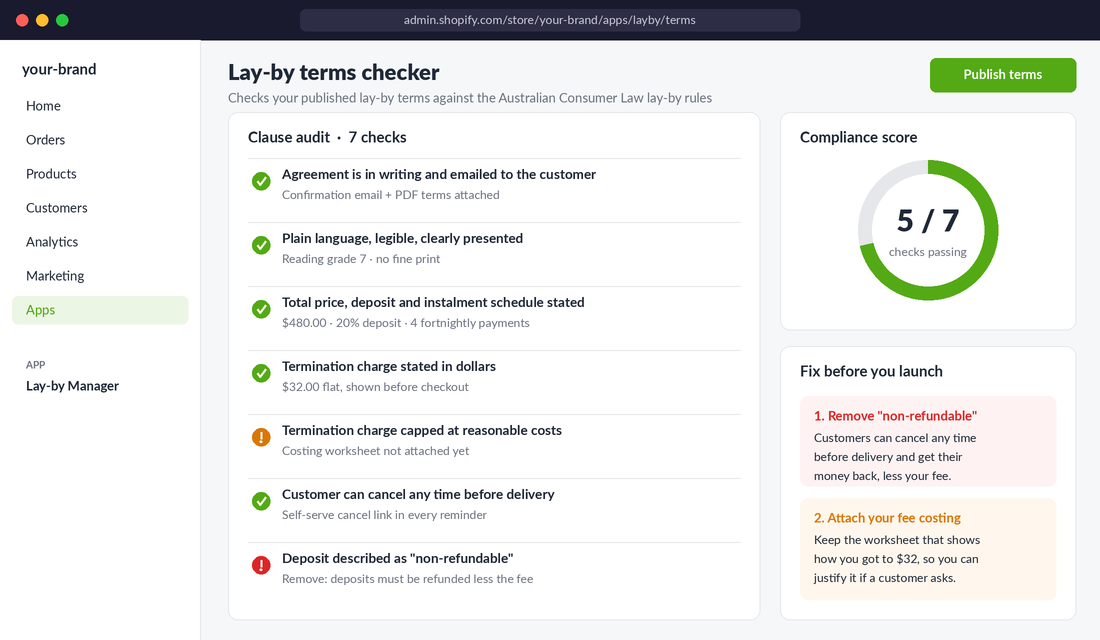
Here are the 7 clauses your published lay-by terms need:
- 1. It is in writing, and the customer gets a copy. Your confirmation email should include the full terms or a PDF. A link to a page you can edit later is not enough on its own.
- 2. Plain language. The law says lay-by terms must be transparent: plain language, legible and clearly presented. No 6-point legalese.
- 3. The numbers. Total price, deposit, instalment amounts, payment dates and the final payment date.
- 4. The termination charge, in dollars. If you charge a cancellation fee, state it clearly. Write “$32” rather than “a fee may apply”.
- 5. The fee is capped at reasonable costs. There is no fixed percentage in the law. Your charge cannot be more than your reasonable costs in relation to the agreement, and regulators expect you to be able to justify the figure. Step 3 shows you how.
- 6. The customer can cancel any time before delivery. They get every dollar back except your termination charge. You cannot charge that fee at all if you breached the agreement, or if you are the one cancelling.
- 7. When you can cancel. You can only cancel if the customer breaches the terms (like missing a payment), you stop trading, or the product becomes unavailable for reasons outside your control. Deciding to pull the product from sale yourself does not count.
The single most common mistake? Calling the deposit “non-refundable”. Deposit apps built for the US market often encourage it, and it is fine for some genuine custom work. On a lay-by, it puts you on the wrong side of the rules, because the customer is entitled to a refund of everything they paid, less your reasonable termination charge.
Two smaller traps to include in your terms. First, warranty timing: Consumer Affairs Victoria notes a manufacturer’s warranty on a lay-by item starts when the customer finalises the lay-by and takes the goods, not when they put down the deposit. Second, collection deadlines. BIG W’s 2026 terms say Christmas-themed lay-bys must be paid in full and collected by 1 December. Set your own final payment date with your courier cut-offs in mind. Our Christmas cut-off playbook shows you how to work backwards from your carrier’s last safe dispatch date.
Lay-by agreements on standard terms can also be caught by the unfair contract terms rules, so treat this as general information, not legal advice. Have your lawyer look over the final wording once. It is a one-hour job that you reuse every year.
Step 3: Price Your Fees From Real Costs, Not Round Numbers
Look at what the market charges and you will see a wide range. BIG W charges a $3 non-refundable service fee on standard 10-week lay-bys, needs a 10% minimum deposit and takes a flat $20 if a lay-by is cancelled. Baby Little Planet, a Melbourne nursery retailer on Shopify, asks for a 25% deposit with a 25% cancellation fee. Adoreu Baby uses a 20% deposit and caps cancellation at 20% of the original value.
A big retailer can justify $20 across millions of transactions and a national store network. Your number has to stand on your own costs. So build it from the ground up.
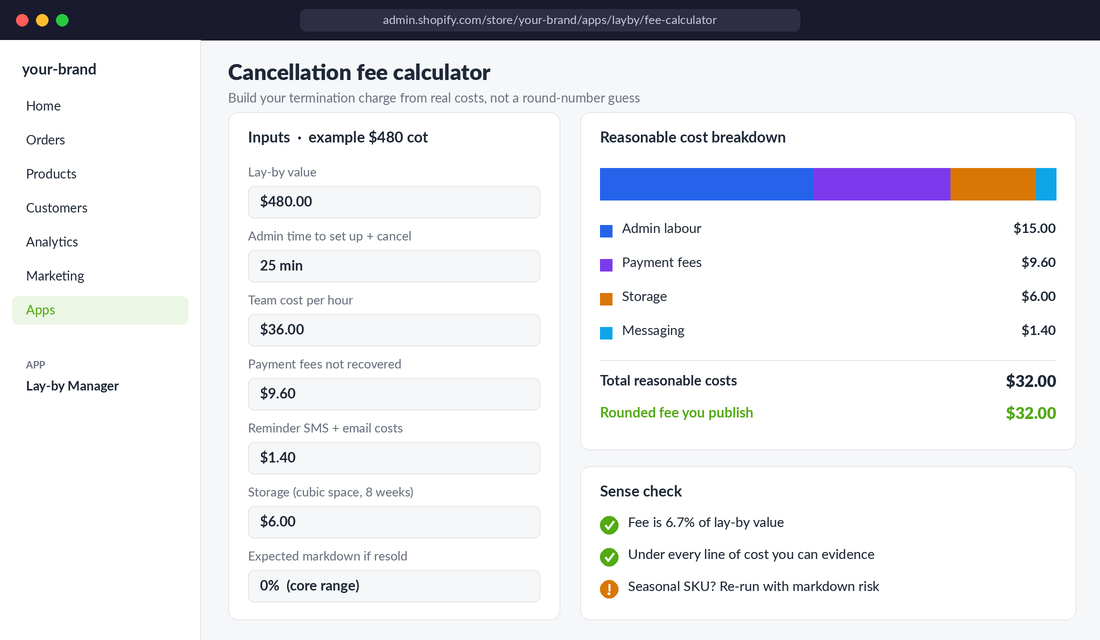
Here is the worked example for a $480 cot:
- Admin labour: 25 minutes to set up, chase and cancel, at $36 an hour fully loaded = $15.00.
- Payment fees you cannot recover: about 2% of the $480 processed = $9.60.
- Storage: the cubic space the boxed cot ties up for 8 weeks = $6.00.
- Messaging: reminder SMS and emails = $1.40.
Total: $32.00. That is your termination charge, and you keep the costing sheet on file.
Now the important nuance. Consumer Affairs Victoria gives the example of a winter coat put on lay-by in June and cancelled in August. Because the coat is harder to sell at the end of winter, the cancellation fee could take into account the need to discount it. The same logic applies to Christmas stock. If a lay-by on a Christmas-themed product is cancelled on 15 December, the markdown risk is real, and a higher seasonal fee can be justified if you can show your numbers. Run the calculator twice: once for core range, once for seasonal SKUs.
On deposits, 10-25% is the normal band. Go with 20% for most brands. It is high enough to filter out tyre-kickers and low enough to feel accessible.
Then choose your payment structure. Deposit plus one balance payment is the simplest to run and is what most Shopify deposit apps automate. Deposit plus fortnightly instalments feels more like classic lay-by and suits tighter budgets, but takes more admin. Either way, let customers pay early whenever they like, and time your nudges to pay cycles. Our payday playbook shows how to line up reminder emails with when Aussies actually get paid.
Should you charge a service fee on top? Only if it covers real setup costs, and say so up front. Plenty of brands win more lay-bys by charging no service fee at all and only charging the termination fee if the customer cancels.
Step 4: Build Lay-By Into Shopify (Without Breaking Checkout)
Shopify does not have a native lay-by checkout. You have two practical options.
Option A: Downpay (best for most stores). Downpay is a deposits and partial payments app built for Shopify. It adds a deposit purchase option to your product page, takes the deposit at checkout and stores the customer’s payment method on file so the balance can be collected later. Its standard setup is one deposit plus one automated balance payment, and customers can pay off early with a “Pay Now” button on their order page. Pricing starts at US$29 a month for up to US$5,000 in monthly Downpay order value, with a 7-day free trial and no transaction fees. It works with Shopify Payments, Stripe, PayPal Express, Adyen and Authorize.net.
Setup steps:
- 1. Install and pick your gateway. Make sure Shopify Payments (or another supported gateway) is active, otherwise the deposit option will not show on your storefront.
- 2. Create a purchase option called “Christmas Lay-By”. Set the deposit at 20% and the balance due date to your final payment date.
- 3. Assign it to your lay-by range only. Use the bulk editor to add products in groups of 50. Note that smart collections do not sync automatically, so add products by hand or by tag.
- 4. Add the Downpay app block to your product template in the theme editor, directly under your price.
- 5. Write your policy and notification copy. Downpay shows customers a link to your cancellation policy at checkout, which you edit in Settings > Policies under “Purchase options cancellation policy”. Paste in your 7 clauses, remove any “non-refundable” wording and add the full terms to your order confirmation, which becomes your written agreement.
- 6. Turn on the customer portal and set fortnightly nudges. The portal lets customers manage and cancel their own deposit orders, which makes clause 6 easy to honour. Then schedule fortnightly “pay a little off early” emails, timed for the morning after a typical payday.
- 7. Tag every lay-by order with Shopify Flow (“layby-2026”). That tag drives your dashboard, your packing hold and your post-Christmas review.
Three limits to know. Downpay deposits do not run through Shopify POS, so in-store lay-bys need a separate process. More than one scheduled future payment is only offered through a partial-pay beta for Shopify Plus merchants. And because deposits use Shopify’s purchase options, your checkout may show a “Subscription policy” label; Downpay’s help centre explains how to fix the wording.
Option B: Manual draft orders (best for under 10 lay-bys a season, or true fortnightly instalments). Create the order in Shopify admin, add a “LAY-BY” tag, take the deposit and record each instalment against it. It is clunky, but it costs nothing, handles any instalment schedule and is a good way to test demand before paying for an app.
Whichever option you choose, reserve the stock. When the order is created, Shopify commits that inventory, which is exactly what you want. Then add a fulfilment hold rule so nobody in the warehouse ships a lay-by before the final payment clears. Shipping early turns your lay-by into unsecured credit, and that is a different risk and a different set of rules.
Step 5: Run the Lay-By Book Every Week
A lay-by program lives or dies on follow-up. Most of the pain comes from three things: missed payments, customers who go quiet, and a pile of unpaid orders on 15 December.
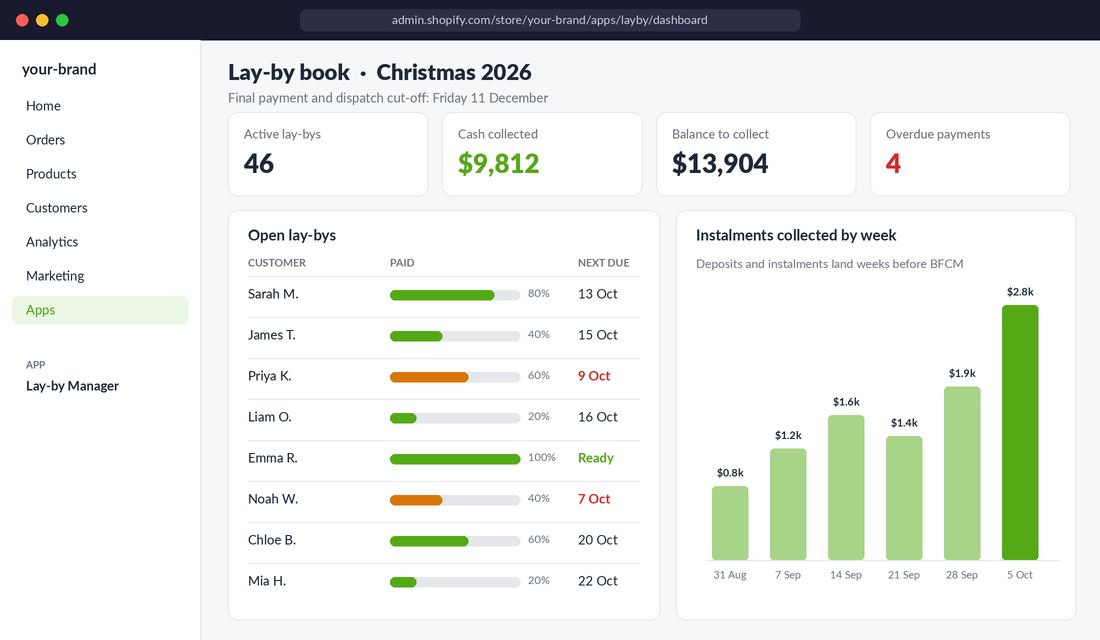
Run this 15-minute check every Monday:
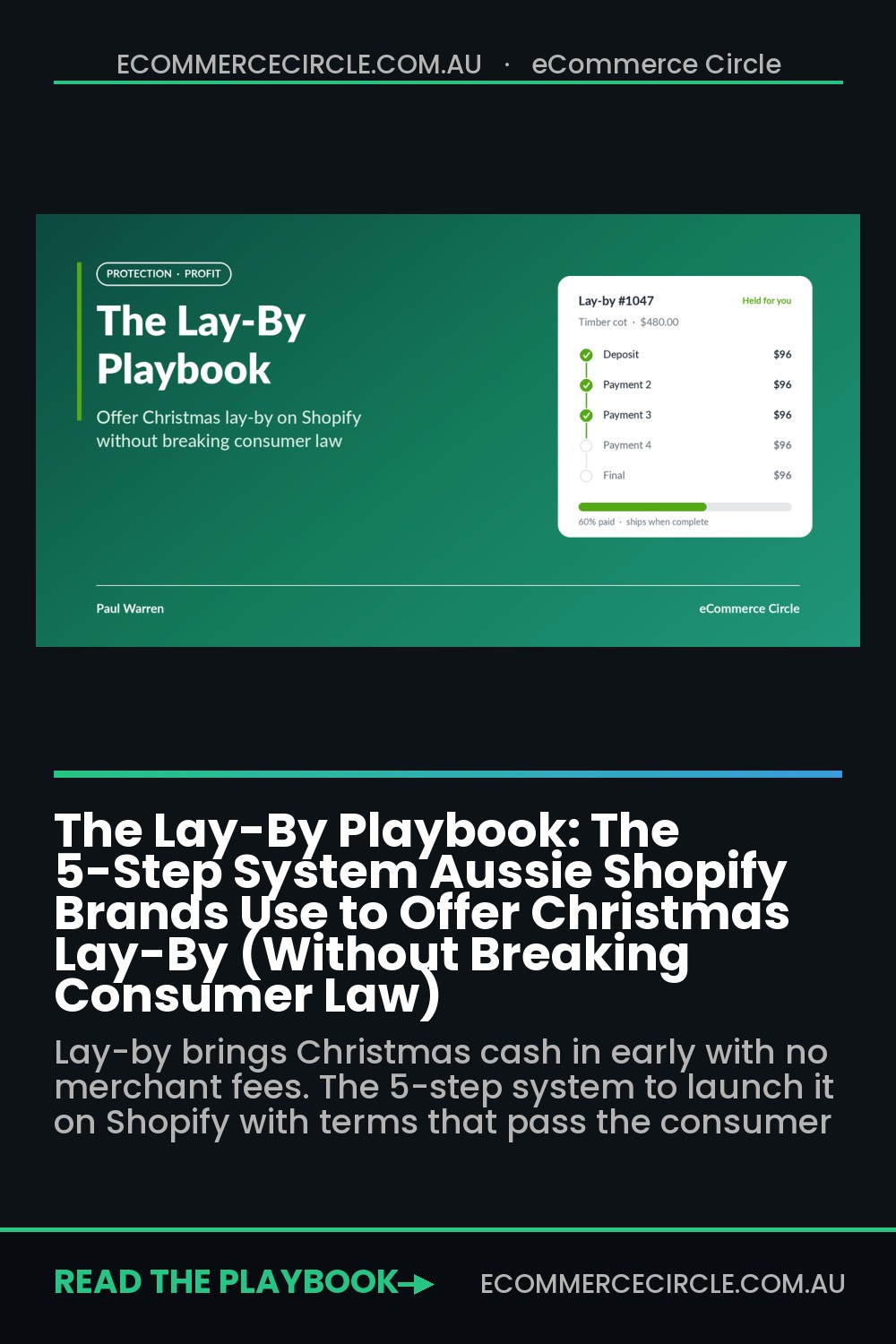
- Cash collected vs balance owed. This is your real forward revenue. In the example dashboard, $9,812 has already landed before BFCM with $13,904 still to come.
- Overdue payments. Contact anyone more than 3 days late. Use a friendly SMS, then an email, then a phone call. Most late payers have simply forgotten.
- Upcoming final payments. Send a “your order is nearly ready” email one week before the final payment. It lifts completion and gives you a chance to upsell gift wrapping or an accessory.
- Ready to ship. Release the fulfilment hold on fully paid lay-bys the same day and send a dispatch email that celebrates the finish line.
Set a firm escalation rule in your terms. Adoreu Baby’s terms say that if no payment arrives after two reminders, it can cancel the lay-by and apply the cancellation fee. That is a clean, fair process: two reminders, then a written cancellation notice, then a refund of everything paid less your published fee within a few business days.
When a customer cancels, process the refund fast and kindly. A lay-by customer who gets their money back within 48 hours is far more likely to come back in January for a smaller purchase. A slow refund turns into a chargeback or a fair trading complaint.
Lay-By vs BNPL vs Pre-Order: Where Each One Fits
These three tools solve different problems, and the best stores use them side by side.
- BNPL (Afterpay, Zip): customer gets the goods now, you get paid now and pay a merchant fee. Since 10 June 2025, BNPL providers must hold an Australian credit licence, and ASIC regulates most BNPL contracts as low cost credit. Best for impulse and mid-ticket purchases.
- Lay-by: customer pays over time, you hold the goods, no merchant fee. Best for high-ticket planned purchases and budget-conscious Christmas shoppers who want to avoid debt.
- Pre-order: customer pays (fully or partially) for stock that has not landed yet. Our preorder playbook covers this. Be careful: a pre-order taken in several instalments, where goods are released only after the final payment, can fall within the lay-by rules.
One more interaction to watch. BIG W does not accept BNPL methods like Afterpay to pay off lay-by instalments. Decide your own policy. Allowing a customer to pay a lay-by instalment with BNPL means paying a merchant fee on cash you were meant to receive free, which defeats the point.
The Compound Effect: Why Lay-By Pays Off Beyond Christmas
On its own, each step looks small. Together, they build something bigger than a payment option.
The fit test keeps lay-by on high-margin, high-ticket products where the admin pays for itself. Compliant terms protect you from the refund disputes that eat founder time in January. Cost-based fees mean cancellations cover your costs instead of creating losses. The Shopify setup locks stock to real buyers. And the weekly book turns lay-by into a forecastable cash line that lands before BFCM, when you need it most.
Then the long-term payoff kicks in. Lay-by customers have already made 5 or 6 payments to your brand by the time the product arrives. That is a level of engagement no welcome flow can match. Tag them, segment them in Klaviyo, and invite them first to your autumn launch. Treat a completed lay-by customer like a VIP, not a one-off Christmas buyer.
And because Compare the Market found a typical Australian was planning to spend $828 on Christmas 2025, a lay-by on a single big gift captures a large share of the season’s budget in one go.
Your Lay-By Launch Checklist
Use this before you switch lay-by on:
- ☐ Fit test passed (3 of 4 questions answered yes)
- ☐ Lay-by range selected: 10-20 high-ticket, reliably stocked SKUs, no perishables
- ☐ Minimum lay-by value set ($100-$150 for most online brands)
- ☐ Deposit set (20% recommended) and payment structure chosen (one balance or fortnightly instalments)
- ☐ Final payment date set with your carrier cut-offs in mind
- ☐ Termination charge calculated from real costs, with the costing sheet saved
- ☐ Seasonal SKU fee recalculated with markdown risk
- ☐ Terms written with all 7 clauses, with no “non-refundable deposit” wording
- ☐ Terms reviewed once by your lawyer
- ☐ Downpay (or draft-order process) set up and tested with a real card
- ☐ Order confirmation email includes the full terms
- ☐ Shopify Flow tag and fulfilment hold active on every lay-by order
- ☐ Reminder and early-payment nudges scheduled (fortnightly, timed to payday)
- ☐ Monday 15-minute lay-by book review in the calendar
- ☐ Refund process documented: cancellation refunds within 48 hours
Copy it into your project tool, assign an owner, and you can have lay-by live within a week.
Get Lay-By Live Before the Early Shoppers Are Gone
Lay-by will not suit every brand. But for the right products, it is one of the few Christmas levers that brings cash in early, costs nothing in merchant fees and builds loyalty instead of debt. The window is now. Every week you wait, more early shoppers commit their budget somewhere else.
Inside eCommerce Circle, protecting your profit through peak season is one of the core pillars we work on with every member. If you want to see exactly where your store is being capped, take the free More Orders Scorecard. It takes two minutes and shows you which of the 10 P’s to fix first.