It’s the last week of November. A customer emails you a screenshot: the exact product in their cart is A$40 cheaper at a bigger retailer. They want to know if you’ll match it. You say yes, because a sale is a sale. Then another three arrive before lunch, one of them from a marketplace seller you’ve never heard of, and by Cyber Monday you’ve matched your way into selling your best SKU at a loss.
What’s in This Article
That’s how most Aussie Shopify brands handle price matching. No written policy, no margin floor, no rules about who counts as a competitor. Just a founder in the inbox making it up order by order, under pressure, in the busiest fortnight of the year.
The brands that do this well treat price matching as a policy, not a favour. Bunnings, JB Hi-Fi and Officeworks have built entire value positions on it, and every one of them runs it on tight, published rules. This playbook gives you the same thing at Shopify scale: five rules that decide whether you should match at all, who you match, how low you’ll go, how to stay on the right side of the ACCC, and how to run the whole thing inside Shopify without it eating your week.
Why Price Matching Matters More This Peak Than Any Before It
Your customers are comparing harder than they ever have. The IAB Australia and Pureprofile Commerce & Discovery Report 2026 found 71% of Australian online shoppers have changed their retail choices because of rising costs, 69% rely on online research to feel confident before buying, and 92% use search engines or online retail stores to compare products and brands.
At the same time, the anchor for what counts as a fair price is being dragged down. Roy Morgan’s retail research shows Temu’s "has low prices" association jumped from 34% to 41% in a single year, overtaking The Reject Shop, while Amazon gained 7 points over five years. Roy Morgan’s own summary: "cheap is getting even cheaper."
Here’s the part most founders miss. A price match promise works mainly as a trust signal, not a discount engine. A RetailMeNot survey cited by Wiser found around 80% of shoppers say they’re more likely to buy when a retailer offers price matching, yet only a small slice of customers ever claim it. The promise removes the reason to open another tab. The rules decide whether the few who do claim it cost you money.
So the question isn’t "should I be cheaper?" It’s "can I stop a comparison shopper leaving without giving away margin on everyone else?" That’s what the five rules below are built to answer.
Rule 1: Decide If You Should Price Match at All
Price matching only makes sense when the exact same product is sold by other Australian retailers. That splits Shopify stores into three camps, and your answer depends entirely on which one you’re in.
| Your business model | Should you price match? | Why |
|---|---|---|
| Reseller of branded goods (appliances, outdoor gear, baby products, beauty brands) | Yes, with rules | Customers can find your exact SKU elsewhere in seconds. Matching keeps the sale and the customer relationship. |
| Hybrid (your own label plus stocked brands) | Only on stocked brands | Match on the third-party SKUs. Never on your own label, where nobody else sells the identical item. |
| Own-brand DTC sold only through your store | No, use a value guarantee | There’s no identical competitor. Offer a guarantee on quality, fit or returns instead. |
| Own brand also sold via stockists (Myer, David Jones, THE ICONIC) | Match your own stockists only | Stockist sales undercut your RRP. A narrow match stops customers buying elsewhere and protects the DTC relationship. |
That last row is the one that catches brands out. If you wholesale to department stores, they’ll run 25% off events you don’t control. A narrow "we’ll match any authorised stockist of our brand" promise keeps customers on your site, where you own the data, the email and the next order.
If you’re pure own-brand DTC, skip to the alternatives section below. You’ll get more from a value guarantee than a price promise nobody can ever trigger.
Rule 2: Define "Identical" and "Eligible Competitor" Before Anyone Asks
Every argument you’ll ever have about price matching comes down to two words: identical and competitor. Define both in writing now, and you’ll never have to improvise at 9pm on Black Friday.
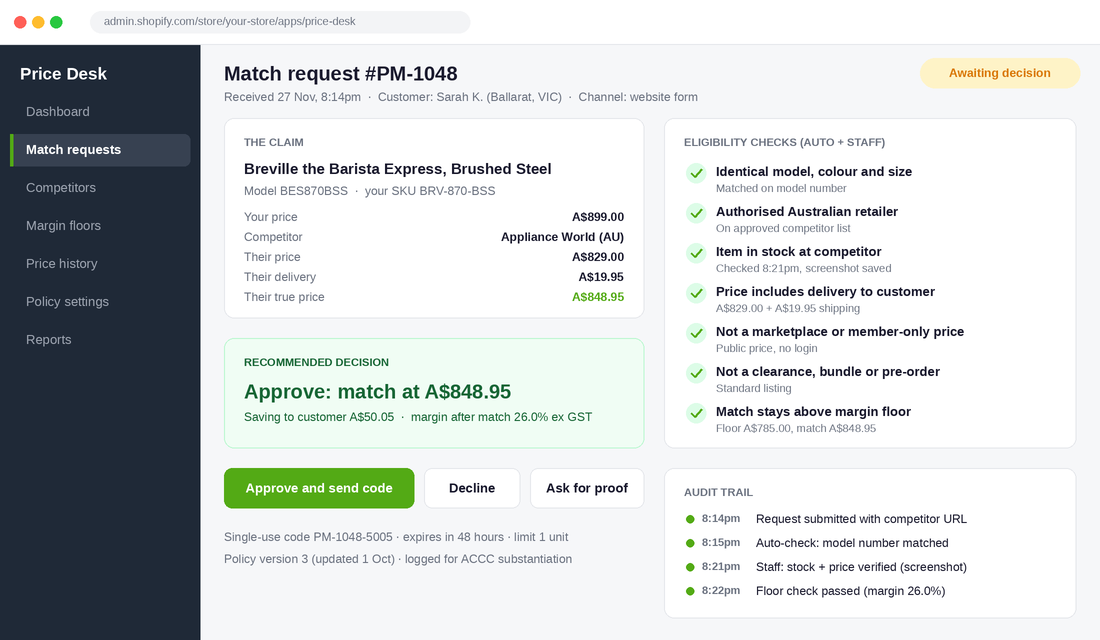
Look at how the big Aussie retailers do it. JB Hi-Fi matches identical, in-stock products from Australian competitors but excludes grey imports not sold through an authorised Australian reseller, and its own marketplace sellers. Bunnings beats a competitor’s lower price by 10% on the same in-stock item, with the comparison including GST and delivery, and excludes trade quotes, stock liquidations and commercial quantities. Officeworks beats by 5%, caps it at two eligible products per customer per competitor offer, and only honours it in store or over the phone.
Borrow the structure, not the generosity. Your policy should define:
- Identical product. Same brand, model number, size, colour and condition. Match on the manufacturer model or GTIN, not the product title.
- Eligible competitor. Australian retailers selling through authorised local distribution. Keep a named list in your policy (for example, "the retailers listed on this page") and update it quarterly.
- Exclusions. Marketplaces and third-party sellers (Amazon Marketplace, eBay, Temu, Facebook Marketplace), overseas sites, grey imports, clearance and liquidation prices, member-only or login-gated prices, bundle and gift-with-purchase deals, pre-orders, and price errors.
- The true price. The competitor’s price including delivery to the customer’s postcode. A$829 plus A$19.95 shipping is A$848.95, not A$829.
- Stock. The item must be in stock and available to buy at the competitor when you check.
- Limits. One or two units per customer per request, and no stacking with your discount codes or loyalty rewards.
One call you need to make up front: match or beat? Beating by 5% or 10% is a powerful headline for a business with Bunnings’ buying power. For a Shopify brand with 30 to 45% gross margins, a straight match is almost always the right call. Keep your promise to "we’ll match it" and let service, speed and returns do the rest.
Rule 3: Set a Margin Floor for Every SKU
This is the rule that turns price matching from a risk into a controlled cost. Every SKU gets a floor price, and you never match below it. If a competitor goes lower, you politely decline, and your policy already says you will.
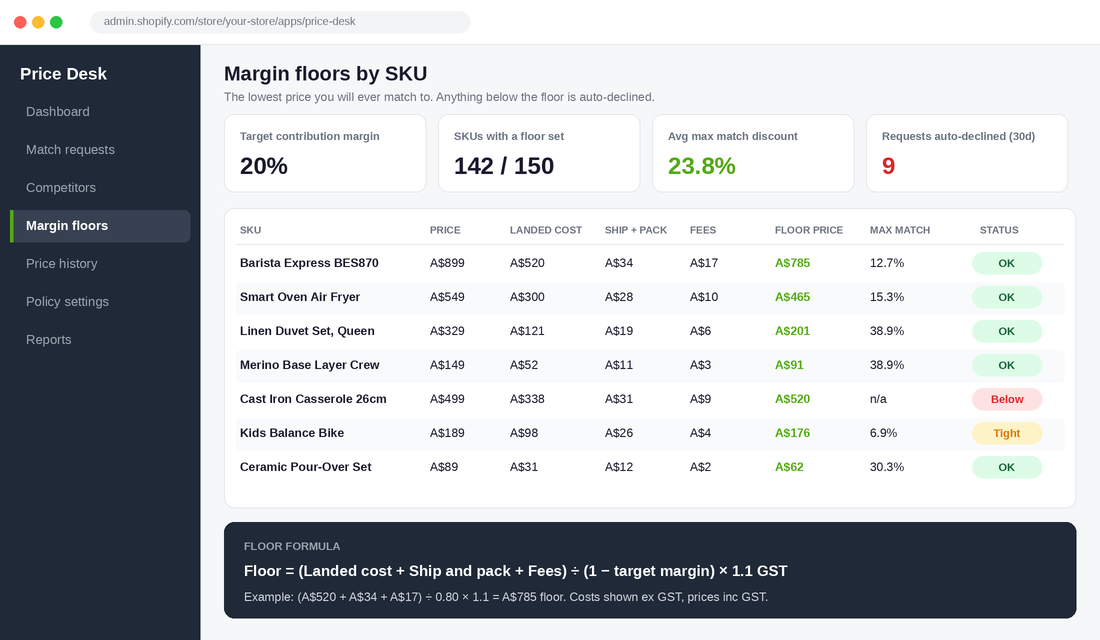
Here’s the formula we use with members, working on contribution margin rather than gross margin:
Margin floor formula
Floor price (inc GST) = (Landed cost + Pick, pack and ship + Payment fees) ÷ (1 − target contribution margin) × 1.1
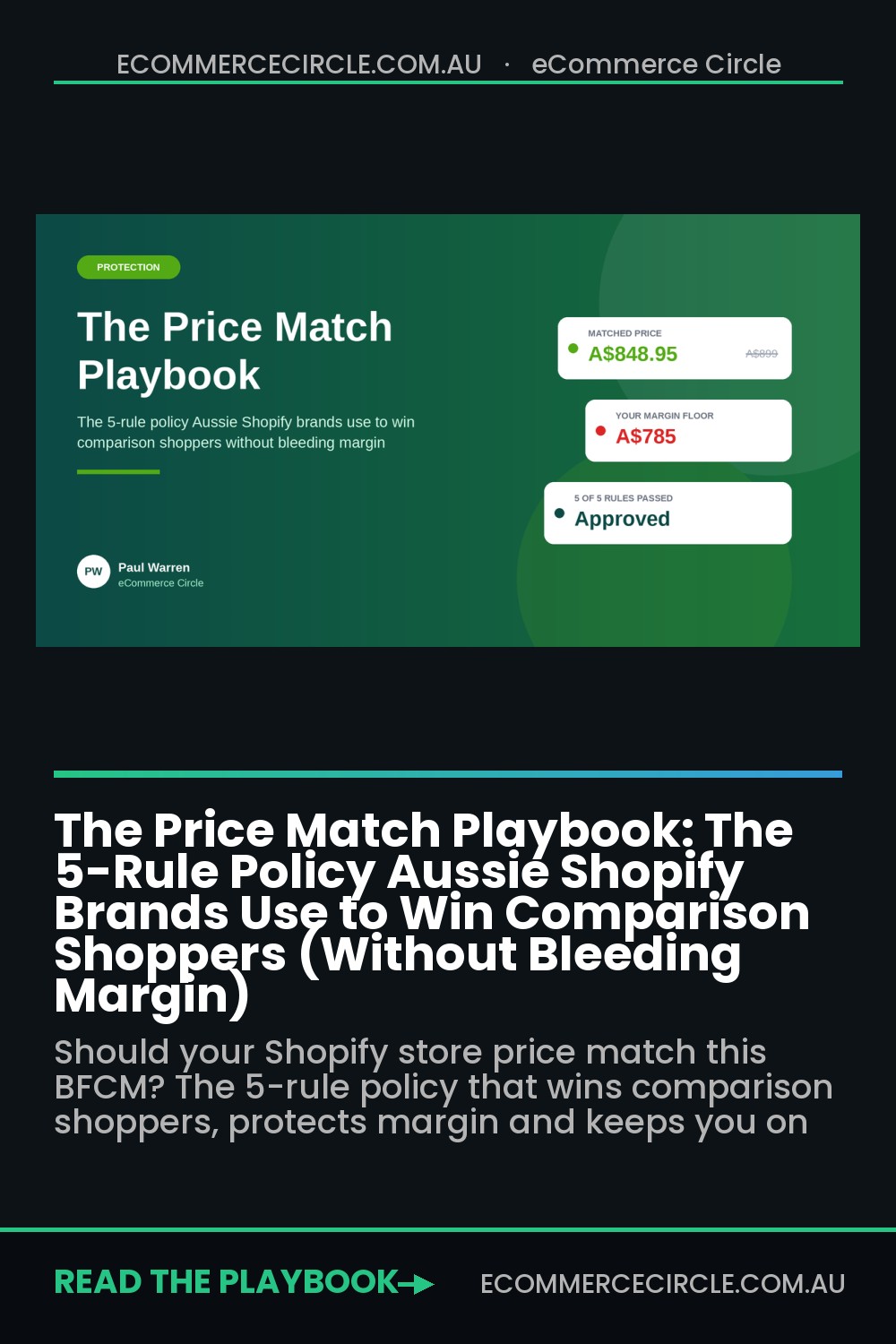
Worked example: a coffee machine with a A$520 landed cost, A$34 fulfilment and A$17 fees. At a 20% target margin: (A$520 + A$34 + A$17) ÷ 0.80 × 1.1 = A$785 floor. At a A$899 shelf price, you can match down 12.7% and still hit target.
Notice the GST step. Your costs sit ex GST in Xero, but your prices and your competitors’ prices are GST-inclusive. Forget the 1.1 and you’ll set every floor about 9% too low, which is exactly the kind of mistake that only shows up in the BAS three months later.
Three practical tips when you build your floors:
- Use real fulfilment costs. Pull the average from your 3PL invoices or carrier rate card, not the flat shipping you charge. Bulky items blow out fast.
- Decide what target margin means during peak. Some brands accept a lower target in November because a matched order still brings a new customer into the email flow. Make that a deliberate call, not an accident.
- Flag the no-match SKUs. Any product where the floor sits at or above your shelf price can’t be matched at all. That’s useful to know before BFCM, and it often points to a pricing problem worth fixing on its own.
If you haven’t mapped contribution margin by SKU yet, start with our contribution margin playbook. The floors fall straight out of it.
Rule 4: Make the Promise Legally Bulletproof
A price match promise is an advertised term. Under the Australian Consumer Law, the moment you publish it, you have to honour it. Legal guides from Sprintlaw and LegalVision both make the point: failing to honour a valid claim can be misleading conduct, and fine print won’t rescue a headline that says something different.
The stakes went up this year. The Treasury Laws Amendment (Doubling Penalties for ACCC Enforcement) Act 2026 took effect on 28 March 2026, lifting the maximum corporate penalty for false or misleading representations to the greater of A$100 million, three times the benefit obtained, or 30% of adjusted turnover during the breach period, according to DW Fox Tucker Lawyers. Misleading pricing is also squarely on the ACCC’s radar as an enforcement priority heading into peak.
You won’t get a nine-figure fine for a Shopify store. But you can get an ACCC letter, a Fair Trading complaint, or a Reddit thread that does more damage than either. Protect yourself with these five habits:
- Match the headline to the rules. "We’ll match any Australian retailer’s price on identical in-stock items" is safe. "Lowest price guaranteed" is a claim you have to be able to prove on every SKU, every day. Don’t write it.
- Put the full policy one click from the claim. Every badge, banner or PDP mention should link to the policy page. No hidden conditions.
- Honour every valid claim, even the painful ones. If a request meets your published rules, you match it. If you don’t like the outcome, change the policy going forward, with a new version date.
- Keep evidence. Screenshot the competitor page (price, delivery cost, stock status, date and time) for every approved and declined request.
- Train whoever answers the inbox. A VA who says "sure, we’ll match that" to a marketplace price has just set a precedent you’ll struggle to walk back.
If price claims are new territory for you, our sale price compliance guide covers the ACL rules on was/now pricing and strikethroughs that sit right beside this. And a quick reminder: this is general information, not legal advice. Have your lawyer review the final policy wording.
Rule 5: Run It Inside Shopify Without It Eating Your Week
A good price match process takes about three minutes per request. A bad one takes twenty and a back-and-forth email chain. Here’s the workflow we set up with members.
Step 1: Capture requests in one place
Add a short form to your policy page and PDP (Shopify Forms, Typeform or your helpdesk’s form builder all work). Ask for: product link on your store, competitor product URL, competitor price, delivery cost to their postcode, and their email. Route every submission to a single tag or view in Gorgias, Zendesk or your inbox, so nothing lives in DMs.
Step 2: Verify against the checklist
Your team opens the competitor link, confirms the six eligibility checks from Rule 2, screenshots the page and compares the true price to the SKU floor. Approve, decline or ask for proof. Aim to respond within two business hours during peak, because a comparison shopper won’t wait overnight.
Step 3: Issue a single-use code, not a manual price change
Never edit the product price to honour a match. You’ll accidentally give everyone the lower price and trigger the next wave of complaints. Instead, create a unique, single-use discount code in Shopify admin (Discounts > Create discount > Amount off products), limited to that product, one use, one customer, with a 48-hour expiry. For phone or email orders, a draft order with a line-item discount does the same job.
Step 4: Log it and tag it
Tag the order "price-match" (Shopify Flow can apply the tag automatically when the order uses a code starting with PM-). That tag lets you report monthly on requests, approval rate, margin given away and, most importantly, which competitors keep undercutting you.
Step 5: Watch competitor prices before customers do
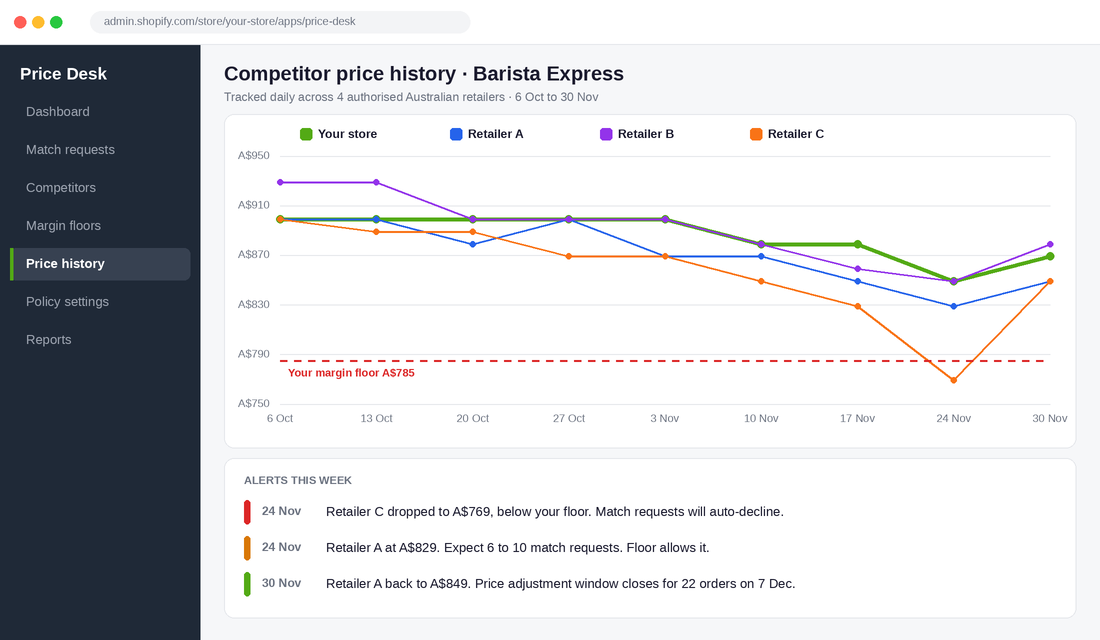
You don’t want to learn about a competitor’s price drop from 12 customer emails. Two tools make this simple:
- Google Merchant Center price competitiveness report (free). If you already run Shopping ads through the Google & YouTube app, open Merchant Center, go to Analytics > Pricing (older accounts show it under Growth > Price competitiveness, and you may need to opt in to Market insights first), and you’ll see how your prices compare with the benchmark other retailers charge for the same products. Sort by your top 20 SKUs and check it weekly through November.
- Prisync (paid, from around US$59 a month per 2026 Capterra listings). Setup takes under an hour: install the Shopify app, import your products, add competitor URLs for each SKU (or let it discover them from Google Shopping), then set an email alert for any competitor price that drops below your floor. The 14-day free trial covers a full BFCM dry run.
When an alert fires, you have three choices: hold and let the policy decline anything below floor, match proactively on your own store, or reallocate ad spend away from that SKU for the week. The worst option is finding out after the fact.
The BFCM Stress Test: Price Adjustments and Your Own Sales
Peak season creates two price match situations founders rarely plan for.
1. Customers asking you to match your own sale. Someone buys on 18 November at full price, then sees your Black Friday offer on the 27th and wants the difference back. Decide now whether you offer a price adjustment window (say, 7 days) or none at all. Either is fine if it’s written down and applied the same way for everyone. Most brands that offer one exclude their own sale events, so write that exclusion into the policy explicitly.
2. Competitors dropping below your floor during the sale. Big retailers will run loss-leaders on hero SKUs. Your policy’s floor handles this for you. A polite decline template that says "we can’t match this price, but here’s what you get with us" (free returns, local support, faster dispatch, a gift with purchase) will save more of those sales than you’d expect.
Also think about the calendar. A price match policy that’s live from October through to Boxing Day covers the three periods where comparison is most intense: Click Frenzy, Black Friday week and the final Christmas shipping days. If you’re sequencing those events now, map the policy onto your plan in the Temu-proof playbook so price is only one of the reasons customers choose you.
If You Shouldn’t Price Match: Offer a Value Guarantee Instead
Own-brand DTC stores can’t price match in any meaningful way. That’s good news, because it means you’re not competing on price in the first place. What you can do is remove the other fears a comparison shopper has.
- Quality guarantee. "If it doesn’t hold up for 12 months, we’ll replace it." Backed by your own supplier QC.
- Fit or satisfaction guarantee. Free exchanges on size or colour within 30 days.
- Christmas delivery promise. A clear cut-off date and an honest plan B if a carrier misses it.
- Exclusive bundles. A set nobody else sells can’t be price compared. That’s the logic behind most own-brand gift sets.
These promises do the same job as a price match badge: they stop the shopper opening another tab. They just protect your full price while they do it.
Your Price Match Policy Template (Copy, Paste, Edit)
Here’s a starting policy for an Australian Shopify reseller. Swap in your details and have your lawyer review the final version.
[Store name] Price Match Promise
Found the same product cheaper at another Australian retailer? We’ll match their price. Here’s how it works:
- The product must be identical: same brand, model number, size, colour and condition.
- The competitor must be an Australian retailer selling through authorised Australian distribution. See our list of eligible retailers below.
- The item must be in stock and available to buy from the competitor at the time we check.
- We compare the total price including delivery to your postcode.
- We don’t match marketplaces or third-party sellers, overseas websites, grey imports, clearance or liquidation prices, member-only prices, bundles or gift-with-purchase offers, pre-orders, or pricing errors.
- Limit of [2] units per customer per request. Can’t be combined with other discount codes or rewards.
- Submit your request using the form on this page before you buy. We’ll reply within [2] business hours (9am to 5pm AEST, Monday to Friday).
- [Price adjustments: if our own price drops within 7 days of your order, we’ll refund the difference. This excludes our Black Friday, Cyber Monday and Boxing Day sale events.]
This policy doesn’t affect your rights under the Australian Consumer Law. Policy version [1], updated [date].
The pre-launch checklist
- Business model confirmed: reseller, hybrid, or stockist-only match (Rule 1)
- Eligible competitor list written and published (Rule 2)
- Exclusions list written in plain English (Rule 2)
- Margin floor set for every matchable SKU, with GST handled correctly (Rule 3)
- No-match SKUs flagged and reviewed (Rule 3)
- Headline claim matches the policy, and every badge links to it (Rule 4)
- Evidence process in place: screenshot, date, time, delivery cost (Rule 4)
- Request form live and routed to one inbox view (Rule 5)
- Single-use code process documented for the team (Rule 5)
- Price-match tag and monthly report set up (Rule 5)
- Competitor monitoring live on your top 20 SKUs (Rule 5)
- Price adjustment window decided and written down (BFCM stress test)
How the Five Rules Work Together
On their own, each rule is a small bit of admin. Together, they change how comparison shoppers experience your store.
Rule 1 stops you offering a promise that doesn’t fit your model. Rule 2 means every request gets the same answer, whether it lands at 10am on a Tuesday or 11pm on Black Friday. Rule 3 means every match you approve still makes money. Rule 4 means the promise builds trust instead of creating legal exposure. And Rule 5 turns the whole thing into a three-minute process with data behind it.
That data is where the real value sits. After one peak season, your price-match log tells you which competitors consistently undercut you, which SKUs are genuinely price-sensitive, and where your margin structure is too thin to compete. That’s intelligence you can take into supplier negotiations, range planning and next year’s pricing strategy. The brands that win peak aren’t the cheapest. They’re the ones who know exactly where their price line is and hold it with confidence.
Protect Your Price Before the Comparison Starts
Inside eCommerce Circle, pricing and risk protection sit together as core pillars we work on with every member, because a policy you haven’t written down is a risk you haven’t priced. If you want to see exactly where your store is being capped, take the free More Orders Scorecard. It takes two minutes and shows you which of the 10 P’s to fix first.