A customer lands on your product page at 11am on a Thursday. She needs a gift for Saturday. Your shipping line says “3 to 7 business days”. She closes the tab and buys something worse from a retailer who promised it today.
What’s in This Article
Most Aussie Shopify brands handle this one of two ways. They ignore same-day delivery completely because “we’re not Amazon”, or they switch on a courier app in a panic in mid-December, price it off the top of their head and lose money on every order that uses it.
The brands winning with fast delivery do something different. They run the numbers first, launch it in the zone where it actually pays, and sell it hard at the moments when urgency is real. According to Shippit’s Commerce Delivery Report 2026, retailers offering same- or next-day delivery generated 3.5 to 4 per cent more orders across the 2025 Black Friday to Cyber Monday period. That is the prize. This playbook is the five-step test that tells you whether you can claim it without wrecking your margin.
Why Same-Day Delivery Is Now a Conversion Lever, Not a Luxury
Delivery used to be the boring bit after the sale. In 2026 it is part of the buying decision itself. Australia Post’s eCommerce Report 2026 found Australians spent a record $82.6 billion online in 2025, and 73 per cent of shoppers said a positive delivery experience makes them more likely to shop online rather than in-store.
Here are the numbers every founder should have in front of them before deciding anything:
- 43 per cent of shoppers will pay more for same-day or next-day delivery (Australia Post eCommerce Report 2026).
- 59 per cent of Gen Z and Millennial shoppers will pay more for it. If your customer is under 45, this is not a niche.
- Same-day delivery is now possible for 24 million Australians, according to Australia Post. The coverage excuse is gone.
- 64 per cent of Aussies won’t return after a bad delivery experience (Shippit Commerce Delivery Report 2026). Speed you can’t keep is worse than no speed at all.
Notice the tension in those last two points. Shoppers will pay for speed, but they punish broken promises hard. That’s why the test below starts with maths and ends with messaging, not the other way around.
And you don’t need to offer it to everyone. Koala, one of Australia’s best-known DTC brands, offers free 4-hour or same-day delivery in metro Sydney, Melbourne, Brisbane, Adelaide and Perth, but only on weekdays, only for orders placed before 3pm, and only when the item is in stock. Every one of those conditions is a deliberate margin and operations decision. That is the model to copy: a tight, honest promise inside a defined zone.
Step 1: Map Your Delivery Radius (Find Out Who Could Actually Use It)
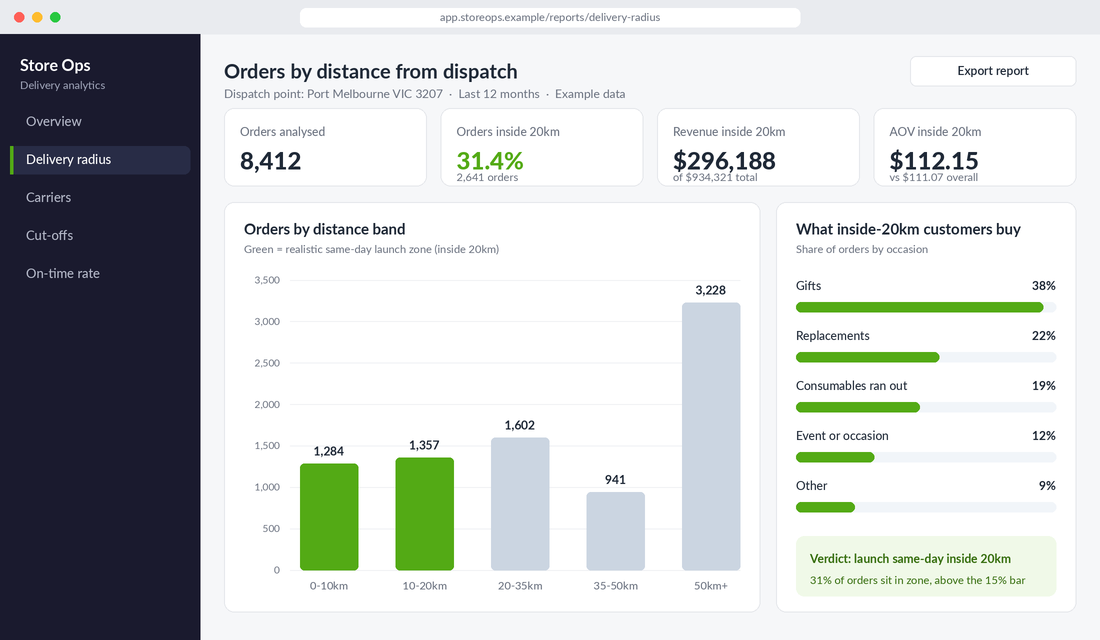
Before you call a single courier, find out how many of your customers live close enough to use same-day delivery. This is the step almost everyone skips, and it’s the one that decides whether the whole thing is worth doing.
Here’s how to do it in under an hour:
- Export the last 12 months of orders from Shopify (Orders, then Export, with the shipping postcode column).
- Tag every order by distance band from your dispatch point: 0 to 10km, 10 to 20km, 20 to 35km, 35 to 50km and 50km plus. A free postcode-to-suburb list and a spreadsheet lookup will do the job.
- Calculate your “same-day addressable share”: the percentage of orders and revenue inside 20km. That is your realistic zone for launch.
- Check what those customers bought. Were they gifts? Replacements? Consumables that ran out? Urgent categories are where same-day earns its keep.
Our rule of thumb with coaching clients: if fewer than 15 per cent of your orders land inside 20km of where your stock sits, same-day delivery is a marketing feature, not a revenue line. Offer it narrowly, keep it simple and don’t build operations around it.
If the share is higher, you have a real opportunity. And local is growing. Shippit’s report found the proportion of deliveries travelling less than 15km has grown from 10 per cent in 2022 to 15 per cent, as retailers move stock closer to customers. Shippit also says its on-demand carrier network can reach 90 per cent of Australia’s population within 50km of a pickup point.
One more thing to check: where your stock actually sits. If you use a 3PL in western Sydney but half your customers are in Melbourne, your same-day zone is only as big as the warehouse’s metro area. Map from the dispatch point, not from your office.
Step 2: Price It So Every Same-Day Order Still Makes Money
This is where most brands get burnt. Same-day couriers are not priced like standard parcels. Zoom2u, for example, lists same-day courier jobs in Sydney and Melbourne from $19 including GST, and 3-hour or 1-hour windows cost more again. Compare that to the $9 to $13 you probably pay for a standard satchel.
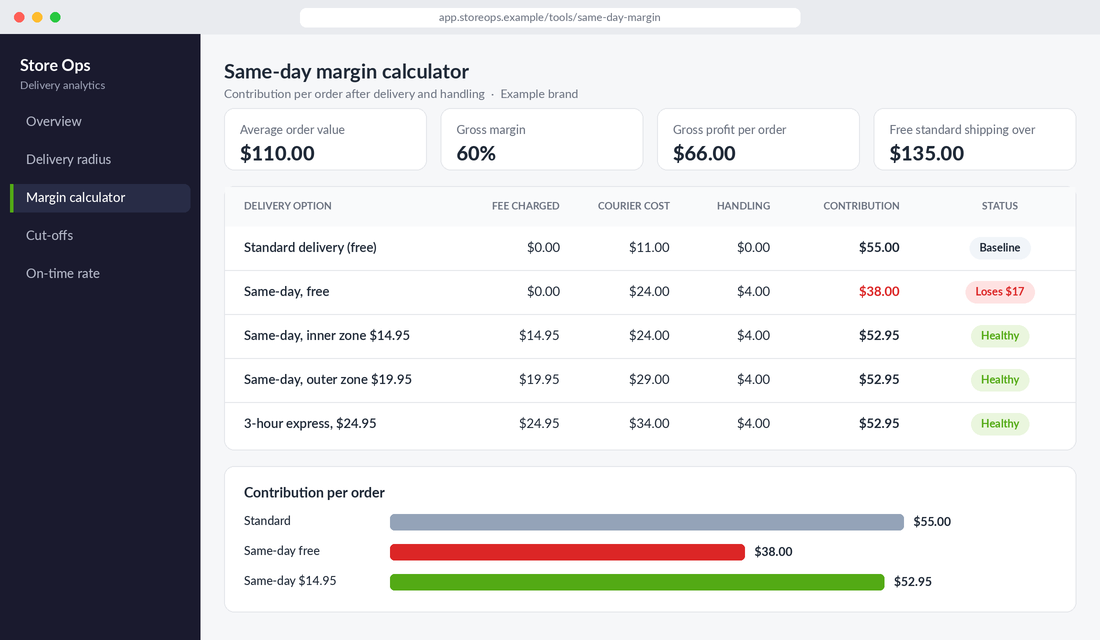
Work out the true cost of one same-day order with this simple sum:
- Courier cost for your typical parcel and distance band (get real quotes, not website “from” prices).
- Extra handling cost: the staff time to pick and pack out of your normal batch. Budget 5 to 10 minutes per order at your real hourly rate.
- Minus the delivery fee you charge the customer.
Here’s a worked example for a brand with a $110 average order and a 60 per cent gross margin. Standard delivery costs the brand $11 and is free over $135. Same-day costs $24 via courier plus $4 of handling.
- Free same-day delivery: $66 gross profit minus $28 = $38 contribution. Ouch.
- Same-day at $14.95: $66 minus $28 plus $14.95 = $52.95 contribution. Close to a standard order.
- Standard delivery, free: $66 minus $11 = $55 contribution.
The lesson: charge for it. Shoppers expect to. Remember that 43 per cent are willing to pay more for speed, and the ones who choose same-day are telling you they value time over money. A fee between $12.95 and $19.95 covers most metro courier jobs for small parcels.
If you want to make it free, attach it to a higher minimum order. Koala only unlocks free same-day when the order includes a mattress or furniture item, which guarantees the order value can absorb the cost. You can do the same with a minimum order value per delivery zone, which Shopify supports natively (more on that in Step 4). If you haven’t audited what each order really costs you to fulfil, run our cost-to-serve audit first.
Step 3: Set a Cut-Off Time and a Promise You Will Keep Every Single Day
Same-day delivery lives or dies on the cut-off time. Get it wrong and you’ll have orders arriving at 2:55pm that your team can’t possibly pick, pack and hand to a driver before the last collection.
Build your cut-off backwards from the courier’s last pickup:
- Find the courier’s last booking time for same-day in your area.
- Subtract your worst-case pick and pack time, not your average. On a busy December day that might be 90 minutes.
- Subtract a 30-minute buffer for the stock that’s in the wrong spot, the label printer that jams and the phone that rings.
- Round down to a time that’s easy to say. “Order by 12pm” beats “order by 12:47pm”.
Then define the promise precisely. Weekdays only, or Saturdays too? Metro postcodes only? In-stock items only? Koala says all of this in plain language on its delivery page, which protects the brand when an order falls outside the rules.
Accuracy matters more than you think. Shippit found the average delivery promise at checkout is 5.2 days, but actual delivery takes 1.7 days, and the report calls that gap one of retail’s biggest conversion killers. Same-day is the extreme version of this lesson. A promise of “today” that becomes “tomorrow” turns a delighted customer into one of the 64 per cent who won’t come back.
So write down what happens when things go wrong. If the courier doesn’t show, who calls the customer? Do you refund the same-day fee automatically? Decide now, not at 5pm on 22 December. The Christmas cut-off playbook covers how to build your full peak-season delivery calendar around dates like these.
Step 4: Build It in Shopify (Three Setups, From Simple to Scaled)
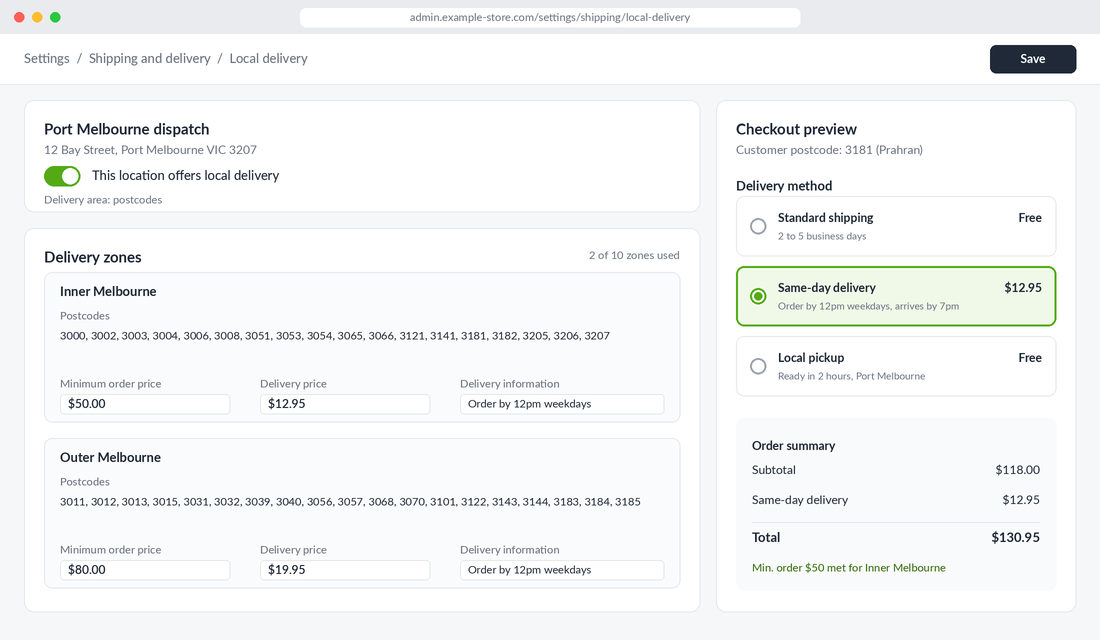
There are three ways to run same-day delivery on Shopify. Pick the one that matches your volume, not your ambition.
Setup A: Shopify Local Delivery (free, you or a courier do the driving)
Shopify’s built-in Local Delivery method is the fastest way to test demand. It adds a delivery option at checkout for customers inside the area you define. Here’s the setup:
- In your Shopify admin, go to Settings, then Shipping and delivery.
- Under Local delivery, choose the location you dispatch from and turn on “This location offers local delivery”.
- Choose your delivery area: a distance radius (up to 160km) or a list of postcodes. For Australia, postcodes usually give you tighter control because radius maps ignore bridges, tolls and traffic.
- Create up to 10 delivery zones per location. Give each zone its own minimum order price and delivery price. For example, inner zone $12.95 with a $50 minimum, outer zone $19.95 with an $80 minimum.
- Write the delivery information customers see at checkout: “Order by 12pm weekdays for delivery by 7pm today. Orders after 12pm arrive next business day.”
- Place a test order from a postcode inside and outside the zone to confirm the option shows and hides correctly.
Local Delivery doesn’t book a driver for you. You either deliver yourself (fine for a handful of orders a day) or book a courier manually. If you’re doing your own runs, a route-planning app like EasyRoutes plugs into Shopify’s local delivery orders and builds optimised routes with a driver app and customer tracking.
Setup B: A shipping platform with on-demand carriers
Once you’re past a few same-day orders a day, manual booking breaks. A shipping platform such as Shippit connects Shopify to on-demand and same-day carriers including Uber Direct, Sherpa, GoPeople, DoorDash and Australia Post’s metro services. Your team prints a label and the driver is booked automatically. Rates and cut-offs show at checkout based on the customer’s address.
Worth knowing: Uber Direct launched a native Shopify app for Shopify Plus merchants in the US, Canada and France in December 2025. In Australia, going through a shipping platform is currently the simplest path to Uber’s network for most brands.
Setup C: Ship from store (for brands with retail locations)
If you have a shop or two, they’re your biggest same-day asset. Chemist Warehouse now fulfils eligible fast-delivery orders from around 550 stores through Rendr, an Australia Post company. Based on roughly 32,000 orders in July 2026, the model averaged 56 minutes from order to delivery, and it didn’t need dedicated fulfilment staff in stores. Their GM of supply chain transformation put it simply: “There’s now one exit path for fast delivery.”
The lesson for smaller brands is the same: one process, one exit path, no special cases. If you already run local pickup, our click and collect playbook shows how to set up the back-of-house workflow that same-day delivery can share.
Step 5: Sell It Where Urgency Already Lives
Here’s the part that separates brands who “offer” same-day from brands who make money from it. Same-day delivery that’s hidden in checkout does almost nothing. The shopper who needed it already left your product page.
Put the promise where decisions happen:
- Product page, under the price: “Need it today? Order in the next 2h 14m for same-day delivery in metro Melbourne.” A live countdown to your cut-off is one of the strongest urgency cues you can add, because it’s true.
- Announcement bar: “Same-day delivery across metro Sydney. Order by 12pm weekdays.”
- Cart drawer: show the same-day option and fee before checkout so there are no surprises.
- Email and SMS: the last-minute gift sends in December, Mother’s Day and Valentine’s Day should lead with same-day, not discounts.
- Google Business Profile and ads: “same day delivery [your category] Sydney” style searches are high intent. Mention the service in ad copy for metro-targeted campaigns.
Now think about timing. Every Christmas, standard parcel cut-offs pass somewhere around mid-December. After that date, same-day becomes your only way to take a gift order and deliver it before 25 December. For a metro-heavy brand, that final week can be the highest-converting week of the year, simply because the competition has stopped promising anything.
Finally, measure it. Track same-day orders as their own shipping method in Shopify analytics and watch four numbers each week: same-day share of orders, on-time rate, contribution per same-day order and repeat purchase rate of same-day customers compared with everyone else. If on-time drops below 95 per cent, tighten the cut-off before you do anything else.
The Compound Effect: How the Five Steps Work Together
Each step on its own is useful. Together, they turn delivery from a cost line into a growth lever.
The radius map tells you where same-day is worth offering, so you don’t promise it to customers you could never reach in time. The pricing maths means every same-day order still makes a healthy contribution, so growth doesn’t dilute profit. The cut-off and promise protect your reputation with the 64 per cent of shoppers who walk after one bad experience. The Shopify setup removes manual work so the service survives December. And the urgency marketing puts the offer in front of the shoppers who value it most, at the exact moments they’re deciding.
Miss any one and the system leaks. Great marketing with bad maths loses money faster. Perfect maths with no marketing sits unused. A tight promise with no cut-off discipline turns into refunds and one-star reviews. When all five line up, you get what Shippit measured: a few extra per cent of orders in the busiest week of the year, from customers who are more likely to come back. Pair it with a sharp carrier rate card review and your whole delivery offer gets stronger, not just the fast lane.
Your Same-Day Delivery Launch Checklist
Work through this before you switch anything on. Aim to have it done by the end of October so the service is proven before the Black Friday rush.
- Radius: Orders from the last 12 months tagged by distance band, and your share inside 20km calculated.
- Urgency categories: The products and occasions where same-day matters most listed (gifts, replacements, consumables, event needs).
- Courier quotes: At least two real quotes for your typical parcel size in each zone.
- Contribution check: Profit per same-day order calculated at your planned fee and minimum order.
- Fee and minimum: Delivery price and minimum order set per zone (for example, $12.95 inner, $19.95 outer).
- Cut-off: Last courier pickup minus worst-case pack time minus 30-minute buffer, rounded down.
- Promise wording: Days, postcodes, in-stock rules and cut-off written in one plain sentence.
- Failure plan: Who contacts the customer and what compensation applies if a same-day order misses.
- Shopify setup: Local Delivery zones or shipping platform configured, and test orders placed inside and outside the zone.
- On-site messaging: Product page countdown, announcement bar and cart messaging live.
- Campaign plan: Same-day messaging scheduled for the post cut-off week before Christmas.
- Weekly tracking: Same-day share, on-time rate, contribution per order and repeat rate on your dashboard.
Make Speed a Decision, Not a Reaction
Same-day delivery isn’t for every brand, and that’s fine. But the decision should come from your own order data and margin maths, not from panic in the second week of December. Run the five-step test this month and you’ll know exactly where fast delivery pays, what to charge and how to sell it.
Inside eCommerce Circle, delivery and checkout experience is one of the Platform pillars we work on with every member, because it touches conversion, retention and profit at the same time. If you want to see exactly where your store is being capped, take the free More Orders Scorecard. It takes two minutes and shows you which of the 10 P’s to fix first.