Here is a question worth asking before your next campaign brief lands: who in your customer file spends the most per order, comes back most reliably, and still reads your emails? For most Aussie Shopify brands the honest answer is a 46 to 61 year old. And for most of those same brands, nobody on the team has ever built a single campaign with that person in mind.
What’s in This Article
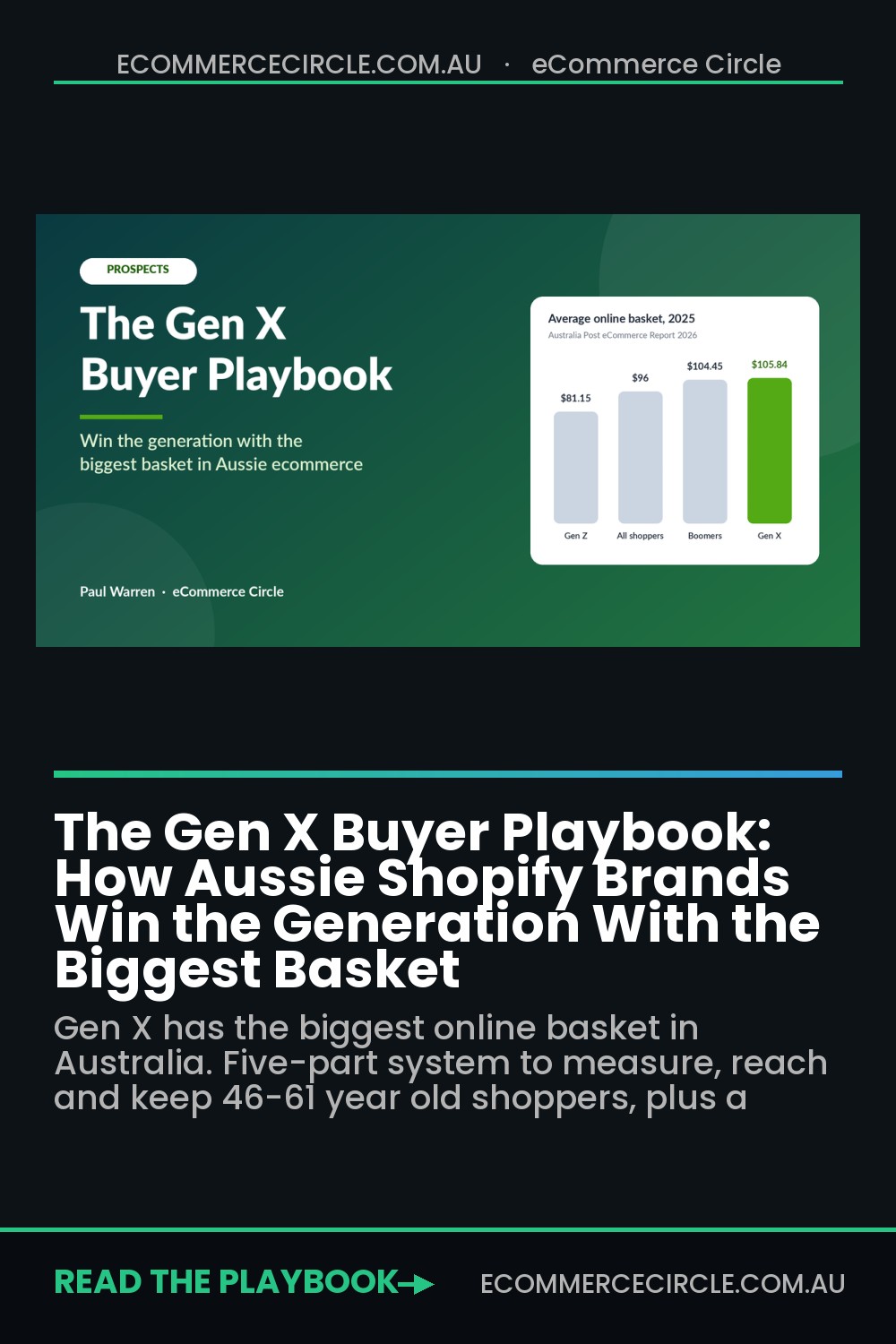
The pattern is predictable. Creative gets briefed for TikTok, the hero model is 26, and the “new customer” strategy is built around whoever is loudest on social this quarter. Meanwhile Gen X quietly carries the P&L. According to the Australia Post eCommerce Report 2026, Gen X shoppers had the highest average online basket of any generation in 2025 at $105.84, against a national average of $96. They spent $22.7 billion online, second only to Millennials.
The brands that win this cohort do not do anything flashy. They measure it, they sell with proof instead of hype, they show up in the channels Gen X actually uses, and they reward loyalty in plain dollars. This playbook gives you the five-part system to do exactly that, plus a 15-point checklist you can hand to your team this week.
Why Gen X Is the Most Profitable Customer You Are Ignoring
Gen X in 2026 means anyone born between 1965 and 1980, so they are now aged 46 to 61. They are sitting in their peak earning and peak wealth years at the same time.
KPMG’s January 2026 analysis of ABS data puts the average Gen X household net worth at $2.18 million, with the most wealth in property ($1.455 million) and shares ($235,000) of any generation. That is more than double the average Millennial household at $905,000.
The US numbers tell the same story. Forbes reports that Gen X is just 19% of the US population but drives 31% of all retail spending, and 81% say they stay loyal to brands they believe in.
So why do brands overlook them? Three reasons we see over and over:
- They are quiet. Gen X does not make viral unboxing videos. Their value shows up in your repeat purchase report, not your comments section.
- They are smaller than the generations either side. Marketers chase the biggest headcount, even when the smaller group spends more per head.
- Nobody on the marketing team is one of them. If your content creator is 27 and your media buyer is 31, your ads will talk to people aged 27 and 31.
The fix is not a rebrand. It is a system. If you have already worked through our Baby Boomer Buyer Playbook or the Gen Z Buyer Playbook, you will notice Gen X sits in a very specific middle: digitally fluent like Millennials, but with the scepticism and loyalty of Boomers.
Part 1: Measure Your Gen X Share Before You Change Anything
You cannot manage a cohort you cannot see. Shopify does not store customer age by default, so most founders are guessing. Here is how to stop guessing in under a week.
Step 1: Add one question to your post-purchase survey
If you run Fairing, KnoCommerce or Zigpoll on your thank-you page, add a single-select question: “Which age group are you in?” with bands of 18-29, 30-45, 46-61 and 62+. Response rates on thank-you page surveys are high because the customer has just bought, so you will build a usable sample within a few weeks.
Collect an age band or birth year, not a full date of birth. Under the Australian Privacy Principles you should only collect personal information you actually need, and you should tell people why. A line like “This helps us recommend the right products” does the job.
Step 2: Push the answer into Klaviyo and Shopify
Map the answer to a Klaviyo profile property (for example age_band or birth_year) and, if your survey app supports it, a Shopify customer tag. Now every future report and segment can be split by generation.
Step 3: Run the three numbers that matter
After 30 to 60 days, export orders with the age tag and calculate, for each generation:
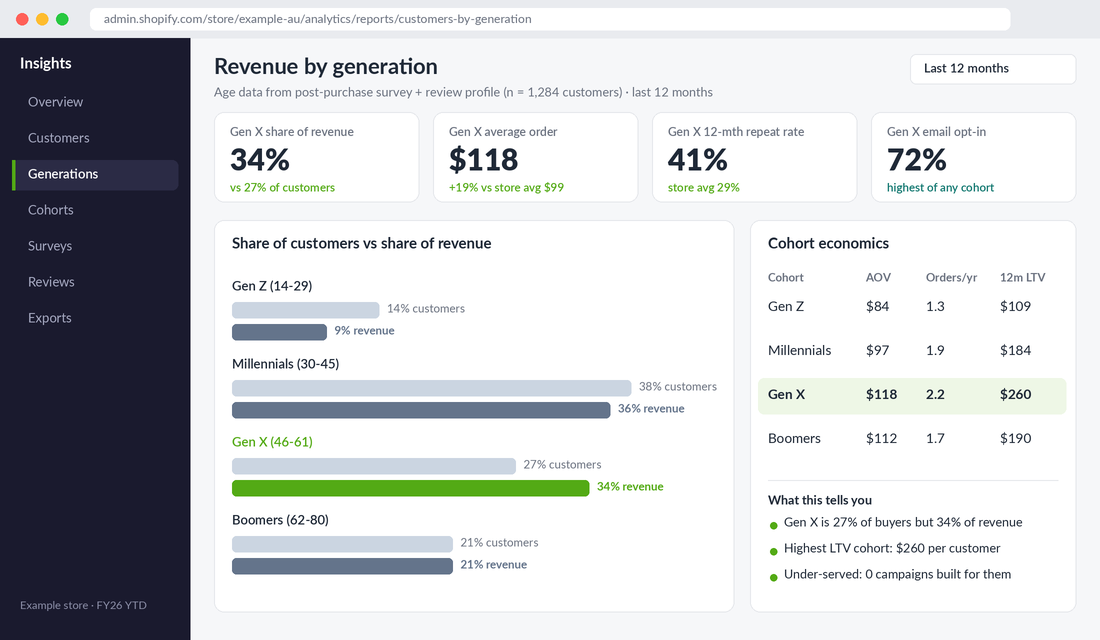
- Share of customers vs share of revenue. If Gen X is 27% of buyers but 34% of revenue, they are punching above their weight.
- Average order value. Compare it to your store average. Most brands we audit find Gen X sitting 10-20% above.
- 12-month repeat rate and lifetime value. This is the number that changes how much you can afford to spend acquiring them.
In the example above, Gen X customers are worth $260 over 12 months versus $184 for Millennials. That is 41% more room in your acquisition budget for the same payback period.
Here is how that plays out in practice. Say your contribution margin is 40% after product, shipping and payment fees, and you want your acquisition cost paid back within 12 months. A Millennial customer at $184 LTV generates $74 of contribution, so that is your ceiling on cost per acquisition. A Gen X customer at $260 generates $104. If your Meta account is currently capping bids at $60 per new customer across the board, you are almost certainly under-bidding for your most valuable buyer and over-bidding for your least valuable one.
Do not skip this step. Every decision in Parts 2 to 5 gets easier once you can point to a number.
Part 2: Sell With Proof, Not Hype
Gen X grew up with the birth of mass advertising and has been sceptical of it ever since. They are the generation that reads the specs, checks the returns policy and scrolls to the one-star reviews first. According to HubSpot data cited by Gladly, 70% of Gen X say they are more likely to buy from a company they trust with their data.
That means your product page has to do the heavy lifting. Here is the Gen X proof stack we build with members:
- A specs and care block above the fold on mobile. Materials, dimensions, what is in the box, how to care for it. No adjectives, just facts.
- A warranty or guarantee in plain English. “30-day change of mind returns, 12-month warranty on stitching” beats “Shop with confidence!”
- A real phone number and a real address in the footer. Gen X will call. When they do, they buy more.
- Delivery dates, not delivery ranges. “Order today, arrives Thursday in Melbourne” removes the last reason to wait.
- Reviews from people like them. This is the big one, and it is where most stores fall down.
Tool setup: Okendo age-range review attributes
A 52-year-old reading a review from a 22-year-old is not getting proof. Okendo lets you collect a reviewer’s age range and lets shoppers filter reviews by it. Okendo’s help centre recommends single-select attributes for exactly this. Setup takes about 15 minutes:
- In Okendo, open the Attributes tab and click Add Attribute Collection, then choose the Shopify collection (start with “All Products”).
- Go to the Profile Attributes tab, select Profile Questions and add a Single Select question called “Age range” with options 18-29, 30-44, 45-54, 55-64 and 65+.
- Save, return to the attribute collection, add the new profile attribute and save again.
- Keep the total to 3-5 attributes so the review form stays short (Okendo’s own recommendation).
- Turn on review filtering in your widget settings so shoppers can tap “45-54” and see only those reviews.
Once the attribute is collecting, check your Okendo integrations: if your plan connects Okendo to Klaviyo, you get a second source of age data for the segments in Part 3.
Real example: birdsnest
Regional NSW retailer birdsnest built its entire model on this principle. Instead of pushing trends, it asks women to set up a style profile, and more than 85,000 women have shared their body shape, favourite colours, lifestyle and wardrobe needs with the brand. Pair that with personalised styling advice and no-hassle returns, and you have a proof-first experience that speaks directly to a customer who has bought enough clothes to know what does not work on her.
Part 3: Show Up Where Gen X Actually Pays Attention
The channel mix for Gen X is refreshingly old-fashioned, which is great news because those channels are usually cheaper.
Email is the main event
Data Axle’s generational preferences research found email is the number one preferred channel for every generation except Gen Z. For Gen X that means your email program is not a support act for paid social. It is the headline.
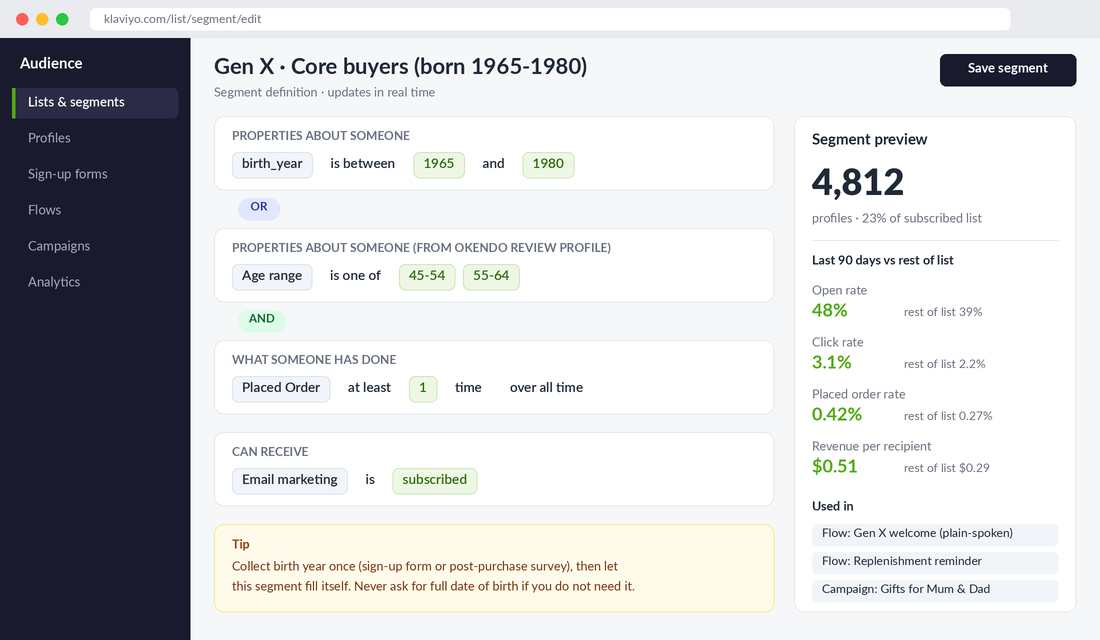
Build a dedicated Gen X segment in Klaviyo:
- Condition 1: Properties about someone,
birth_yearis between 1965 and 1980. - OR Condition 2: Okendo profile property “Age range” is one of 45-54 or 55-64.
- AND: Placed Order at least once over all time, and can receive email marketing.
Then give that segment its own welcome flow variant. Keep the copy plain-spoken, lead with the problem the product solves, and swap the “OMG obsessed” tone for “here is why this works”. Test one change at a time and watch placed order rate, not just opens.
Facebook and YouTube over TikTok
Gen X is still heavily active on Facebook and uses YouTube for research, especially “how to” and review content. If your Meta spend is 100% Reels-first creative, carve out 20% for a Gen X test: a 45-60 age band, feed placements, and creative that looks like a product demonstration rather than a trend.
On YouTube, a 60-second demo that answers “Is this worth the money?” will outperform a polished brand film with this cohort.
Google search for considered purchases
Gen X researches before they buy. Target long-tail question keywords (“best merino base layer for hiking Australia”, “is a weighted blanket worth it”) with blog content and Shopping ads. They are not impulse buyers, so the brand that answers the question well gets the sale.
Part 4: Build Loyalty That Pays in Dollars, Not Games
Gen X is the loyalty generation, and they also hold the purse strings. NielsenIQ research cited by Gladly found close to 90% of Gen X households say they are the primary grocery decision-maker at home. They run the household budget, and they reward brands that respect it.
What they do not want is gamification. Spinning wheels, badges and “level up” mechanics feel like a trick to this cohort. Here is what works instead:
- Points that convert to dollars, clearly. “Every $1 earns 1 point, 200 points is $10 off” beats a tiered system that needs a diagram. Our loyalty program maths guide shows how to price this without giving away margin.
- Replenishment reminders. If you sell consumables, a reminder timed to when they will run out is service, not marketing. Gen X will thank you with a reorder.
- Priority service over priority access. “Skip the queue, call this number” means more to a 55-year-old than early access to a drop.
- Subscribe and save, with easy pausing. They like convenience but hate traps. Make cancelling a two-click job and they will stay longer.
- A touch of nostalgia. Forbes highlights Nordstrom Rack’s updated retro branding as a deliberate nod to Gen X. A limited-edition colourway, a throwback design or an 80s reference in an email subject line can land beautifully if it fits your brand.
A simple test: if you cannot explain your loyalty program in one sentence, it is too complicated for your best customers.
Part 5: Sell to the Sandwich Generation
Here is the insight most brands miss entirely. McCrindle calls Gen X the sandwich generation because many are caring up and caring down at the same time: supporting teenage or young adult Gen Z kids and ageing Boomer parents. They make up 17% of the global population but 27% of the working population.
That means a Gen X customer is often buying for three generations. Your store should make that easy, especially with Christmas less than three months away:
- “Gifts for Mum and Dad” and “Gifts for teens” collections. Curated, priced in clear bands, and written for the buyer, not the recipient.
- Ship to another address, tested properly. Make it obvious at checkout, and make sure the invoice does not go in the box.
- Gift notes and gift receipts. A free text field at checkout and a price-free packing slip remove two common objections.
- Time-saving bundles. A pre-built “care package” or “uni starter kit” solves a problem for someone who has no time to shop three stores.
- Flexible returns for gifts. Extend the window for orders placed in November and December so the recipient can swap sizes in January.
If you have already mapped this out for younger families with our Parent Buyer Playbook, add a grandparent and teen layer on top. It is the same buyer, a decade further on.
The Five Mistakes That Push Gen X Away
Before you build anything new, check you are not already turning this cohort off. These are the five we see most in store audits:
- Fake urgency. Countdown timers that reset on refresh and “only 2 left” badges on items with 400 in stock. Gen X has seen every trick, and one fake timer undoes a year of trust.
- Tiny, low-contrast text. Many Gen X shoppers now wear reading glasses. Grey 12px body copy on a white background is a conversion leak you will never see in your analytics.
- Hiding the phone number. Burying contact details behind a chatbot tells a Gen X buyer you do not want to hear from them. They will take the hint and shop elsewhere.
- Discount addiction. Constant 30% off sales train this cohort to wait. They are value-driven, not bargain-driven, and they respect a brand that holds its price and explains why.
- Youth-only creative. If every model, voice and reference point is under 30, the message is clear: this brand is not for you. You do not need to swap your whole creative library, just make sure one ad in five shows someone who looks like your highest-value customer.
Fixing these costs almost nothing, and most of the fixes lift conversion for every age group, not just Gen X.
How the Five Parts Compound
Each part on its own is a small win. Together, they change the economics of your store.
Part 1 shows you Gen X is worth more, which gives you permission to spend more acquiring them. Part 2 lifts conversion because your product pages finally answer their questions. Part 3 puts that proof in front of them through cheaper channels, so your cost per acquisition falls while your average order value stays high. Part 4 turns a $118 first order into a $260 customer. And Part 5 multiplies each Gen X customer into three gift recipients, some of whom become customers themselves.
That is the flywheel. Higher value per order, lower cost to acquire, longer lifetime, and a built-in referral engine. Most brands leave all of it on the table because nobody asked who was actually buying.
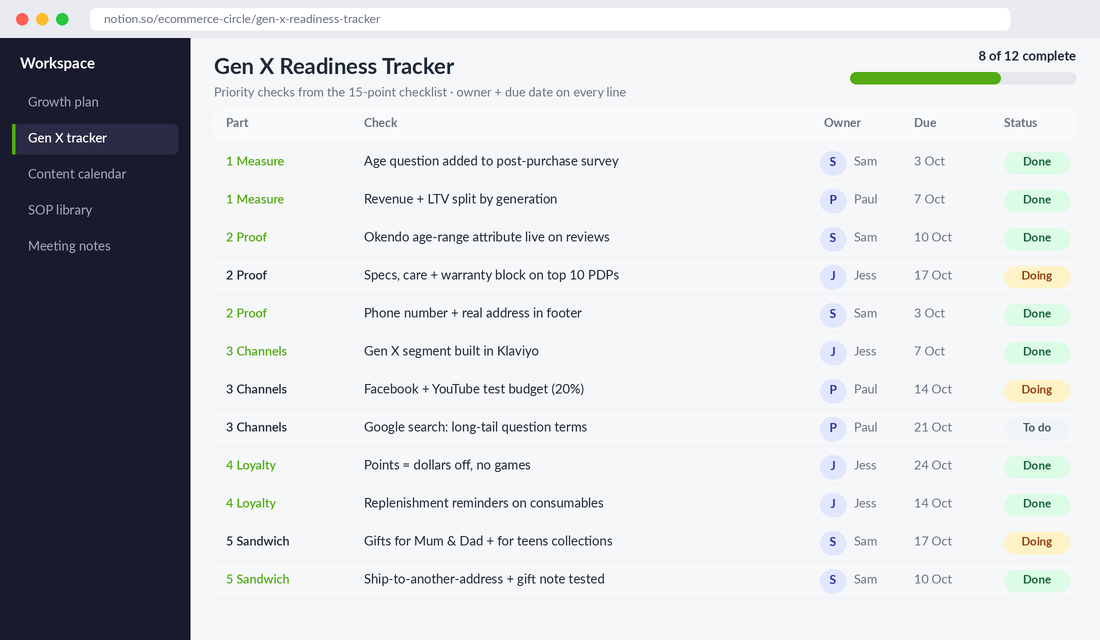
The Gen X Readiness Checklist
Copy this into your task manager and give every line an owner and a due date.
Measure
- Age question added to your post-purchase survey (age band or birth year only)
- Age data syncing to a Klaviyo profile property and Shopify customer tag
- Revenue, AOV, repeat rate and 12-month LTV split by generation
Prove
- Specs, care and warranty block on your top 10 product pages
- Okendo (or equivalent) age-range attribute live, with review filtering turned on
- Phone number and real business address visible in the footer
- Delivery dates shown on product pages, not just ranges
Reach
- Gen X segment built in Klaviyo with its own welcome flow variant
- 20% Meta test budget on a 45-60 audience with feed placements and demo creative
- Five long-tail question keywords targeted with content or Shopping ads
Keep
- Loyalty program explainable in one sentence, with points shown as dollars
- Replenishment reminders on every consumable product
- Subscribe and save with a two-click pause or cancel
Serve the sandwich
- “Gifts for Mum and Dad” and “Gifts for teens” collections live before 1 November
- Ship to another address, gift notes and price-free packing slips tested end to end
Your Next Step
Gen X will not make noise about your brand. They will just keep buying, spending more each time, and quietly telling their friends. The brands that notice them first will own a customer that competitors are too busy chasing trends to see.
Inside eCommerce Circle, knowing exactly who your most valuable customers are is one of the core pillars we work on with every member. If you want to see exactly where your store is being capped, take the free More Orders Scorecard. It takes two minutes and shows you which of the 10 P’s to fix first.