Your best marketing channel is not Meta. It is not your email list, and it is not that influencer you have been chasing for three months. It is the moment a customer sits on their kitchen floor in Brunswick or Bondi and opens the parcel you sent. Every single paying customer experiences it. No algorithm sits in the way, no inbox filter, no ad blocker. It is the one touchpoint with a 100% open rate, and most Aussie founders spend more time choosing a font for their homepage than choosing what that moment feels like.
What’s in This Article
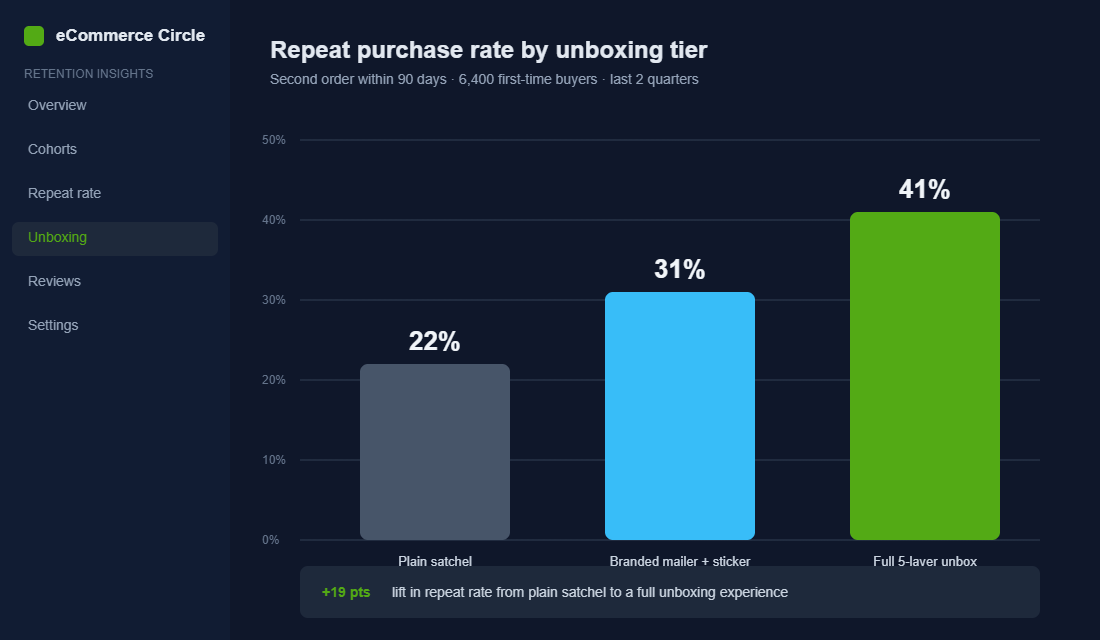
Here is why that is a costly mistake. Roughly 88% of shoppers say they are more likely to buy again after a positive unboxing experience, and customers who get premium packaging show repeat purchase rates 40 to 61% higher than those who get a plain satchel. Flip it around and the downside is just as sharp: 73% of consumers say they are less likely to buy from a brand again if the product turns up damaged. The box is not a shipping expense. It is a retention lever you have already paid to put in your customer’s hands.
This playbook breaks the delivery moment into five layers you can build one at a time, shows you exactly what each one costs, and gives you a way to turn every parcel into reviews, repeat orders, and free content. We have walked hundreds of Aussie Shopify founders through this, and the ones who win treat the box as the first page of the second sale.
The Unboxing Moment Is Your Most Under-Priced Channel
Think about what you pay for attention everywhere else. A cold Meta click costs real money before anyone even reads your name. An email gets a 30 to 40% open rate on a good day. Your parcel gets opened by 100% of buyers, and they are already in a good mood because something they chose has arrived. That is the highest-intent, lowest-cost attention you will ever get.
The numbers back the instinct. Around 72% of consumers say package design influences their purchasing decisions, and 32% of businesses report increased revenue after improving their packaging. This is not about looking fancy. It is about using a moment you already own to do a job you are currently paying other channels to do worse.
Most operators miss it because packaging sits in the operations column of the spreadsheet, next to freight and pick-and-pack. It gets optimised for cheapest-per-unit, full stop. The founders who pull ahead move it into the marketing column and ask a different question: what would make this person want to show someone, order again, and leave a review? For more on where that second order actually comes from, our Shopify LTV playbook pairs directly with everything below.
The 5 Layers of a Repeat-Driving Unbox
A great unboxing is not one big expensive idea. It is five cheap layers stacked in the right order. Build them in sequence and you can start today with the two that cost almost nothing, then add the rest as the repeat revenue funds them.
- Layer 1: Outer. The mailer or box. Its job is to survive the AusPost network and set the first visual impression.
- Layer 2: Protection. Void fill and product protection. Its only job is that nothing arrives broken or rattling.
- Layer 3: Reveal. Tissue, sticker, stamp. The cheap brand cues that make opening feel deliberate rather than industrial.
- Layer 4: Message. The printed insert card. This is where you ask for the second order and the review.
- Layer 5: Ask. The single next action, usually a QR code, that turns a happy customer into a repeat buyer or a piece of content.
Get them in this order because the early layers protect the later ones. A beautiful tissue-wrapped reveal means nothing if the candle arrived cracked. Nail damage prevention first, then earn the right to be pretty.
Layers 1 and 2: Win the Boring Stuff First
Damage is the fastest way to turn a new customer into a refund and a one-star review. With 73% of shoppers refusing to reorder after a damaged delivery, this layer is pure profit protection. Start by right-sizing your outer. A product swimming in an oversized box both looks cheap and moves around in transit, and it quietly inflates your freight through dimensional weight, which AusPost and every major courier now charge on. Snug is safer and cheaper.
For most Aussie DTC brands under a couple of kilos, a quality compostable or padded mailer beats a box on cost, weight, and shelf space. Match the void fill to the product: recycled paper for solid goods, moulded pulp or honeycomb wrap for anything fragile. Skip plastic bubble wrap where you can, because it undercuts every sustainability cue you are about to build in the next layer.
One practical test: pack a live order, then drop it from waist height onto a hard floor three times and open it. If anything shifted, cracked, or rattled, your protection layer is not done. This ten-minute check has saved founders more in refunds and returns than most conversion tweaks. Our Shopify thank-you page playbook covers the digital half of this same post-purchase window.
Layer 3: The Reveal That Costs Cents
This is where brand feeling gets manufactured for almost nothing. A sheet of custom tissue, a branded sticker to seal it, and a printed thank-you stamp turn a generic parcel into something that feels chosen. None of it is expensive. It just has to be intentional.
noissue built an entire business on exactly this problem. As small business owners themselves, the founders could not find custom packaging at low minimum order quantities, so they made it: compostable custom tissue printed with soy-based inks on FSC-certified paper, custom stickers, and tape, all at MOQs a small Aussie brand can actually afford. You can order a few hundred sheets of branded tissue rather than committing to a pallet, which means the reveal layer is accessible even at a few hundred orders a month.
Lean into sustainability here, because in Australia it is a genuine buying signal rather than a nice-to-have. Around 40% of Australian consumers say they will pay a premium for recyclable packaging, that figure jumps to 83% among shoppers aged 44 and under, and 54% actively consider sustainable packaging when choosing a product. Home-compostable tissue and mailers are not just kinder, they are a reason to choose you and a reason to feel good posting about it.
Layer 4: The Insert Card That Does the Selling
If you only add one thing to your parcels this week, make it a printed insert card. It is the single highest-return piece of packaging you can produce, because it is the only layer whose entire job is to drive the next purchase. Most brands either skip it or waste it on a generic “thanks for your order” with no ask.
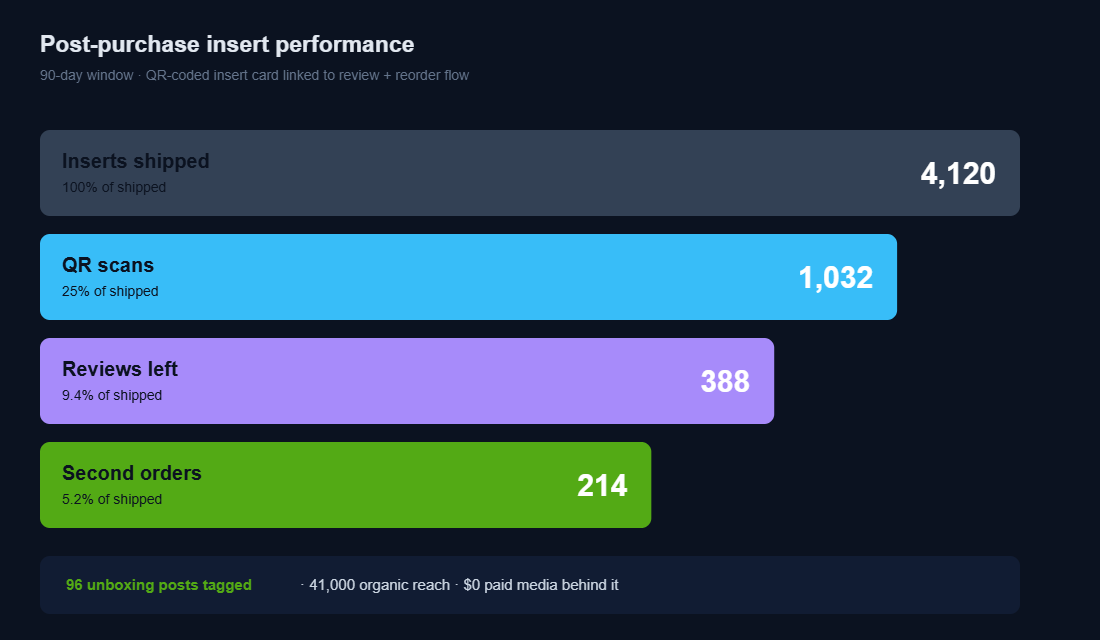
A working insert does three jobs in a few lines. It thanks the customer like a human. It gives them one specific reason to come back soon, usually a time-boxed reorder offer such as 15% off a second order in the next 30 days. And it asks for a review while the product is literally in their hands, which is the highest-intent review moment you will ever get. Keep it to one card, one offer, one action.
Here is a copy template you can lift directly:
- Line 1 (human): “Hey [name], thanks for backing a small Aussie brand. It genuinely means a lot.”
- Line 2 (reason to return): “Here is 15% off your next order, valid for 30 days: code THANKS15.”
- Line 3 (the ask): “Loving it? Scan the code to leave a 30-second review. Hating it? Reply first, we will make it right.”
That “reply first” line is deliberate. It routes unhappy customers to your inbox instead of a public one-star review, which quietly protects your rating. For the full system behind turning that moment into repeat revenue, our Shopify reviews playbook goes deep on the follow-up mechanics.
Layer 5: Turn Every Box Into Content
Unboxing is not a niche behaviour. Videos with “unboxing” in the title racked up more than 12.5 billion views on YouTube in a single year, and 52% of consumers say they have bought a product after watching an unboxing video. Your customers are already a distribution channel. The Ask layer just gives them a reason and a nudge.
Make sharing easy and worth it. Put your handle and a simple hashtag on the insert, and offer a small incentive for a tagged unboxing post, such as entry into a monthly credit draw or a bonus on their next order. You are not paying for reach, you are rewarding customers who were already delighted enough to film it.
Hero Packaging, the Sydney brand founded by Anaita Sarkar and Vik Bansal, is the local case study. It started when they were shipping 80 to 100 orders a day of their own fashion label in plastic and could not stomach the waste. They built home-compostable mailers from corn starch, cassava root, and a binding polymer, and have since shipped tens of millions of them as a Certified B Corp. The packaging itself became the story customers wanted to tell, which is exactly what you are engineering when the box is worth filming.
Do It Without Wrecking Your Margins
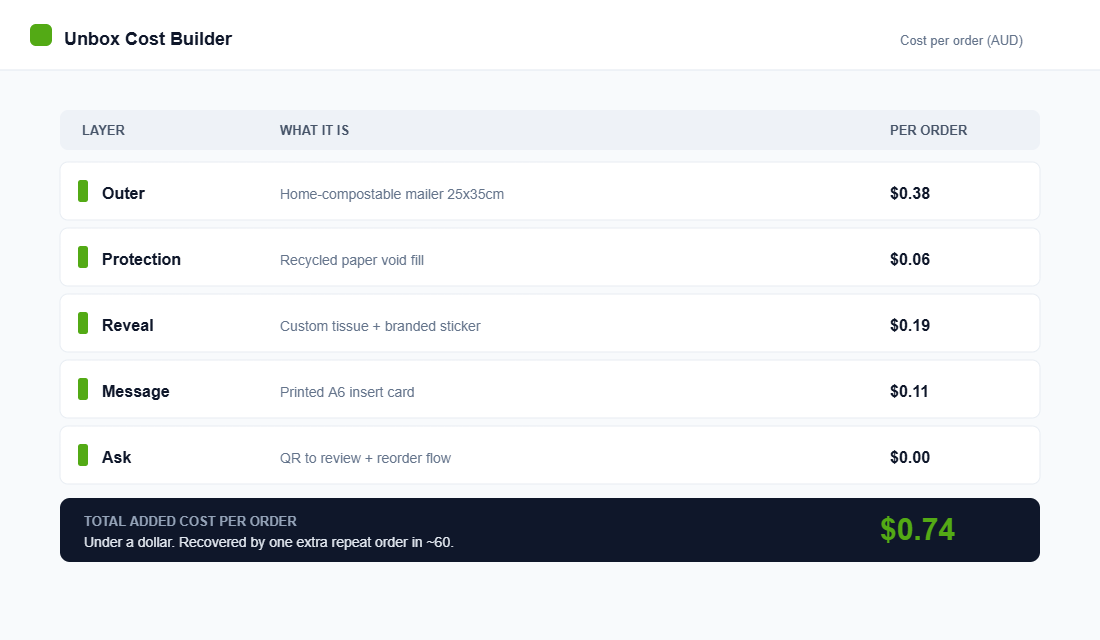
The objection is always the same: this sounds expensive. Built deliberately, the full five-layer experience adds well under a dollar to a typical order. The cost sheet above lands around 74 cents: a compostable mailer, paper void fill, custom tissue and a sticker, a printed insert, and a QR code that costs nothing to generate. One recovered repeat order in roughly sixty pays for the packaging on all sixty.
The discipline is to add layers in order of return, not in order of prettiness. Start with Layer 4, the insert, because it is a few cents and drives the second sale immediately. Add Layer 3, the reveal, once the insert is working. Only invest in fully custom printed mailers once volume makes the per-unit price sensible. Never let the box cost outrun the repeat revenue it generates, and track that link so it stays honest.
A useful benchmark: aim to keep total added packaging cost under 2% of your average order value, and expect a well-built insert to lift your 90-day repeat rate by several points on its own. If your numbers beat that, reinvest the gain into the reveal layer. If they do not, your ask or your offer is the problem, not the paper.
Set It Up This Week: Tool and 30-Minute Plan
You can stand up a working version of all five layers in under an hour using tools that suit an Aussie small brand. Here is the concrete setup.
- Order the reveal (10 mins). On noissue, design custom tissue and a seal sticker in the browser editor, upload your logo as an SVG or high-res PNG, choose compostable stock, and order the lowest MOQ to test. Do the same for compostable mailers via Hero Packaging.
- Build the insert (10 mins). In Canva, set an A6 card, write the three-line template above, and add your reorder code. Send to any local printer or order through your packaging supplier.
- Create the Ask (5 mins). Generate a free QR code that points to your review page or a simple Shopify page with a review link and the reorder offer. Print it on the insert.
- Wire the offer (5 mins). In Shopify, create the discount code from the insert (for example THANKS15, 30-day expiry) so it is live the moment parcels land.
- Instrument it (5 mins). Use a unique code per campaign so you can see reorders and review lift attributed straight back to the insert, and review it monthly.
That is a complete, measurable unboxing system for the price of a coffee per dozen orders.
Common Unboxing Mistakes That Quietly Cost You
Most packaging problems are not dramatic. They are small, invisible leaks that never show up as a line on your P and L because they surface as slightly lower repeat rates and slightly worse reviews. These are the ones we see most often when we audit an Aussie brand’s parcels.
- Oversized outers. Paying dimensional weight to ship air, while the product rattles around and arrives feeling cheap. Right-size before you do anything else.
- A generic insert with no ask. “Thanks for your order” printed on card is a wasted asset. If the insert does not drive a review or a reorder, it is decoration.
- Sustainability claims with no substance. Aussie shoppers are sharp on greenwashing. If you say compostable, it needs to actually be certified home-compostable, or the trust you build evaporates.
- Peak-season neglect. The exact moment you get the most new customers, BFCM and Christmas, is when rushed packing and stockouts of branded materials wreck the experience for your highest-value cohort.
- No measurement. If you cannot tell whether the insert drove reorders, you will cut it the first time cash gets tight. Unique codes make the value visible so it survives.
None of these are hard to fix. They persist because packaging sits in an operational blind spot that nobody owns. Give one person the job of owning the unboxing experience end to end, review a live parcel every month, and most of these leaks close on their own.
What Each Layer Should Actually Cost You
The reason most founders never upgrade their packaging is that nobody ever tells them the numbers. So here is the honest cost model for a typical Aussie DTC order, at the volumes a growing store is realistically buying at.
- Mailer or carton: $0.45-$1.20 plain, $0.90-$2.20 custom printed at 1,000-5,000 units. Custom printing stops being a luxury at around 500 orders a month.
- Void fill and internal protection: $0.15-$0.60. Tissue and a paper band read as considered. Loose plastic fill reads as cheap and generates complaints.
- Sticker or seal: $0.06-$0.15. The single highest-impact cent-per-cent item on this list.
- Insert card: $0.12-$0.35 printed. This is the piece that does the selling, so it should be the last thing you cut.
- Tape, labels, sundries: $0.10-$0.25.
All in, a genuinely good unbox lands between $0.90 and $4.50 a parcel depending on product size and print quality. On an $80 average order value, the upper end of that is under 6% of the order, and roughly a third of what you are paying to acquire the customer in the first place.
Judge the spend against repeat rate, not against gross margin. If you send 1,000 orders a month and packaging costs you an extra $1.80 a parcel, that is $1,800. You only need repeat purchase rate to move from 22% to 24% at an $80 AOV for the maths to work, and that is a modest shift for a change every single customer experiences. If you do not currently know your repeat rate by cohort, the method is in our 90-day cohort LTV framework.
Two cost discipline rules keep this from getting away from you. Order printed stock in quantities you will use within six months, because dead packaging in a corner of the warehouse is the same waste as dead inventory. And never let packaging push a parcel into the next satchel size or over a shipping weight break — a $0.30 upgrade that adds $2.40 of freight is not an upgrade. Model it properly alongside your free shipping threshold before you commit to a box size.
When the Parcel Arrives Damaged: The Layer Nobody Plans For
Everything above assumes the box arrives intact. Between 1% and 3% of Australian domestic parcels arrive damaged, delayed past the promise, or not at all, and that moment does more to your repeat rate than any tissue paper ever will. It is the layer nobody designs for because it feels like the carrier’s problem.
It is not. The customer bought from you, so the recovery is yours to run, and a well-handled failure converts better than a smooth delivery. Customers who have a problem resolved quickly repeat at a higher rate than customers who never had a problem at all, because you have given them evidence that you are safe to buy from twice.
- Detect it before they email you. Set a tracking alert for anything sitting in the same status for more than 72 hours. Aim to contact the customer first in at least half of all delivery failures.
- Replace, do not investigate. Under about $60 in landed cost, send a replacement the same day and chase the carrier separately. The 20 minutes of support time you save is worth more than the unit.
- Say what happened. “Your parcel was damaged in transit, a replacement is on its way, here is the new tracking number” beats any apology template. No discount code required.
- Log the reason. Tag every incident by carrier, route, and product. Three months of tags will usually point at one product that needs better internal protection or one lane that needs a different carrier.
Aim to resolve inside four business hours during the working week. That is the window where a damaged parcel becomes a story the customer tells favourably rather than a review you have to answer in public. The full recovery sequence, including the exact messages, is in our failed delivery playbook, and setting the expectation correctly in the first place is covered in the delivery promise playbook.
One last piece of prevention, because it is cheaper than any of the above. If more than 2% of your parcels are arriving damaged, the problem is your internal protection, not the carrier. Order five units of your best seller to your own address, open them the way a customer would, and see what actually moves inside the box. Most damage traces back to a product rattling in a mailer that was one size too big.
How the Layers Compound
Any one layer is a nice touch. Stacked, they become a flywheel. The protection layer stops refunds. The reveal makes the moment feel premium and worth filming. The insert converts that goodwill into a second order and a review. The Ask turns the customer into reach that brings you the next first-time buyer, who then enters the same loop. One parcel now does the work of a retention email, a review request, and a paid ad at once, for cents.
That is the shift. Stop thinking of packaging as the last cost of the first sale and start treating it as the first asset of the second. The founders who internalise that are compounding repeat rate and organic reach while their competitors are still comparing satchel prices by the hundred.
Your 5-layer checklist: right-sized protective outer that survives a drop test, clean void fill with no plastic, a cheap intentional reveal with sustainability cues, a one-offer insert card with a human note, and a single QR-coded Ask that drives a review or a reorder. Ship that, measure the repeat lift, and let the returns fund the upgrades.
Inside eCommerce Circle, the unboxing experience is one of the core Product and Patrons levers we work on with every member, because it quietly moves both first impressions and repeat rate. If you want a second opinion on yours, let’s talk.