Let us be honest: your product is probably not unique. Whatever you sell on Shopify, there are 50 other stores selling something very similar. Same ingredients, same features, same supplier in most cases. The brands that win are not the ones with the best product — they are the ones with the clearest position in their customer’s mind.
What’s in This Article
Brand positioning is the answer to one question: why should someone buy from you instead of the other 50 options? If your answer is “because our product is better quality,” you have already lost. Every brand says that. Positioning is about owning a specific space in your market that no one else can claim. And in a world where Google Shopping shows 20 near-identical products side by side and Meta ads serve six competitor ads before breakfast, the brands that have not answered this question lose customers daily to brands that have.
The good news is that positioning does not require a massive budget or a brand agency. It requires clarity, commitment, and the willingness to repel some customers in order to magnetically attract the right ones. Done well, it is the single most valuable thing you can do for your Shopify store — and most of your competitors have not done it.
Find the Gap: Where Your Competitors Are Not
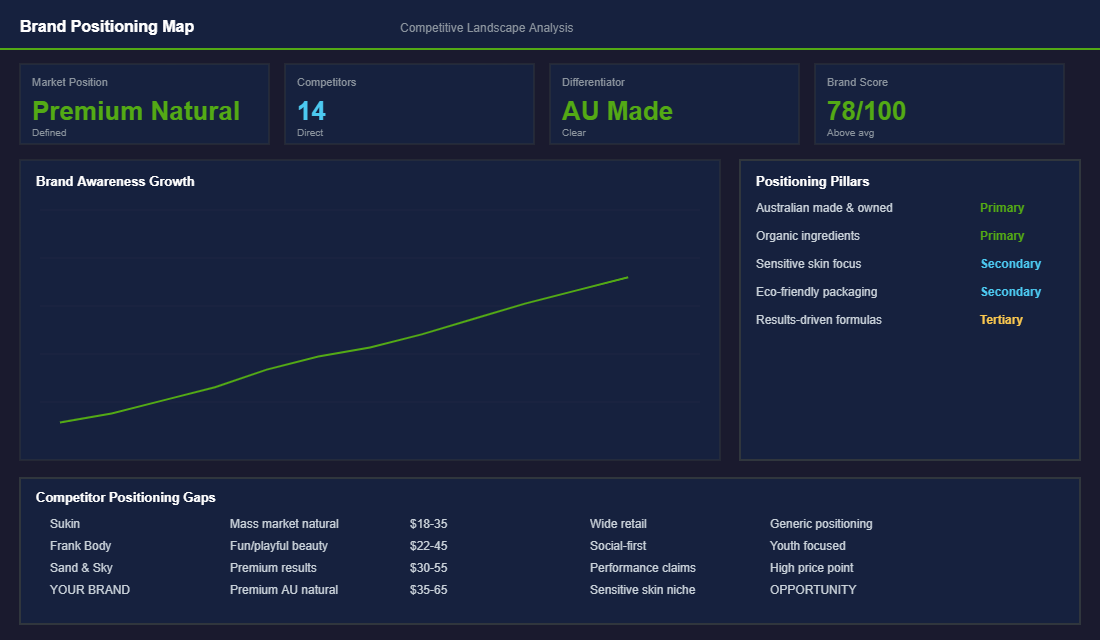
The first step in positioning is mapping your competitive landscape. List your top 5–10 competitors and for each one, write down their core positioning: what they claim, who they target, and what makes them different. Then look for the gaps. Use the Meta Ad Library to see what creative angles they are running, Semrush or SimilarWeb to see which keywords and audiences they are targeting, and just spend 30 minutes reading their websites and emails with fresh eyes.
For example, in the Australian natural skincare market, you might see:
- Sukin: Affordable natural skincare for everyone (mass market positioning)
- Frank Body: Fun, playful beauty for young women (personality-driven)
- Sand & Sky: Premium results-driven natural skincare (performance positioning)
- Go-To: No-nonsense, simple skincare routines (simplicity positioning)
Where is the gap? Maybe nobody is specifically positioning around “Australian-made organic skincare for sensitive skin.” That is a specific, defensible position with a clear audience and a clear reason to believe. It is narrow enough to feel like “this was made for me” but broad enough to build a $1M+ brand.
When mapping competitors, look across four positioning axes: audience specificity (who exactly is this for), price point (budget vs premium vs ultra-premium), provenance and ethics (where is it made, how, by whom), and emotional identity (what does buying this say about me). Most markets are clustered around one or two combinations. The most defensible positions occupy a combination no one else has claimed.
The key is to be specific enough to resonate and narrow enough to differentiate. “Premium skincare” is not a position. “Australian-made organic skincare formulated specifically for sensitive and reactive skin” is.
The Positioning Statement: Your One-Sentence Filter
Before you touch a word of your website copy, write your positioning statement. This is not a tagline — it is an internal compass. Every brand decision gets filtered through it. Here is the template:
[Brand] is the [category] for [specific audience] who want [specific outcome], unlike [competitors], because [reason to believe].
A strong example: “Bondi Beauty Co is the natural skincare for Aussie women with sensitive skin who want visible results without guesswork, unlike generic pharmacy brands, because every formula is developed and tested in Sydney using ingredients sourced from Australian suppliers.”
Once you have this, use it as a filter. Every time you write a headline, create an ad, or design packaging, ask: does this communicate or reinforce our position? If it does not, cut it. Most Shopify brands have five different messages running in five different channels and wonder why nothing sticks. One clear position, repeated consistently, compounds into brand recognition that competitors cannot buy their way out of. Build this statement from a deep understanding of who your ideal customer actually is — our guide to building an ecommerce customer avatar walks through the exact process for getting this right.
Build a Brand Voice That Is Unmistakably Yours
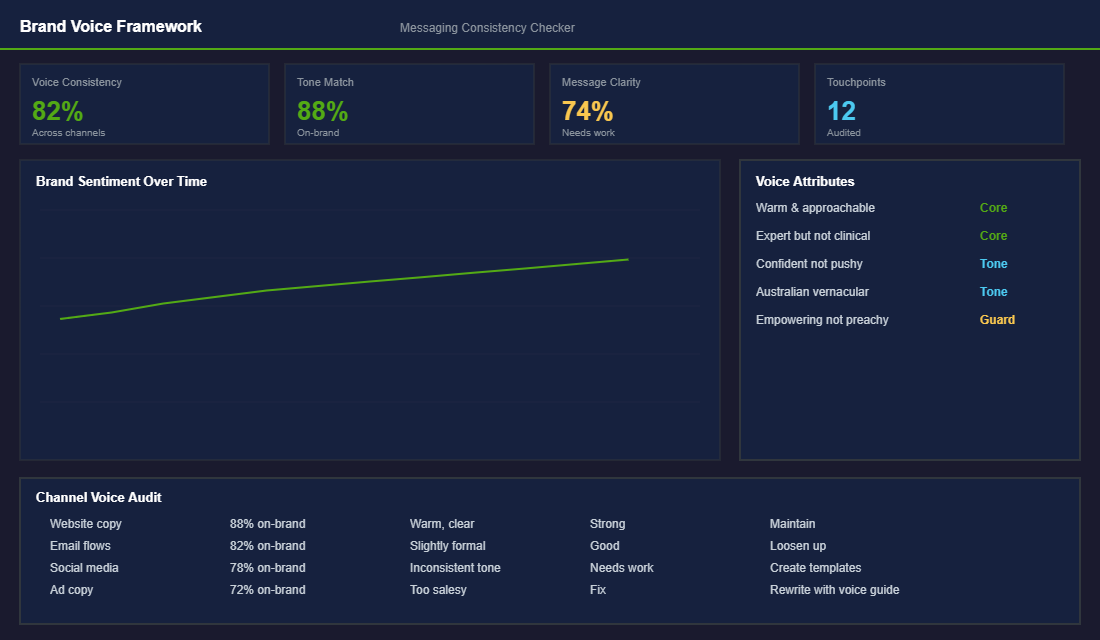
Your brand voice is how your positioning comes to life across every touchpoint. It is the difference between a brand that feels like a faceless store and one that feels like a trusted friend who happens to sell great products.
Define your voice with three to four attributes. For example:
- Warm and approachable: Talk like a knowledgeable friend, not a clinical expert. “Your skin is going to love this” not “Clinically proven to reduce transepidermal water loss.”
- Confident but not pushy: State what your products do clearly. Let the results speak. Never use high-pressure tactics or artificial urgency.
- Australian and real: Use natural language, reference Aussie life casually, and avoid corporate speak. “Perfect for throwing in your bag before a beach day” beats “Ideal for active lifestyles.”
Apply this voice consistently across your website, emails, social media, ads, and packaging. Consistency builds recognition, and recognition builds trust. A customer should be able to read a social post and know it is your brand before seeing the logo. Here is a simple test: read your copy aloud. Does it sound like a real person talking to another real person? If it sounds like a press release, rewrite it.
Brands with consistent voice and messaging across all channels see 23% higher customer lifetime value and 18% better ad click-through rates than those with inconsistent messaging. That is not a soft, feel-good benefit — it is a hard financial return on brand discipline.
Translate Your Positioning Into Store Copy
Positioning is worthless if it stays in a Google Doc. It needs to show up in every line of copy on your store. Here is where to apply it first:
Homepage hero headline. Your position in one line, above the fold, before any other message. Not “Shop our collection” — something like “Australia’s only skincare built specifically for sensitive, reactive skin.” This immediately tells the right customer they are in the right place and gives everyone else permission to leave.
Collection page H1s. These are SEO real estate and positioning real estate at the same time. “Natural Skincare for Sensitive Skin” is better than “Skincare.” It qualifies the visitor and reinforces your position with every organic click. Our guide to Shopify product page optimisation covers how to layer positioning into every section of your PDP.
Product descriptions. Write for your positioned customer, not for everyone. If you are “Australian organic skincare for sensitive skin,” your descriptions should speak directly to someone managing redness, reactions, and frustration with mainstream products — not someone looking for the cheapest option or a fun gift.
Ad creative angles. Each of your positioning attributes is an ad angle. Provenance: “Made and tested in Sydney.” Audience specificity: “For women who have given up on mainstream skincare.” Outcome: “Finally, results you can actually see.” Test one angle per campaign and let performance data tell you which aspect of your positioning resonates most with cold audiences.
The Unboxing Experience: Your Most Underrated Brand Touchpoint
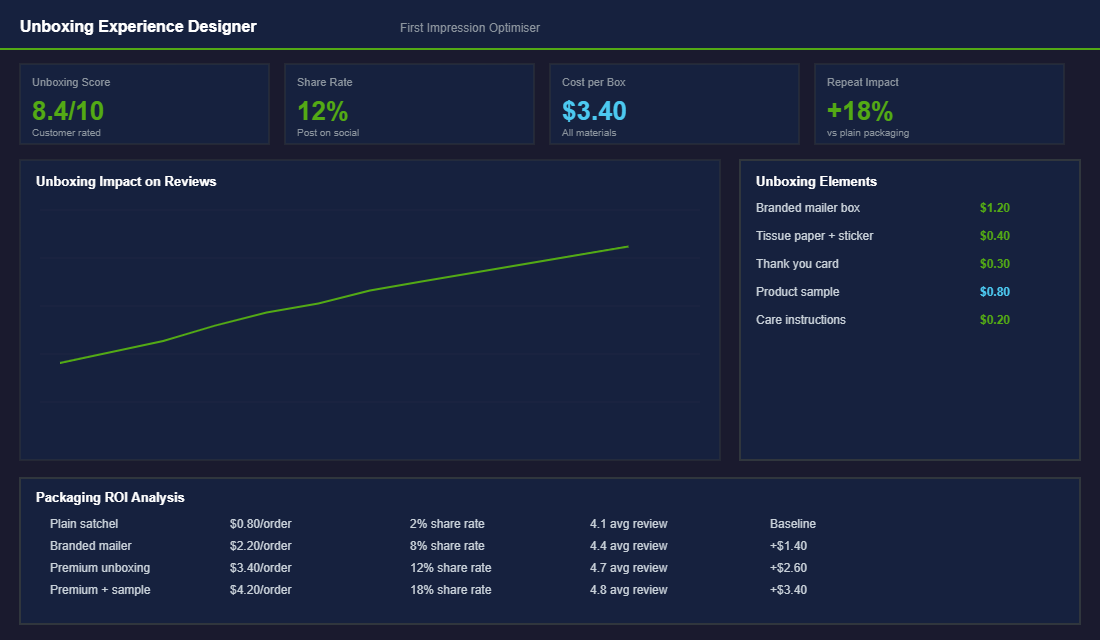
In ecommerce, the unboxing moment is the first time a customer physically interacts with your brand. It is your handshake, your first impression, and your best opportunity to create an emotional connection that drives repeat purchases and word of mouth. And it is one of the most powerful ways to bring your brand position to life in a tangible, memorable way.
Brands that invest $2–4 per order in premium packaging see measurably better outcomes:
- Higher review scores. Products that arrive in branded packaging with care inserts receive average reviews 0.3–0.5 stars higher than those in plain satchels.
- Social sharing. A beautiful unboxing experience triggers organic social posts. 12–18% of customers will photograph and share a premium unboxing vs 2–3% for plain packaging.
- Repeat purchase uplift. Customers who have a memorable unboxing experience are 18–25% more likely to reorder. The packaging becomes part of the product experience.
You do not need to spend $10 per box. A simple branded mailer, some tissue paper, a handwritten-style thank you card, and a small sample of another product creates a premium experience for $3–4 all in. Aussie suppliers like Noissue and Signet offer short-run custom packaging accessible for stores doing $20K+ per month. For a complete guide, read our breakdown of ecommerce packaging and unboxing experience design.
The Positioning Mistakes That Cost Shopify Brands Revenue
Most brands that struggle with positioning are not making one big mistake — they are making four small ones simultaneously.
Trying to appeal to everyone. “Our products are for anyone who wants quality” is not a position — it is a statement of surrender. The more specifically you define who you are for, the more powerfully you attract them. Frank Body did not try to be for all women. They went hard on fun, young, irreverent energy and built a cult brand in the process.
Positioning on price. Competing on “we are the cheapest” is a race to the bottom, and in that race, you will always be beaten by a larger competitor or a marketplace. For a $500K–$5M Shopify brand, price-led positioning destroys margins without building loyalty. It also actively repels your best customers — the ones willing to pay for quality and keep coming back.
Copying your top competitor’s position. If your largest competitor owns “premium” in your category, you will not beat them on premium. Go adjacent. Own “accessible” or “personalised” or “ethically sourced.” Distinct beats derivative every time. And remember: your competitor has a head start, more reviews, more brand awareness. The only way to beat them is to not fight them on their ground.
Inconsistent positioning across channels. Your website says “premium and artisan.” Your Meta ads say “50% off this weekend only.” Your email says “best price guaranteed.” These three messages cancel each other out. Chronic discount messaging when your positioning claims premium creates cognitive dissonance that erodes trust over time — and trains your customers to wait for sales.
The Compound Effect: Brand Equity Reduces Every Other Cost
Strong positioning and brand building do something remarkable over time: they reduce your cost of doing business across every channel. A recognisable brand gets higher click-through rates on ads — which means lower CPA for the same budget. A trusted brand converts at higher rates on product pages — which means more revenue from the same traffic. A loved brand drives word of mouth and repeat purchases — which means lower acquisition cost and higher LTV across your whole customer base.
The numbers back this up. Brands with strong, consistent positioning see 37% lower customer acquisition costs over a 24-month period compared to undifferentiated competitors in the same category. Their contribution margin improves because they hold price without discounting. Their loyalty program performs better because customers buy into the brand, not just the product. And their customer lifetime value compounds — returning customers spend 67% more than first-time buyers, and a clearly positioned brand attracts more returning customers by giving them something to identify with.
This is why the brands inside eCommerce Circle that invest early in positioning and brand experience consistently outperform those that compete purely on product and price. Brand equity is the ultimate competitive moat — and it compounds every year you build it.
Proof Your Positioning Is Working: The 4 Numbers to Watch
Positioning feels fuzzy, so most founders never measure it. But strong positioning shows up in hard numbers within 2 to 3 quarters. Here is the scoreboard.
- Branded search volume. People typing your brand name into Google is the purest signal that your position is landing. Check it free in Google Search Console — a healthy DTC brand should see branded queries growing 10 to 20% quarter on quarter while you are investing in brand.
- Direct and returning traffic share. In GA4, watch the share of sessions arriving direct or from returning visitors. Commodity stores live and die on paid traffic; positioned brands typically build to 30%+ of sessions from direct and returning sources.
- CAC versus category. Strong positioning lowers acquisition cost because your ads stop competing on product features and start converting on identity. If your blended CAC is falling while competitors complain about rising Meta costs, your positioning is paying rent.
- Repeat purchase rate. A clear position attracts the right customers, and right-fit customers come back. Track 90-day repeat rate by cohort — positioned brands routinely run 25 to 40% versus the 15 to 20% commodity baseline.
And one qualitative check that beats all of them: ask new customers “what nearly stopped you buying, and why did you choose us?” If their answer echoes your positioning statement back to you in their own words, you have won. We give you the full interview script in the Founder-Led Customer Interview Playbook — and if you want to know why customers leave your competitors for you, run the Switcher Research Playbook next.
Want to Define Your Brand Position?
Inside eCommerce Circle, brand positioning is woven through everything we do. From the Prospects pillar (understanding exactly who you serve and what they actually want) to the Platform pillar (communicating your position on every page of your store), a clear position makes every other marketing activity work harder. If you want help finding your gap, writing your positioning statement, and building a brand that stands out in a crowded market, let’s talk.