You are doing everything. Answering customer emails at 11pm. Processing orders between meetings.
What’s in This Article
Editing product photos on your phone during your kid’s soccer practice. You started this business for freedom, and somehow you have built yourself a 60-hour-a-week job with no weekends.
Sound familiar? Here is the hard truth: if you are still doing everything yourself at $15-30K/month in revenue, you are the bottleneck. You cannot scale what only you can do. The brands that break through to $50K+ months are the ones where the founder stops being the chief-everything-officer and starts being the CEO.
But hiring wrong is worse than not hiring at all. We have seen Shopify store owners blow $3-5K on VAs who ghosted after two weeks, or worse, made expensive mistakes with customer orders. Here is how to hire your first virtual assistant the right way.
The Sign You Are Ready (And the Sign You Are Not)
Not every Shopify store needs a VA. Here is the honest litmus test:
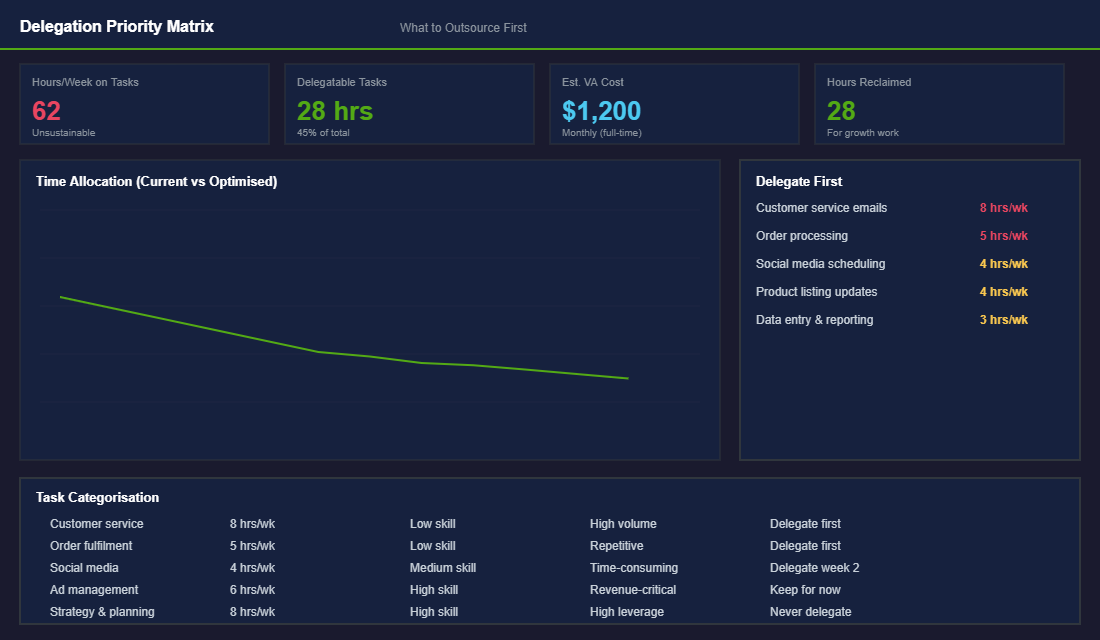
You are ready if: You are consistently doing $15K+/month in revenue, you work more than 45 hours a week on the business, and you can identify at least 15-20 hours of repetitive tasks that do not require your specific expertise (customer service, order processing, data entry, social media scheduling).
You are not ready if: Your revenue is under $10K/month (focus on getting product-market fit first), you cannot clearly describe the tasks you want delegated (if it is not documented, it cannot be delegated), or you are looking for someone to “figure out your business” (a VA executes, they do not strategise).
The most important readiness signal is this: are there tasks you keep putting off because you are busy with operational work? If you know you should be working on your Meta Ads strategy, building new email flows, or developing new products, but you cannot because you are buried in customer tickets and order processing, that is your sign.
What to Delegate First (And What to Keep)
Not all tasks are created equal. You need to categorise everything you do into four quadrants:
- Delegate immediately: Customer service emails, order processing and tracking updates, returns management, basic product listing updates, social media scheduling (not strategy), data entry and reporting. These are high-volume, low-skill tasks that a good VA can handle within the first week.
- Delegate after training: Influencer outreach, basic graphic design (Canva templates), blog formatting, inventory management, and supplier communication. These need a 2-4 week training period but save you enormous time once delegated.
- Keep for now: Ad management, financial decisions, brand strategy, product development, and key supplier relationships. These require your specific knowledge and judgement. Delegate these only when you have a trusted operations manager, not a general VA.
- Never delegate: Vision and strategy, hiring decisions, key partnership negotiations, and financial management. These are founder responsibilities regardless of company size.
Where to Find Good VAs (And What to Pay)
The two most popular platforms for finding ecommerce VAs are OnlineJobs.ph (Philippines-based, largest VA marketplace) and Upwork (global, more expensive but more vetted). For Shopify-specific VAs, OnlineJobs.ph is usually the better option: the Philippines has a huge pool of English-speaking talent with ecommerce experience.
- General VA (customer service, admin, data entry): $4-7 USD/hour full-time. That is roughly $800-1,400 AUD/month for a full-time VA (40 hours/week).
- Ecommerce specialist VA (Shopify experience, email marketing): $6-10 USD/hour. Roughly $1,200-2,000 AUD/month full-time.
- Part-time option: Start with 20 hours/week ($400-700 AUD/month) if you are not sure about the volume of work. Scale to full-time once you have proven the ROI.
Pro tip: always hire for attitude and communication first, skills second. Shopify and Klaviyo can be taught in a week. Reliability, initiative, and clear communication cannot be taught.
The Hiring Process That Filters Out Bad Candidates Fast
Do not hire based on a resume and an interview. Use this process to find the right person:
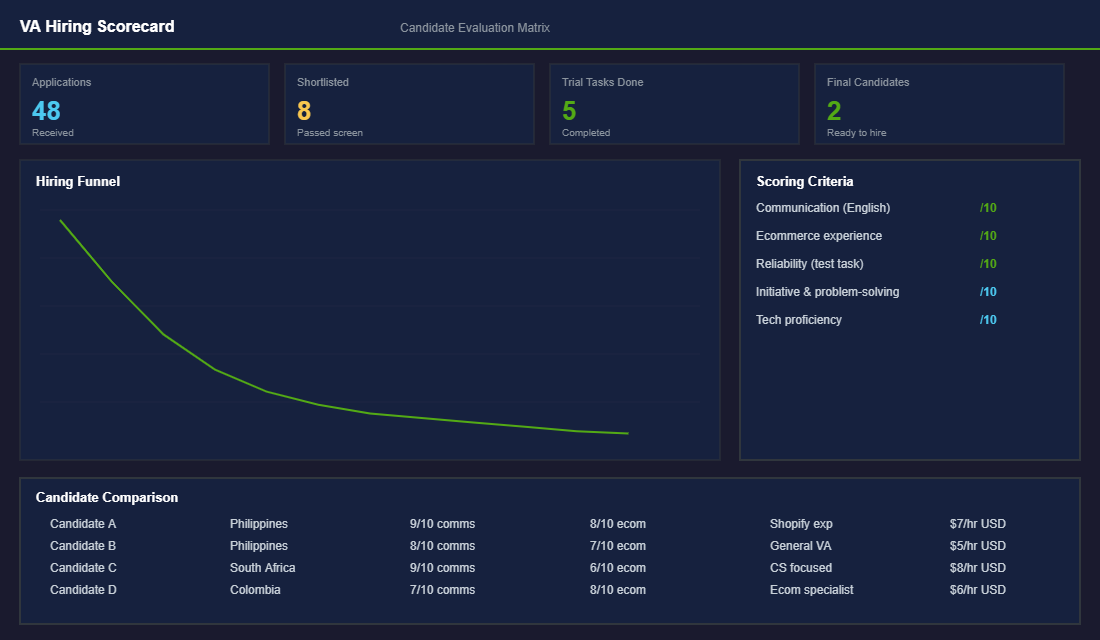
- Step 1: Post a detailed job description. Include specific tasks, required tools (Shopify, Klaviyo, Canva), hours, and timezone requirements. The more specific your listing, the better candidates you attract.
- Step 2: Add a screening question. Put a specific instruction in your listing like “Start your application with the word ORANGE.” This instantly filters out applicants who do not read the requirements, and you will be shocked how many that eliminates.
- Step 3: Shortlist 5-8 candidates. Look for relevant experience, strong English communication, and stable work history. Avoid candidates who have held 10 VA jobs in 12 months.
- Step 4: Give a paid trial task. Create a realistic task that mirrors what they will actually do. “Write three customer service responses to these enquiries” or “Update these five product listings with this information.” Pay them $20-30 USD for the trial. How they complete the task tells you everything.
- Step 5: Do a video interview with your top 2-3. Check communication, internet connection quality, and cultural fit. Ask scenario questions: “A customer emails saying their order arrived damaged. What do you do? (Tip: hand them your customer service macro library on Day One. It answers 80% of incoming tickets without a back-and-forth.)”
Setting Your VA Up for Success (The First 30 Days)
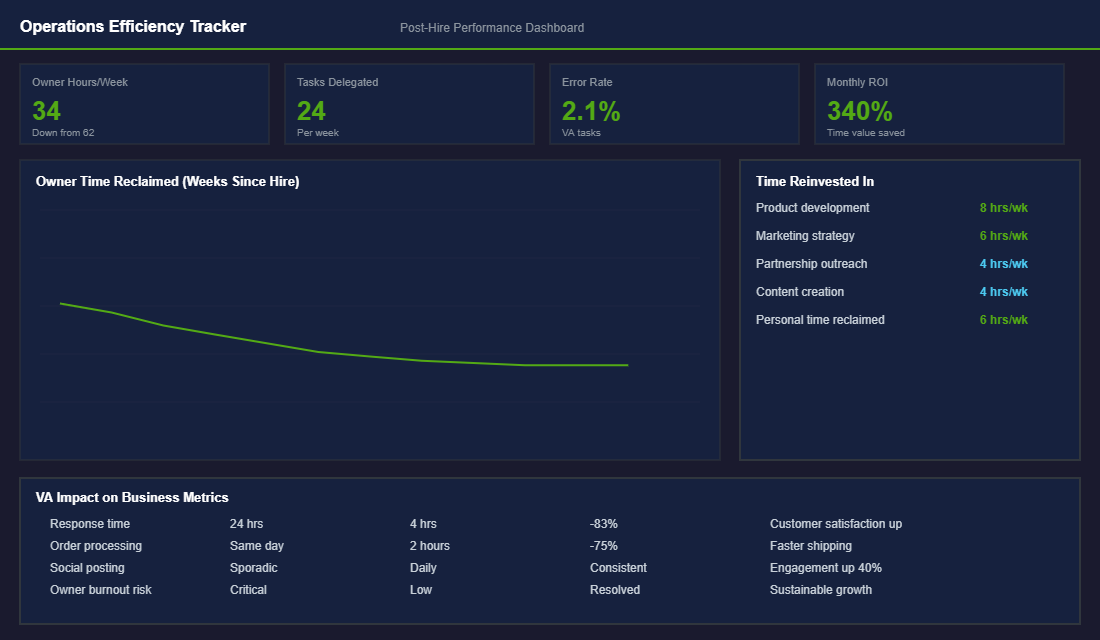
Most VA relationships fail not because of the VA, but because the founder did not set them up properly. The first 30 days are critical:
- Week 1: Document everything. Before they start, create simple SOPs (Standard Operating Procedures) for every task. Use Loom to record 3-5 minute walkthroughs. “Here is how you respond to a shipping enquiry.” “Here is how you process a return.” These do not need to be perfect. They just need to exist.
- Week 2: Shadow and train. Have daily 15-minute check-ins. Review their work, give feedback, and answer questions. This investment of time pays off enormously in weeks 3-4 when they can work independently.
- Week 3: Supervised independence. Let them work autonomously but review all output at the end of each day. Flag errors gently and update SOPs based on what comes up.
- Week 4: Full autonomy with spot checks. By now they should be handling their tasks independently. Switch to weekly reviews and a daily 5-minute stand-up message (what they did, what is planned, any blockers).
Use tools like Slack for communication, Loom for training videos, Time Doctor or Hubstaff for time tracking (optional but useful for the first month), and LastPass for sharing account access securely.
The Compound Effect: How Delegation Drives Growth
When you reclaim 20-25 hours per week, everything changes. You finally have time to work on your Google Ads and Meta strategy instead of just running the same campaigns. You can build out those post-purchase flows you have been putting off.
You can develop new products, explore wholesale, or attend networking events. These are the high-use activities that actually grow revenue, the work that only you can do.
Inside eCommerce Circle, we have seen members go from $20K to $40K months within 90 days of hiring their first VA. Not because the VA is generating revenue directly, but because the founder finally has time to focus on growth instead of being buried in operations.
The Day-One Tool Stack That Pays for Itself
Your VA cannot be productive without the right tools, and you cannot delegate cleanly without a shared system. The cheapest mistake we see Aussie founders make is hiring a VA, then expecting them to magically run operations through Slack DMs and screenshots. That is not delegation.
That is just a slower version of you doing the work. Spend the first weekend before they start setting up these six tools (total cost around $80-150 AUD/month) and you will save yourself 40-60 hours of correction work in the first quarter alone.
- Loom: Record every recurring task once. A 4-minute Loom replaces a 30-minute Zoom call and gives your VA something to rewatch. Aim for a library of 25-30 SOPs by month two.
- ClickUp or Asana: One source of truth for tasks. No more Slack DMs that get lost. Use recurring tasks for daily order-checks, weekly inventory pulls, and monthly reporting.
- LastPass or 1Password (Business plan): Share Shopify, Klaviyo, and Meta Ads logins without ever sending passwords. Set role-based access. Revoke instantly if needed.
- Slack or Microsoft Teams: Asynchronous comms only. No live-chat expectations across timezones. Set “office hours” so your VA knows when to expect replies.
- Time Doctor or Hubstaff: Not for spying. For seeing how long tasks actually take, so you can refine your hourly estimates and spot bottlenecks before they cost you money.
- Google Drive + a shared SOP folder: Every process documented in plain English. If it is not written down, it does not exist. Period.
One eCommerce Circle member, a homewares brand doing $35K/month out of Geelong, spent their first weekend recording 18 Looms before their VA started. Their VA was running 80% of customer service unsupervised within three weeks. Compare that to another founder who skipped the setup, spent 11 weeks micromanaging, and eventually let the VA go.
Same hire on paper. Different result entirely.
What Good VA Performance Looks Like (The 90-Day Benchmarks)
One of the biggest reasons VAs fail is that founders never define what “good” looks like. You cannot manage what you do not measure. After working with hundreds of Aussie Shopify brands inside eCommerce Circle, here are the realistic benchmarks a competent VA should hit by Day 90. If your VA is consistently below these, that is your data (not a vibe) telling you something needs to change.
- Customer service response time: Under 6 business hours for 90%+ of tickets. Resolution time under 24 hours for non-escalations.
- Customer service CSAT: 4.5/5 or higher on post-resolution surveys. If they are dipping under 4.2, retraining is needed, not firing.
- Order processing accuracy: 99%+ on order fulfilment data entry. One wrong address per 200 orders is the line.
- Product listing throughput: 8-12 fully optimised new product listings per day (title, description, alt text, SEO meta) once they have hit their stride at Week 6.
- Inventory updates: Stock counts cross-checked against Shopify weekly with zero discrepancies above 2%.
- Weekly reporting: A 5-minute Loom every Monday: what they did last week, what is on this week, what they need from you. Non-negotiable.
The number that matters most is not any of these in isolation. It is your reclaimed hours. Track your own time for the first 90 days. If you are not getting 20+ hours per week back by Day 60, the issue is almost always delegation discipline, not the VA. Read more on building the systems side of your business in our piece on why your second sale matters more than your first: operational consistency is what makes that second sale possible.
The First Five Tasks to Hand Over (and How to Record Them in One Afternoon)
The biggest mistake founders make with a first VA is handing over a vague job description instead of specific tasks. “Help with admin” guarantees a slow start. Five recorded tasks with a clear definition of done gets your VA useful in week one.
These five are the best starting point for most Shopify stores, because they are frequent, low-risk and easy to check:
- Tier-1 customer service. “Where is my order?”, address changes and simple returns. These usually make up 50-70% of inbound tickets and follow a script.
- Order exceptions. Failed payments, flagged fraud checks and address errors. A daily 20-minute sweep stops orders sitting unshipped.
- Product listing uploads. Titles, descriptions from your template, images, alt text, tags and SEO fields. One template means consistent listings every time.
- Review requests and replies. Replying to every review within 48 hours, and flagging anything below 3 stars to you.
- Weekly reporting. Pulling the same 6-8 numbers from Shopify, Klaviyo and Meta into one sheet every Monday.
To record them, block one afternoon. Do each task once while recording a Loom, narrating why you do each step, not just what you click. Then paste the video link into a one-page SOP with three headings: when to do it, how to do it, and what “done” looks like. Most founders get all five recorded in 3-4 hours. Our Shopify SOP playbook has a template you can copy.
Resist the urge to hand over everything at once. Add one new task every week or two, once the previous one is running without questions. Rushing the handover is the most common reason a good VA looks like a bad hire.
Five Red Flags in the First Two Weeks (and What to Do About Each)
Most VA hires that fail show warning signs early. Catch them in the first fortnight and you can either fix the problem or cut your losses before you have sunk months of training time into the wrong person.
- Silence instead of questions. A new VA who never asks anything is usually guessing. Fix: book a 15-minute daily check-in for the first two weeks and ask them to bring one question each time.
- Missed daily updates. If the end-of-day summary stops arriving in week one, it will not magically return in week six. Fix: make the update a non-negotiable written rule, and address the first miss the same day.
- The same mistake twice. One error is training. The same error twice means the SOP is unclear or the attention to detail is not there. Fix: rewrite the SOP step, then watch the next three attempts.
- Customer replies that do not sound like your brand. Fix: give them 10 real past replies you love as examples, and approve every reply for the first week.
- Hours logged that do not match output. Fix: compare time tracked per task against the time it took you. A 30-50% longer time in week one is normal. Three times longer in week three is not.
If two or more of these are still showing up at the end of week three, despite clear feedback, move on. A paid trial week at the start makes that decision far less painful. For the wider question of what to hand over and in what order, our delegation playbook maps it out by role.
Ready to Get Your Time Back?
Inside eCommerce Circle, People and Practice are the final two pillars of the More Orders Operating System. Building a team and writing down your operations is what takes you from a solo hustle to a real business that runs without you. If you are drowning in day-to-day work and ready to build the team that lets you focus on growth, we would love to help you get there.