You started the brand. You also reply to the support tickets. You write the email. You ship the photoshoot brief. You log in to Klaviyo on a Sunday because nobody else can. And somewhere between the 64th and 80th hour of your working week, you start wondering whether you actually built a business, or whether you built yourself a very stressful job that nobody else can do.
What’s in This Article
That feeling is not unique to you. The Founder Institute pegs the average startup founder week at 64 to 80 hours. Leadership researcher Richard Hagberg studied 122 startups and found 58% of founders were poor at delegating, and those companies plateaued earlier than their peers. Entrepreneur magazine puts the number even higher: 75% of entrepreneurs struggle to hand work off properly. And the Aflac 2025 workforce survey found 72% of entrepreneurs are now running at moderate-to-high stress at work.
The hardest part of all of this is that most Aussie Shopify founders we work with already know they need to delegate. They have hired the VA. They have written the job ad. They might even have a head of growth. And yet they are still the bottleneck. The reason is almost never the people. The reason is that they have never done a proper time audit, so they hand off the wrong things and keep doing the work that should be in someone else’s lane.
This article is the framework we walk every member through to fix that. It is a 4-quadrant founder time audit, built specifically for Aussie Shopify operators between $40k and $500k a month. By the end of it you will know exactly which 20 hours of your week to hand off this quarter, what to keep, what to delete, and the order to do it in.
Why Most Founders Delegate the Wrong Things First
The most common delegation mistake we see is this: a founder finally accepts they need help, so they offload the thing that annoys them the most. Usually that is customer service, or invoicing, or social posting. They feel a brief surge of relief. Within six weeks they are back working 70 hours and wondering why nothing changed.
The reason is that “things you hate” and “things you should not be doing” are two different lists. The annoying tasks are often only 2 or 3 hours a week. The hours that should not be on your plate are usually buried in work you actually quite enjoy. Replying to DMs. Tinkering with the homepage. Sending the campaign email. Approving every supplier PO. The Founder magazine analysis of 122 startups found the founders who plateaued were not lazy delegators, they were enthusiastic delegators of the wrong things.
A Harvard Business Review study referenced widely in the founder-coaching space found that leaders who delegate effectively generate 33% more revenue than peers who centralise decisions. The mechanism is speed. When the person closest to the problem can solve the problem without booking time on your calendar, the whole business moves faster. The audit below is how you find that work.
Stage 1: The Two-Week Time Log (No Skipping This)
Before any framework is useful, you need real data on where your week actually goes. Most founders cannot answer this question accurately. They can describe the dramatic moments (a stock-out, a campaign, an angry email) but the steady 4 hours a day on Slack, the 90 minutes of context-switching, the unstructured “checking in” with the team, all of that disappears into the haze.
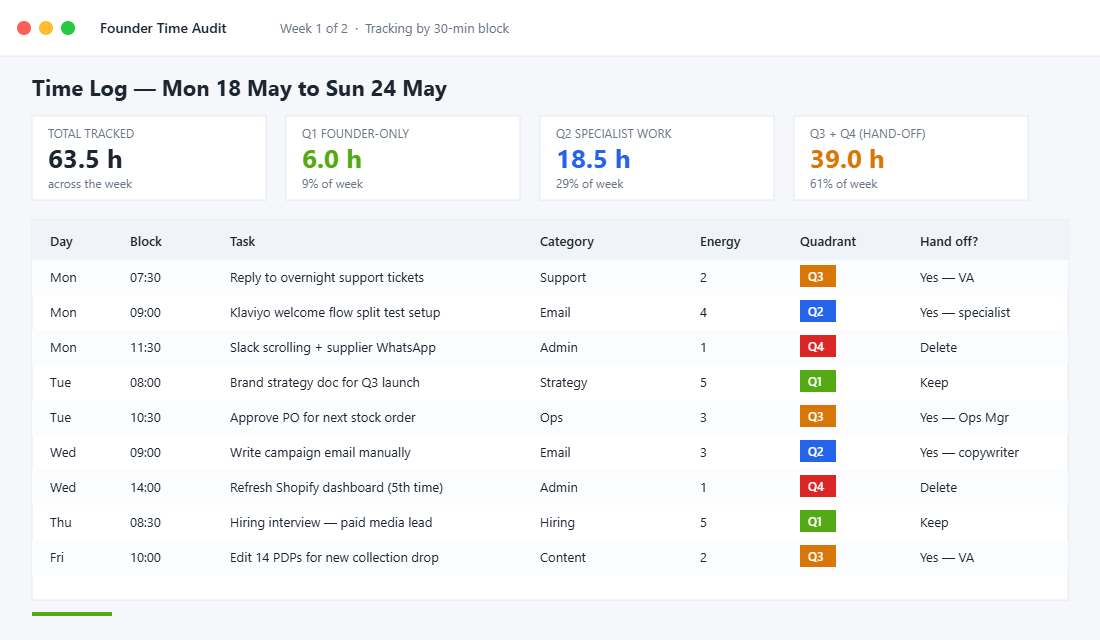
The tool we recommend is dead simple. Open a Google Sheet. Six columns. Date. Time block (30-minute chunks). Task name. Rough category (Strategy, Marketing, Ops, Support, Admin, Personal). Energy level after the task (1 to 5). Could someone else have done this? (Yes / No / Maybe).
Track every 30 minutes for two full weeks. Not a calendar export. Not memory. Live tracking. We have tried fancier tools (Toggl, RescueTime, Clockify) and they all work, but the friction of a Google Sheet is what forces honesty. The act of typing “30 min, replying to the same supplier email thread again, energy 2, yes someone could do this” is what makes the bottleneck visible.
Two weeks is the right window. One week skews to whatever was on fire. Two weeks reveals the pattern. You will end up with somewhere between 110 and 160 hours of logged time, which is genuinely uncomfortable to look at. Sit with it. That sheet is your most valuable strategic document for the next quarter.
Stage 2: The 4-Quadrant Founder Time Audit
Once you have two weeks of data, you sort every task into one of four quadrants. This is the framework. It is a modified Eisenhower matrix, but we have rebuilt it around dollar-per-hour value and replacement difficulty, because that is what actually matters for an Aussie DTC founder.
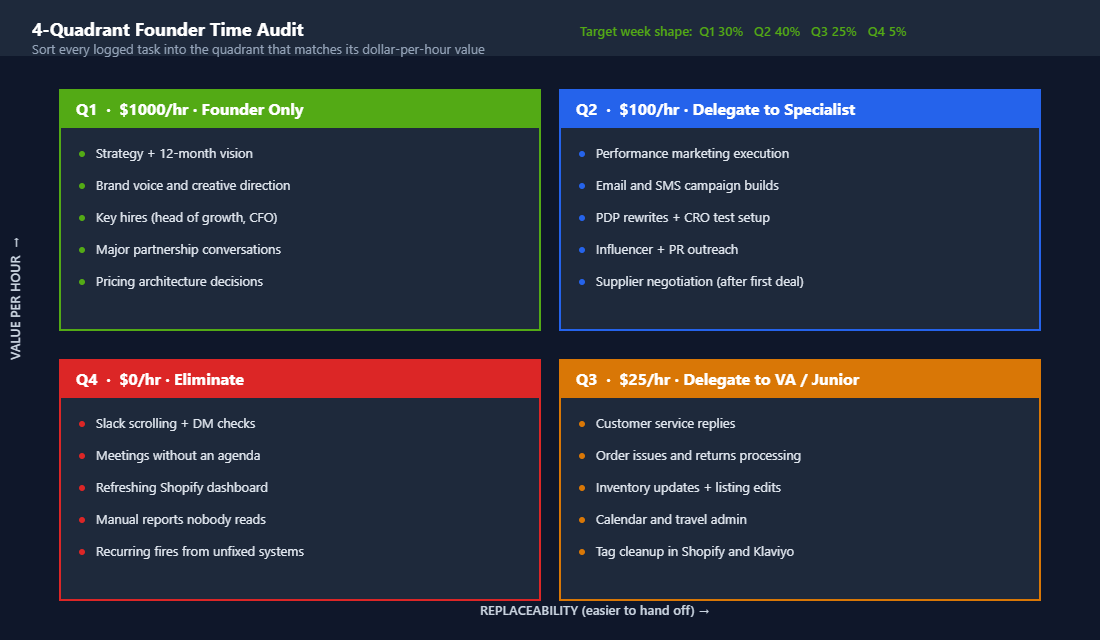
Quadrant 1: $1000-an-hour work (Founder Only). Strategy. Brand voice. Key hires. Big partnership conversations. The 12-month vision. Major creative direction. Pricing architecture. Investor and board conversations if you have them. This is the work nobody else can do, and the work that actually compounds the value of the business. Most founders we audit spend less than 4 hours a week here. The target is 15 to 20 hours a week.
Quadrant 2: $100-an-hour work (Delegate to a Specialist). Performance marketing execution. Email campaign builds. Copy editing. CRO test setup. PDP rewrites. Influencer outreach. Supplier negotiations beyond the first contract. Reporting that is not strategy. This work requires real skill, but the skill is teachable and hireable. A founder doing this work is paying themselves $100 an hour to avoid hiring someone for $80 an hour. It is the most expensive mistake on the time log.
Quadrant 3: $25-an-hour work (Delegate to a VA or Junior). Customer service replies. Order issue resolution. Inventory updates. Listing edits. Returns processing. Scheduling. Calendar management. Travel booking. Social comment moderation. Tag and label cleanup in your tools. This is the work most founders think they are too busy to document, so they keep doing it forever. The math is brutal. If you spend 10 hours a week here at $25 an hour replacement cost, you are burning $13,000 of founder time per year on $1,300 of actual work.
Quadrant 4: $0-an-hour work (Eliminate). Slack scrolling. Meetings without agendas. Recurring fires from broken systems that you have never fixed at the root. Manual reports that nobody reads. Email subscriptions you skim out of guilt. Checking ad accounts more than once a day. Refreshing Shopify on the live dashboard. This work feels productive because it is busy. It is not. Delete it ruthlessly. Most founders find 5 to 8 hours of pure Quadrant 4 in their first audit.
Stage 3: The Hand-Off Sequence
Once your two weeks are sorted, you do not delegate everything at once. That is how good intentions become messy hand-offs. You sequence the hand-offs in this exact order, and you only start a new one when the previous one is genuinely working.
Hand-off 1: Quadrant 4 deletion (Week 1). Before you hand anything off, delete the work that should not exist at all. Cancel the standing meetings nobody needs. Unsubscribe from the newsletters. Turn off the Slack notifications. Decide that you check Meta Ads Manager once a day, not twelve times. This is the fastest, cheapest, most powerful hand-off you will ever do. You hand work off to “no one”. Most founders reclaim 5 to 8 hours a week here in the first two weeks alone, before they have even hired anyone.
Hand-off 2: Quadrant 3 to a VA (Weeks 2 to 6). Start with the bottom of the value pyramid because the systems and the trust both compound. Hire one well-trained VA (look at our VA hiring platforms comparison for the Aussie-friendly options). Document the tasks with Loom. Build SOPs from the recordings in Notion (Loom’s AI now drafts the written SOP from your video, which has cut documentation time roughly in half compared to what it used to be). Move customer service, listing edits, returns, and basic reporting off your plate first.
Hand-off 3: Quadrant 2 to a specialist (Weeks 6 to 12). Now that the operational base is calm, hand off your highest-value Quadrant 2 work. For most Aussie founders at $1m to $5m revenue, that is either paid media or email and SMS. Both have a well-defined skill profile, both have measurable outputs, and both are eating 8 to 15 hours of founder time a week. We have written a paid media specialist hire roadmap and a marketing manager hire framework that walk through the right sequencing for both.
Hand-off 4: Quadrant 2 deepening (Months 4 to 9). Now you build out the second specialist seat. Usually CRO and lifecycle, or content and creative, depending on which lever is loudest in your monthly business review. By month 9, your week should be 60% Quadrant 1, 25% Quadrant 2 oversight, and 15% admin, recruiting, and brand work. That is the founder time profile of a brand that is built to scale past you, not because of you.
Stage 4: The Documentation Loop That Makes It Stick
A delegation that lives only in someone’s head will break the first time they take leave. The only delegation that holds up under stress is the kind that is documented well enough that a new hire can pick up the task from cold. This is the single biggest difference between founders who keep getting pulled back into the business and founders who actually get to lead it.
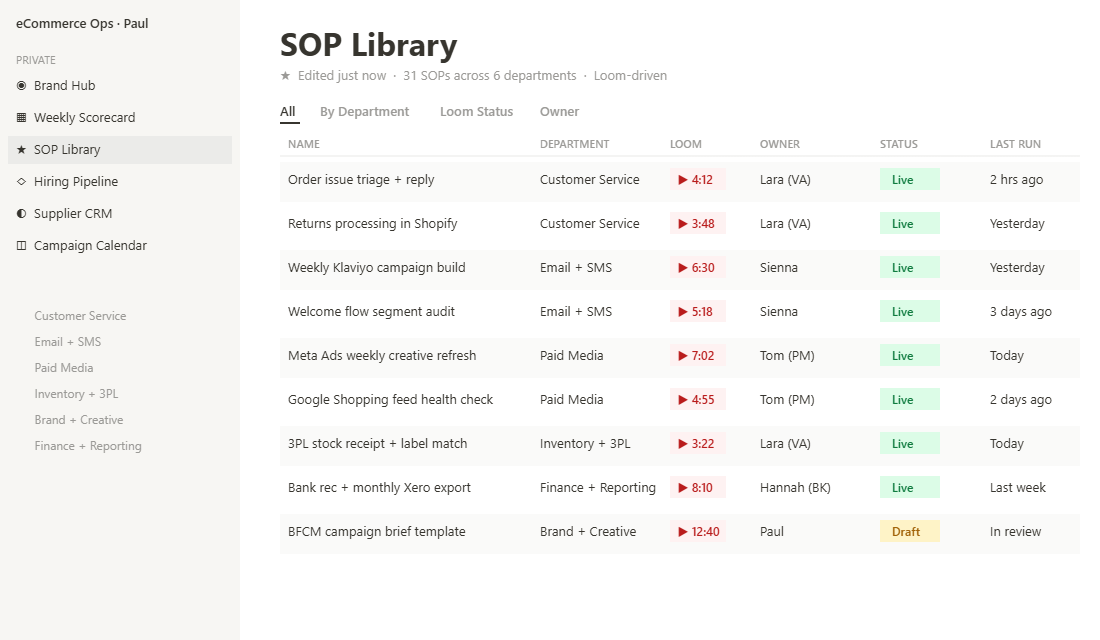
The documentation loop we recommend is three steps and uses tools every Aussie founder already has on the stack. Record the task in Loom as you actually do it, narrating the decisions as you go. Convert the Loom to a written SOP using Loom’s AI doc feature, or use Docsie if you want a more structured library. Park the SOP in a Notion database organised by department (Customer Service, Email, Paid, Inventory, Brand, Finance) with one page per task.
Notion’s marketplace has a free 10-SOP ecommerce service starter pack that gives you the schema, so you do not need to build the database from scratch. Within 90 days of disciplined recording, most founders we work with have 25 to 40 SOPs in their library, which is more than enough to onboard new hires and to take a two-week holiday without the wheels falling off the business.
A good SOP is not a 12-page Word document. It is a Loom video at the top (under 5 minutes), a written summary of the steps, a list of the tools touched, the inputs required, the outputs expected, the escalation path if something goes wrong, and the success metric. Anything longer than one Notion page is a sign you have wrapped two SOPs into one.
The Aussie Brand Examples Worth Studying
The Aussie founders who have built nine-figure brands almost all share one feature: they did this audit early. Shaun Wilson and Blair James at Bondi Sands made a deliberate decision around year five to bring on the first permanent finance employee and to build the systems and processes needed to expand globally. That was a Quadrant 2 hand-off (finance and ops) made before the business needed it operationally, because they could see that without it, they would always be the bottleneck on global expansion. The brand was acquired by Kao Corporation in August 2023.
Who Gives a Crap kept a deliberately lean structure in the early years, with three co-founders and a small full-time team of around six people. The discipline was not “do everything yourself”, it was “delegate the work that does not need a founder, and only add headcount when a clear function exists to fill”. That sequencing kept margins healthy while the brand scaled, and is the textbook version of using the 4-quadrant audit to decide who comes next.
Frank Body grew from a $5k investment into a brand selling over 2 million body scrubs in 149 countries, with annual revenue topping $20 million by 2017. Co-founders Jess Hatzis, Bree Johnson, and Steve Rowley were explicit about splitting domains early. They never had two of them doing the same Quadrant 1 work. That clarity, more than the coffee scrub, is what compounded.
The Compound Effect: Why This Audit Is Worth a Quarter
The math on this is the part that takes a while to believe. The University of CUNY School of Public Health published a 2025 model showing that founder burnout costs companies anywhere from $4,000 to $21,000 per entrepreneur per year, through turnover, absenteeism, and lower productivity. That is the obvious cost. The hidden cost is much larger.
If you spend 3 hours a day on operational noise that should not be on your plate, that is 15 hours a week, 60 hours a month, and more than 700 hours a year. At a founder dollar-per-hour value of $300 (a conservative estimate for a $2m-revenue Shopify brand), that is $210,000 of founder time per year being burned on $25-an-hour work. A single round of this audit, done properly, is the highest-ROI exercise an Aussie founder can run this quarter. It costs nothing but two weeks of tracking and the discipline to actually act on what you find.
The brands that grow past the founder bottleneck do not get there with motivation, willpower, or working harder. They get there with documentation. A 4-quadrant audit shows you the work to hand off. A Notion SOP library, fed by Loom recordings, makes the hand-off stick. A specialist hired into a clear Quadrant 2 lane gives you back 15 hours a week and 33% more revenue (per the HBR delegation research) within the year. That is the system. That is the only system we have ever seen work.
Your Two-Week Founder Time Audit Checklist
Run this in the next two weeks. Print it if it helps. The whole audit takes about 45 minutes of work spread across 14 days.
- Day 1. Open a Google Sheet with the six columns above. Set a 30-minute timer on your phone. Start logging.
- Day 1 to 14. Track honestly. Every block. Include the 11pm Shopify dashboard checks. Include the time you spend writing this week’s email even though you have a copywriter.
- Day 15. Sort every task into Quadrant 1, 2, 3, or 4. Sum the hours in each quadrant.
- Day 15. Calculate your current week. Most founders find 4 to 8 hours in Q1, 12 to 20 hours in Q2, 15 to 30 hours in Q3, and 5 to 10 hours in Q4.
- Day 16. Delete all of Q4 this week. No exceptions. Cancel the meetings. Unsubscribe. Disable the notifications.
- Day 17 to 30. Pick the top 3 Q3 tasks (highest hours, lowest skill). Record a Loom of each. Convert to SOPs. Hire or assign a VA against them.
- Day 31 to 60. Pick the biggest Q2 lane (usually paid media or email). Run a structured hire against it.
- Day 90. Re-run the audit. Compare week shape. Your Q1 hours should have at least doubled.
This is the quarterly cadence we use with every member of the program. Founders who run it twice a year are unrecognisable from their starting point inside 18 months. Founders who run it once and put the sheet away are back at 70-hour weeks within four months. The cadence is the magic.
What an Hour of Your Time Is Actually Worth
Most founders resist hand-offs because the cost is visible and the saving is not. You can see the $35 an hour going out the door. You cannot see the $180 an hour you just freed up.
So do the sum properly. Take your last twelve months of net profit, not revenue, and divide it by the hours you actually worked. A founder clearing $220,000 net on a 60-hour week across 48 weeks is producing roughly $76 an hour. That number is your floor, and it is the only honest benchmark for a delegation decision.
Now price the alternatives against it. In Australia in 2026, a Philippines-based ecommerce VA runs $9 to $16 an hour, an Australian part-time ops coordinator sits around $38 to $52 an hour fully loaded with super and leave, and a specialist contractor for paid media or email lands between $95 and $160 an hour. A full-time ecommerce manager costs $85,000 to $115,000 plus 12% super, which is about $52 an hour on a 38-hour week.
The decision rule is simple. If a task sits in Quadrant 3 and someone can do it at 80% of your quality for under half your effective hourly rate, hand it off this month. You are not buying time. You are buying back the hours that produce the $76.
Imagine you run a $1.5m skincare brand out of Brunswick. Your audit shows 18 hours a week on order enquiries, dispatch checks and reposting UGC. At $76 an hour that block is costing you roughly $1,370 a week in foregone founder output. A VA at $14 an hour covering the same 18 hours costs $252. The gap is not close, and it holds even if the VA is slower for the first month.
The Tool Stack That Makes the Audit Stick
You do not need much, and every tool here has a free tier that works at founder scale.
- Toggl Track or Clockify for the two-week log. Both are free for one user. Use a timer, not a memory reconstruction at 9pm. Founders who reconstruct underestimate admin time by 30 to 40% every single time.
- Loom for turning a task into a hand-off. The rule is one Loom per task, under eight minutes, recorded while you do the job for real rather than while you explain it.
- Notion or Google Docs for the SOP library. Structure beats polish. One page per task, screenshots inline, an owner name at the top and a review date at the bottom.
- Shopify Flow for anything you were about to delegate that does not need a human at all. Tagging high-value orders, flagging repeat customers and routing enquiries are automation jobs, not VA jobs.
- A shared inbox such as Gorgias, Zendesk or even Gmail delegation. Support cannot be handed off from a personal inbox, and this is the single most common blocker on Quadrant 3 tasks.
Automate before you delegate. Roughly 20 to 30% of what shows up in a founder’s Quadrant 3 is a workflow problem wearing a staffing costume, and paying a person to do it just makes the bad process permanent. The same logic applies when you are deciding which numbers to check each week: fix the system first, then staff what remains.
When the Hand-Off Goes Wrong (and It Will)
Expect a dip. Almost every hand-off costs you quality and speed for the first three to six weeks, and this is where most founders take the task back. Taking it back is the mistake. You have now paid the training cost and kept none of the benefit.
Set the expectation before you start. Agree what “good enough” looks like in writing, define the two or three failure modes that genuinely matter, and let everything else be imperfect. A support reply that is 85% as warm as yours but arrives in two hours instead of two days is a better customer experience, not a worse one.
Then run a weekly 20-minute review for the first month, fortnightly for the second, monthly after that. If you are still checking the work daily at week six, you did not delegate the task. You added a step to it.
Inside eCommerce Circle, the founder time audit is one of the core pillars we work on with every member, alongside the operating system that makes hand-offs stick. If you want a second opinion on yours, let’s talk.