Sending the same email to your entire list is the marketing equivalent of shouting into a crowd and hoping the right person hears you. Your VIP customer who has purchased 8 times receives the same generic promotion as someone who signed up yesterday and has never bought anything. Your loyal advocate gets the same discount offer as someone who has not opened an email in 6 months.
What’s in This Article
This is not just inefficient — it is actively damaging. When customers receive irrelevant messages, they disengage. Open rates drop, unsubscribes increase, and your email deliverability suffers. Meanwhile, your most valuable customers feel like a number rather than a valued patron, and customers at risk of churning receive no intervention at all.
Customer segmentation fixes all of this. By grouping customers based on their behaviour, purchase history, and lifecycle stage, you can send messages that feel personally relevant to each group. Segmented campaigns generate 3-5x more revenue per send than broadcast emails. Here is how to build a segmentation system that transforms your email marketing.
RFM Analysis: The Foundation of Smart Segmentation
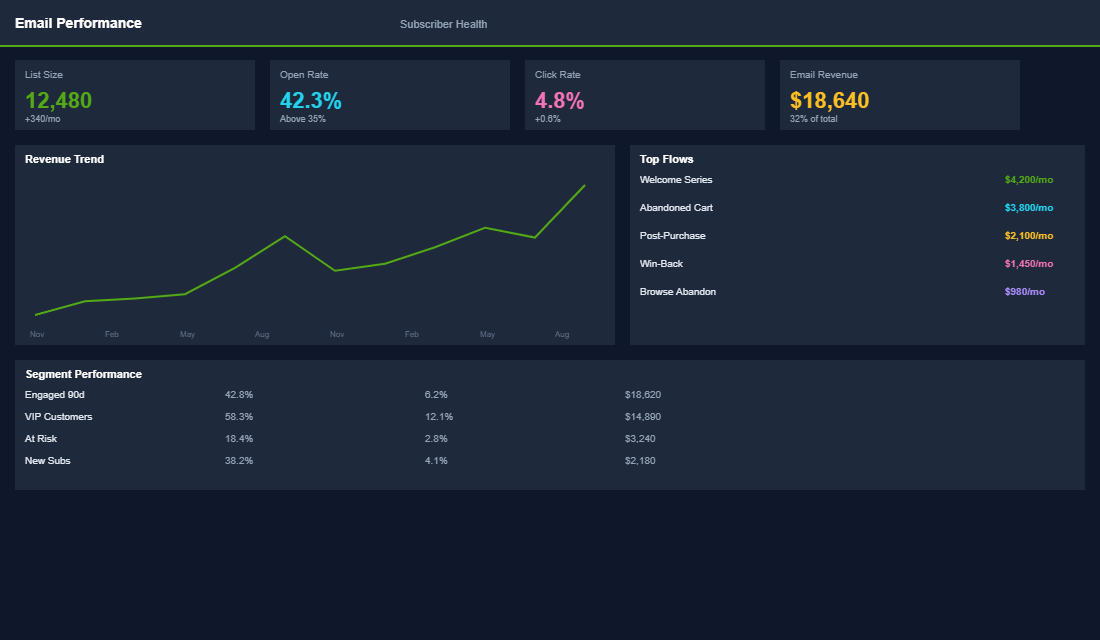
RFM stands for Recency (how recently someone purchased), Frequency (how often they purchase), and Monetary (how much they spend). It is the gold standard framework for customer segmentation in ecommerce because it uses actual purchase behaviour — not demographics or guesses — to group customers.
Both Klaviyo and Omnisend can calculate RFM segments automatically from your Shopify data. But understanding the segments is what matters:
- Champions (top 10%). Bought recently, buy frequently, spend the most. These are your best customers. They drive 40-50% of your revenue despite being just 10% of your base. Treat them like royalty — early access, exclusive offers, personal touch points. Never blast them with generic promotions.
- Loyal Customers (next 15-20%). Buy regularly and spend above average but not at the Champion level. These are your growth opportunity — move them toward Champion status with loyalty rewards, VIP perks, and personalised recommendations based on their purchase history.
- Promising (next 20-25%). Have made 1-2 purchases recently. They like your brand but have not committed yet. Your goal is to drive the second and third purchase through targeted follow-ups, product education, and social proof from other customers in their category.
- At-Risk (15-20%). Used to buy but have not purchased recently. These customers are drifting away. They need a win-back intervention — a compelling reason to return. This is where reactivation campaigns with strong offers live.
- Lapsed (remaining 25-35%). Have not purchased in a long time and show no engagement. Before spending effort on reactivation, send a final re-engagement email. If they do not respond, suppress them from your active list to protect your deliverability.
Behavioural Segments: What They Do Tells You What They Want
Beyond RFM, layer in behavioural segments based on how customers interact with your store and emails. These segments let you deliver hyper-relevant messages based on real-time actions:
Browse behaviour. Someone who has viewed a product page 3+ times without purchasing is showing strong interest but has a barrier. A browse abandonment email showing the specific products they viewed, with social proof and a gentle nudge, converts 4-6% of these visitors into buyers.
Category affinity. Customers who consistently browse or buy from specific categories should receive communications focused on those categories. If someone has purchased three skincare items but never clicked on a haircare email, stop sending them haircare promotions and double down on skincare recommendations.
Purchase frequency patterns. If data shows that customers in a specific category typically repurchase every 45 days, set up a replenishment reminder email at day 38. These emails feel helpful rather than promotional and convert at 12-18% because the timing aligns with actual need.
Engagement level. Segment by email engagement: highly engaged (opens most emails), moderately engaged (opens occasionally), and disengaged (has not opened in 60+ days). Send your most important campaigns to highly engaged first. Send re-engagement campaigns to disengaged subscribers. And consider sending frequency-reduced emails to the moderate group to prevent them from sliding into disengagement.
Segment-Specific Campaign Strategies
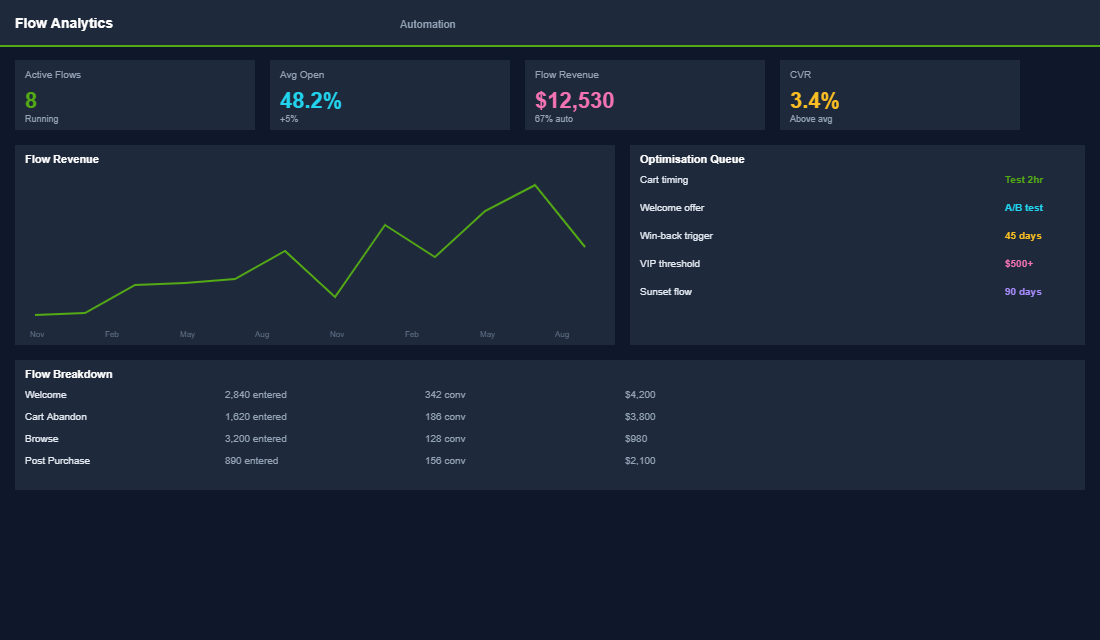
Each segment deserves different messaging, different offers, and different frequency. Here is how to tailor your approach:
For your Champions and VIPs: send them early access to new products (24-48 hours before the general list), exclusive colours or sizes, handwritten thank-you notes on their next order, and invitations to provide feedback on upcoming products. Do NOT send them discount codes — they buy at full price. Discounting to VIPs trains them to wait for deals.
For your Promising segment: focus on driving the second purchase. Send product education content, cross-sell recommendations based on their first purchase, and social proof from customers who bought similar products. A modest incentive (10% off second purchase, free shipping) can nudge them over the line.
For your At-Risk segment: this is where win-back campaigns live. Send a “We miss you” email with a compelling offer (15-20% off), followed by a product update showing what is new since they last purchased, followed by a final “Last chance” email with your strongest offer. If they do not respond to all three, move them to the lapsed segment.
For your New subscribers (not yet purchased): your welcome series does the heavy lifting. Introduce your brand story, showcase bestsellers with social proof, address common purchase barriers, and include a first-purchase incentive. A well-built welcome series converts 5-10% of new subscribers into buyers within 7 days.
Lifecycle Automation: The Revenue Engine That Runs Itself
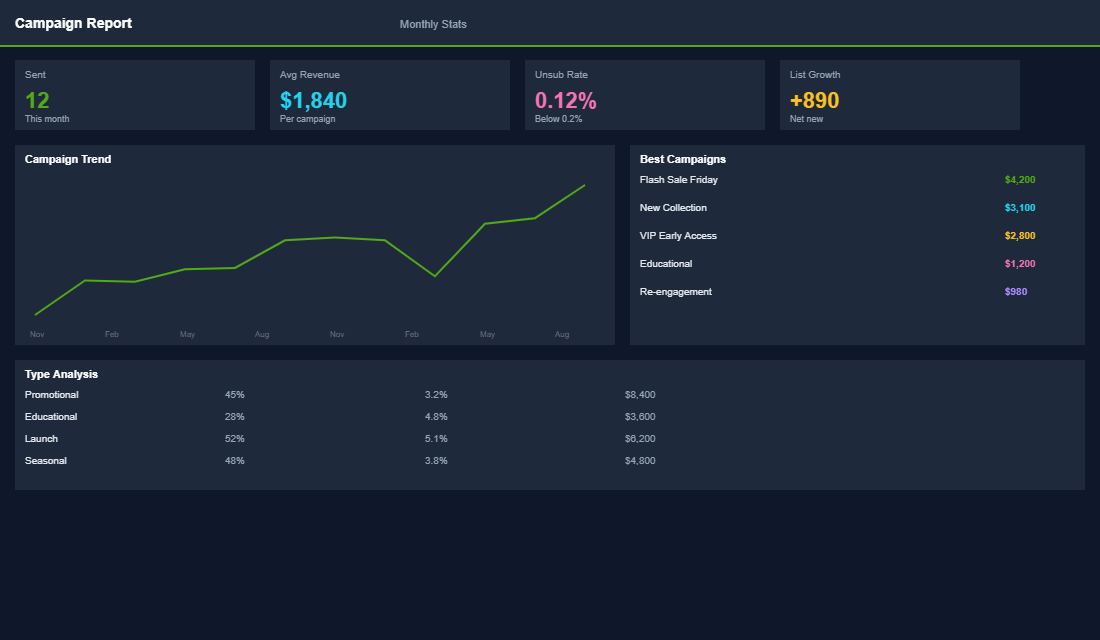
The ultimate expression of segmentation is lifecycle automation — email flows that trigger automatically based on where each customer sits in their journey with your brand. Once built, these flows generate revenue 24/7 without you touching them.
The essential lifecycle flows for every Shopify store are:
- Welcome Series (4 emails over 7 days). Introduce brand, showcase bestsellers, share social proof, first-purchase offer. Expected: 5-10% conversion to first purchase.
- Post-Purchase (3 emails over 14 days). Order confirmation with cross-sell, shipping update with product tips, review request with next-purchase incentive. Expected: 8-12% cross-sell conversion.
- Abandoned Cart (3 emails over 24 hours). Reminder, social proof, urgency/offer. Expected: 10-15% cart recovery rate.
- Browse Abandonment (2 emails over 48 hours). Product reminder with social proof, follow-up with related recommendations. Expected: 4-6% conversion.
- Win-Back (3 emails over 21 days). “We miss you” with offer, product update, final chance. Expected: 5-8% reactivation of at-risk customers.
- VIP Nurture (monthly). Exclusive content, early access, personal updates from the founder. Expected: 60%+ open rates, maintained loyalty.
- Replenishment (product-specific timing). Reminder to reorder based on typical usage cycle. Expected: 12-18% conversion.
- Sunset Flow (disengaged subscribers). Re-engagement attempt before suppressing. Protects deliverability.
The Compound Effect of Intelligent Segmentation
When every customer receives messages tailored to their relationship with your brand, everything improves simultaneously. Open rates increase because messages are relevant. Unsubscribes decrease because customers are not bombarded with irrelevant offers. Revenue per email increases because the right offer reaches the right person at the right time. And deliverability improves because inbox providers see consistent engagement.
One eCommerce Circle member went from sending 3 broadcast emails per week to their entire list, to a system of 8 automated lifecycle flows plus 2 segmented campaigns per week. Their email revenue increased from $8,400/month to $22,600/month — a 169% increase — while their unsubscribe rate dropped by 40%. They send fewer total emails but each one is dramatically more effective.
Customer segmentation and email automation are core pillars inside the eCommerce Circle. We help members build their segmentation frameworks, design lifecycle flows, and implement the campaigns that turn their email list into a predictable revenue engine. If your email marketing feels like a blunt instrument, we can help you make it a precision tool. Let us chat about your segmentation opportunity.
Segment Benchmarks, Tools, and Klaviyo Templates You Can Steal
The reason most Aussie Shopify founders never get value from segmentation is they treat it as a tagging exercise instead of a revenue lever. A segment that does not drive a different message, offer, or send-time is just a database row. The tooling matters, the templates matter, and so do the benchmarks you compare against. Here is the stack and the numbers that turn segmentation into a revenue line.
The email and SMS platforms that segment best for Shopify. Klaviyo is the default for $40k a month and above because its native Shopify integration captures every order, browse, and add-to-cart event in real time and lets you build behavioural segments without writing SQL. Omnisend is the budget pick under $20k a month and includes SMS in the base price. Postscript and Attentive both layer cleanly on top of Klaviyo for SMS-first brands. If you want unified profiles across web, app, and offline, Bloomreach and Ortto are worth the higher price tag once you cross $5m in revenue.
Four Klaviyo segments every Shopify brand should have live by Friday. First, VIP customers (top 10% by 365-day spend) get earlier launches and free shipping always. Second, at-risk loyal customers (placed 3+ orders, last order 60 to 120 days ago) get a “we miss you” with a low-friction product reminder, not a discount. Third, first-time buyers under 30 days (one order ever) get the welcome-to-the-brand education flow. Fourth, browse abandoners with no purchase ever get the “saw you looking” email plus a soft proof element like a press logo or review count. Those four segments alone typically lift email revenue 18% to 30% within two months.
Australian benchmarks you should be hitting. Email should drive 25% to 35% of total Shopify revenue at maturity. Within that, flows (automations) should contribute 50% to 65%, not campaigns. Klaviyo VIP segments routinely show 8 to 12x the revenue-per-recipient of an unsegmented blast. If your at-risk lapsed segment is converting under 3%, the offer is wrong or the timing is wrong. If your welcome flow is converting under 8%, your opt-in promise and your first email do not match.
Segmentation is the connective tissue across your retention stack. It feeds your SMS marketing flows, your subscription save flow, and your email deliverability setup. If any one of those is weak, your best-targeted message lands in spam, hits the wrong cohort, or saves no one.
Where to Build Your Segments: Shopify, Klaviyo or Both
Shopify’s native customer segments are free and surprisingly capable. You can filter by number of orders, total spend, location and email subscription status, then push those segments straight into Shopify Email. For a store under $30K AUD a month, that is often enough to start.
Once you pass that mark, Klaviyo earns its subscription. Its predictive analytics estimate lifetime value, churn risk and expected next order date for every profile once you have roughly 500 customers and 180 days of history. That means you can trigger a win-back email based on when that specific customer is overdue, not a generic 60-day timer. Omnisend is the budget-friendly alternative at roughly half the cost, and its segmentation covers 90% of what most Aussie stores actually use.
Whichever platform you choose, resist the urge to build 20 segments on day one. Stores that get results typically run 5 to 7 active segments. More than that and you spend your week maintaining lists instead of selling. If you want the full RFM build-out, our RFM segmentation playbook walks through the six segments that matter.
Your 30-Day Segmentation Sprint
Week 1: Audit your data. Export your customer list and check the basics. What percentage have a valid email? How many have ordered twice or more? Most Shopify stores find 70 to 80% of their list has never purchased, and that single number reshapes the whole plan.
Week 2: Build your five core segments. VIPs (top 10% by spend), active repeat buyers, one-time buyers inside 90 days, at-risk customers with no order in 90 to 180 days, and engaged non-buyers. Five lists, one afternoon.
Week 3: Ship two campaigns. Send your VIPs early access to something new, no discount needed, and send one-time buyers a replenishment or cross-sell nudge. VIP early-access emails routinely pull 2 to 3x the revenue per recipient of a list-wide blast. Pair this with the five core Klaviyo flows so the automation keeps working between campaigns.
Week 4: Measure and prune. Compare revenue per recipient across segments, not open rates. If a segment is not beating your list-wide average by at least 50%, rework the offer or fold it back in. Well-run segmented campaigns typically account for 55 to 60% of total email revenue, and email itself should sit around 25 to 30% of store revenue.
Inside eCommerce Circle, segmentation is one of the first things we rebuild with every new Aussie Shopify founder we work with. If you want a second opinion on your current setup, let’s talk.