Most Shopify founders treat their email list like one big room full of identical people. Same campaign, same offer, same subject line, sent to everyone from the customer who spent $2,000 with you last quarter to the bargain hunter who bought one sale item in 2024 and never came back.
What’s in This Article
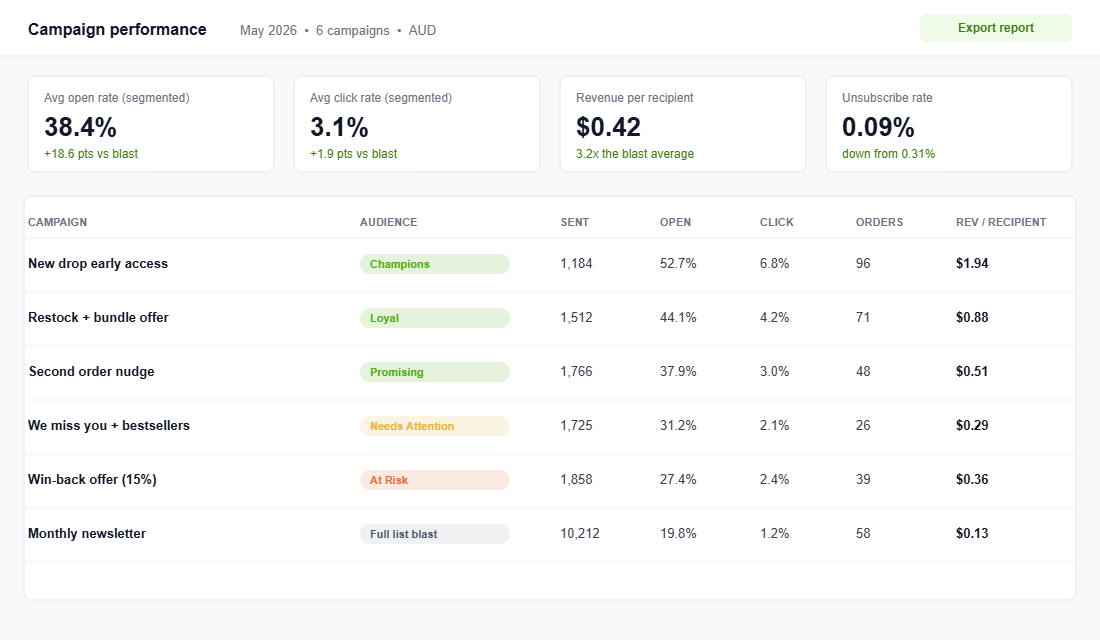
The data says that habit is expensive. Klaviyo’s segmentation benchmark research found that highly segmented sends earn more than 3x the revenue per recipient of unsegmented blasts: $0.19 versus $0.06. Open rates nearly double too, 16.17% against 9.95%. Same list, same products, same brand. The only thing that changed was who got what.
RFM segmentation is the simplest, most proven way to make that shift. Three numbers per customer (Recency, Frequency, Monetary value) sort your entire database into six segments that each get treated differently. This playbook walks through what RFM is, the six segments that matter, how to build them in Klaviyo this afternoon, and exactly what to send each group.
Why Blasting Your Whole List Is the Most Expensive Habit in Email
Every campaign you send to someone who does not care about it does quiet damage. They skim the subject line, ignore it, and Gmail takes notes. Do that weekly and your sender reputation erodes, your best content lands in Promotions, and your unsubscribe rate creeps up until the list you spent years building stops responding.
The performance gap is not subtle. Klaviyo’s benchmark data puts highly segmented sends at almost double the open rate of unsegmented ones, and click-through rates at 1.99% versus 0.92%. More than double the clicks, from the same subscribers, just by matching the message to the buyer.
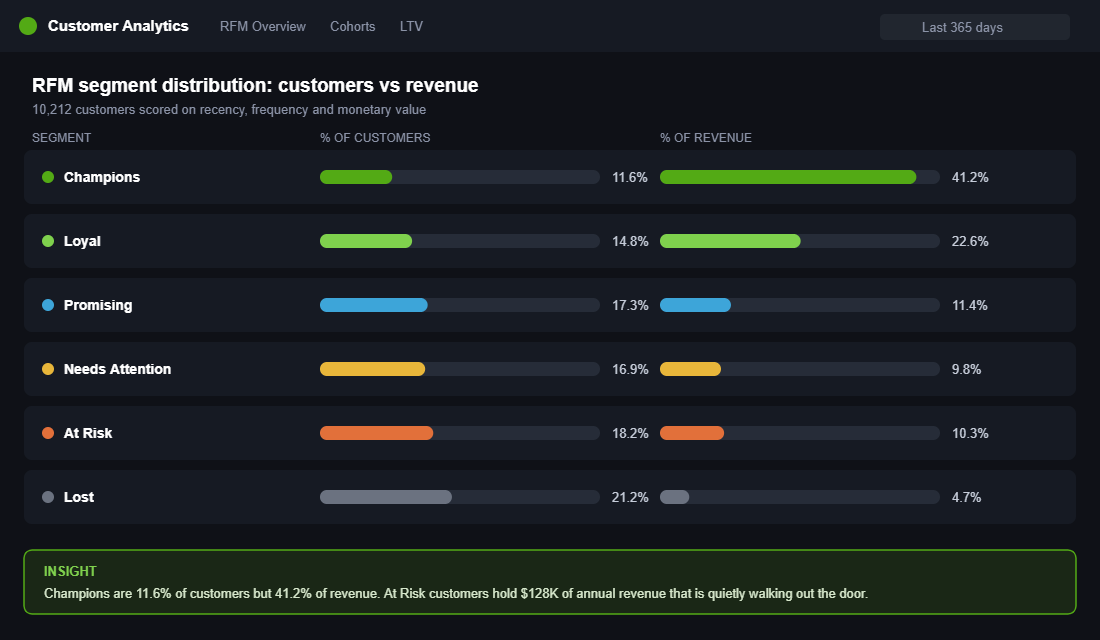
Underneath that sits a distribution most founders have never actually measured in their own store. In a typical ecommerce database, 10 to 15% of customers generate 35 to 45% of total revenue. Another 15 to 20% are previously frequent buyers who have quietly gone dark. Treating those two groups the same way is the core mistake RFM fixes.
And the prize for fixing it is large. Bain & Company’s well-known retention research found a 5% lift in customer retention boosts profit somewhere between 25% and 95%. Segmentation is how you find the exact customers that retention effort should focus on.
RFM in Plain English: Three Numbers That Tell You Who Matters
RFM stands for Recency, Frequency, Monetary. For every customer you ask three questions. How recently did they buy? How often do they buy? How much have they spent in total?
Score each answer from 1 to 5, with 5 being best. A customer who ordered last week, has bought six times, and has spent $800 with you might score 5-5-5. The one who bought once, 14 months ago, for $30 scores 1-1-1. Every customer in your store lands somewhere on that grid.
The reason RFM beats demographic segmentation is simple: it is built on behaviour, not attributes. Two 34-year-old women in Brisbane can be your best customer and a one-time buyer who hated the product. Age, location and gender tell you almost nothing about purchase intent. What someone actually did with their wallet tells you nearly everything.
The Six Segments That Actually Matter
You can slice RFM scores into dozens of micro-segments. Do not. For a store doing $40K to $500K a month, six is the number that balances precision with sanity.
- Champions. Bought 3 or more times, ordered within the last 60 days, top-tier lifetime spend. Usually 10 to 15% of customers and 35 to 45% of revenue. These people fund your business.
- Loyal. Buy regularly with solid spend, but their last order is 60 to 120 days back. Reliable, not currently hot.
- Promising. One or two orders, placed recently. This is your biggest growth pool: the entire game is getting them to order number two before they cool off.
- Needs Attention. Average recency, frequency and spend, and all three are drifting down. They have not left yet. They are deciding.
- At Risk. Used to buy often, spent well, and have now been silent for 90 days or more. The single most valuable rescue mission in your store.
- Lost. No purchase in 12 months or more. Worth one last swing, then suppression. Keeping them on full sends only hurts deliverability.
Notice what this does to your planning. “What should we email this week?” becomes six much easier questions, each with an obvious answer, because each segment has one job: keep Champions spending, push Promising to a second order, pull At Risk back before they hit Lost.
Build It in Klaviyo This Afternoon
You do not need a data analyst or a paid app to start. If you run Klaviyo connected to Shopify, every property you need is already synced. Here is the setup, step by step:
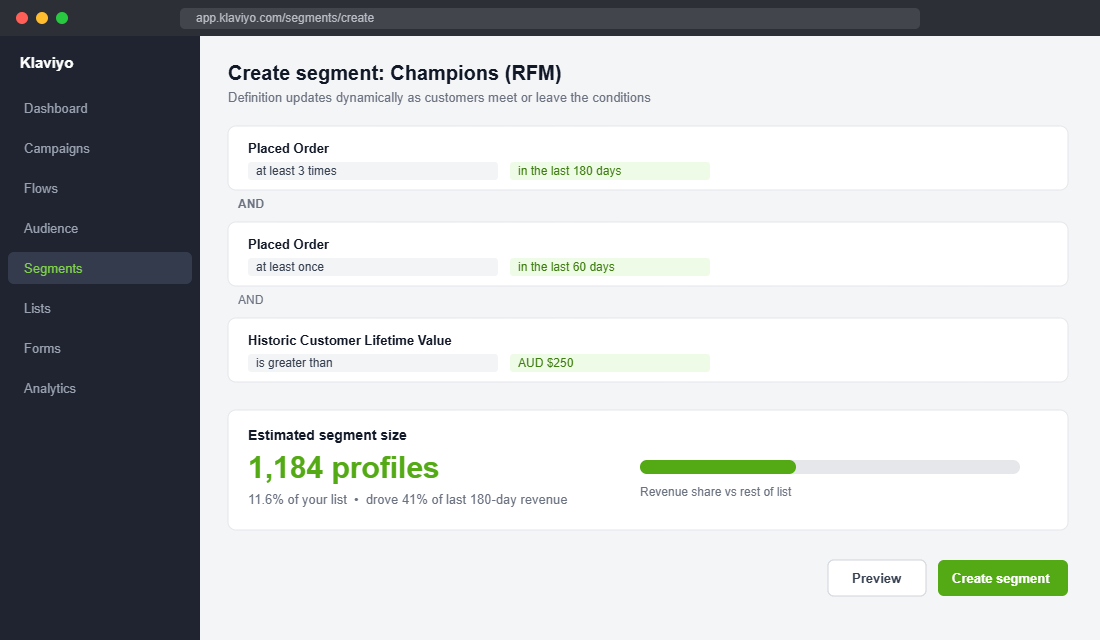
- Open Audience, then Segments, then Create Segment. Name the first one “Champions (RFM)”.
- Add three conditions joined with AND. Placed Order at least 3 times in the last 180 days. Placed Order at least once in the last 60 days. Historic Customer Lifetime Value greater than your top-quartile figure (pull it from Shopify Analytics; for many Aussie DTC brands it sits between $200 and $350).
- Repeat for the other five segments, adjusting the order counts and day windows. At Risk, for example, is Placed Order at least 3 times overall AND Placed Order zero times in the last 90 days.
- Check the sizes. Champions should land somewhere near 10 to 15% of your buyer base. If it is 40%, your thresholds are too loose to mean anything.
- Turn on Klaviyo’s predictive analytics if you have 500 or more customers with orders. It adds predicted next order date and churn risk, which sharpens At Risk targeting considerably.
- Exclude Lost from your default campaign audience from today. This one change usually lifts open rates within a fortnight.
If you want RFM scoring without building it by hand, Shopify’s built-in customer segments handle basic recency and frequency rules on any plan, and apps like Lifetimely or Peel will compute full RFM grids and cohort views for you. But honestly, the six Klaviyo segments above cover 90% of the value, and they are free.
What to Send Each Segment (This Is Where the Money Is)
Building segments is admin. Sending each one the right message is the part that moves revenue. Here is the send strategy we work through with members, segment by segment:
- Champions: access, not discounts. Early access to new drops, first dibs on restocks, review and referral requests, the occasional handwritten thank-you. Discounting Champions is setting fire to margin; they were already going to buy. LSKD runs exactly this play, using launch access as the reward for its most engaged buyers.
- Loyal: expand the basket. Cross-sell campaigns built on what they already own, bundles, and loyalty points reminders. Their next order is yours to lose; make it bigger.
- Promising: engineer order two. A second purchase within 60 days is the strongest predictor of long-term value in most stores. Send a “complete the routine” campaign, styling or usage content, and make sure your welcome flow hands new buyers straight into this push.
- Needs Attention: re-earn the open. Bestsellers, customer stories, your strongest social proof. No hard sell yet. You are reminding them why they bought in the first place.
- At Risk: escalate deliberately. Start with a “we miss you” plus what is new, then your strongest offer, then a last call. We covered the full sequence in the win-back flow playbook; RFM is what feeds that flow the right people at the right time.
- Lost: one swing, then sunset. A single aggressive final offer. No response? Suppress them from regular sends. Emailing dead profiles drags down deliverability for everyone else.
Proof From Two Aussie Brands Doing It Well
LSKD, the Queensland-born functional fitness label, scaled past $100 million in revenue with segmentation doing serious lifting. One example: they identified first-time BFCM sale shoppers as their own segment and built campaigns specifically to convert them into full-price repeat buyers. With deeper personalisation across segments, LSKD doubled its year-on-year revenue from Klaviyo flows in 2024.
Who Gives A Crap grew its email list 640% by treating segments as genuinely different audiences. Subscription customers get different messaging from ad-hoc buyers, and the team even splits content style: some segments respond to sustainability storytelling, others click on toilet humour. Same brand, two different conversations, both converting.
Neither brand needed exotic tech. They needed the discipline to stop sending one message to everyone.
The Hidden Bonus: RFM Sharpens Your Customer Avatar
Most founders build their customer avatar from instinct and a few survey responses. RFM gives you something better: a named list of the customers your business should be built around. Export your Champions and study them. Which product did they buy first? Which channel did they arrive through? What do their reviews say in their own words?
That research loop turns segmentation into strategy. If 60% of Champions started with one hero product, that product leads your ads. If they overwhelmingly arrived through a particular channel, that channel earns more budget. You stop describing an imaginary ideal customer and start reverse-engineering the real ones who already pay you the most.
Beyond Email: Point Your Ad Budget at the Same Segments
Once the segments exist, they are too valuable to leave inside Klaviyo. Sync them to Meta as custom audiences and your ad account gets sharper overnight.
- Suppress Champions and Loyal from prospecting campaigns. You are currently paying Meta to show ads to people who would have bought anyway. Stop.
- Build your lookalike from Champions only, not all purchasers. A lookalike seeded with your top decile finds buyers who behave like your best customers, not your average ones.
- Run a small At Risk retargeting budget alongside the win-back emails. Two channels pulling the same direction beats either alone; Shopify’s own data found adding SMS to email win-back flows lifted conversion around 54%.
- Exclude Lost from everything paid. Spend that money acquiring someone new instead.
The Monthly RFM Ritual: 30 Minutes That Replaces Guesswork
RFM is not a set-and-forget build. Its real power shows up when you watch customers migrate between segments month to month. Block 30 minutes on the first Monday of each month and record four numbers:
- Champions count. Growing, flat, or shrinking? This is your forward revenue indicator, months before it shows in sales.
- At Risk count. A rising number here is churn you can still do something about. If it keeps climbing, your retention problem starts further upstream; our churn prediction playbook covers the early-warning signals.
- Revenue share of your top 10% of customers. If it creeps past 50%, you are over-reliant on a small group and acquisition needs attention.
- Revenue per recipient across campaigns. The single best measure of whether your sends are getting smarter. Klaviyo’s top performers sit above $0.18; unsegmented blasts average $0.06.
The Compound Effect: One Build, Four Payoffs
Here is why this one afternoon of setup outperforms most marketing projects you could run this quarter. The same six segments power four systems at once.
Your campaigns stop being a weekly guess and become six repeatable plays. Your flows get smarter, because welcome, win-back and post-purchase sequences can branch on segment membership. Your ad spend tightens, because Meta finally knows who not to target. And your product decisions improve, because watching what Champions buy first tells you which products create your best customers.
Omnisend’s analysis of 20 billion emails found automated, behaviour-triggered sends drove 37% of email revenue from just 2% of send volume. That is the endgame: less volume, more relevance, more money. RFM is the targeting layer that makes it possible.
A Worked Example: What This Looks Like at Eighty Grand a Month
Numbers make this concrete. Say you run an Aussie skincare brand doing $80K a month with 10,000 customers on file and an average order value of $85.
You build the six segments and find 1,150 Champions, 1,500 Loyal, 1,750 Promising, 1,700 Needs Attention, 1,800 At Risk and 2,100 Lost. Your Champions, 11.5% of the list, turn out to be driving roughly $390K of your last year’s revenue. Your At Risk segment used to spend around $130K a year and is now spending almost nothing.
Run the playbook conservatively. A monthly Champions early-access send at $1.50 revenue per recipient adds about $1,700 a month. A second-order push to Promising converting just 3% adds around $4,400 a month. A win-back sequence that rescues 8% of At Risk customers over a quarter brings back roughly 145 buyers, worth about $12K a quarter at one reorder each. Suppressing Lost costs you nothing and lifts the deliverability of everything else.
That is somewhere near $10K a month in added revenue, with zero extra ad spend, from a build that took one afternoon. The leverage sits in the list you already own.
Five Mistakes That Quietly Break RFM
We see the same handful of errors when members bring us their segment builds. Avoid these and you are ahead of most stores:
- Copying someone else’s thresholds. A coffee subscription brand and a furniture brand have wildly different “recent”. Set your day windows off your own reorder cycle: pull your median time between orders from Shopify Analytics and build around it.
- Building segments and still blasting. The segments do nothing if every campaign still goes to the full list. Change the default audience on your next send, not someday.
- Discounting Champions. The fastest way to train your best customers to wait for sales. Reward them with access and recognition, and save the offers for At Risk.
- Forgetting one-time buyers are a timer, not a segment. A Promising customer who does not reorder inside your reorder window becomes Needs Attention automatically. Your job is to beat that clock, not watch it.
- Never revisiting the build. Thresholds that fit you at $40K a month will be wrong at $200K. Re-cut the quartiles every six months or after any major range change.
Your RFM Quick-Start Checklist
Steal this and run it this week:
- Pull your top-quartile customer lifetime value from Shopify Analytics
- Build the six segments in Klaviyo: Champions, Loyal, Promising, Needs Attention, At Risk, Lost
- Sanity-check sizes (Champions should be roughly 10 to 15% of buyers)
- Exclude Lost from your default campaign audience today
- Send one Champions-only campaign this week: early access or a genuine thank-you, no discount
- Point your win-back flow at At Risk and your second-order push at Promising
- Sync Champions to Meta as a lookalike seed and a prospecting exclusion
- Book the monthly 30-minute review and track the four numbers
Inside eCommerce Circle, knowing exactly who your best customers are (and treating them like it) is one of the core pillars we work on with every member. If you want a second opinion on your segments and what to send them, let’s talk.