Your Meta CPMs went up again this quarter. You did not change the creative, you did not change the audience, and the account is still spending the same. The cost of reaching a thousand Australians just went up because more businesses are bidding for the same inventory.
What’s in This Article
The numbers back that up. Meta CPM inflation ran at roughly 20% year on year, moving from $11.82 to $14.19 as competition intensified across Reels, Stories and newer placements. In Australia specifically, average Meta CPC sits around $1.47, up about 12% year on year, and median Meta CPA across industries has climbed from $30.00 to $38.19. You are paying more to talk to the same people.
Meanwhile there is a whole category of attention almost nobody in Australian DTC is buying properly. Independent email newsletters. Real audiences, opened by choice, read in a quiet inbox with no algorithm deciding whether your message shows up. Most Aussie founders have never bought a single newsletter placement, and the handful who have usually did it badly: paid rate card, wrote a banner ad, tracked nothing, and concluded the channel does not work. This is the system that makes it work.
Why Newsletter Inventory Is The Last Cheap Attention In Australian Ecommerce
Newsletter advertising is priced on a cost per thousand sends basis, the same way display and social are. Direct sponsorship rates for ecommerce and consumer newsletters sit broadly in the $30 to $70 range. That looks expensive next to a $14 social CPM until you look at what you are actually buying.
A social impression is a scroll past. A newsletter send lands in an inbox where the reader has already opted in, and ecommerce and retail lists typically report open rates in the 28% to 32% band, with well-run independent lists sitting far higher. A click rate of 2% to 3% against total sends is normal, and anything above 5% is exceptional. Do the arithmetic on a 40,000 send at a 2% click rate and you have 800 people arriving on your site from a source that trusts the sender.
Here is the part that matters most. Newsletter inventory is sold by individual publishers, most of them one or two people, most of them without a sales team. There is no auction. Prices are set by whatever the publisher guessed was reasonable, and they move a lot when you negotiate. That is the arbitrage, and it closes as more brands find it.
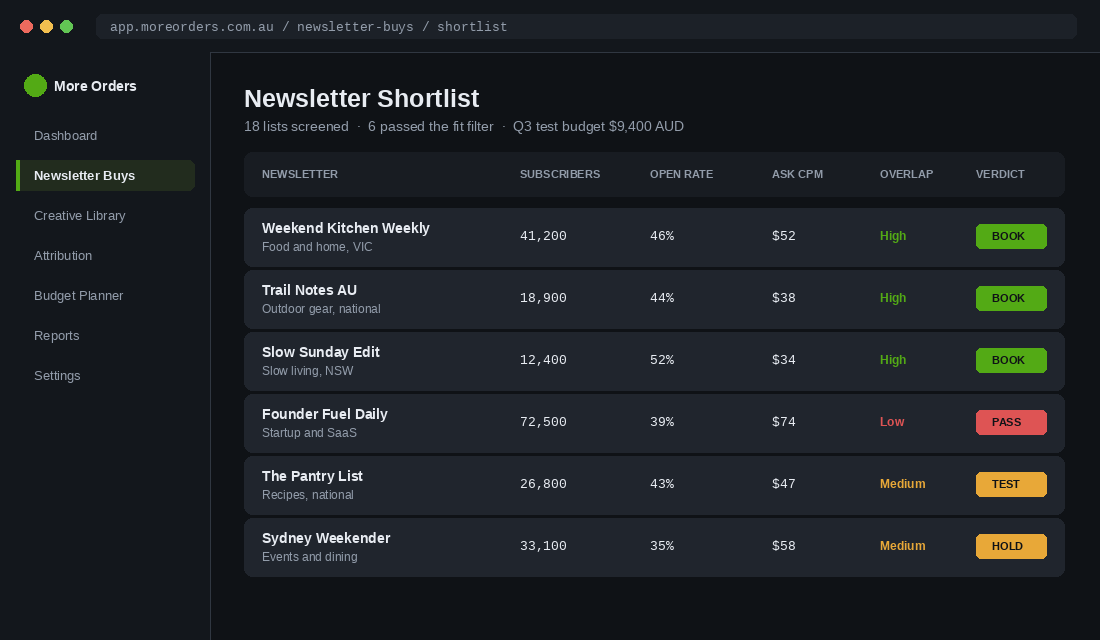
Part 1: Build The Fit Filter Before You Look At A Single Subscriber Count
The most common mistake is buying the biggest list you can afford. Size is the least useful number on a media kit. A 70,000 subscriber general news list will almost always underperform a 12,000 subscriber list written for exactly your buyer.
Score every candidate list on four things before you even ask for pricing:
- Audience overlap. Would a typical reader of this newsletter recognise the problem your product solves without you explaining it? If you sell merino base layers, an outdoor gear list is high overlap and a general business list is low overlap, no matter how big the business list is.
- Purchase context. Is the reader in a spending frame of mind when they open it? A Friday food and home newsletter is read while people plan a weekend and buy things. A Monday industry briefing is read at a desk between meetings.
- Editorial voice. Read four back issues. If the publisher writes with a personal voice and readers reply to them, a recommendation carries weight. If it is a link roundup with no personality, your ad is just a banner.
- Sponsor history. Look at who has advertised in the last ten issues. If it is all SaaS and finance, physical product offers may not have been tested. If you can see a competitor or an adjacent brand rebooking across multiple issues, that list works for products like yours.
Screen at least fifteen lists to find three worth testing. That ratio sounds brutal and it is the whole job. Most of the value in this channel comes from selection, not from the ad you write.
One warning on reported open rates. Apple Mail Privacy Protection inflates reported opens by 15 to 20 percentage points or more, so a media kit claiming a 62% open rate is probably a real rate closer to 42%. Ask the publisher for click rate on their last five sponsored placements instead. Publishers who will not share click data are telling you something.
Part 2: Work Out Your Rate Ceiling Before You Ask For A Media Kit
Never walk into a negotiation without knowing the highest price you can pay. Most founders ask for the rate card, feel it is a bit steep, haggle by instinct, and end up agreeing to a number they cannot justify. Do the maths first and the negotiation becomes easy.
The calculation is four steps:
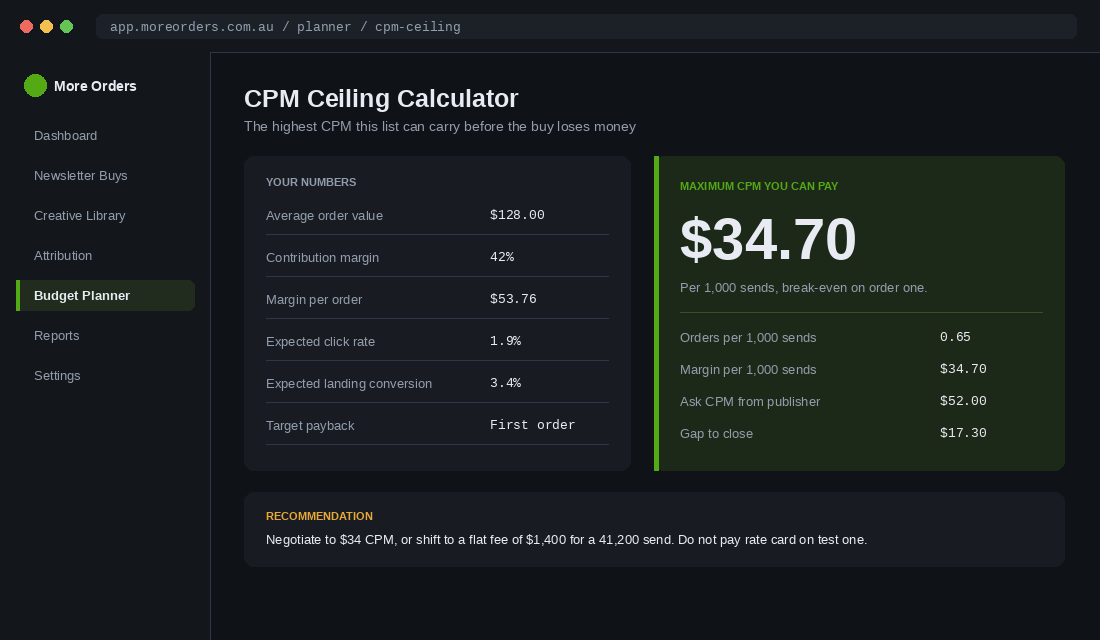
- Margin per order. Take your average order value and multiply by your contribution margin after cost of goods, shipping, payment fees and pick and pack. On a $128 AOV at 42% contribution, that is $53.76.
- Clicks per thousand sends. Use 1.9% as a conservative planning assumption, so 19 clicks per 1,000 sends.
- Orders per thousand sends. Multiply clicks by your landing page conversion rate. At 3.4%, 19 clicks becomes 0.65 orders.
- Rate ceiling. Multiply orders by margin per order. 0.65 x $53.76 gives you roughly $34.70 per thousand sends. That is your break-even on the first order.
So when a publisher asks $52 per thousand, you now know exactly what you are looking at: a $17.30 gap you either close through negotiation or absorb because your repeat purchase rate justifies paying above first-order break-even. That is a decision, not a guess. If you are not yet confident in your contribution number, fix that first with the contribution margin playbook, because every calculation in this article depends on it.
Three negotiation levers work reliably with independent publishers:
- Ask for a flat fee instead of a rate. Publishers like certainty. A flat $1,400 for a 41,200 send is easier for them to say yes to than a per-thousand negotiation, and it lands you under your ceiling.
- Buy the quiet weeks. Rates spike 20% to 40% in October through December as advertisers compete for Q4 inventory. February and July are cheap. Top-of-newsletter placements also carry a 30% to 50% premium over mid or footer positions, so a mid placement in a high-fit list often beats a top placement in a poor-fit one.
- Offer performance structure. The market has already moved this way. In early 2026 the share of newsletter deals sold on a pure rate basis dropped to about 51%, with cost per action, cost per lead and revenue share arrangements making up the rest. Offering a smaller flat fee plus a commission on tracked orders often gets you into lists that would otherwise be out of budget.
Part 3: Write The Ad As An Editor, Not As A Marketer
Newsletter readers are there for the writer, not for you. The ads that work read like the publisher briefly recommending something. The ads that fail read like a banner that wandered in from a display network.
Use a five block structure and keep the whole thing under 120 words:
- Block 1, the reader’s situation. One sentence naming a problem this specific audience has. Not your product category. Their Tuesday.
- Block 2, the shift. One sentence on what changes when the problem is solved. Concrete, not aspirational.
- Block 3, the proof. One number or one specific detail. Where it is made, how many people bought it, what the guarantee is. Specificity is the only thing separating you from every other ad that week.
- Block 4, the offer. Give the list its own code. Not a generic 10% off. Something the reader could only have got here.
- Block 5, one link. One call to action, one destination, no alternatives.
Write three variants and let the publisher pick which one sounds most like their newsletter. They know their audience better than you do, and giving them the choice makes them an ally rather than a vendor. Publishers who feel involved write better introductions to your ad, and that introduction is worth more than anything in your copy.
Send the traffic to a dedicated landing page, never your homepage. The page should repeat the newsletter’s name in the first line so the reader knows they are in the right place. This is exactly the continuity problem covered in the Shopify landing page playbook, and it is the single biggest reason newsletter tests underperform.
Part 4: Track It With Codes, Because Analytics Will Not Save You
Newsletter traffic is an attribution nightmare if you rely on analytics alone. Many email clients strip referrers, plenty of readers open on a phone and buy on a laptop later, and a good chunk of the impact shows up as direct traffic and branded search over the following fortnight. If you judge the channel on last-click, you will kill a channel that is working.
Build four layers of measurement into every buy:
- A unique discount code per list. Not per campaign, per list. This is your hard floor of attributable revenue and it works even when every other signal fails.
- A dedicated landing page URL per list. Gives you session data and lets you see bounce and add to cart rates by source.
- UTM parameters. Useful, but treat them as your least reliable layer, not your primary one.
- A post-purchase survey question. Ask new customers how they heard about you. This catches the delayed and cross-device conversions the other three layers miss, and it consistently reveals more newsletter-driven orders than code redemption alone. The post-purchase survey attribution system covers how to set this up in about twenty minutes.
Then measure on a 14 day window, not a 24 hour one. Take the day before the send as your baseline for direct traffic and branded search, and count the lift across the fortnight. Newsletter buys have a long tail because people forward them, save them and come back.
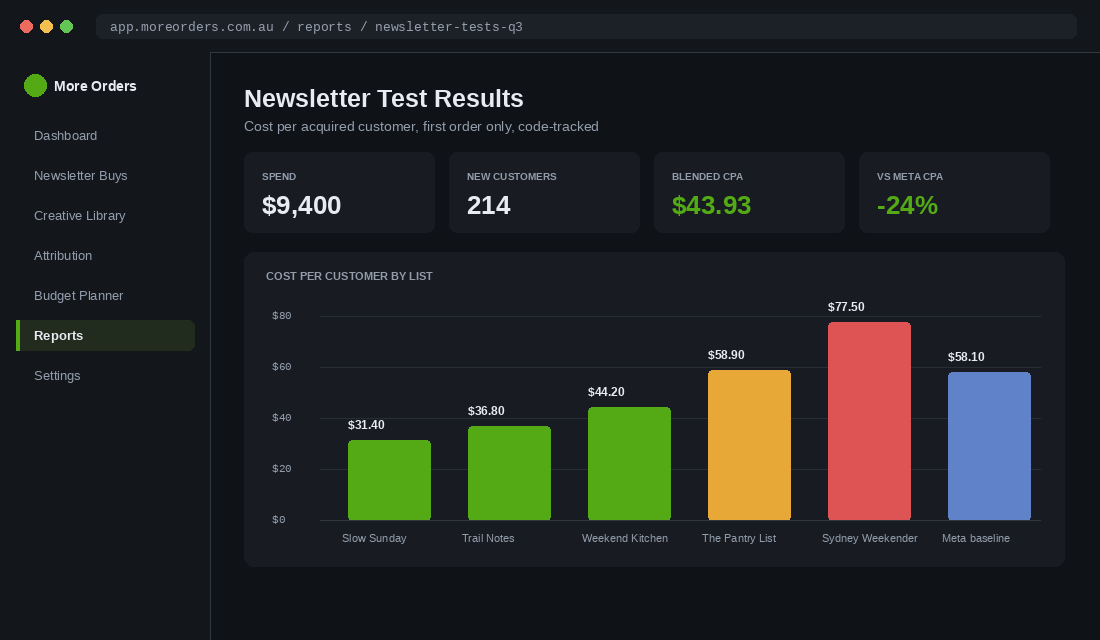
Judge every buy against one benchmark: your current blended cost to acquire a customer on paid social. If a list beats it, you have found inventory worth owning. If it does not, you have spent a small amount to learn something specific. Track the whole thing at the portfolio level using the marketing efficiency ratio framework rather than obsessing over individual placement returns.
Part 5: The Rebooking Ladder That Turns One Test Into A Channel
Single newsletter placements almost never work as well as they should. Readers need to see a brand more than once before it registers, and the first placement in a list is doing recognition work that the second and third placements get to convert on.
Every founder who tries this channel once and quits made the same error: they judged a first placement on first-placement numbers. Run the ladder instead.
- Rung one, the single test. One placement, mid-newsletter, negotiated below rate card. Budget it as research. You are buying data on whether this audience responds at all.
- Rung two, the triple. If cost per customer lands within about 150% of your paid social benchmark, book three placements across six weeks. This is where most lists find their real performance, usually on the second or third appearance.
- Rung three, the quarter. If the triple beats your benchmark, lock a quarterly slot. Publishers will discount 15% to 25% for a booked quarter because it takes the sales problem off their desk.
- Rung four, the partnership. Your best lists become something more than ad inventory. Co-created content, a reader-exclusive product, a subscriber-only bundle. This is where a channel stops being buyable by your competitors.
Set the rule before you spend, not after. Write down the number that triggers a rebooking and the number that triggers a stop. Founders who decide this afterwards always find a reason to keep spending on a list they liked personally.
Where To Actually Find And Book Australian Lists
Finding good lists is the part that stops most people, so here is the practical path.
Start with the beehiiv Ad Network and Paved. Both are marketplaces connecting advertisers with newsletter publishers. beehiiv runs an ad network with pre-negotiated campaigns and a direct sponsorship storefront where publishers set their own pricing and invoicing runs through Stripe. Paved operates a marketplace for direct deals plus a programmatic network where you set a budget and buy across multiple newsletters on a cost per click basis, meaning you only pay when someone clicks.
Setting up a first buy through Paved takes about half an hour:
- Create an advertiser account and filter the marketplace by category and audience location. Filter for Australia and New Zealand, then widen if the inventory is thin.
- Shortlist using the fit filter above, ignoring subscriber count until the last step.
- Request the media kit and, separately, the click rate on their last five sponsored placements.
- Run your rate ceiling calculation, then make one offer below rate card with a flat fee and a specific date.
- Supply three copy variants, a dedicated landing page and a unique discount code.
Then go direct, because that is where the value is. Marketplaces take a cut and the best Australian lists are often not listed on them at all. Build your own list of candidates by asking your existing customers what they read. That is a single question in a post-purchase survey and it will surface publications no marketplace would have shown you. If you are already running a zero-party data programme, add the question there.
Then email the publisher directly. Independent publishers reply to short, specific emails from real founders. Tell them what you sell, why you think their readers would care, the date you want, and the number you are offering. No media kit request, no long introduction. Offering a concrete number in the first email gets a reply rate far higher than asking what they charge.
The Newsletter Test Card
Copy this into a Google Sheet and fill one out per buy. Do not book anything until every line has an answer.
- List name and publisher contact.
- Audience overlap: high, medium or low, with one sentence of reasoning.
- Subscribers, claimed open rate, and actual click rate on last five sponsored placements.
- Your margin per order after cost of goods, shipping, payment fees and fulfilment.
- Your rate ceiling from the four-step calculation.
- Publisher ask, your offer, agreed price and structure (flat, per thousand, or performance).
- Placement position and send date.
- Unique discount code and dedicated landing page URL.
- Rebook trigger: the cost per customer at or below which you book the triple.
- Stop trigger: the cost per customer above which you walk away.
- Result at 14 days: spend, code redemptions, survey-attributed orders, cost per customer, decision.
Ten lines. The founders who fill this in before booking get a working channel. The ones who wing it get an expensive anecdote about how newsletters do not work.
Why This Compounds When Paid Social Does Not
Here is where the five parts stop being separate tactics and start behaving like a system.
Your fit filter gets sharper every round, because every test teaches you something real about which audiences convert and which just look right on paper. Your rate ceiling gets more generous as repeat purchase rates improve, which means lists you could not afford last year come into range this year without anything changing on the publisher’s side. Your copy gets better because publishers tell you which variant they picked and why. Your tracking gets more honest as survey data accumulates.
And the relationships are the real asset. A publisher you have booked four times will hold a date for you, tell you when a competitor enquires, and eventually make things with you rather than just selling you space. None of that is available on an ad platform, because none of it is buyable with budget alone.
Compare that to paid social, where every efficiency gain you find gets competed away, and your costs rise every year regardless of how good you get. Email marketing already returns somewhere around $36 to $42 for every dollar spent on owned lists. Newsletter sponsorship is how you rent that same quality of attention before you own it, and it is how you build the list you will eventually own.
Start with one buy. Screen fifteen lists, book the best one for under a thousand dollars, and fill in the test card properly. You will know more about this channel in a fortnight than most Australian DTC brands know after two years.
Inside eCommerce Circle, finding acquisition channels that are not already priced to death is one of the core pillars we work on with every member. If you want a second opinion on where your next customers should come from, let’s talk.