You’ve spent months building your email list. You’ve got Klaviyo flows firing on all cylinders. Your Meta Ads are driving traffic. But here’s the thing — your customers aren’t sitting at their desks reading emails anymore. They’re scrolling their phones in the checkout queue at Woolies, between meetings, and on the couch at 9pm. And the channel that meets them exactly where they are? SMS.
What’s in This Article
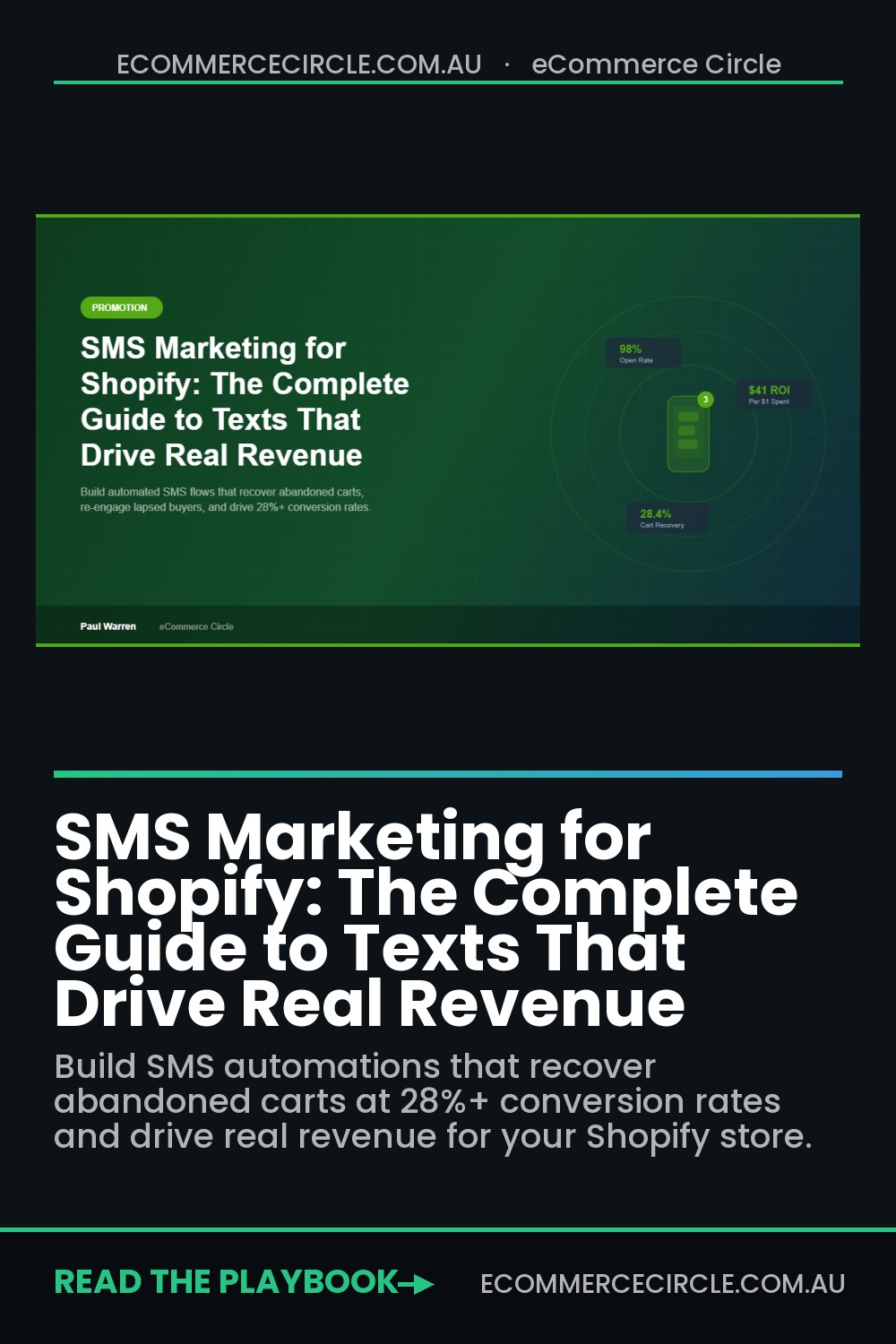
Most Shopify brands treat SMS like an afterthought — a “nice to have” they’ll get to eventually. Meanwhile, the brands that have built SMS into their marketing stack are seeing 98% open rates, click-through rates that dwarf email, and abandoned cart recovery numbers that would make your Meta retargeting look like a rounding error. Australian fashion brand Princess Polly generated millions in SMS-driven revenue within just three months of launching the channel, with a 64x total ROI.
This isn’t about replacing email. It’s about adding a direct line to your customer’s pocket — one that gets read within three minutes, not three days. Here’s exactly how to build an SMS marketing program for your Shopify store that drives real revenue without annoying your list into oblivion.
Why SMS Works So Well for Ecommerce (and Why Most Brands Are Late)
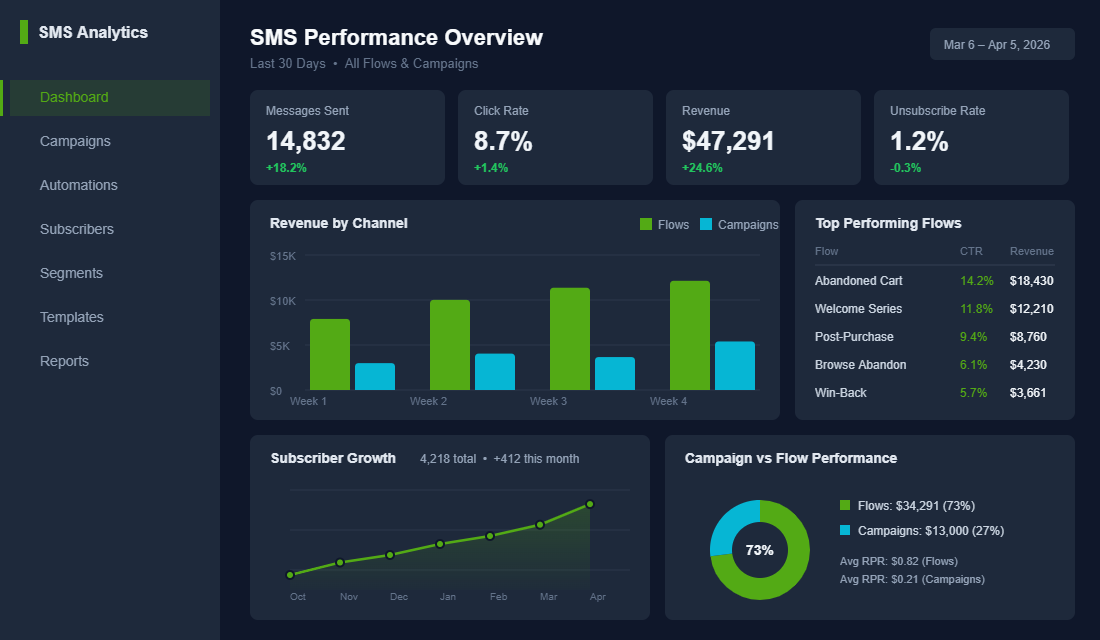
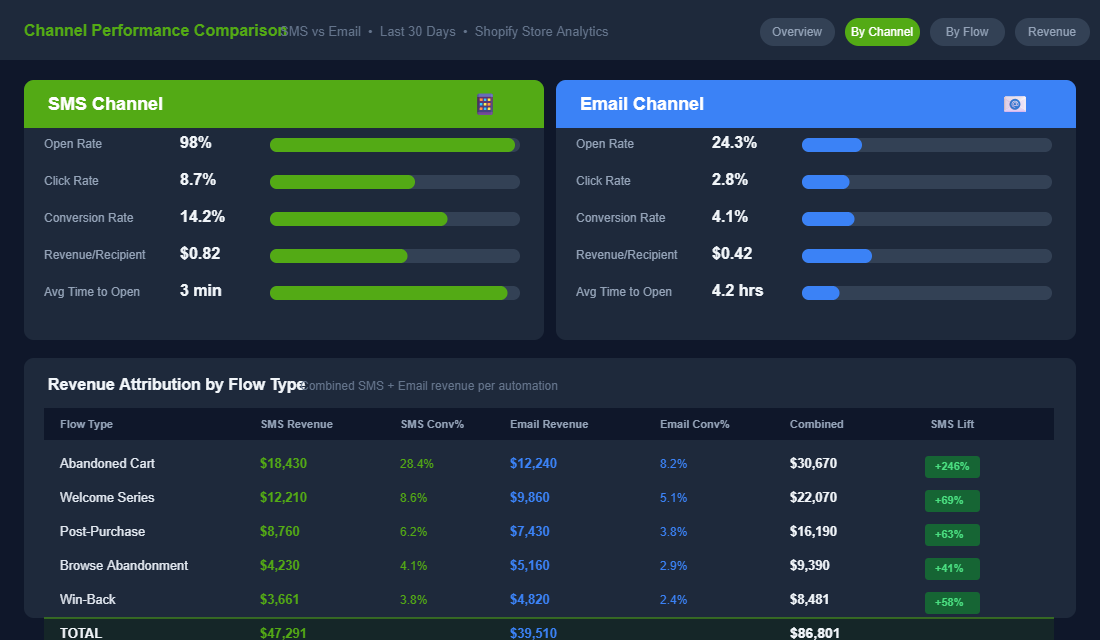
The numbers on SMS aren’t just good — they’re almost hard to believe if you’re used to email benchmarks. SMS messages hit a 98% open rate. Compare that to the 20-25% open rate you’re likely seeing on your best email campaigns. Around 90% of texts are read within three minutes of delivery, which means your message doesn’t just get seen — it gets seen now.
But open rates are just the start. According to Klaviyo’s 2026 benchmarks report (aggregating data from over 167,000 brands), SMS flows achieve click rates nearing 10% on average — almost double the performance of broadcast campaigns. The top performers are pushing past 16% click rates on automated flows. For context, a strong email campaign might hit 2-3% click-through rates on a good day.
Here’s the stat that should really get your attention: SMS flows account for just 7.6% of total sends, yet they drive 45.2% of all SMS revenue. That’s an enormous concentration of revenue in automated, intent-based messages — welcome sequences, abandoned cart reminders, and post-purchase follow-ups doing the heavy lifting while you sleep.
The ROI picture is equally compelling. Industry data puts SMS marketing ROI between $21 and $41 for every dollar spent, with some seasonal campaigns (think Black Friday) returning as high as $71 per dollar. Automated SMS messages generate roughly 5x more revenue per send than broadcast campaigns, which means the money is in the flows, not the blasts.
So why are most Shopify brands still sitting on the sidelines? Two reasons: they think SMS is “spammy,” and they don’t know where to start. Both are solvable problems. Let’s fix them.
Building Your SMS Subscriber List (Without Being Annoying)
Your SMS list will always be smaller than your email list — and that’s perfectly fine. SMS subscribers are higher-intent, higher-value customers who’ve given you permission to show up in their most personal digital space. Quality over quantity matters more here than in any other channel.
The foundation is consent. In Australia, the Spam Act 2003 requires express consent before sending commercial SMS messages. This isn’t optional — it’s the law. Every subscriber needs to actively opt in, and every message needs a clear opt-out mechanism. The good news is that every major SMS platform on Shopify (Klaviyo, Omnisend, Postscript) has compliance features baked in.
Here are the highest-converting opt-in touchpoints for Shopify stores:
- Pop-up forms with an SMS field. Add a phone number field to your existing email pop-up. Offer a stronger incentive for SMS opt-in — if your email pop-up offers 10% off, offer 15% for SMS subscribers. The extra 5% pays for itself within the first purchase.
- Checkout opt-in. Shopify’s checkout supports SMS marketing consent collection natively. A simple checkbox like “Get order updates and exclusive offers via text” converts at 4-8% of all orders when positioned correctly.
- Post-purchase page. After someone places an order, they’re in peak engagement mode. A “Get your shipping updates via text + exclusive VIP offers” prompt on the thank-you page converts at 10-15% because the customer already trusts you with their money.
- Keyword opt-in campaigns. Run a “Text DEALS to [your number]” campaign on your social media, packaging inserts, or in-store signage. This works especially well for brands with physical retail or events.
- Existing email list migration. Send an email campaign to your most engaged email subscribers inviting them to join your SMS list. Offer early access to sales or exclusive SMS-only deals as the hook. Expect 3-5% conversion from a well-crafted migration campaign.
Oz Hair and Beauty, a leading Australian beauty retailer, built their SMS list through a combination of checkout opt-ins and targeted campaigns. Their approach led to a 12% click-through rate on SMS campaigns and a 13% conversion rate on abandoned cart messages — numbers that far exceed their email performance on the same metrics.
One rule to live by: never buy an SMS list. Beyond being illegal under Australian law, purchased lists destroy your sender reputation, generate complaints, and waste money sending messages to people who will never buy from you. Build your list the right way and it will outperform a purchased list of 10x the size.
The 5 SMS Automations Every Shopify Store Needs
If you’ve read our guide on the 5 Klaviyo flows every Shopify store needs, you already understand the power of automated sequences. SMS automations follow the same principle — set them up once and they generate revenue on autopilot. Here are the five that matter most.
1. Welcome Series (First 48 Hours)
Your welcome SMS fires the moment someone opts in. This is your highest-engagement window — the subscriber just raised their hand and said “yes, talk to me.” Don’t waste it.
Message 1 (Immediate): Deliver the promised incentive. “Hey [First Name]! Here’s your 15% off code: WELCOME15. Shop now: [link]. Reply STOP to opt out.” Keep it under 160 characters. Include the discount code, a direct link to shop, and the required opt-out language.
Message 2 (24 hours later): If they haven’t used the code, send a gentle reminder with a bestseller recommendation. “Your 15% off expires tomorrow! Our customers love [Product Name] — grab it before your code runs out: [link].”
Message 3 (48 hours): Final nudge with urgency. “Last chance — your welcome discount expires tonight at midnight. Don’t miss out: [link].” A well-built welcome series should convert 5-10% of new SMS subscribers into first-time buyers.
2. Abandoned Cart Recovery
Around 70% of online shopping carts are abandoned. That’s not a leak — it’s a flood. And SMS is your fastest, most direct way to plug it.
SMS abandoned cart messages convert between 24-39% when sent within the right window. Compare that to abandoned cart emails, which typically convert at 5-10%. The immediacy of SMS is what makes the difference — your message arrives while the customer still remembers what they were looking at.
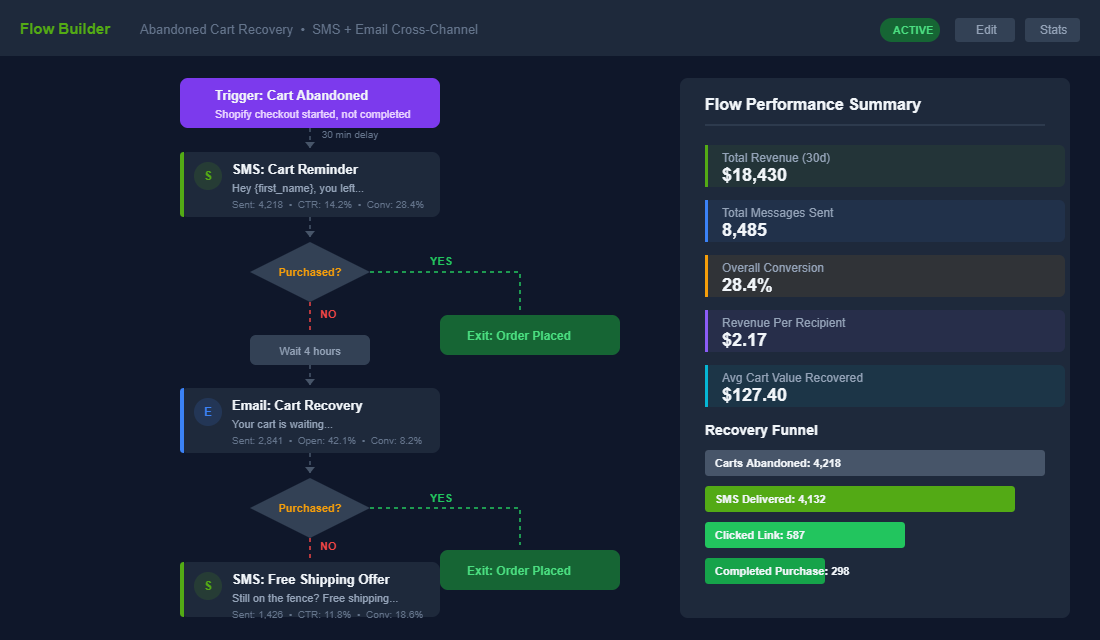
Timing matters enormously. Send the first SMS 30-60 minutes after cart abandonment. This catches people who got distracted but are still in buying mode. If you’re also running abandoned cart emails (and you should be — check our email marketing funnel guide), stagger your SMS before the first email. SMS is faster and more likely to close the sale before the email even gets opened.
Keep the message personal and specific. Don’t send a generic “you left something behind.” Instead: “Hey [Name], you left the [Product Name] in your cart. Still thinking it over? Grab it here before it sells out: [link].” Australian brand Hello Molly uses exactly this approach — personalised cart recovery texts with direct links back to the cart, mentioning any active discounts.
Consider a second attempt at 24 hours with a small incentive if the first message didn’t convert. “Still on the fence? Here’s free shipping on your order — just for today: [link].” This two-touch approach maximises recovery without being aggressive.
3. Post-Purchase and Shipping Updates
This one isn’t about driving immediate revenue — it’s about building the trust that drives repeat purchases. Customers want to know where their order is, and SMS is the perfect channel for real-time updates.
Set up automated texts for order confirmation, shipping notification with tracking link, out-for-delivery alert, and delivered confirmation. These transactional messages have the highest open and engagement rates of any SMS type, and they train your customers to expect (and welcome) texts from your brand.
The clever move here is to add a soft cross-sell or review request to the delivery confirmation. “Your order just arrived! We’d love to hear what you think — leave a review here: [link]. PS: Use code THANKYOU10 on your next order.” LSKD, the Australian sportswear brand, generates 39% of their product reviews via SMS prompts — a massive driver of social proof and conversion.
4. Browse Abandonment
Browse abandonment is the earlier cousin of cart abandonment — the customer looked at products but didn’t add anything to their cart. It’s a softer intent signal, so your messaging needs to match.
Trigger a browse abandonment SMS 2-4 hours after the session ends. Keep the tone conversational, not pushy: “Hey [Name], we noticed you checking out our [Category/Product]. Still interested? Here’s a closer look: [link].” Only send this to subscribers who viewed a product page at least twice or spent more than 60 seconds on the page — you want real intent, not accidental clicks.
This flow typically converts at 3-5%, which is lower than cart recovery but targets a much larger audience. The volume makes up for the lower conversion rate.
5. Win-Back and Re-Engagement
When a customer goes quiet — no purchases in 60-90 days — an SMS win-back sequence can bring them back more effectively than email alone. For the full win-back playbook including email + SMS coordination, see our guide on win-back campaigns for Shopify. The directness of SMS cuts through inbox clutter that might be burying your re-engagement emails.
Message 1 (60 days since last purchase): “Hey [Name], we miss you! Here’s 20% off your next order — just for you: [link]. Use code COMEBACK20.” Lead with value, not guilt.
Message 2 (75 days, if no purchase): Share a new product or bestseller. “We just dropped something you’ll love — [Product Name]. Check it out: [link].” This shifts from discount to discovery.
Message 3 (90 days, final attempt): “It’s been a while, [Name]. Your 20% off code expires this week — last chance: [link].” If they don’t re-engage after three touches, respect their silence and suppress them from future SMS campaigns (but keep them on email at a reduced frequency).
SMS Campaign Strategy: Beyond the Automations
Automations do the heavy lifting, but well-timed broadcast campaigns are where you drive spikes in revenue. The key word is “well-timed.” Unlike email, where you can send 3-4 campaigns per week without major pushback, SMS demands restraint. Send too often and your unsubscribe rate will eat your list alive.
Frequency sweet spot: 2-4 SMS campaigns per month on top of your automated flows. That’s it. Every text you send needs to earn its place in your customer’s inbox. If it’s not genuinely valuable — a real sale, early access, a time-limited restock alert — don’t send it.
The campaigns that work best on SMS all share one trait: urgency and exclusivity. Here are the campaign types that consistently drive strong results:
- Flash sales. “24-hour sale — 30% off everything. SMS subscribers get early access. Shop now: [link].” The time constraint plus the VIP framing drives immediate action. Send these no more than once per month.
- Product drops and restocks. “The [Product Name] is back in stock — and it sold out in 48 hours last time. Grab yours: [link].” Scarcity messaging works even better on SMS because the immediacy of the channel matches the urgency of the offer.
- VIP early access. Give SMS subscribers a 12-24 hour head start on sales events. This rewards them for being on the channel and gives them a concrete reason to stay subscribed. Run these before every major sale event including BFCM, EOFY, and seasonal clearances.
- Seasonal and event-driven campaigns. Mother’s Day gift guides, Valentine’s Day last-minute reminders, Christmas shipping cut-off dates. These work because they’re genuinely helpful, not just promotional.
Segmentation matters on SMS, too. Don’t blast your entire list with every campaign. Segment by purchase history, product interest, and engagement level. Klaviyo makes this straightforward — you can build SMS segments using the same customer data that powers your email segmentation strategy. Send flash sale texts to engaged buyers, restock alerts to people who viewed the specific product, and win-back offers to lapsed customers.
Choosing the Right SMS Platform for Your Shopify Store
The Shopify ecosystem has several strong SMS marketing platforms. Your choice depends on your current tech stack, budget, and how deep you want to go with SMS.
Klaviyo (Best for unified email + SMS). If you’re already on Klaviyo for email — and most serious Shopify brands are — adding SMS is the obvious move. You get unified customer profiles, shared segmentation across email and SMS, and the ability to build cross-channel flows (email first, then SMS if no open). Klaviyo’s free tier includes 250 contacts and 150 SMS credits monthly, making it easy to test before committing. The predictive analytics and unified reporting justify the investment once you scale past the free plan. Klaviyo supports SMS in 22 countries including Australia.
Omnisend (Best for budget-conscious brands). Omnisend combines email, SMS, and push notifications in one platform at a price point that undercuts Klaviyo for many store sizes. With over 5,200 reviews and a 4.8 rating on the Shopify App Store, it’s the most popular marketing automation platform by review count. Omnisend supports SMS in over 200 countries and offers a free plan with 250 contacts and 60 SMS credits. If you’re starting out or running under $500K in annual revenue, Omnisend gives you the most functionality per dollar.
Postscript (Best for SMS-only specialists). If you want the deepest possible SMS feature set and you’re happy running email separately, Postscript is purpose-built for Shopify SMS with a 4.9 rating. It offers two-way conversational SMS, advanced automation, and granular subscriber management. Postscript is the pick for brands already north of $1M in revenue that want to treat SMS as a dedicated, high-performance channel rather than an add-on to email.
Setup Steps: Getting Klaviyo SMS Running on Your Store
Since most eCommerce Circle members are on Klaviyo, here’s the quick-start setup:
- Step 1: Enable SMS in Klaviyo. Go to Settings → SMS in your Klaviyo dashboard. Set your sending number (Klaviyo will provision an Australian number for local sends) and configure your compliance settings including the required opt-out keyword responses.
- Step 2: Add SMS consent collection. Update your Klaviyo sign-up forms to include a phone number field with SMS consent checkbox. Enable the Shopify checkout SMS consent integration under Integrations → Shopify.
- Step 3: Build your core flows. Start with the welcome series, abandoned cart, and post-purchase flows outlined above. Use Klaviyo’s SMS flow templates as starting points and customise the copy to match your brand voice.
- Step 4: Set up Smart Sending. Enable Klaviyo’s Smart Sending feature to prevent subscribers from receiving more than one SMS in a 16-hour window. This protects against over-messaging, especially when multiple flows might trigger simultaneously.
- Step 5: Monitor and optimise. Track click rate, conversion rate, revenue per recipient, and unsubscribe rate for every flow and campaign. If your unsubscribe rate exceeds 2% on any send, reduce frequency or improve targeting.
SMS + Email: How the Two Channels Work Together
The biggest mistake brands make with SMS is treating it as a standalone channel. SMS and email aren’t competitors — they’re a one-two punch that’s stronger together than either is alone.
Here’s how to think about the relationship: email is your long-form storytelling channel (product launches, brand stories, detailed guides), while SMS is your “act now” channel (flash sales, cart recovery, time-sensitive alerts). When you layer them together, you cover both the thoughtful browser and the impulse buyer.
The cross-channel flows that work best follow this pattern:
- Abandoned cart: SMS at 30 minutes → Email at 4 hours → SMS at 24 hours (with incentive) → Email at 48 hours (final reminder). The SMS fires first because it’s more immediate. If the SMS converts, the email is suppressed automatically.
- Product launch: Email 3 days before (full story, product details, imagery) → SMS on launch day (“It’s live! Shop the new [Collection] now: [link]”) → Email 2 days after (for non-openers). Use email to educate and SMS to trigger the purchase.
- Sale events: Email the day before (preview + build anticipation) → SMS when the sale goes live → Email mid-sale (to non-purchasers) → SMS in the final hours (last-chance urgency). This is the framework Australian brands use for BFCM, EOFY, and major seasonal sales.
The key technical requirement is a platform that lets you build conditional logic across channels. In Klaviyo, you can create flows that check “Did this person open the SMS?” before deciding whether to send the follow-up email. This prevents over-messaging and ensures each subscriber gets the right message on the right channel at the right time.
Compliance and Best Practices for Australian Stores
SMS compliance in Australia isn’t complicated, but getting it wrong is expensive. The Australian Communications and Media Authority (ACMA) can issue fines up to $2.22 million per day for serious breaches of the Spam Act 2003. Here’s what you need to get right.
- Express consent is mandatory. You must have clear, documented opt-in consent before sending any commercial SMS. Pre-checked boxes don’t count. The subscriber must actively choose to receive your texts.
- Identify yourself in every message. Every SMS must clearly identify your business name. Don’t send texts from random numbers with no brand identification.
- Include an opt-out mechanism. Every marketing SMS must include a way to unsubscribe — typically “Reply STOP to opt out.” Process opt-out requests immediately (within one business day at most).
- Respect quiet hours. While the Spam Act doesn’t specify SMS sending hours, industry best practice (and common sense) says don’t text customers before 9am or after 8pm in their local time zone. Most SMS platforms let you set quiet hours automatically.
- Keep records. Maintain records of when and how each subscriber opted in. If you ever face a complaint, this documentation is your defence.
Beyond legal compliance, there are unwritten rules that protect your list health and brand reputation. Never send more than 6-8 SMS per month (flows and campaigns combined). Always deliver value — if a text doesn’t offer a genuine benefit to the reader, don’t send it. And monitor your unsubscribe rate like a hawk. Anything above 2% per send is a red flag that you’re over-messaging or under-delivering on value.
Measuring SMS Performance: The Metrics That Matter
Forget vanity metrics. Here are the numbers you should track weekly and what “good” looks like for each:
- Click-through rate (CTR). The primary engagement metric for SMS. Benchmark: 8-12% for flows, 3-6% for campaigns. If you’re below 3% on campaigns, your offers aren’t compelling enough or your targeting is too broad.
- Conversion rate. Percentage of SMS recipients who make a purchase. Benchmark: 10-15% for abandoned cart flows, 2-5% for campaigns. Automated flows should always outperform broadcasts.
- Revenue per recipient (RPR). Total revenue divided by number of recipients. This is your ROI metric. Benchmark: $0.50-$1.50 for flows, $0.10-$0.30 for campaigns. Klaviyo’s benchmark data shows automated SMS earning $0.74 per send versus $0.15 for campaigns.
- Unsubscribe rate. Percentage of recipients who opt out after each send. Benchmark: under 2% per send. If a single campaign pushes above 3%, immediately review your frequency and content strategy.
- List growth rate. Net new subscribers per month after accounting for unsubscribes. You should be growing your SMS list by 5-10% monthly in the early stages. If growth stalls, revisit your opt-in touchpoints and incentives.
Build a simple weekly dashboard that tracks these five metrics across your flows and campaigns. Spot trends early — a gradual increase in unsubscribe rate over 4-6 weeks is a signal to pull back on frequency before the problem compounds.
The Compound Effect: SMS as Part of Your Revenue Engine
When you step back and look at the complete picture, SMS isn’t just another marketing channel — it’s the connector that makes all your other channels work harder.
Your Meta Ads drive traffic to your store. Some visitors buy, but most don’t — they browse, maybe add to cart, and leave. Your SMS abandoned cart flow catches the high-intent leavers within 30 minutes, converting 24-39% of them before they forget about you. Your email welcome sequence nurtures the slower buyers over days, while your SMS welcome series closes the quick wins in 48 hours.
Your post-purchase SMS builds trust and generates reviews, which feed back into your product pages and ads as social proof. Your win-back SMS reactivates lapsed customers at a fraction of the cost of acquiring new ones through paid channels. And your VIP early-access campaigns reward your best customers, deepening loyalty and increasing lifetime value.
Each piece reinforces the others. That’s the compound effect — and it’s why the brands that integrate SMS into their full marketing stack don’t just see incremental improvement. They see step-change growth. LSKD saw a 147x ROI on their SMS program. Oz Hair and Beauty achieved 38x return on investment during a single BFCM campaign. These aren’t outliers — they’re what happens when you treat SMS as a first-class revenue channel, not an experiment.
The brands that win in ecommerce aren’t just good at one channel. They’re good at orchestrating all their channels together — email, SMS, paid, organic — into a system that captures, converts, and retains customers at every stage. SMS is the piece most Shopify brands are still missing. Don’t be one of them.
The 5 SMS Mistakes That Will Burn Your List
SMS is a high-trust, high-reward channel — but it is also unforgiving. One bad move and subscribers hit “STOP” permanently. After working with dozens of Shopify brands on their SMS strategy inside eCommerce Circle, these are the mistakes we see destroy lists fastest:
- Sending too frequently. This is the number one list killer. More than 6-8 texts per month (flows and campaigns combined) and your unsubscribe rate will spike. Every text needs to earn its place — if the message does not offer genuine value, do not send it. Track your unsubscribe rate per send religiously. If any single send exceeds 2%, pull back immediately.
- Treating SMS like email. SMS is not a place for long storytelling, detailed product descriptions, or multiple CTAs. Keep every text under 160 characters where possible (to avoid multi-segment charges), include exactly one link, and make the value proposition crystal clear in the first line. Think of SMS as a headline, not an article.
- Ignoring time zones and quiet hours. Sending a promotional text at 6am or 10pm is a guaranteed unsubscribe. Set quiet hours in your SMS platform (9am-8pm AEST is the safe window for Australian stores) and use time-zone-aware sending if you have customers across multiple states. A customer in Perth is two hours behind Sydney — your 9am AEDT send hits them at 6am.
- No segmentation on broadcasts. Blasting your entire SMS list with every campaign is lazy and expensive. Your VIP customers do not need the same message as first-time buyers. Your customers who just purchased yesterday do not need a promotional text today. Use the same segmentation logic you apply to email — purchase history, engagement level, product interest — and send targeted campaigns to relevant segments only.
- Forgetting the opt-out on every message. Under Australian law (Spam Act 2003), every commercial SMS must include an opt-out mechanism. “Reply STOP to opt out” is the standard. Most SMS platforms handle this automatically, but if you are sending manual campaigns or using a less common tool, double-check every single message. ACMA fines for non-compliance start at $2.22 million per day — this is not an area where “I forgot” is an acceptable answer.
The brands that build sustainable SMS revenue treat the channel with respect. Every subscriber on your list gave you access to the most personal screen in their life — their phone. Honour that trust by sending only messages that are genuinely valuable, well-timed, and easy to opt out of. Do that consistently and your SMS list will become the highest-ROI asset in your entire marketing stack.
Planning SMS Around the Aussie Retail Calendar
Most stores treat SMS as an always-on channel and leave it at that. The stores doing 30-40% of revenue from owned channels plan their SMS calendar around the peaks that matter in Australia, and they earn the right to send more often by ramping up gradually.
The peaks worth planning for: Afterpay Day (March and August), Mother’s Day, EOFY sales in June, Father’s Day, Black Friday/Cyber Monday, and Boxing Day. BFCM alone can deliver 3-5x your normal revenue per send, but only if your list has been warmed with consistent value in the preceding months. A list that hears from you twice a year will opt out in droves when you suddenly send daily in November; expect unsubscribe rates of 2-3% per send instead of the healthy 0.3-0.5%.
The ramp rule: six weeks out from a major peak, lift frequency one notch (say, from two sends a month to weekly). Two weeks out, move to twice weekly with early-access teasers for VIP segments. During the event itself, 3-4 sends across the weekend is acceptable because expectations are different, and your VIPs should genuinely get first access. Stores that run this ramp typically see peak-period SMS click-through rates hold above 8% while cold-ramped competitors watch theirs halve.
Respect the quiet hours: the Spam Act does not set sending hours, but Aussie customers do. Sends between 10am and 8pm local time outperform early-morning sends by 20-30% on click-through, and a 6am text is the fastest opt-out generator we have seen. Remember Australia spans three time zones on the east-west axis; platforms like Klaviyo and Postscript can localise send times per subscriber.
One more compounding play: pair your peak calendar with a win-back pass in the fortnight before each event. Lapsed customers who have not purchased in 90-180 days convert at 2-3x their normal rate when re-engaged just before a sale window. Our win-back playbook walks through exactly how to segment and sequence those sends.
Start Building Your SMS Channel This Week
You don’t need to launch everything at once. Here’s your first-week action plan:
- Day 1-2: Enable SMS in your marketing platform (Klaviyo, Omnisend, or Postscript). Add a phone number field to your existing pop-up form with a compelling SMS-specific incentive.
- Day 3-4: Build your welcome series (3 messages over 48 hours) and abandoned cart flow (2 messages over 24 hours). Use the templates in this article as starting points.
- Day 5-6: Enable checkout SMS consent and post-purchase shipping notification flows.
- Day 7: Send your first campaign to early subscribers — an exclusive offer that rewards them for being first. Monitor results and adjust.
Inside the eCommerce Circle, SMS strategy is one of the core Promotion pillars we work on with every member. From setting up your first flows to optimising cross-channel campaigns that drive 30-40% of total revenue, it’s all part of the system. If you want hands-on help building SMS into your marketing stack, let’s talk.