You started your store because you were good at something — sourcing product, building a brand, running ads. But somewhere between $30K and $100K per month, you stopped being the entrepreneur and became the answer machine.
What’s in This Article
Every question runs through you. Every order issue. Every new hire who needs hand-holding for three weeks before they can pack a box without calling you. Your business doesn’t run — you run it, and the moment you step away, things fall apart.
That’s not a team problem. It’s a systems problem. And the fix is simpler than you think: Standard Operating Procedures (SOPs). According to McKinsey, organisations with well-documented SOPs improve productivity by up to 25%. For ecommerce brands doing $50K–$500K per month, that productivity gap is the difference between scaling smoothly and burning out.
What SOPs Actually Are (And Why Most Store Owners Get Them Wrong)
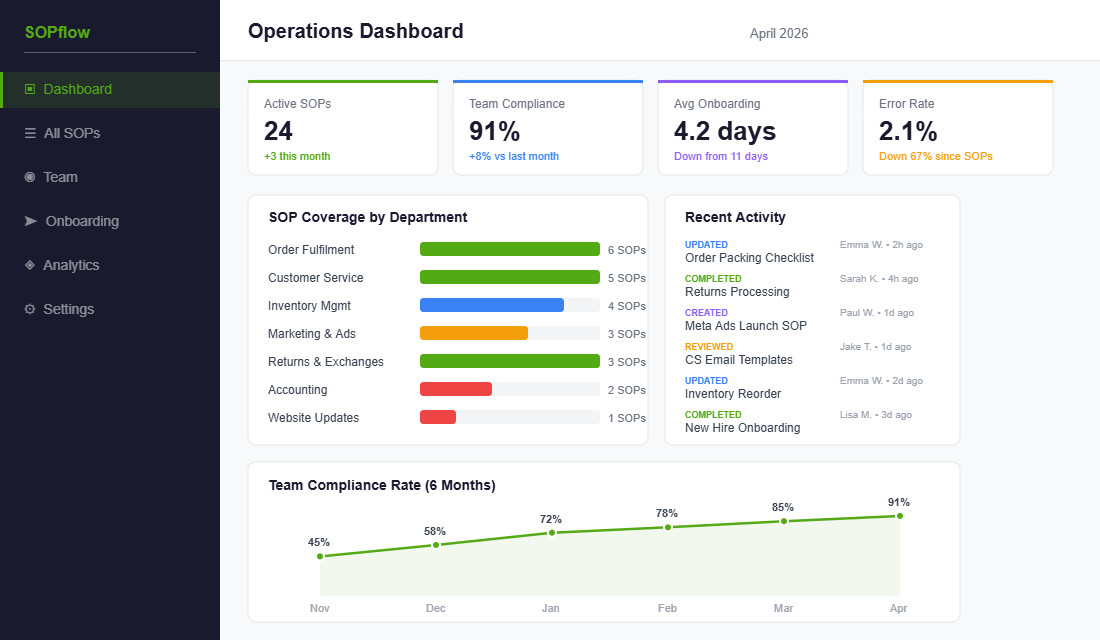
An SOP isn’t a vague job description pinned to a Notion page nobody reads. It’s a step-by-step instruction set that lets anyone on your team complete a task to your standard — without needing to ask you how.
Think of it like a recipe. A great recipe doesn’t just say “make pasta.” It tells you exactly how much water, what temperature, how long to cook, and what to do if the sauce splits. Your ecommerce operations need the same level of clarity.
The mistake most founders make? They try to document everything at once, get overwhelmed, and abandon the project after two SOPs. Or worse, they write high-level overviews that are too vague to actually follow. A good SOP is specific enough that a brand-new team member could complete the task on their first day with zero supervision.
The 7 SOPs Every Ecommerce Store Needs First
You don’t need 50 SOPs to start seeing results. You need seven. These are the processes that eat the most founder time and create the most errors when done inconsistently.
1. Order Fulfilment (Pick, Pack, Ship)
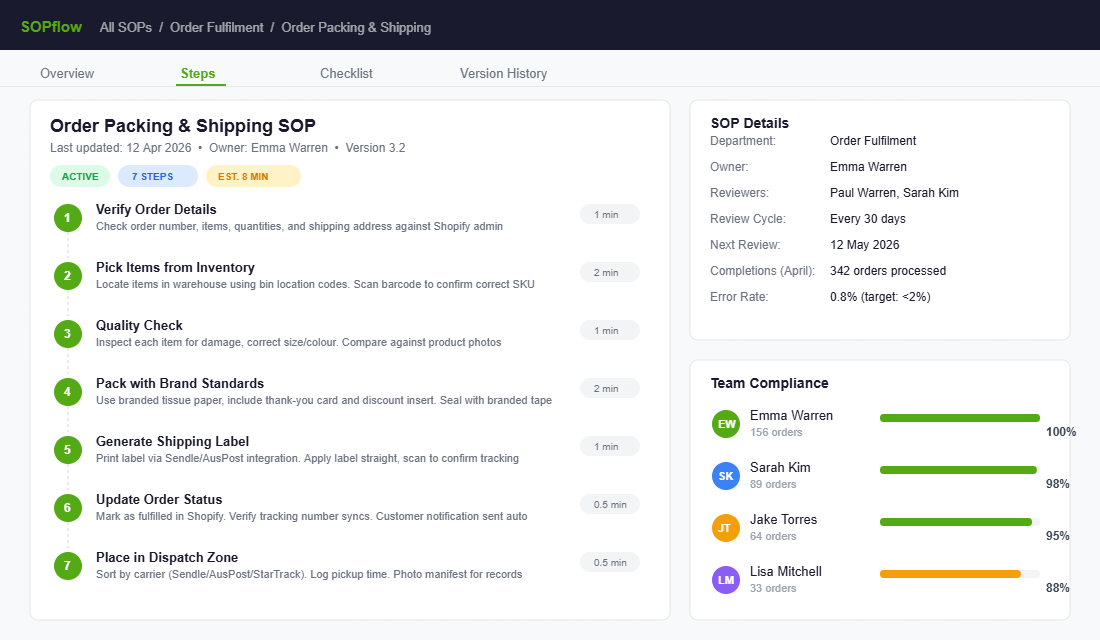
This is your number one SOP. Every order that leaves your warehouse is a brand touchpoint. Document exactly how items get picked (including bin locations or SKU scanning), your packing standards (branded tissue paper, thank-you cards, correct box sizes), label printing steps, and how to mark orders as fulfilled in Shopify. Include a quality check step — the Aberdeen Group found that companies with standardised operations are 19% more likely to deliver quality products consistently.
2. Returns and Exchanges Processing
A clear returns SOP prevents your team from making up policy on the fly — which is how you end up refunding customers who shouldn’t get refunds and frustrating customers who should. Document your return window, condition requirements, refund vs. store credit rules, restocking process, and how to update inventory in Shopify after a return is processed.
3. Customer Service Response Templates
Your CS team should never be writing emails from scratch for common queries. Build an SOP with templates for: order status enquiries, shipping delays, damaged items, return requests, product questions, and complaint escalation. Include the exact tone and language you want used. Brands that standardise their CS responses see resolution times drop by 30–40%.
4. Inventory Reorder and Stock Management
Running out of a best-seller is one of the most expensive mistakes in ecommerce. Your inventory SOP should cover reorder point calculations, lead time buffers, how to run a weekly stock check, and the process for flagging slow-moving stock. If you’re using a tool like Stocky or Inventory Planner inside Shopify, document the exact workflow. For a deeper look at this, check out our guide to inventory forecasting for Shopify.
5. New Product Launch Checklist
Every product launch has dozens of moving parts — photography, copywriting, collection page updates, email announcements, social posts, ad creative, inventory setup. Without an SOP, something always gets missed. Build a launch checklist that covers every step from “product sample approved” to “live and promoted across all channels.”
6. Weekly Reporting and Review
Your team should be pulling the same metrics, in the same format, at the same time every week. Document which reports to pull (Shopify analytics, Google Analytics 4, ad platform dashboards), what metrics matter, and where to log them. This SOP turns your weekly review from a scramble into a 20-minute rhythm.
7. New Team Member Onboarding
This is the SOP that makes all your other SOPs work. Research shows that structured onboarding helps new employees reach full productivity 50% faster. Your onboarding SOP should include: accounts and tools to set up on day one, which SOPs to complete in what order, who their go-to person is for questions, and checkpoints at day 3, day 7, and day 14. If you’re building a remote team, pair this with our guide on managing a remote ecommerce team.
How to Write an SOP Your Team Will Actually Follow
The biggest reason SOPs fail isn’t that they don’t exist — it’s that they’re written like legal documents nobody wants to read. Here’s the format that works for ecommerce teams:
Title and purpose. Name the SOP clearly (“Order Packing and Shipping” not “Fulfilment Process v2.3”). Add one sentence explaining why this process matters.
Scope and owner. Who is responsible for this process? Who reviews it? How often should it be updated? Assign a single owner — shared ownership means no ownership.
Numbered steps with detail. Each step should be one specific action. “Process the return” is too vague. “Open the Returns tab in Shopify Admin, locate the order by number, click ‘Return Items’, select the items being returned, choose refund method (original payment or store credit per policy), and click Submit” is what your team needs.
Screenshots or Loom videos. A 2-minute screen recording is worth 2,000 words of written instructions. Record yourself doing the task, narrate as you go, and embed the link in the SOP. Tools like Loom or Tango make this almost effortless — Tango even auto-captures screenshots as you click through a process.
Edge cases and escalation. What happens when things go wrong? Include a “What to do if…” section. If an item is out of stock during packing, if a customer wants to return outside the window, if a shipping label fails to print. These are the situations where your team currently comes to you. Document the answers once, and you’re free.
The Tools That Make SOP Creation Fast
You don’t need fancy software to start — a shared Google Doc works for your first few SOPs. But as your library grows, dedicated tools make a real difference.
Trainual is purpose-built for small businesses and ecommerce teams. It combines SOP documentation with employee training and onboarding. You create “subjects” (your SOPs), assign them to roles, and track who’s completed what. New hires get a structured learning path instead of a chaotic first week. Setup takes about an hour: create your company account, define your roles, import your first three SOPs, and invite your team. Plans start around $250 AUD/month for small teams.
Notion is a strong free option if you’re already using it for project management. Create a database of SOPs with properties for department, owner, review date, and status. The downside is that Notion doesn’t have built-in training tracking, so you’ll need to manually verify your team has read and understood each SOP.
Loom + Tango are perfect companions for visual SOPs. Record yourself walking through a process in Loom, then use Tango to auto-generate a step-by-step screenshot guide. Together, they cover both the “show me” and “give me a checklist” learning styles. Loom’s Business plan runs about $20 AUD/user per month.
How SOPs Turn Onboarding from Chaos to a System
Here’s where the compound effect kicks in. Without SOPs, every new hire takes 2-3 weeks of your time before they’re semi-independent. With SOPs, that drops to days.
Organisations with structured onboarding programs see 82% higher employee retention and 70% greater productivity from new hires. That’s not a marginal improvement — it’s transformational for a small ecommerce team where every person matters.
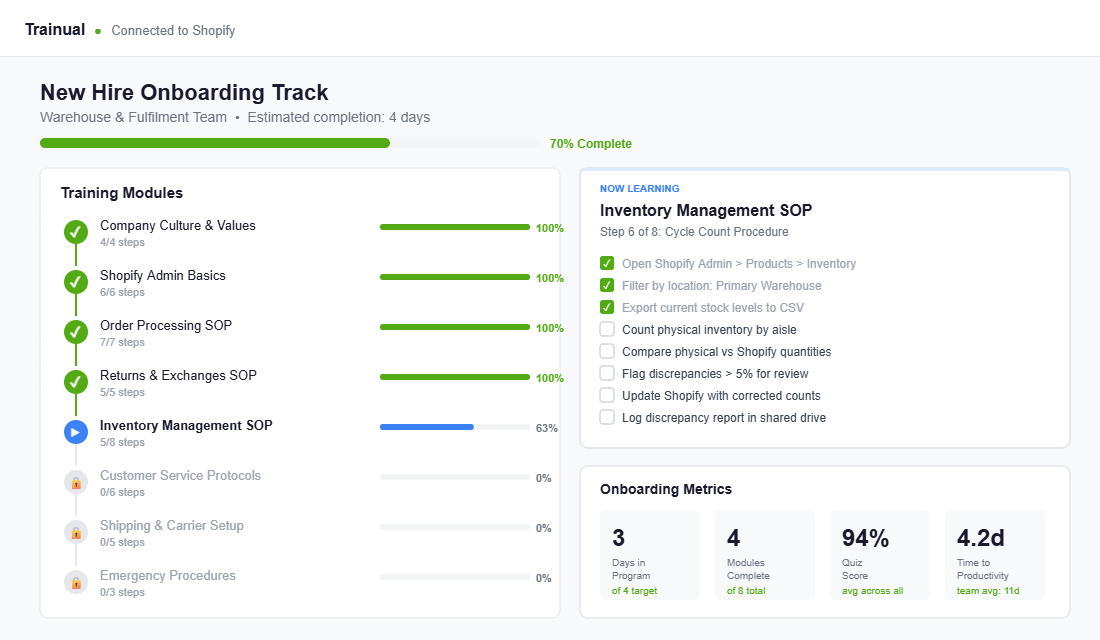
Think about what this means for your business. If you’re hiring a virtual assistant to handle customer service, instead of spending 15 hours training them over Zoom, you point them to your onboarding track. They work through the Customer Service SOP, the Returns SOP, and the Escalation SOP at their own pace. They take a quiz or do a practice run. By day three, they’re handling real tickets — and they’re doing it your way, because the system taught them your way.
Australian fashion brand LSKD scaled from a small operation to handling 19,000 shoppers during a single Black Friday event on Shopify Plus. That kind of scale doesn’t happen with tribal knowledge. It happens when every team member knows exactly what to do because the systems are documented and trained.
The 30-Day SOP Sprint: Your Implementation Framework
Don’t try to document your entire business in a weekend. Use this 30-day framework instead:
Week 1: Audit and prioritise. List every repeating task in your business. Rank them by frequency and impact. Pick the top 3 — these are your first SOPs. For most stores, it’ll be order fulfilment, customer service responses, and returns processing.
Week 2: Document your first 3 SOPs. Use the format above. Don’t aim for perfection — aim for “good enough that someone else could follow this.” Record a Loom video of yourself doing each process as you write the steps. Budget 60-90 minutes per SOP.
Week 3: Test and refine. Have a team member (or your new VA) complete each SOP without any help from you. Watch where they get stuck. Those sticking points are your gaps — fill them in. This feedback loop is what turns a decent SOP into a bulletproof one.
Week 4: Expand and systematise. Add your next 3-4 SOPs (inventory management, product launches, weekly reporting, onboarding). Set up a central SOP library — whether that’s Trainual, Notion, or a simple shared Google Drive folder. Assign an owner and a 30-day review date to each SOP.
By the end of 30 days, you’ll have 6-7 core SOPs covering 80% of your daily operations. The other 20% can be documented as you go.
SOPs Are Your Scaling Engine
Here’s what changes when your business runs on SOPs instead of running on you:
You stop being the bottleneck. Your team can make decisions and complete tasks without waiting for your input. Orders go out while you’re in a meeting. Returns get processed while you’re on holiday.
Quality becomes consistent. Every order gets packed the same way. Every customer email hits the same tone. Every return follows the same policy. That consistency builds customer trust and reduces expensive errors.
Hiring becomes faster. When the training is built into the system, new hires ramp up in days instead of weeks. You’re no longer limited to hiring people with prior ecommerce experience — you can hire for attitude and train for skill.
Your business becomes valuable. A business that depends on the founder’s brain isn’t sellable. A business with documented systems, trained teams, and predictable operations is. Even if you never plan to sell, building a business that could run without you is the definition of a real asset.
SOPs aren’t glamorous. They won’t go viral on Instagram. But they’re the invisible infrastructure that separates ecommerce brands that plateau at $50K/month from brands that scale to $500K and beyond — without the founder working 60-hour weeks to hold it all together.
How to Measure Whether Your SOPs Are Actually Working
Building SOPs is only half the equation. You also need to know whether they are delivering results. Here are three metrics to track monthly:
Time to competency for new hires. Before SOPs, how long did it take a new team member to handle tasks independently? After SOPs, how long? Track this for every role. The goal is to cut ramp-up time by at least 50%. If your returns processing SOP means a new VA handles returns solo by day 3 instead of day 14, that is a measurable win worth thousands in saved training time.
Error rates by process. Track mistakes per week for each documented process — wrong items shipped, incorrect refunds issued, missed launch steps. Well-implemented SOPs typically reduce process errors by 30–50% within the first month. If errors are not declining, the SOP needs refinement, not the person.
Founder hours reclaimed. Keep a simple log of how many hours per week you spend answering questions that should be covered by SOPs. This number should trend toward zero over 30–60 days. Every hour you reclaim is an hour you can spend on growth strategy, product development, or simply stepping away from the business without things falling apart.
Review these metrics monthly. If a specific SOP is not reducing questions or errors, sit with the team member who uses it most and watch them follow it. The gaps will become obvious — and filling them is a 15-minute fix that pays dividends every day. For a broader framework on tracking operational performance, see our guide on the ecommerce delegation playbook.
What Skipping SOPs Actually Costs You (In Dollars, Not Vibes)
If SOPs still feel like homework you can put off, run this maths on your own business. At $1M a year in revenue, your time as a founder is worth $75 to $150 an hour on the work only you can do. Most owners we coach are spending 12 to 15 hours a week answering questions their team has asked before. That is $50,000 to $100,000 a year of founder time spent being a human FAQ.
The benchmarks worth knowing before you start:
- Documented onboarding cuts ramp time by 50-60%. A new hire who takes six weeks to become useful with tribal knowledge takes two to three weeks with written SOPs and screen recordings.
- Fulfilment error rates drop below 1% once pick-pack-ship is documented with photos. Stores running on memory typically sit at 2-4%, and every mispick costs you postage twice plus a customer’s trust.
- Owner interruptions should fall by two-thirds within 60 days. Track it: count the questions you answer this week, build your top 7 SOPs, count again in month two.
- Tool cost is trivial next to the payoff. Notion is free for small teams (around $15 per user beyond that), Loom’s free tier covers 25 videos, SweetProcess runs about $99 USD a month, and Trainual starts around $300 a month for bigger teams. Even the dearest option costs less than one hour a week of your time.
Imagine you run an apparel brand in Brisbane doing $150K a month with a team of four. Your 3PL misships spike every time a casual covers the warehouse, your customer service tone changes depending on who answers, and your weekly reporting only happens when you personally build the spreadsheet. Three SOPs fix all of it, and each one takes under two hours to write using the format above. That is a single quiet Friday afternoon in exchange for getting your weekends back.
Ready to Build the Systems Behind Your Growth?
Inside the eCommerce Circle, operational systems and SOPs are one of the core pillars we work on with every member under our Practice framework. We help Shopify store owners build the processes, teams, and rhythms that turn owner-dependent businesses into scalable operations. If you’re ready to stop being the bottleneck, let’s talk.