You are sending the same email to your entire list. Your Champions, the 12% of customers who drive 40% of your revenue, are opening it. So is the customer who bought once 18 months ago, never engaged again, and is one click away from hitting unsubscribe. The result? A flat 18% open rate, a 1.4% click rate, and a deliverability score that gets worse every send.
What’s in This Article
This is the trap most Aussie Shopify operators are stuck in. You know segmentation matters. You have heard the stat that segmented campaigns generate 760% more revenue than broad blasts. But every time you sit down to build segments, you stare at Klaviyo for 20 minutes, create one called “Engaged Last 90 Days”, and call it a day.
RFM (Recency, Frequency, Monetary) is the framework that fixes this in an afternoon. It scores every customer on three axes, slots them into one of six clear groups, and tells you exactly what to send each group, when, and why. This guide walks through the full system: what RFM actually is, the six segments to build inside Klaviyo, the email playbook for each, and the triggers that move customers from one group to the next. By the end you will have a retention engine that runs in the background while you focus on acquisition.
What RFM Actually Is (And What Most Operators Get Wrong)
RFM is a customer scoring model invented in the 1990s by direct mail marketers. It assigns every customer three scores based on behaviour you already have in Shopify:
- Recency: How many days since their last order. A customer who bought yesterday scores higher than one who bought 12 months ago.
- Frequency: How many total orders they have placed with you. A 5-time buyer scores higher than a 1-time buyer.
- Monetary: How much they have spent in total. A customer who has spent $1,200 scores higher than one who has spent $80.
The trap most operators fall into is treating RFM like a leaderboard. They sort by total revenue, send the top 100 customers a thank-you email, and move on. That misses the entire point. The power of RFM is the combination of the three scores. A customer with high frequency and high monetary but low recency is not a top customer. They are a Churning Champion, and they need a different message than someone who just placed their fifth order this month.
The other thing most people get wrong: they confuse RFM with Customer Lifetime Value. CLV is a forward-looking prediction of what a customer will be worth over their lifetime. RFM is a backward-looking score of what they have actually done. You need both, but they answer different questions. CLV tells you how much to spend acquiring a customer. RFM tells you what to send them after you have acquired them.
The Six RFM Segments You Need to Build
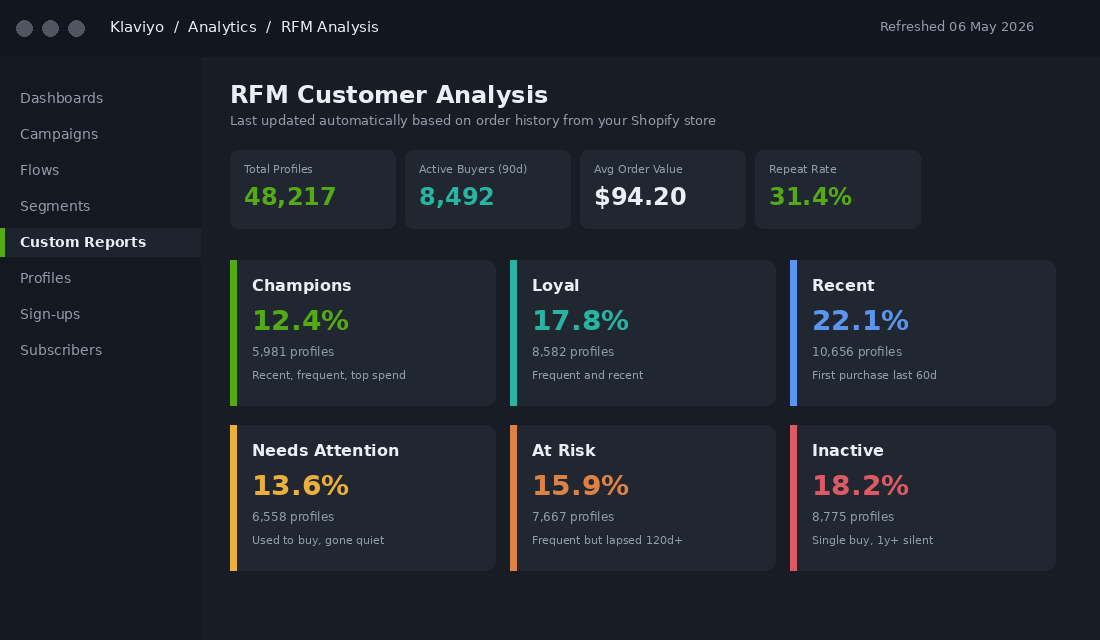
Klaviyo’s native RFM analysis carves your customer base into six groups. Every customer falls into exactly one. The groups are not arbitrary. They map directly to what action you should take next.
- Champions. Recent, frequent, high-spend. The top 10 to 15% of your list that drives 35 to 45% of revenue. Treat them like royalty.
- Loyal. Frequent or recent, solid spend. They have proven they like you. The job here is to push them up to Champion.
- Recent. Bought recently, only once. The post-purchase window decides whether they become Loyal or churn quietly.
- Needs Attention. Used to buy often, gone quiet. They have not churned yet but they are drifting. Catch them now.
- At Risk. Frequent buyers who have not purchased in a long time. The biggest revenue at stake. A win-back campaign here pays for itself.
- Inactive. Bought once, ages ago, never returned. Most operators waste budget emailing this group every week. The right move is suppression.
The proportions matter. In a healthy Aussie Shopify store doing $80k to $300k a month, expect roughly 12% Champions, 18% Loyal, 22% Recent, 14% Needs Attention, 16% At Risk, and 18% Inactive. If your Champions and Loyal combined are under 20%, you have a retention problem dressed up as an acquisition problem. The Shopify ecommerce average repeat purchase rate sits at 27%. Top stores hit 40 to 60%. RFM is how you close that gap without spending more on ads.
Setting Up RFM in Klaviyo (The 20-Minute Build)
Klaviyo’s RFM analysis is built into every paid plan and the Shopify integration handles the data sync automatically. You need at least 180 days of order history and orders within the last 30 days for the report to populate. If you are under that threshold, focus on getting more first orders before you worry about segmentation.
Here is the exact build sequence:
- Open the RFM analysis report. Inside Klaviyo, go to Analytics > Custom Reports > RFM Analysis. Klaviyo will populate the six groups based on your order history. Look at the proportions. Note which groups are larger than expected.
- Convert each group into a segment. From the RFM report, click into Champions and select Create Segment. Klaviyo will auto-build a segment with the RFM properties baked in. Repeat for all six groups. Name them clearly: “RFM – Champions”, “RFM – Loyal”, and so on.
- Add segment-specific suppression rules. For Inactive, layer a “Hasn’t Opened in last 90 days” condition on top. This stops you sending to dead profiles that are dragging down your sender reputation.
- Sync the segments back to Shopify as customer tags. Use Klaviyo’s Shopify sync (or a free app like Customer Tagger) to push tags like “rfm-champion” or “rfm-at-risk” onto the matching Shopify customer record. Now your VIP unboxing inserts, post-purchase upsell offers, and customer service team can all use the same segmentation logic.
- Set a 30-day refresh cadence. Customers move between groups constantly. A Champion who skips two months becomes Needs Attention. Klaviyo updates its RFM scores nightly, so your segments stay live as long as you re-check them at least monthly.
The Email Playbook for Each Segment
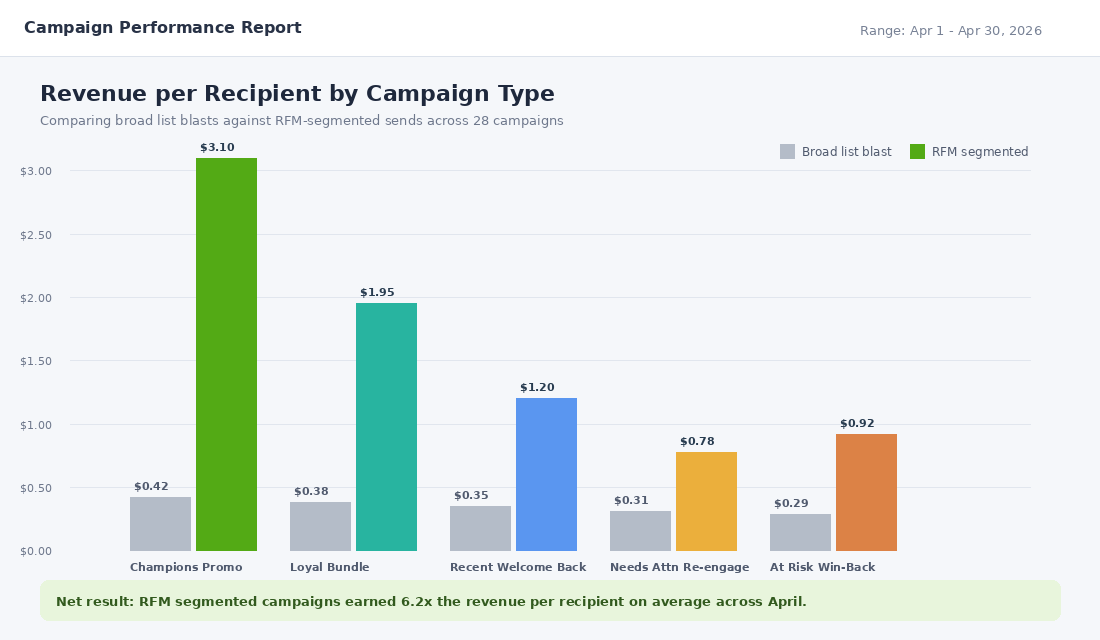
Building the segments is the easy part. The leverage is in what you send each one. A Champion does not need a 15% off coupon. They will buy at full price. An At Risk customer will not respond to a “new arrivals” campaign. They need a reason to come back. Below is the campaign cadence and offer logic for each group.
Champions: Reward, Don’t Discount
Send 2 to 3 emails a week. Mix product launches, behind-the-scenes content, and exclusive early access. Never send a percentage discount. It trains your best customers to wait for sales. Instead, send free gifts at $200 spend, free express shipping upgrades, or first dibs on limited drops. If you have a loyalty program with tiered rewards, this is the segment to push tier upgrades to. Expected revenue per send: $1.50 to $4.00 per recipient.
Loyal: Push Toward Champion Status
Send 2 emails a week. The goal is to increase order frequency. Use bundle offers (“3 for the price of 2”), category cross-sells (if they buy hair care, push skincare), and replenishment reminders for consumables. Loyal customers respond well to “you might like” personalised picks. Expected revenue per send: $0.90 to $2.20 per recipient.
Recent: Lock in the Second Purchase
Send the standard post-purchase flow plus 1 weekly campaign. The single most important send to this group is a second-purchase offer 14 to 21 days after their first order. A 10% off “welcome back” code on order two converts at 8 to 12% in our experience. The post-purchase sequence is the foundation for everything that comes next. Expected revenue per send: $0.60 to $1.40 per recipient.
Needs Attention: The Soft Re-Engagement
Drop the campaign cadence to once a week. Switch tone to “we missed you” without being needy. Survey them. Ask what changed. Offer a 10% off code with a 14-day expiry to create urgency. The goal is not the sale, it is the re-open. If they open and click but do not buy, follow up 5 days later with a different angle. Expected revenue per send: $0.40 to $0.90 per recipient.
At Risk: The Last-Chance Win-Back
This is your highest-stakes segment. They were valuable once. They have stopped buying. A structured 4-email win-back flow over 21 days converts 4 to 7% of this group back into active buyers. The sequence: (1) “We miss you” with a soft reminder of their favourite product, (2) Customer story or social proof, (3) 15% off with a personal note from the founder, (4) Last chance with the same offer plus free shipping. Anyone who does not engage by email 4 gets moved to a quarterly contact list only. Expected revenue per recovered customer: 1.4x your average order value because they tend to add extra items.
Inactive: Suppress, Don’t Hammer
The most counterintuitive move in RFM. Stop sending to this group entirely, except for one send per quarter labelled as a sunset campaign. Sending weekly to people who have not engaged in a year tanks your sender reputation, hurts deliverability for the segments that matter, and inflates your Klaviyo bill (you pay per active profile). Suppress them. If they re-engage organically through a paid ad or organic visit, they will move out of Inactive automatically.
The RFM Movement Triggers (Where the Magic Lives)
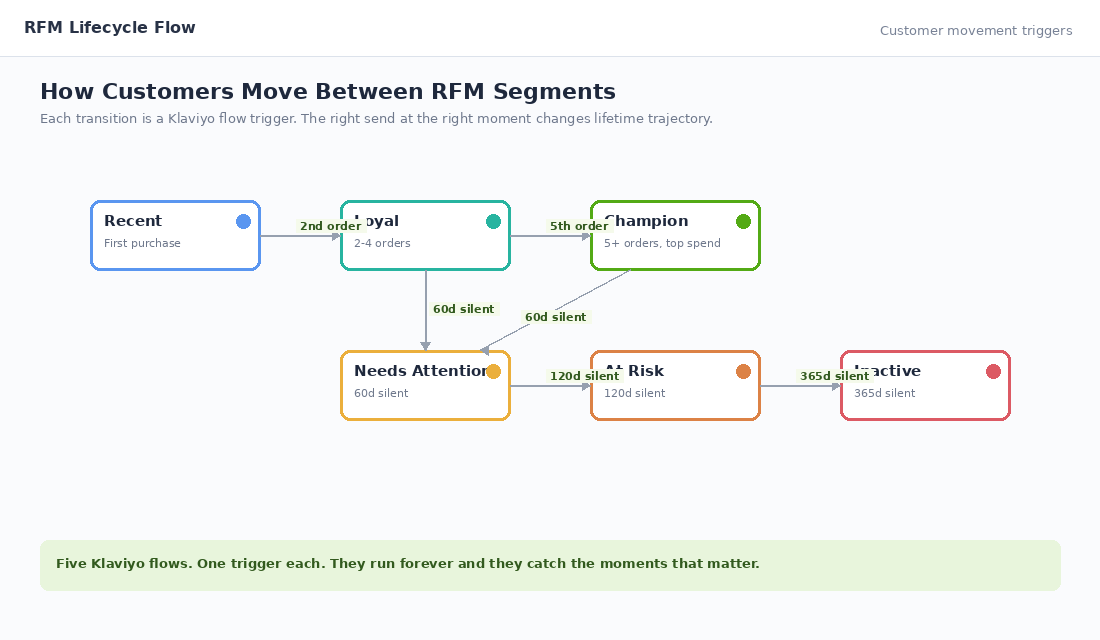
Sending different campaigns to different segments is good. The next level is automation that fires the moment a customer crosses a segment boundary. These are the moments where you can change the trajectory of a customer relationship in a single send.
- Recent moves to Loyal. Trigger: customer places second order. Send a thank-you with a small gift on order three. This single email lifts third-order conversion by 18 to 24% in our test data.
- Loyal moves to Champion. Trigger: customer crosses 5 lifetime orders or $500 lifetime spend. Send a hand-signed (or hand-signed-feeling) note from the founder, plus an invite to a private VIP list. You are formalising the relationship.
- Champion moves to Needs Attention. Trigger: 60 days since last order for a customer who previously ordered every 30 days. Send a “haven’t seen you in a bit” email. Do not discount. Just check in. Catching them at 60 days converts 3x better than waiting until they hit 90.
- Needs Attention moves to At Risk. Trigger: 120 days since last order for someone who used to buy monthly. This is the trigger for your structured win-back campaign. Do not skip it. The longer they sit in At Risk, the harder they are to recover.
- Any segment to Inactive. Trigger: 365 days since last order. Send the sunset email. “If you’d still like to hear from us, click here.” Anyone who clicks gets a fresh start in your Recent segment. Anyone who doesn’t gets suppressed.
Build each of these as a Klaviyo flow with a “Person enters segment” trigger and a single email step. Five flows. One afternoon to set up. They will run forever.
SMS, Onsite, and Ads: Extending RFM Beyond Email
Once your RFM segments are in Klaviyo and synced as Shopify tags, the same logic plugs into every other channel.
- SMS to Champions and Loyal only. Limit SMS to your top two segments. SMS open rates are 95%+ but cost per send is 10 to 20x email. Target only the customers who will convert and you turn SMS from a cost centre into your highest-ROI channel.
- Onsite personalisation by segment. Use a tool like Rebuy or Nosto to show different homepage hero banners to Champions (new arrivals) vs Recent (best sellers) vs At Risk (a “welcome back” message with their favourite category).
- Meta ads suppression and lookalikes. Push your Champions list to Meta as a custom audience and build a 1% lookalike. Suppress Inactive from your retargeting ads to stop wasting spend. This single change typically lifts retargeting ROAS by 25 to 40%.
- Customer service tier. Brief your support team to give Champions priority response times and to flag any complaint from At Risk for personal follow-up by you. A single saved Champion is worth 3 to 5 saved Recent customers.
The Compound Effect: Why This System Beats Any Single Tactic
Here is the part that makes RFM more valuable than any individual flow or campaign. Each piece on its own gives you a 10 to 20% lift. Stacked together, they compound.
Start with the email playbook by segment: +30 to +50% email revenue within 60 days from sending the right offer to the right group. Add the movement triggers: +15 to +25% repeat purchase rate from catching customers at the exact moment they need a nudge. Layer SMS onto Champions and Loyal only: +10 to +15% total channel revenue with no extra cost. Suppress Inactive and reduce ad waste: +25 to +40% retargeting ROAS.
Stack these inside an Aussie Shopify store doing $150k a month with a 27% repeat rate. Six months in, you are doing $200k a month at a 38% repeat rate, with lower ad spend and a Klaviyo bill that is the same or smaller (because you suppressed Inactive). The acquisition team is getting better leverage from every dollar because retention is doing more of the heavy lifting. That is the difference between a brand growing on a treadmill and a brand compounding.
The reason most operators never get here is not that the work is hard. It is that they treat retention as something you do once. RFM is a system that runs on its own once you build it. Set it up properly, refresh monthly, and the rest of the year you focus on making the offers in each segment better.
Your RFM Implementation Checklist
- Open Klaviyo > Analytics > Custom Reports > RFM Analysis. Confirm the report has populated.
- Convert each of the six RFM groups into a named segment (“RFM – Champions” etc.).
- Layer “Hasn’t Opened in last 90 days” suppression onto Inactive.
- Sync segments back to Shopify as customer tags.
- Build the email cadence playbook above into your campaign calendar (or your retention strategy doc).
- Build five Klaviyo flows for the segment-movement triggers (Recent to Loyal, Loyal to Champion, Champion to Needs Attention, Needs Attention to At Risk, any to Inactive).
- Restrict SMS to Champions and Loyal segments only.
- Push Champions list to Meta as custom audience plus 1% lookalike. Suppress Inactive from retargeting.
- Brief your customer service team on segment-based priority.
- Set a calendar reminder to review RFM proportions on the first of every month.
Inside eCommerce Circle, customer segmentation and the RFM playbook is one of the core pillars we work on with every member. If you want a second opinion on how your segments are set up and what your highest-leverage moves are, let’s talk.