The truth most Aussie consumable brands refuse to face: your first sale was the easy one.
What’s in This Article
You spent $40 to $80 in ads to acquire that customer. They bought your 30-day skincare bottle, your 60-pack of bamboo toilet paper, your bag of single-origin coffee. They liked it. They told a friend.
And then, six weeks later, they ran out. And someone else got the reorder.
Sometimes it was Amazon, where they could click once and have it tomorrow. Sometimes it was the Coles aisle, because they happened to walk past a substitute. Often it was just a different brand they remembered seeing on Instagram. The point is, it was not you.
This is the single biggest unforced error in Aussie ecommerce, and it shows up in every retention dashboard I open with members. Annual ecommerce churn sits at 70 to 75% across the board. Your customer base evaporates each year, and the only reason most stores stay flat is they keep paying Meta to refill the leak.
A replenishment flow stops the leak. It is the single highest-converting email automation in your account, with category benchmarks of 10 to 20% click-to-buy. Listrak’s lifecycle data put replenishment reminders at the top of the click-to-open rate chart, ahead of welcome, browse abandonment, and post-purchase. Once you stack it with Klaviyo’s predictive analytics and a soft subscription path, the math compounds in your favour every month.
This is the playbook we run with consumable brands inside eCommerce Circle. Five stages, real timing, real copy templates, real Aussie examples. By the time you finish reading, you will know exactly when to send the first reminder, what to say in it, and how to convert your one-time buyers into repeat orders that show up on a predictable cadence.
What a Replenishment Flow Actually Is (and Why It Is Not a Post-Purchase Email)
Most Aussie founders conflate two flows that should never live in the same automation. The post-purchase flow is what fires in the first 30 days after order: thank you, delivery confirmation, product education, review request, soft cross-sell. Its job is to make the customer feel taken care of and to set up the second order conceptually.
A replenishment flow is different. It fires 7 to 30 days before the predicted run-out date for the specific product they bought. Its only job is to land the reorder. If your post-purchase flow does its job, your reader trusts you. Replenishment is the message that arrives at the exact moment they are running low and reminds them to refill from you instead of typing your product name into Amazon.
The difference matters because the trigger logic is completely different. Post-purchase is triggered by the order placement event with delays measured in days. Replenishment is triggered by a calculated date that depends on the SKU. A bottle of Frank Body coffee scrub lasts about 30 days at one use per shower. A 48-roll bundle of Who Gives a Crap lasts roughly 60 to 90 days for a two-person household. A bag of Industry Beans coffee lasts two to three weeks at one cup per day. The flow that wins is the one that knows the difference.
Build one generic post-purchase sequence and call it your retention plan, and you will miss the reorder window for half your catalogue. The brands that win this game build per-product reorder timing into the data layer and let the flow do the work.
For a primer on the first 30 days of nurture, see our breakdown of the 7-email post-purchase sequence for Shopify. Today’s piece picks up where that one ends.
Stage 1: Map Your Reorder Windows (Per Product, Not Per Store)
The first move is unglamorous spreadsheet work. Open a Google Sheet. List every SKU you sell that is consumable. For each one, fill in three numbers:
- Estimated daily usage at typical consumption (one capsule, one shower, one cup, one wash).
- Total servings per pack.
- Predicted run-out date in days (servings divided by daily usage).
Here is what that looks like in practice for a few Aussie categories:
- Skincare cleanser, 250ml: roughly 2 to 3 pumps per use, 200 to 250 uses per bottle. The bottle lasts 75 to 100 days for once-daily users, 40 to 60 days for twice-daily users.
- Greens powder, 30 serves: 1 serve per day equals a 30-day pack. Most customers skip days, so the realistic run-out is 35 to 45 days.
- Bamboo toilet paper, 48 rolls: a two-person household uses roughly 1 roll every 2 days, so the pack lasts 90 to 100 days. A 24-roll pack is 45 to 50 days.
- Single-origin coffee, 250g: 18 to 22 cups per bag, 1 to 2 cups per day, so the bag lasts 10 to 22 days depending on the user.
- Pet food, 7kg dry: a medium dog at 150g per day finishes the bag in about 45 days.
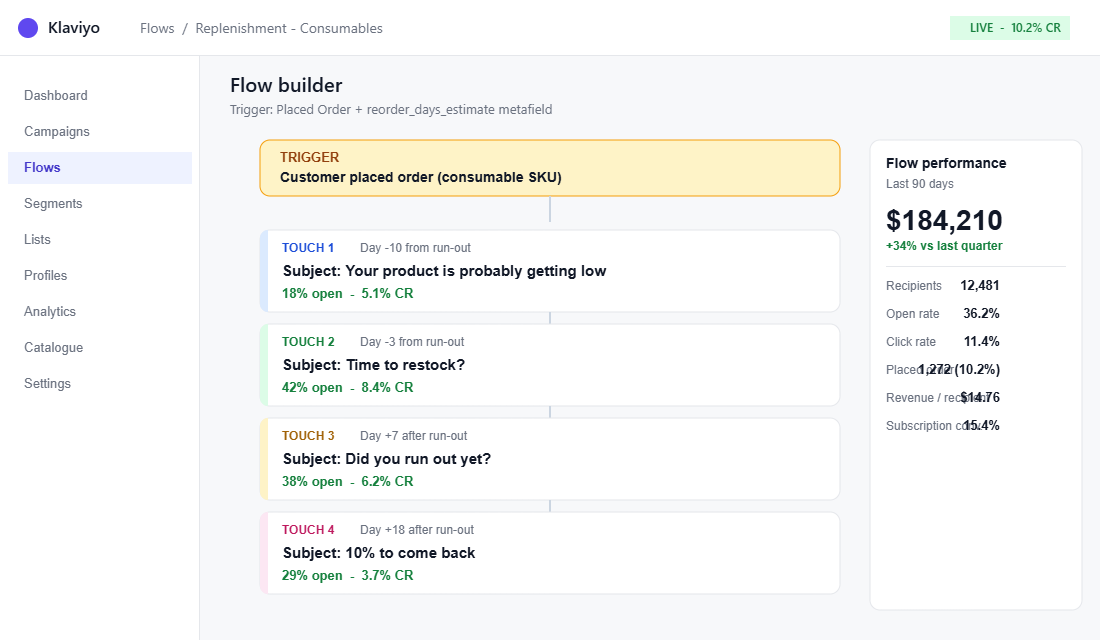
Once you have the windows, work backwards. If a customer’s product runs out in 45 days, the first replenishment email needs to land at day 35. The second at day 42. The third at day 50 (one week post-run-out, still a high-intent reorder moment). The fourth at day 65 if they have still not ordered, this time with a small incentive.
Get this number wrong and your flow either annoys customers (too early) or misses them entirely (too late). The 7 to 14 day window before predicted run-out is where intent peaks. Mass brands like Costco win this by being physically in the customer’s home. You win it by being in their inbox at the right moment.
Set up a single product metafield in Shopify called reorder_days_estimate and fill it for every SKU. This becomes the source of truth that drives your Klaviyo flow timing. If you are running a thousand-plus SKUs, fill it for your top 80% of revenue first, then catch the long tail later.

Stage 2: Build the 4-Touch Replenishment Sequence
Once you know the timing, the sequence itself is the easy part. Here is the structure that converts in the 10 to 20% range when timing is right.
Touch 1: The Gentle Reminder (day -10 from predicted run-out)
Subject line: “Your [product] is probably getting low.”
Tone: useful, not pushy. Acknowledges the purchase, references the specific product, hints at run-out.
The opening line does the work: “It has been about 35 days since your bottle of [product] arrived. If you have been using it daily, you are probably down to the last quarter. Want us to send another?” One-click reorder button. No discount. No pressure.
Touch 2: The Direct Ask (day -3 from predicted run-out)
Subject line: “Time to restock [product]?”
Tone: more direct, surfaces the friction of running out. “We figured we would check in. If you do not order this week, you are likely to run out next week. Click below and we will ship today.”
Include a star rating block and one customer review of the same product. Social proof reinforces the decision and lifts conversion by 15 to 30% on this touch in our member data.
Touch 3: The Run-Out Reminder (day +7 after predicted run-out)
Subject line: “Did you run out yet?”
Tone: warm, slightly cheeky. “We were guessing you would run out around now. If you have already grabbed a replacement from somewhere else, ignore this. If not, the same one-click reorder link is below.”
This touch is critical. The customer is now in the gap between brands. They have not refilled. They are scrolling Instagram. If you land in their inbox before they search for your product on Amazon, you keep the lifetime value. If you do not, you lose them.
Touch 4: The Soft Incentive (day +18 after predicted run-out)
Subject line: “10% to come back to your [product].”
Tone: friendly, last call. Offer a modest discount, ideally on subscription rather than a one-off. Frame the subscription option as the easier path so they never have to think about it again.
Resist the temptation to discount earlier in the flow. If you train customers that waiting 30 days past run-out earns them a 10% off code, you will erode margin on every reorder. The discount is a recovery lever for genuine lapsers, not a default offer.
Each touch is a single product email tied to a single SKU. If a customer bought three products with different reorder windows, they will receive three separate flow sequences. Klaviyo handles the orchestration in flow filters: “Has placed order with item ID X in the last 60 days” and “Has not placed order in the last 30 days” are the two filters you need.
Stage 3: Layer in Klaviyo Predictive Analytics
Once your manual timing is in place, the next compounding move is to switch from static windows to dynamic ones. Klaviyo’s predictive analytics calculate the average days between orders for each customer individually, then surface an Expected Date of Next Order (EDNO) per profile.
You need three things in place for EDNO to fire reliably: at least 500 customers who have placed orders, at least 180 days of order history, and at least some customers who have placed 3 or more orders. Most Aussie brands at $40k a month and above hit those thresholds within their first year. If you are not there yet, run static windows from Stage 1 until your data populates.
Once EDNO is populated, build a parallel flow triggered on “Expected Date of Next Order is 7 days from now.” This catches the heavy-buyer cohort whose actual cadence differs from your category average. A customer who has bought your coffee 8 times at 14-day intervals does not need a 35-day reminder. They need it on day 12. Klaviyo’s predictive layer hits that timing automatically.
The combination of a static window for new buyers (Stage 2) and a dynamic EDNO trigger for repeat buyers (Stage 3) covers your full customer base. The static layer protects the first reorder. The predictive layer protects the long tail. Together they create a self-tuning system that gets sharper every month as more order data flows in.
While you are in Klaviyo, hook up two helper metrics to your master dashboard. Average Time Between Orders by cohort tells you whether your replenishment cycle is tightening or stretching over time. CLV Predicted by cohort tells you whether your repeat layer is paying back. Both should trend up as the flow matures.
If you are still calculating CLV manually, our piece on customer lifetime value for Shopify walks through the formula step by step.
Stage 4: Convert Replenishment Buyers Into Subscribers
A replenishment email is a one-time reorder. A subscription is the same reorder, automatically, every month, with no email needed. The economics are dramatic. Subscription churn for replenishment-model products sits at 7 to 10% per month, compared to annual ecommerce churn of 70 to 75% for one-time buyers. Subscribers spend 2 to 3 times the AOV of one-off buyers because the brand stays in their household indefinitely.
This is where many Aussie brands leave money on the table. They build the replenishment flow, capture the reorder, and stop. The smart play is to use every reorder as a subscription pitch.
Inside the Touch 2 and Touch 4 emails, include a “Subscribe and save 10 to 15%” option alongside the standard reorder button. Subscription apps that integrate cleanly with Shopify include Shopify Subscriptions (native), ReCharge, Smartrr, and Loop. All four handle the conversion logic with a one-click upgrade from a standard cart.
The pitch matters. Do not lead with the discount. Lead with the convenience: “Set it and forget it. We will ship a new bottle every 30 days, you can pause or cancel anytime from your account.” The discount is the kicker, not the headline.
Aussie brands like Vital All-In-One built their subscription base off the back of this exact funnel. Customers came in via a one-time purchase, received two well-timed replenishment touches, then converted to monthly subscription at a notable rate by the third reorder. Once the customer is on subscription, they are effectively locked out of the Amazon comparison. The competitor never gets the search query.
If you want to layer this with a loyalty program, our Shopify loyalty program blueprint explains how to stack points on top of subscriptions without cannibalising margin.
The Aussie Consumables That Nail This
Three Aussie brands worth studying for replenishment execution.
Frank Body runs a tight 30 to 45 day window on its coffee scrub and exfoliant range. The replenishment emails arrive in the brand’s voice (cheeky, first-person, irreverent) and convert with subject lines like “Babe, you forgot something” and “It is bath time again.” The subscription path offers a 10% saving and free shipping, and the flow is paired with a refer-a-friend that turns each replenishment into two potential new customers.
Who Gives a Crap treats replenishment as a customer service moment, not a sale. The replenishment cycle is calibrated to household size at the point of purchase (the cart asks how many people live in your home), so the 24-roll or 48-roll reminder timing is personalised from day one. The brand’s CSR mission and tone keep the email from feeling pushy. The Give and Get refer-a-friend layer adds a viral coefficient on top.
Vital All-In-One uses a 28 to 32 day window because the product is a 30-day pack. The first reminder lands at day 22, the direct ask at day 28, and the recovery touch at day 38. The subscription option saves 15% and is positioned as the easier path. The brand’s repeat customer rate sits well above the consumables benchmark of 35%, which is a direct outcome of this discipline.
What all three share: they treat the reorder window as a product attribute, not a marketing decision. The product page knows how long the pack lasts. The customer record knows when they bought it. The flow does the rest.
The Compound Effect: 12 Months of a Running Replenishment Flow
Run the math on a $1m a year Aussie consumable brand. The acquisition layer brings in 6,000 first-time customers a year at $80 CAC each. Without a replenishment flow, roughly 25% reorder within 90 days. That is 1,500 second orders, baseline.
Switch on the four-touch flow with proper timing and the second-order rate lifts to 40 to 45%. That is 2,400 to 2,700 second orders. The difference is 900 to 1,200 extra orders at an average value of $60, which is $54,000 to $72,000 in incremental revenue with zero additional ad spend.
Layer in Stage 4 (subscription conversion) and assume 15% of replenishment buyers convert to subscription. That is 360 to 405 new subscribers locked in at $60 a month. Annualised, those subscribers throw off $260,000 to $290,000 in recurring revenue without any further ad spend, assuming a 9-month average tenure.
The total flow-driven revenue uplift for a $1m a year brand sits at roughly $310,000 to $360,000 a year. That is a 30%+ revenue lift from a single email automation that costs nothing to run once it is built. This is why every coaching call with a consumable brand inside eCommerce Circle starts with the question, “Is your replenishment flow on?” If the answer is no, the build is week one of the engagement.
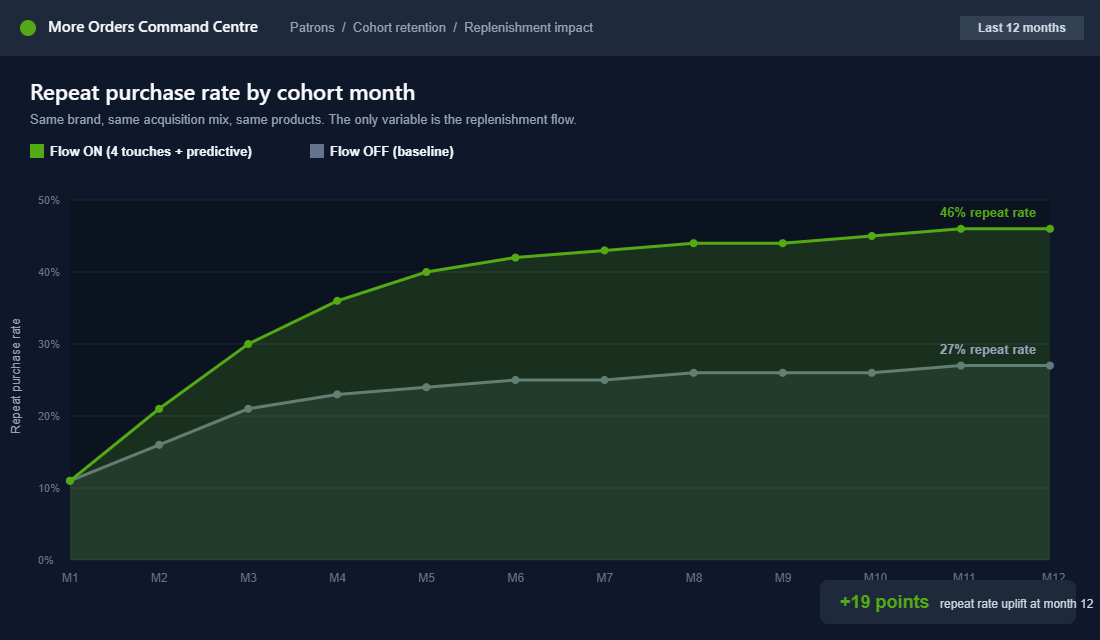
The compounding effect is what makes this so powerful. Each year the flow runs, the cohort retention curve shifts up. The CLV your finance team uses to model future spend goes up. The maximum CAC your performance team is allowed to bid goes up. Your ability to outspend competitors on Meta goes up. It all comes from sending the right email on the right day.
Common Mistakes That Kill Replenishment Performance
Five errors I see on nearly every consumable brand audit. Avoid these and your flow will outperform the benchmarks above.
- One window for the entire catalogue. If your daily-use serum and your annual ski wax sit in the same 45-day flow, both will underperform. Per-SKU timing or bust.
- Discounting in Touch 1. Discounting before the customer has shown intent erodes the margin you were going to earn anyway. Save the discount for Touch 4, post run-out.
- No exclusion for active subscribers. Subscribers should never receive a replenishment reminder. The flow filter is “Active subscription = no.” Without it, you are paying to harass your best customers.
- Generic subject lines. “Restock now” pulls a 3% click rate. “Your Frank Body Coffee Scrub is running low” pulls 11%. Product-specific subject lines are not optional.
- No measurement. If you cannot show me revenue per recipient and subscription conversion rate by cohort in 60 seconds, you cannot improve the flow. Wire those into your master dashboard before you ship.
Your Replenishment Flow Build Checklist
Use this as your launch sequence. Tick each item before declaring the flow live.
- Reorder window mapped per SKU in a master sheet and entered into Shopify product metafield
reorder_days_estimate. - Master flow built in Klaviyo with 4 touches at day -10, day -3, day +7, day +18 relative to predicted run-out.
- Per-SKU flow variants for your top 5 to 10 products with different reorder windows.
- Predictive trigger (EDNO 7 days from now) added as a parallel flow once Klaviyo predictive analytics is populated.
- Subscription upsell block added to Touch 2 and Touch 4 emails.
- One-click reorder URL generated for each SKU and embedded in every email.
- Klaviyo flow exclusion for active subscribers so subscribers never receive replenishment emails.
- Master dashboard metric added: replenishment flow revenue per month, conversion rate per touch, subscription conversion rate per cohort.
- Cohort retention chart baselined before launch so you can measure the lift.
The build takes most teams 2 to 3 weeks of focused work. The payback typically arrives in the first 60 days as the predicted run-out windows trigger for your existing customer base. The compound effect kicks in from month 4 onwards as your cohort retention curve lifts.
The Second Rail: When an SMS Beats the Reorder Email
A replenishment email lands in an inbox that already holds 40 unread messages. A replenishment SMS lands on a lock screen. For a purchase the customer has already decided to make, that difference is worth real money.
The benchmarks are not close. A well-built replenishment email typically opens at 35-45% and converts 2-4% of the send. The same message over SMS reads at 95-98% within three minutes and converts 8-15% for consumables, because the buying decision is already made and the message removes the last step. The catch is cost. In Australia you are paying roughly $0.05-$0.09 AUD per SMS segment, so a 5,000-contact send costs $250-$450 before anyone buys. Email costs you almost nothing per send.
That economics gap gives you the rule: email carries the sequence, SMS carries the moment. Do not duplicate all four touches across both channels. Pick the single touch where timing matters most and put SMS on it.
Where the SMS goes: Touch 2, the direct ask at day -3. This is the moment the customer is scraping the bottom of the jar and has not yet defaulted to Amazon or the supermarket. Everything before that is education, everything after is recovery. Day -3 is the only touch where being read in three minutes instead of nine hours changes the outcome.
Keep the message short enough to fit one segment, which is 160 characters in GSM-7. Something like: “Hi Sarah, your Daily Serum is due about now. One tap to reorder, we will have it to you Thursday: [link] Reply STOP to opt out.” Named product, implied delivery date, one link, compliant opt-out. No discount. Adding a code here trains people to wait for one, which is the fastest way to destroy the margin the flow was built to protect.
Three rules that keep the SMS rail profitable:
- Send between 10am and 6pm local time. Klaviyo and Attentive both handle Australian quiet hours, but check the timezone is set to your customer’s state and not your Shopify store default. A 7am text in Perth from a Melbourne-set store is a fast way to earn unsubscribes.
- Suppress anyone who bought in the last 14 days. The most damaging replenishment message is the one asking someone to reorder something sitting in their hallway.
- Cap the customer at one replenishment SMS per cycle. If they do not act, the email sequence picks it up. SMS fatigue shows up as list churn about six weeks before it shows up in revenue.
Measure the rail on its own, not blended. Revenue per SMS sent is the number to watch, and for consumables you want to see $0.40-$1.20 AUD against a send cost of under $0.09. If you drop below about $0.25 the list is either too broad or the timing model is wrong. Our SMS marketing playbook for Klaviyo covers list building and compliance, and the post-purchase SMS flow shows how the replenishment text fits with the rest of the lifecycle so the two do not collide.
Reading the Silence: When a Missed Reorder Is Actually a Churn Signal
The flow above tells you when to ask. It does not tell you what it means when nobody answers, and that is the more valuable signal.
For a consumable brand, a customer who sails past their predicted run-out date without reordering is not “quiet”. They have bought elsewhere, switched product, or stopped using the category. You now have a dated, product-specific churn signal that most stores never build, and it fires 60-90 days before the generic lapsed-customer segment would catch the same person.
Build the health score off the reorder window. For each customer, take their predicted reorder date and divide days-since-last-order by their expected cycle length. That ratio is your signal:
- Under 1.0 — healthy. Still inside the window. Leave them to the flow.
- 1.0 to 1.5 — at risk. They are 1 to 15 days late on a 30-day cycle. This is where a single well-timed message still recovers 20-30% of them.
- 1.5 to 2.5 — lapsing. Standard replenishment copy stops working here. Switch to a reason-to-return message, not a reminder.
- Over 2.5 — churned. Move them out of the replenishment flow entirely. Continuing to send reorder reminders to a churned customer trains your domain reputation down for nothing.
Set that ratio up as a Klaviyo profile property and you can segment on it in about twenty minutes. The at-risk band is the one worth your attention, because it is the only band where the customer still remembers you fondly.
What you send that band matters more than when. A discount is the wrong first move, because it teaches the profitable half of the band to stall next cycle. Ask a question instead. A one-line email that says “You are usually due about now. Did something change, or did the last batch just not suit?” will pull a 3-8% reply rate from at-risk consumable buyers, and those replies are the cheapest product research you will ever get. Roughly half will tell you something you can fix: a fragrance change, a pump that failed, a delivery that arrived late.
Then track the recovery rate as a metric in its own right. If you are recovering less than 15% of the at-risk band, the problem is not the message, it is upstream in product or delivery experience. Our churn prediction playbook covers the full five-signal health score this ratio feeds into, and the win-back email sequence picks up the customers who have already crossed into the churned band.
The Punchline
The brands that win in Aussie ecommerce over the next five years will not be the ones with the cleverest ads. They will be the ones who treat the reorder as a discipline, not an afterthought. Acquisition cost will keep climbing. Meta will keep getting more expensive. The only durable answer is to make every customer worth more, and the replenishment flow is the single highest-impact way to do that.
Inside eCommerce Circle, the replenishment flow is one of the core builds we work on with every consumable brand we coach. If you want a second opinion on yours, let’s talk.