Most Aussie Shopify founders treat bundles as a discount mechanism. They pick three products, slap on 20% off, build a landing page, and then wonder why their margin tanks the moment the bundle starts converting. The math gets ugly fast. A 20% bundle discount on a 55% gross margin product cuts you to 44% gross. Add Klaviyo, ad spend, and the cost of pick and pack on three units instead of one, and the bundle is often less profitable per order than just selling the hero SKU on its own.
What’s in This Article
Bundles done well do the opposite. They lift AOV by 25 to 40%, hold gross margin within a point or two of the baseline, and quietly become the highest-converting product page on the store. Sephora has been doing this for two decades. Aesop does it on every product launch. The Aussie brands that have figured it out (Frank Body, Go-To Skincare, Bondi Sands, MECCA) treat bundles as a strategic SKU category, not a promotion. That is the shift.
This article is the framework we use inside eCommerce Circle to build a bundle program that actually moves AOV. Six bundle types. The math behind each. Where to place them. The tools stack. The launch playbook. By the end you will know exactly which two or three bundle types to ship first, what to price them at, and how to forecast the AOV lift before you build a single product page.
Why Most Shopify Bundles Fail (and What the Math Actually Says)
Bundles fail for one of three reasons. The first is the discount trap. You glue three products together, drop the price 20%, and now you have shifted demand from individual product pages to a bundle SKU that earns 11 percentage points less margin per unit. If the bundle does not have a meaningfully higher conversion rate AND a higher attach rate, you have just rearranged your revenue at a lower contribution margin. That is a loss.
The second reason is the wrong basket. Operators bundle products that customers were going to buy together anyway. The repeat customer who buys cleanser, toner, and moisturiser every six weeks does not need a bundle to do that. Bundling those three only matters if you can convert a NEW customer who would otherwise buy one. Bundles should solve a discovery problem, not a logistics problem.
The third reason is no anchor. A bundle without a reference price is just a price. A bundle with a reference price (“normally $186, today $158”) triggers the contrast principle and converts 40 to 60% better. Shopify research published in 2024 found that bundle product pages with itemised pricing converted 47% higher than bundle pages showing only a final price. The anchor is what makes the saving feel real.
Run the unit economics before you build. A bundle should hit three numbers: it should lift AOV by at least 20% over baseline, it should hold gross margin within 3 percentage points of the underlying products, and it should grow attach rate by 8 to 15% on the customers it reaches. Miss any of those three and the bundle is decorative, not financial.
The 6-Type Bundle Framework (and What Each One Does)
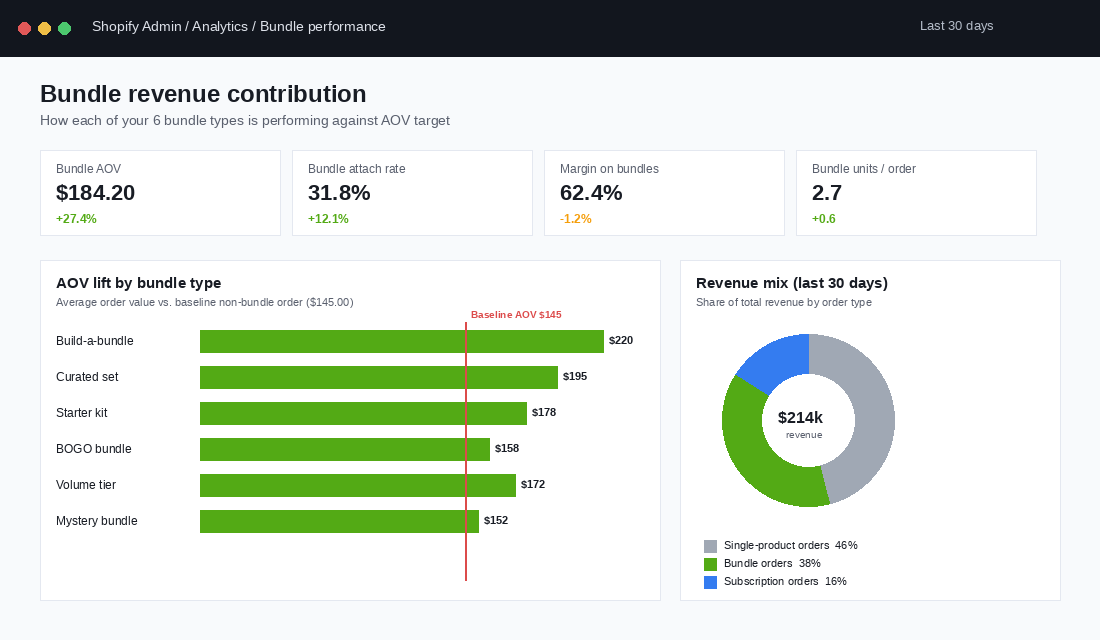
Every bundle on every Shopify store fits one of six archetypes. Each does a different job. The fastest-growing brands run three to five of these simultaneously, not one. The mistake most operators make is treating “bundle” as a single play. It is not. It is a portfolio.
Type 1: The Starter Kit
Purpose: convert new customers who do not know which product to buy first. The starter kit is a curated trio (or quartet) sized for first-use and priced 10 to 15% under the sum of parts. Frank Body’s Original Coffee Scrub starter kit is the Aussie template. The starter kit usually sits on the homepage, in the navigation, and as the first product in the first collection. It is the front door, not the back room.
AOV target: 1.4 to 1.7x baseline first-order value. Margin: hold within 2 percentage points. Attach rate among new visitors: 12 to 22% when displayed prominently.
Type 2: The Curated Set
Purpose: solve a specific use-case for an existing customer (the “weekly reset”, the “travel kit”, the “gift for him”). Curated sets are themed, not just discounted. The narrative does the work. MECCA’s pre-curated gift sets are the Aussie example. A curated set typically discounts 8 to 12% on the bundle subtotal and trades on the editorial framing, not the dollar saving.
Place curated sets on PDPs as cross-sell modules, in cart drawer add-ons, and on a dedicated /collections/sets page. Margin: usually hold within 1 percentage point because the discount is shallow. AOV lift: 1.3 to 1.5x baseline.
Type 3: The Build-a-Bundle
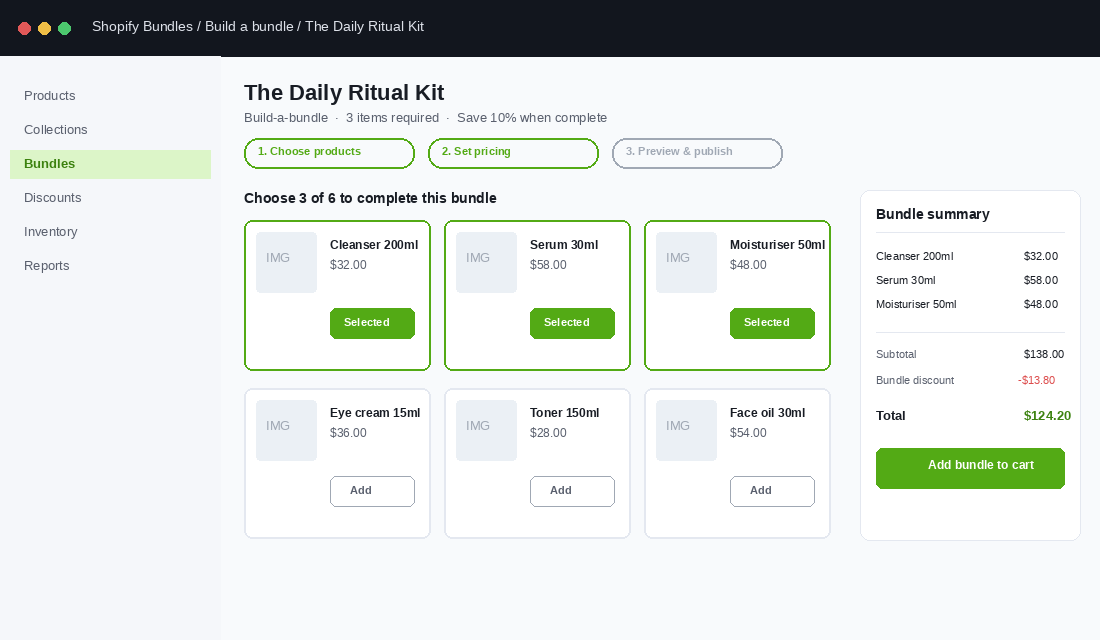
Purpose: maximise basket size while letting the customer self-select the products they actually want. Build-a-bundle is a 3 of 6, 4 of 8, or 5 of 10 picker that triggers a 10 to 15% discount when the customer hits the threshold. Bondi Sands runs a build-your-tan-bundle that lifts AOV materially. Build-a-bundle wins because it removes choice friction (curation) while preserving customer agency (selection).
Build-a-bundle has the highest AOV lift of any bundle type (often 1.6 to 2.2x baseline) but it requires real engineering. Shopify Bundles (the native app) handles the mechanics but most stores use Rebuy, Bold Bundles, or Bundler. Bundler is the Aussie favourite for stores under $300k/month.
Type 4: The BOGO Bundle
Purpose: clear slow-moving SKUs without devaluing the brand. BOGO (buy one, get one) bundles work when paired with one hero SKU and one inventory liability. Buy the hero at full price, get the slow mover at 50% off. The customer perceives a deal. You move dead stock. Margin on the hero is intact, only the slow mover is discounted.
Use BOGO bundles sparingly. Aussie founders typically run them four to six times a year, tied to inventory cycles. AOV lift: 1.4 to 1.6x. Margin trade: you accept a 15 to 25 percentage point hit on the slow SKU in exchange for moving the unit. Per-order contribution often holds because the hero carries the basket.
Type 5: The Volume Tier (Quantity Bundle)
Purpose: lift AOV on consumables and supplements where customers buy multiples anyway. Volume tier is the “buy 2, save 10%, buy 3, save 15%” structure on a single SKU. Vital Proteins, Swisse, Bulk Nutrients (Australia) all run volume tiers as the default purchase pattern. The customer feels rewarded for committing, you bank a larger basket and a longer interval between repurchase windows.
Volume tiers only work on consumables and replenishables. They do not work on apparel, homewares, or anything seasonal. AOV lift: 1.5 to 1.9x on supplements and skincare. Set tier breakpoints at 2x and 3x, never higher. Beyond 3 the discount required to motivate the buy starts eating margin.
Type 6: The Mystery / Surprise Bundle
Purpose: stress-test new SKUs and clear edge inventory while creating a community-led marketing moment. Mystery bundles are higher-effort and lower-AOV than the other five types. The Daily Edited (Aussie luxury accessories) used mystery bundles to launch new colourways. The mechanic: pay a fixed price, receive a curated selection valued at 1.5 to 2x the bundle price. Customers post unboxings. You generate UGC.
Mystery bundles deliver the lowest AOV of the six (1.1 to 1.3x baseline) but they earn their place by generating content and clearing inventory at a controlled discount. Run them quarterly at most.
The Math: How to Forecast AOV Lift Before You Build
Before you build a single bundle, run the math. A bundle is worth shipping only if it changes one of three numbers: AOV, attach rate, or margin per order. The forecast template is straightforward.
Take your baseline order. Suppose your store does 1,000 orders a month at $145 AOV. That is $145,000 in revenue. Your gross margin is 60% so contribution is $87,000.
Now suppose you ship a starter kit bundle. The kit is priced at $189 against an a-la-carte sum of $215 (a 12% bundle discount). You expect 15% of new-customer orders to convert to the bundle instead of a single product. 1,000 orders x 60% new x 15% bundle take = 90 bundle orders. Those 90 orders move from $145 single-product to $189 bundle. The other 910 stay at $145. Blended AOV becomes $148.96. AOV lift: 2.7%.
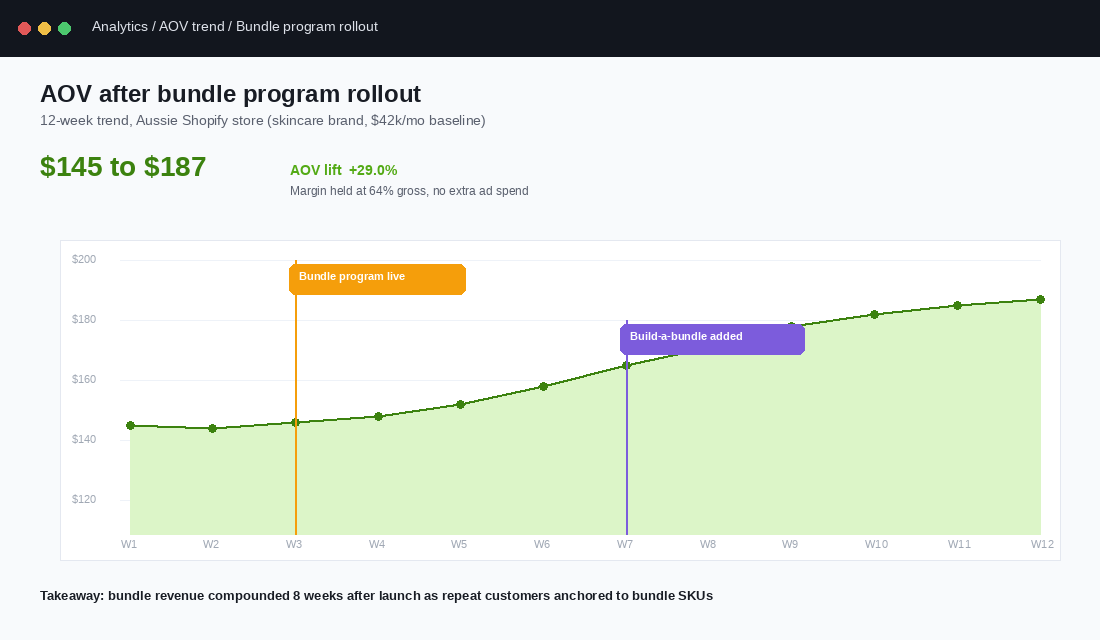
That is underwhelming. The starter kit alone moves the needle by 3%. This is why brands stack types. Add a build-a-bundle that 25% of repeat customers use at $220 (a 1.5x lift), and a volume tier on your hero SKU that 18% of orders trigger at $172. The combined blended AOV pushes to $169. That is a 16.5% AOV lift on a $145 baseline. Same traffic, same ad spend, $24,000 more revenue per month at a slightly improved gross margin (because volume tier and curated set discounts are shallower than starter kit).
Where to Place Bundles in Your Store (the Surface Map)
A bundle that nobody sees does not lift AOV. Placement is at least 40% of the result. The brands that ship bundle programs and see no lift almost always failed at surface, not at product. Here is the surface map we use inside the eCommerce Circle workshop.
- Homepage hero or sub-hero. The starter kit lives here. Image plus headline plus price anchor plus CTA. This is the front door for first-time visitors.
- Collection page (top of grid). Pin the relevant bundle to the top of each collection. Browsers see the bundle before any single SKU. Aussie brand Frank Body does this on every collection.
- PDP cross-sell module. Below the buy box on every product page, surface a curated set that includes the current product. Rebuy and Bold do this automatically.
- Cart drawer add-on. If the cart is below the build-a-bundle threshold, surface the next product needed to trigger the discount. This is where Upcart and Rebuy earn their licence fees.
- Checkout one-click upsell. Post-purchase upsell page can offer a bundle complement (“add the kit for $32 more”). Shopify’s native Checkout Extensibility enables this on Plus.
- Dedicated /collections/bundles or /collections/sets page. One URL where every bundle lives. Indexable, link-able, share-able. This becomes a real organic traffic asset over time.
- Email and SMS broadcast slots. Bundles are perfect campaign creative because they have a built-in offer narrative. Klaviyo segmentation lets you tailor bundle pitches to RFM cohorts.
If you only ship one surface, ship the PDP cross-sell module. It generates the most incremental basket lift per dollar of dev time. If you ship two, add the cart drawer add-on. Three: the homepage hero. After that, layer in the rest.
The Tools Stack (and What We Actually Use)
You do not need every bundle app. You need the right two for your stage. Here is the stack matrix.
- Shopify Bundles (free, native). Use this if you are under $50k/month and only need fixed bundles or simple build-a-bundle. It plays nicely with Shopify inventory because each bundle component is tracked at the SKU level. No app fee.
- Rebuy Engine ($99 to $499/month). The default mid-market choice. Strong PDP and cart drawer widgets, AI-driven recommendations, attribution baked in. We use Rebuy on most $100k to $500k/month Aussie stores.
- Bundler ($9 to $79/month). The Aussie founder favourite for stores under $250k/month. Lightweight, low cost, ships fixed bundles, build-a-bundle, and volume tiers. Less polished than Rebuy but a quarter of the price.
- Bold Bundles ($30 to $80/month). Solid alternative to Bundler, slightly more mature feature set, particularly for multi-currency stores.
- Upcart ($25 to $200/month). Not a bundle app, but the cart drawer that lets your build-a-bundle widget actually convert. Required infrastructure for any bundle program past the starter-kit stage.
Total monthly app spend for a healthy bundle stack: typically $130 to $250 per month at the $100k to $300k revenue band. Payback inside 7 days if the program lifts AOV even 5%.
Pricing Architecture: How Much to Discount (and When Not To)
Most operators over-discount. The bundle discount should be the smallest amount that still makes the saving feel real. Test from the bottom up, not the top down.
- Curated set: 8 to 12% discount on the sum of parts. The narrative does most of the persuasion work, the discount confirms it.
- Starter kit: 10 to 15% discount. Slightly deeper because you are converting a first-time buyer who has no anchor on your brand.
- Build-a-bundle: 10 to 15% discount, applied at threshold. The picker mechanic provides agency, the discount provides the reason to complete.
- Volume tier: 8% on tier 1 (2 units), 13 to 15% on tier 2 (3 units). Never go past 18% on volume.
- BOGO: 50% off the second item is the standard. Anything deeper devalues the lower SKU permanently.
- Mystery bundle: Price at 50 to 60% of the retail value of contents. This is the one bundle where the deep “saving” is the entire mechanic.
Never run a flat 20% off a bundle as your primary lever. That is a discount with a bundle attached, not a bundle program. The customer will train on it, repeat orders will only convert when the bundle is live, and your margin will erode every month.
The Launch Playbook: 4-Week Rollout
Most bundle programs fail in launch, not in concept. Here is the four-week rollout we run with members.
- Week 1: Audit and pick. Pull your last 12 months of order data. Identify the three or four product affinities that show up most often (which products are bought together by repeat customers, in which sequence). These become your candidate curated sets.
- Week 2: Build and price. Build the first two bundle SKUs in Shopify Bundles or your chosen app. Set itemised pricing (anchor + bundle price). Build the dedicated /collections/bundles page. Add PDP cross-sell modules.
- Week 3: Soft launch. Live to the site but not to email or paid. Watch the analytics for 7 days. Track bundle attach rate, AOV on bundle vs non-bundle orders, and gross margin per order. Confirm the unit economics match the forecast.
- Week 4: Hard launch. Klaviyo broadcast to active and lapsed cohorts. SMS to VIPs. Paid social with bundle creative. Update homepage hero. By end of week 4 the bundle should be 20 to 35% of orders.
If you are not seeing 15%+ bundle attach rate by end of week 4, the bundle is wrong. Either the basket is unfamiliar, the discount is too shallow to motivate, or the surface is too quiet. Fix the lowest-effort variable first (almost always surface), then iterate.
Measuring Bundles After Launch: The Four Numbers That Tell You the Truth
AOV is the number everyone screenshots on day three, and it is the least useful of the four. AOV can rise while profit falls, because a discounted bundle can pull customers who would have paid full price for two items into paying less for three. You need a dashboard that catches that, and Shopify Analytics will not build it for you. Here is the four-number read we run with members at 30, 60 and 90 days.
- Bundle attach rate. Orders containing a bundle divided by total orders. A healthy starter kit on the PDP lands 12 to 20% attach. Below 8% after 30 days means the bundle is badly placed or badly named, not that bundling does not work for you. Filter by traffic source too: paid social attach is usually double organic, because the ad set up the offer.
- Contribution per order, bundle vs non-bundle. Revenue minus COGS, payment fees, shipping subsidy and pick-and-pack for each group. The bundle group must win by at least $5 per order in absolute dollars, otherwise the discount is eating the AOV lift. The contribution margin playbook walks through the exact calculation and where most brands forget to count the free shipping they just triggered.
- Cannibalisation rate. Compare units of the bundle’s hero product sold at full price in the 8 weeks before launch with the 8 weeks after. If full-price units of the hero fall by more than the bundle added in new units, the bundle is repackaging demand you already had. Fix it by moving the hero out of the discounted bundle and into a build-a-bundle picker where it anchors at full price.
- Return rate on bundle orders. Bundles with a “discovery” item (a third product the customer has never tried) return at 1.5 to 2 times the rate of single-product orders, because one disliked item sends the whole box back. Watch this from week two. If bundle returns pass 8% on a category that usually runs 4%, swap the discovery item for a proven best-seller.
Build the view in a Google Sheet fed by a weekly Shopify order export, tagged by whether the order contained a bundle SKU. Thirty minutes of setup, five minutes a week to maintain. Pair it with your free shipping threshold maths, because the most common way a bundle quietly loses money is that it lands $3 under the threshold, the customer adds a cheap filler to cross it, and you pay the shipping on a lower-margin basket than the one you designed.
The Compound Effect
This is the moment most Shopify operators miss. Bundles do not just lift AOV on the day they launch. They reshape the customer’s mental model of your store. A first-time buyer who buys the starter kit converts to repeat purchase 40 to 60% more often than a first-time buyer who bought a single SKU. That is not a discount effect. That is a discovery effect.
When you bundle, you teach customers that your brand has more than one product. You expand their consideration set on purchase one. The customer who started with a single cleanser thinks of you as the cleanser brand. The customer who started with the starter kit thinks of you as the skincare brand. The second customer comes back. The first does not.
Stack that with the AOV lift on the bundle itself, and you compound twice. Higher first-order value times higher repeat probability times higher CLV per customer. By month six, the brands running a real bundle program are not 20% bigger than the brands that aren’t. They are 60 to 90% bigger. Same traffic. Same ad spend. Just a smarter SKU architecture.
Where Bundles Fit in the Bigger Picture
Bundles are one lever in a wider AOV stack. They pair with cart drawer optimisation (the cart drawer is where build-a-bundle conversions live or die) and with a strategic pricing architecture (the bundle anchor only works if your single-SKU pricing has been thought through). They feed retention through your post-purchase email sequence: the starter kit buyer needs a different sequence from the single-SKU buyer. Run the bundle program inside the wider system and the compound lift is real.
Inside eCommerce Circle, the bundle program is one of the first three projects we run with every new member trying to get past $1m/year. If you want a second opinion on your bundle stack, let’s talk.