Most Aussie Shopify founders treat PR like a lottery ticket. They send five generic pitches to Vogue, Broadsheet, and Mamamia in a single afternoon, hear nothing back for a fortnight, and quietly decide that “press doesn’t work for us.” Then they pour another $8,000 into Meta ads and call it a strategy.
What’s in This Article
Here is the part no one tells you. The average response rate on a media pitch is 3.43%. Only 8% of pitches end up as actual coverage. The journalists you are emailing get 50+ pitches a week, and 6% of them say they “always” reply. So if you fired off five emails and got crickets, you did not fail at PR. You did exactly what the data predicted.
PR is not a lottery. It is a system. The Aussie brands quietly landing features in Broadsheet, Body+Soul, Mamamia, Concrete Playground, and Smith Street are not paying $5,000 a month to a Sydney agency. They are running a four-phase playbook that takes 90 minutes a week. This article walks you through that exact system, the tools, the templates, and the compound effect that turns one feature into six. By the end you will know how to land your first piece of earned media inside 30 days, even if you have never written a press release in your life.
Why PR Still Matters for Shopify Brands in 2026
Before we get into the playbook, you need to understand what PR actually does for a Shopify store. Most founders think of it as “free press.” It is not. It is a layered asset that pays out in five different ways at once.
- Trust acceleration. 73% of consumers say a brand mentioned in a reputable publication feels more trustworthy than one running ads at them. A single Broadsheet feature can compress 12 months of trust-building into one weekend.
- SEO lift. A backlink from a domain authority 70+ publication is worth roughly 50 to 100 backlinks from random blogs. Three solid press hits a year materially shift your organic rankings.
- Ad creative. “As seen in Broadsheet” stickers on your hero image lift Meta ad CTR by 15 to 30% based on the split tests we have run inside eCommerce Circle.
- Email and SMS conversion. Welcome flows that drop a press quote in email two of the sequence convert 18 to 25% better than the same flow without it.
- Wholesale and partnership doors. David Jones, Myer, and the boutique buyers screen press coverage before they open the conversation. No press, no meeting.
Run those five effects together and a single feature in the right outlet can be worth $20,000 to $80,000 in compounding value over twelve months. That is the prize. Now here is the system that wins it.
The 4-Phase Shopify PR System
Every Aussie brand we have helped land their first press feature inside 90 days has followed the same four phases. Skip a phase and your hit rate collapses. Run all four and you will land your first feature in 30 days, and 6 to 12 per year without an agency.
- Phase 1: Press Kit Foundation. Build the assets every journalist asks for before they will write about you.
- Phase 2: The Hit List. Identify the 30 to 50 journalists who actually cover your category. Not the masthead. The journalist.
- Phase 3: The Pitch. The 120-word email template that gets 30%+ open rates and a real reply, not a one-liner.
- Phase 4: The Amplification. Turn one feature into six placements, six pieces of ad creative, and a permanent social proof asset on your home page.
Layer in a fifth tactic, reactive PR through SourceBottle and Qwoted, and you have a system that runs on 90 minutes a week. Let’s break each phase down.
Phase 1: Build the Press Kit Foundation
Here is the silent killer of Aussie founder PR efforts. You send a pitch, the journalist actually likes it, they email back asking for “high-res hero shots and a short founder bio,” you scramble to put it together over the weekend, and by Monday they have moved on to the next story. The window closes. The feature dies.
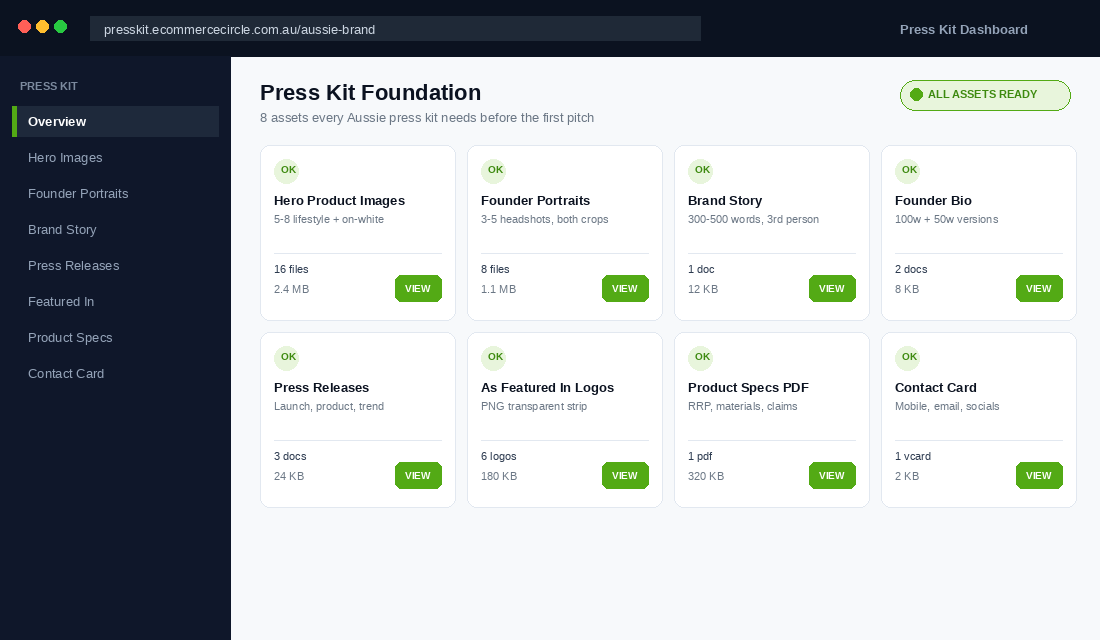
Build the kit before you pitch a single journalist. Every press kit needs these eight assets, all living in a public-link Dropbox or Google Drive folder so a journalist can grab everything in 90 seconds.
- Hero product images. 5 to 8 lifestyle and 5 to 8 product-on-white shots. Minimum 2000px on the long edge. PNG with transparent background where possible.
- Founder portraits. 3 to 5 professional headshots, both vertical and horizontal crops. Mid-tight and full-body. Natural light, plain background, brand-relevant styling.
- Brand story (300 to 500 words). The origin story, the problem you solve, the milestone numbers, the customer transformation. Written in third person, not founder-voice.
- Founder bio (100 words and 50 words). Two lengths. Aussie publications often ask for both. Include any prior career credibility, awards, and where the brand has already been featured.
- Press release templates. Three pre-written press releases: brand launch (already live), new product, and “trend story” angle (more on this below).
- Existing press logos. Even if you have one feature, build the “As Featured In” strip. After your first hit, this becomes your strongest credibility asset.
- Product specs and price points. A simple PDF with RRP, materials, sustainability claims, manufacturing location, and any certifications. Journalists need this to fact-check.
- Contact card. Mobile and email of the founder or PR contact, plus your Instagram, TikTok, and website URLs.
Set this up once. It takes a Saturday. It compounds for the next five years.
Phase 2: Build the Hit List (and Skip the Masthead)
Most founders waste their PR budget pitching publications. They google “Broadsheet editor email” and send a pitch to whatever generic editorial@ address turns up. That email goes into a dead-letter folder shared by 14 people. No one opens it. You will not get a reply, ever.
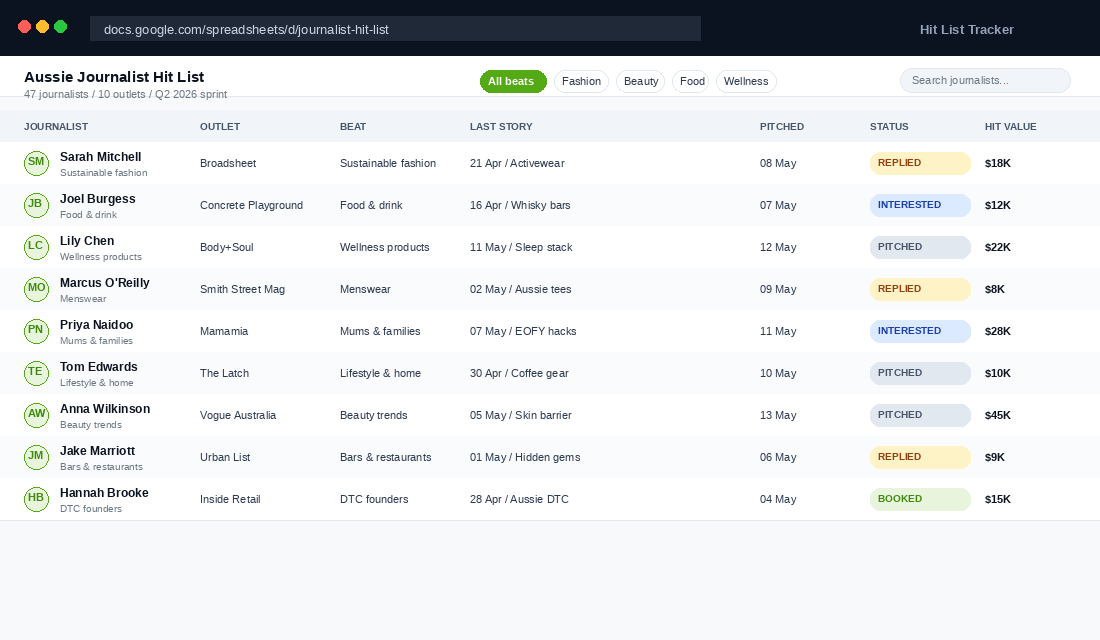
The winning move is to pitch specific journalists at specific outlets. Every byline you have ever read had a real human attached. That human has a beat (a topic they cover), a contact email, and a social presence. Your job is to identify the 30 to 50 humans who cover your category in Australia, and build a single spreadsheet that tracks them.
Here is how to build the list in a Saturday morning.
- Step 1: Pick your 10 target outlets. For most Aussie DTC brands the rotation is Broadsheet, Concrete Playground, Mamamia, Body+Soul, The Latch, Smith Street Mag, urban list, news.com.au lifestyle, Vogue Australia, and one or two niche outlets specific to your category (e.g. The Grocer for food, The Manual for menswear).
- Step 2: Pull the bylines. Visit each outlet, find 3 to 5 recent articles in your category, and note the journalist name plus the article URL.
- Step 3: Find their email. Use Hunter.io (50 free searches a month), Apollo.io, or just check the masthead. Most Aussie journalists publish their email on LinkedIn or the publication’s “Contact” page.
- Step 4: Note their beat. “Beauty and wellness,” “small-batch food,” “sustainable fashion,” “tech and gadgets.” This is the single most important field. Pitch a beauty journalist a kettle story and you are dead on arrival.
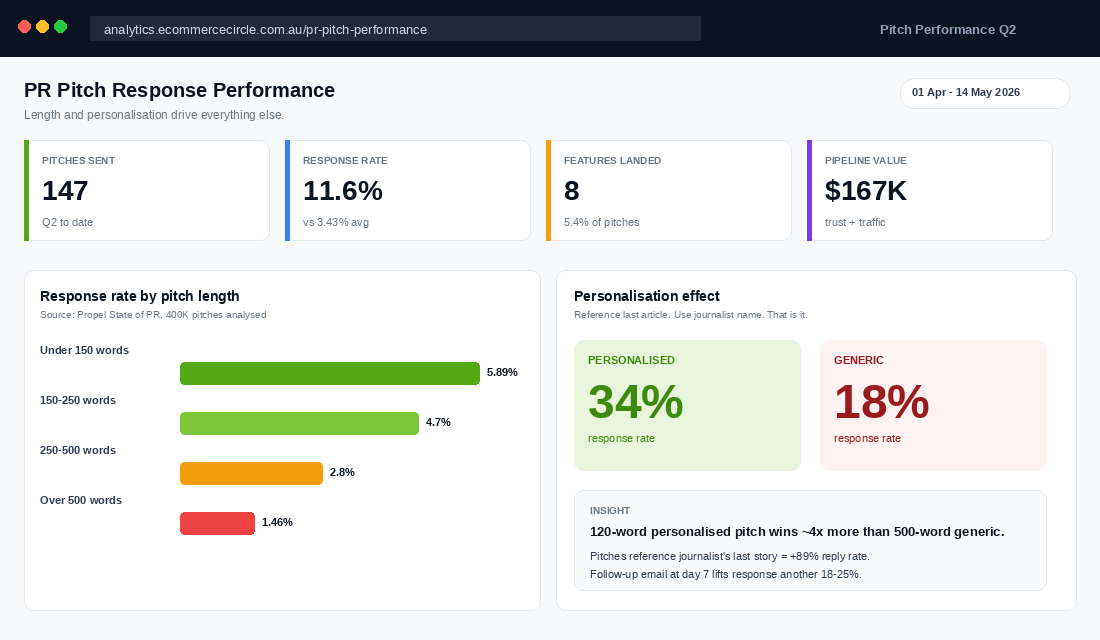
- Step 5: Note their last 3 stories. When you pitch, you will reference one of these to prove you actually read their work. This single line of personalisation lifts response rates from 18% to 34%.
Track all of this in a Google Sheet with columns for journalist name, outlet, email, beat, last-article-link, pitch-date, and response. Five columns separate the founders who land features from the founders who don’t.
Phase 3: The Pitch That Actually Gets a Reply
The data is brutal and clear. Pitches under 150 words get a 5.89% response rate. Pitches over 500 words get 1.46%. The longer your pitch, the worse it performs. Journalists are skimming on a phone between meetings. If they cannot understand the angle in five seconds they archive you.
Every pitch we send for an eCommerce Circle member follows the same six-block template. Total length: 110 to 130 words. Subject line: 6 to 9 words, no clickbait.
- Block 1: The hook (one sentence). The single most newsworthy fact. Not your brand story. The trend, the stat, or the cultural moment your story attaches to.
- Block 2: The personalisation (one sentence). “I noticed your piece last week on [topic].” Reference their actual recent work. This is non-negotiable.
- Block 3: The story angle (two sentences). Why this matters to their readers, framed in their voice and tone. Not “we are a brand.” It is “here is a story about a trend, and we happen to fit inside it.”
- Block 4: The proof point (one sentence). One specific stat, milestone, or detail that makes the story real. “We have sold 14,000 units in 18 months” or “we are now stocked in 32 boutiques across NSW.”
- Block 5: The offer (one sentence). What you will give them. A free sample, an exclusive quote, an interview, the data behind your stat.
- Block 6: The CTA and kit link (one sentence). “Press kit and high-res images here: [link]. Happy to chat by Wednesday.”
Six blocks, 120 words, one link. That is the entire pitch. The reason it works is that you have done all the journalist’s work for them. The angle, the personalisation, the proof, the assets. They can decide in 30 seconds whether to say yes.
The Three Angles That Get Aussie Journalists to Reply
The angle is the make-or-break element. Most founders pitch “we exist” stories. Journalists do not write “we exist” stories. They write stories that hang off a cultural moment, a contrarian truth, or a useful data point. There are three angles that work for Aussie Shopify brands almost every time.
- Angle 1: The Trend Tie-In. Whatever is in the cultural air, attach your story to it. EOFY shopping, Mother’s Day spend, the cost-of-living squeeze, the rise of “buy Australian,” the activewear boom. Watch what journalists are already covering. Pitch them the next chapter of the story they already want to write.
- Angle 2: The Founder Story With Edge. “I left corporate to start a Shopify brand” is dead on arrival. “I am a 28-year-old single mum from Newcastle who built a $1.2M business while paying off a HECS debt” is alive. The edge is the specific detail that makes you not generic. Find yours.
- Angle 3: The Data Drop. Aussie journalists love proprietary data. If you can credibly say “we surveyed 1,200 of our customers and 64% said they no longer trust influencer recommendations,” you have a story. Even small brands can run a 200-person survey through Klaviyo and produce a defensible data drop.
One angle per pitch. Same brand, different angle, different journalist. You can pitch the same product to twelve different journalists across six months using six different angles, and nobody will complain.
Phase 4: Reactive PR With SourceBottle and Qwoted
Here is the hack that almost no Aussie founder uses well. Reactive PR. Instead of you pitching journalists, journalists post requests for sources, and you respond. Higher hit rate, lower effort, and the journalist already wants what you have.
There are two platforms that matter for Aussie brands.
- SourceBottle. Free. Aussie-owned. Aussie and NZ journalists post call-outs daily. Set up an account, pick your categories (Food, Beauty, Wellness, Fashion, Parenting, Business), and you will get 15 to 40 relevant alerts per week by email.
- Qwoted. Paid (the free plan only gives 2 pitches a month). More premium, more global. Good for brands that want to land US and UK press alongside Australia.
Set a 20-minute calendar block twice a week to scan your SourceBottle alerts. Reply to anything that fits with a 100-word response. Done well, reactive PR alone delivers one to two features a month for the average eCommerce Circle member, and the response rate is closer to 25 to 35% because the journalist literally asked for the pitch.
The Amplification Stack: Turn One Feature Into Six
This is where 90% of Aussie founders leave money on the table. They land a feature in Broadsheet, post it once to Instagram stories, and move on. The journalist did the hard work. You should be squeezing 12 months of mileage out of every single hit.
Here is the amplification checklist for every press feature you land. Run it within seven days of publication.
- Update the “As Seen In” strip. Add the publication logo to your home page hero, your PDP trust strip, your email footer, and your Klaviyo welcome flow.
- Run a new ad creative. Pull the most quotable line from the feature. Drop it as a graphic over your hero product image. Run it as a Meta and TikTok creative for 14 days. The “as seen in” framing typically lifts CTR by 15 to 30%.
- Reshare on every social channel. Instagram feed post, Story, LinkedIn (founder profile, not brand page), Threads, TikTok if relevant, and the Facebook page. Tag the publication and the journalist.
- Email the feature to your list. One short email, subject line “We made Broadsheet (and we are still in disbelief).” Aim for 35%+ open rate. Drive readers to the feature, then back to the relevant product page.
- Pitch the next outlet using the feature as proof. “We were just featured in Broadsheet for [trend angle]. I think your readers would also like the next chapter of this story.” A feature multiplies the response rate of your next pitch.
- Update your founder bio and press kit. Add the logo, the publication date, and the article URL. Every future journalist will skim this before deciding.
Run this six-step amplification stack every time and one feature becomes six placements, three new ad creatives, two emails to your list, and a permanent home-page asset that compounds forever.
The Three Mistakes That Kill Aussie Founder PR
The brands that fail at PR fail in three predictable ways. Avoid these and you skip the bottom 80% of the field.
- Mistake 1: Pitching once and giving up. The benchmark is 31 journalists pitched to land one yes. If you sent five emails and stopped, you did not run the test. Pitch 30 to 50 per quarter. Treat it like cold sales outreach, because that is what it is.
- Mistake 2: Pitching the masthead, not the journalist. Editorial@ inboxes are dead. Always pitch a specific human with a specific beat who has written a specific recent piece you can reference.
- Mistake 3: Following up wrong. Most founders never follow up. The data shows a single follow-up email seven days later lifts response rates by 18 to 25%. Two follow-ups is the ceiling. Three is harassment. Keep it polite, short, and additive (“just adding one more proof point since I last reached out”).
The Compound Effect: Year 1 vs Year 3
Most founders who try PR for three months and quit have only seen the first chapter. The real prize is the compound effect in year two and three. Here is what an Aussie brand running this system for three years looks like.
- Year 1. 4 to 6 placements. Mostly mid-tier outlets (Broadsheet, Concrete Playground, niche category press). Most pitches you send. Maybe one inbound from SourceBottle.
- Year 2. 8 to 12 placements. The mix flips. Journalists start coming to you because they remember your earlier features. Two or three Body+Soul or Mamamia level hits. Your “As Seen In” strip now lifts Meta CTR materially.
- Year 3. 15 to 25 placements. You are on journalist contact lists for the categories you serve. Inbound trickles in weekly. A Vogue Australia feature lands. Your home-page social proof is now worth six figures in trust acceleration alone.
The mechanic that makes this work is the same one that makes SEO work. PR rewards consistent execution over a 24 to 36 month horizon. Most founders quit at month three because they want a one-and-done outcome. The ones who keep going for two years find themselves with a moat that no Meta budget can buy.
Your 30-Day PR Sprint Plan
If you have read this far, you have everything you need to land your first feature inside 30 days. Here is the exact week-by-week sprint we run with eCommerce Circle members who are starting from zero.
- Week 1: Build the press kit foundation. One Saturday morning. Eight assets in a public Drive folder. Founder bio, hero shots, brand story, contact card.
- Week 2: Build the hit list. 30 to 50 journalists across 10 outlets. One row per journalist with email, beat, and their last 3 stories.
- Week 3: Send your first 25 pitches. Five per day, Monday to Friday. Three different angles across the 25 pitches so you can test which one lands.
- Week 4: Follow up, then activate reactive PR. One follow-up to anyone who has not replied. Set up SourceBottle and Qwoted. Reply to your first three reactive call-outs.
If you execute the plan, the benchmark by day 30 is one to two yeses, three to five “interested but not now” responses, and a tracker that you can rerun every quarter. Run the same sprint again in month two and three, and you will have your first 6-feature year underway.
Tools and Resources for the Aussie Founder
The toolkit is small and most of it is free. Here is everything you actually need.
- SourceBottle (free, Aussie-focused journalist call-outs). Set up an account in 10 minutes. Pick your categories.
- Hunter.io (50 free email searches a month). Find journalist emails by domain.
- Qwoted (free or paid). Bigger global reach than SourceBottle.
- Google Sheets for the hit list and pipeline tracking. No fancy CRM needed.
- Loom for short founder videos to send to journalists who want a quick interview. 90 seconds beats a 30-minute call.
- Dropbox or Google Drive for the press kit folder. Public share link.
- Klaviyo for surveying your list to generate proprietary data drops.
Total monthly tool cost: $0 to $40 AUD. Compare that to a Sydney PR agency retainer at $5,000 to $12,000 a month. The agency may still make sense at scale, but for the founder doing $40k to $500k a month in Shopify revenue, the in-house system pays back 50 to 200 times harder.
PR Sits Inside the Wider Promotion Engine
PR is one channel inside a layered promotion strategy. Run it on its own and it underperforms. Run it next to your influencer program, your content strategy, and your hero product positioning and the whole engine starts pulling in the same direction. Three companion playbooks worth pairing this one with:
- The Shopify Influencer Marketing Playbook, for partnering with creators who drive actual sales (and double as press references).
- The Content Marketing Strategy for Shopify, for building owned media that compounds alongside earned media.
- The Hero Product Playbook, for picking the single product worth pitching to press in the first place.
The brands that combine all four win across the entire funnel. Earned media drives trust. Influencers drive social proof. Content drives organic. Hero product positioning gives you something worth talking about. Pick one as the priority for the next 30 days. Treat the others as supports.
The Founder Bottom Line
PR is not a lottery, an agency line item, or a “nice to have.” It is a 90-minute-a-week system that turns four phases of work into 6 to 25 features a year and a moat of trust no competitor can outbid you for. Most Aussie Shopify founders quit because they sent five pitches and got nothing. The ones who run the four phases for 12 months walk away with a permanent compounding asset on their home page, their email flows, and their wholesale conversations.
The 30-day sprint above is the fastest way to start. Build the press kit, build the hit list, pitch 25 journalists, follow up once, set up reactive PR. Repeat every quarter. The compound effect does the rest.
The Follow-Up Cadence That Doubles Your Reply Rate
Most founder pitches die from silence, not rejection. You send one email, hear nothing, and quietly decide journalists are not interested in your brand.
They probably never saw it. An Australian lifestyle editor at a masthead like Broadsheet or Body+Soul receives 80 to 200 pitches a week. First-touch reply rates on cold founder pitches sit around 3 to 6%. Add two well-timed follow-ups and that climbs to 9 to 14%, which is more than double for about four minutes of extra work per contact.
Here is the cadence that works without burning the relationship.
- Day 0. The pitch. Subject line under 50 characters, angle in the first sentence, no attachments, press kit as a single link.
- Day 4. Reply in the same thread with one new fact, not a nudge. A sales number, a new stockist, a customer story. “Just following up” is the fastest way to get filtered.
- Day 11. Final follow-up, two sentences, with a clean exit line: “Happy to park this if it is not a fit, just let me know and I will stay out of your inbox.” That line alone gets replies, including useful nos.
- Day 12 onward. Stop. Move the contact to a quarterly list and pitch them a genuinely different angle next quarter.
Send between 7:30am and 9:00am on Tuesday, Wednesday or Thursday in the journalist’s own timezone. Monday is triage day and Friday is a dead zone. If you are pitching a Sydney editor from Perth, that means setting an alarm, and yes it makes a measurable difference.
Track Your Pitches Like a Sales Pipeline
PR fails for Aussie founders because nobody owns the spreadsheet. Treat the hit list exactly as you would a sales pipeline, with the same discipline you would apply to a wholesale prospect list.
Eight columns is enough: outlet, journalist, beat, email, angle pitched, date sent, follow-up dates, outcome. Add a status field with five values only, being Not sent, Pitched, Following up, Replied and Landed. Anything more elaborate and you will stop updating it by week three.
Set a benchmark before you start so you know whether the sprint worked. On a 40-contact hit list run properly over 30 days, expect roughly 4 to 6 replies, 1 to 2 features, and 2 to 3 contacts who ask to be kept in mind for future stories. That last group is the actual asset. It is the reason year three of PR looks nothing like year one.
Useful tooling, all with free or cheap entry points: Hunter.io or Apollo for finding and verifying journalist emails, Mailtrack or Streak for open tracking so you know whether silence means unread or uninterested, Google Alerts and Brand24 for catching coverage you did not know landed, and SourceBottle plus Qwoted for the reactive lane. Skip the $400-a-month media databases until you are pitching more than 20 outlets a month. At founder volume they are an expensive address book.
One last measurement note. Do not judge PR on last-click revenue, because it will always look terrible. A Broadsheet feature drives branded search, direct traffic and a lift in conversion rate across every other channel for the following two to four weeks. Watch branded search volume in Google Search Console and direct sessions in GA4 in the fortnight after a feature lands. That is where the return actually shows up, and it is the same measurement trap that catches founders running any upper-funnel channel.
Inside eCommerce Circle, PR is one of the core pillars we work on with every member. If you want a second opinion on yours, let’s talk.
Related Reading
- Meta Ads for Shopify: The Campaign Structure That Actually Scales
- Attribution for Shopify: How to Know Which Marketing Channels Are Actually Driving Sales
- SMS Marketing for Shopify: The High-ROI Channel Most Aussie Brands Are Ignoring