Most Shopify brands think influencer marketing is about finding someone with a big following, sending them free product, and hoping a post turns into sales. Then they spend a few thousand dollars, get a burst of likes, and wonder why revenue didn’t move.
What’s in This Article
The ones actually driving sales through creators are running a completely different play. They treat influencer marketing as a long-term partnership channel, not a one-off transaction. They track revenue per post, not just reach. And they build relationships with 30-50 creators at a time, not bet their budget on one mega-influencer with a glossy feed.
The payoff when you get this right is real. Businesses are earning an average of $5.78 in revenue for every $1 spent on influencer marketing, and top performers are hitting $20+ in return. That’s a higher ROI than most paid social can deliver right now. But only if you build the system properly. This article is the full playbook, the exact framework we run with eCommerce Circle members who are scaling influencer marketing into a meaningful revenue channel.
Why Influencer Marketing Is a Non-Negotiable for Shopify Brands in 2026
The numbers tell the story. The global influencer marketing industry hit $24 billion in 2024 and is projected to keep climbing through 2026. But the more interesting stat is the one most brands miss: 49% of consumers rely on influencer recommendations to make purchase decisions, and for under-35s the number is higher.
In Australia specifically, this channel has matured faster than in most markets. A 2025 Nielsen study found that 86% of Australian women consult social media before making a purchase decision, and creators have become the single most trusted voice in that discovery process. Not ads. Not your website. Creators.
Here’s the shift: with iOS privacy changes continuing to gut paid social attribution, and Meta CPMs climbing 15-20% year-on-year, influencer marketing has quietly become one of the most efficient ways to drive both awareness and direct-response sales. You’re buying trust, not just impressions. And trust converts.
If you’re running a Shopify brand and you’re not actively building an influencer channel right now, you’re leaving one of the highest-ROI acquisition levers on the table. Let’s get into how to actually build it.
Step 1: Choose the Right Influencer Tier (Most Brands Pick Wrong)
The biggest mistake brands make is chasing follower count. They see a creator with 500k followers, assume that means 500k potential customers, and pay $5,000 for a single post that drives maybe three orders.
The reality is that micro-influencers (10k-100k followers) drive 60% higher engagement rates than macro-influencers, and their audiences are dramatically more likely to actually buy. Why? Because smaller creators still feel like real people to their audience, their recommendations land like a friend’s, not a paid endorsement.
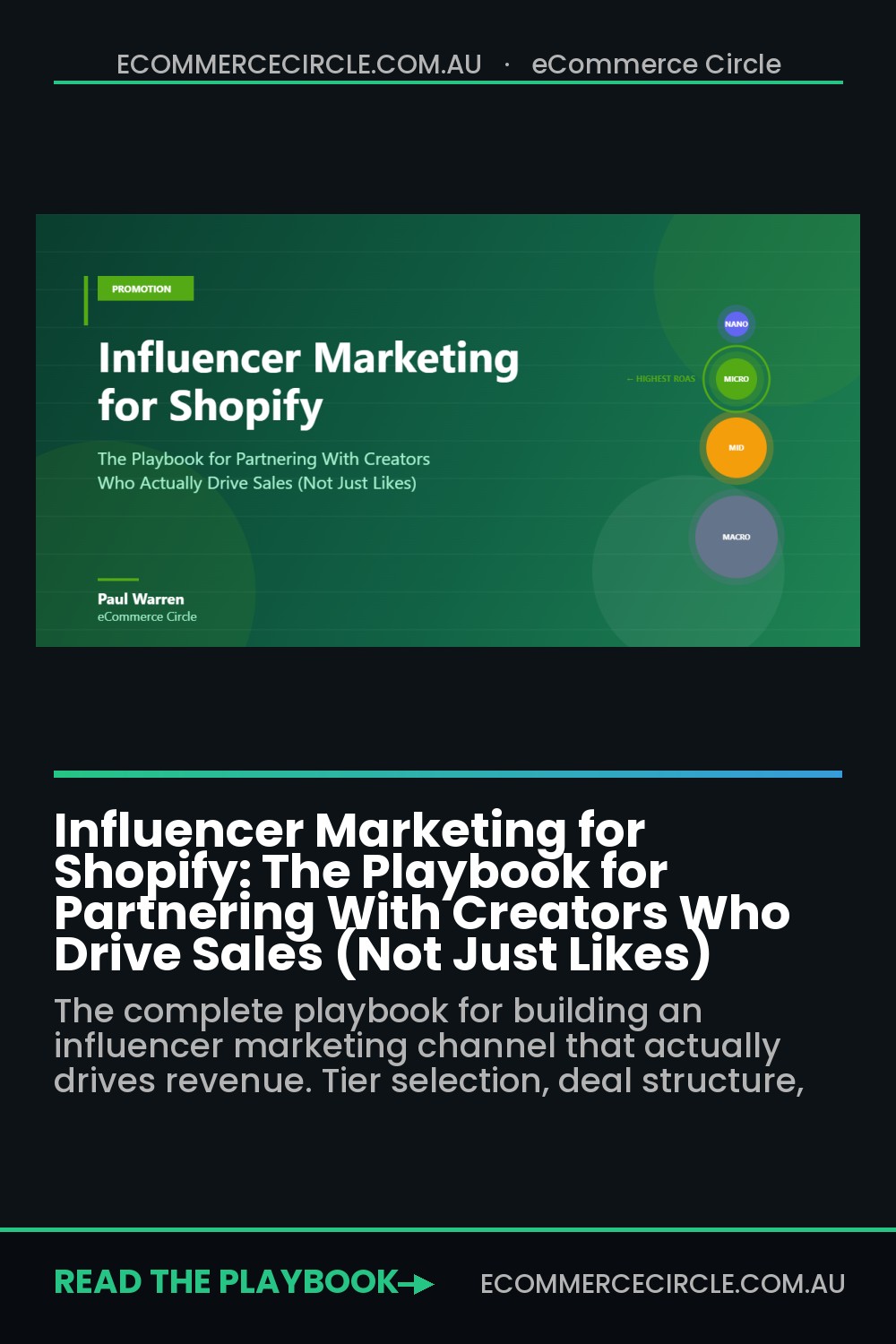
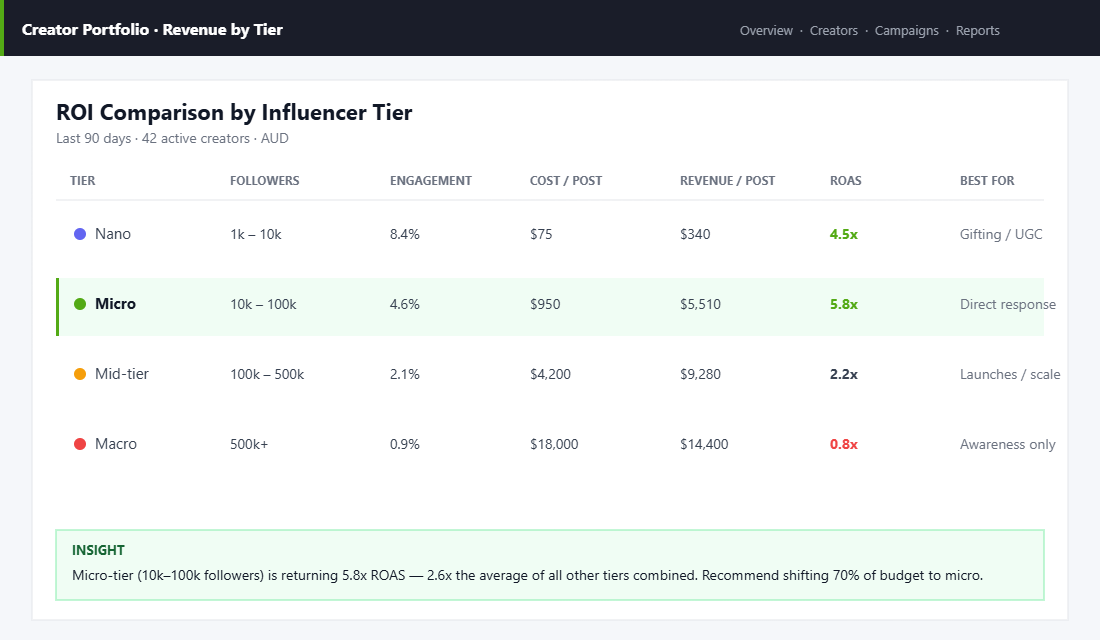
Here’s how the four tiers break down and when to use each:
- Nano-influencers (1k-10k followers). Engagement rates often exceed 7-10%. Use these for gifting programs, authentic UGC generation, and building a content library at scale. Typical cost: product + $50-200 per post. Perfect for new or bootstrapped brands.
- Micro-influencers (10k-100k followers). The sweet spot for most Shopify brands. Engagement typically 3-6%. Real niche authority. Willing to do performance-based deals. Typical cost: $200-$2,000 per post + commission. This is where 70% of your influencer budget should sit.
- Mid-tier (100k-500k followers). Bigger reach but engagement drops to 1-3%. Good for product launches when you need scale and social proof. Typical cost: $2,000-$10,000 per post.
- Macro/celebrity (500k+ followers). Awareness plays only. Expect to pay $10,000-$100,000+. Rarely worth it for direct-response unless the creator has a genuine, demonstrated affinity with your brand category.
The rule we teach inside the eCommerce Circle: start with 20-30 micro-influencers before you ever pay a macro-influencer. You’ll drive more revenue, generate a deeper content library, and learn what messaging actually resonates before you spend big.
Step 2: Build Your Creator Avatar Before You Send a Single DM
Before you start scouting creators, you need clarity on exactly who you’re looking for. A creator avatar is the same concept as a customer avatar, except it describes the ideal content partner for your brand, not your end buyer.
Your creator avatar should answer five questions:
- Audience overlap. Does their audience match your customer? A fitness apparel brand doesn’t want a travel creator whose followers skew 65% male when your buyer is a 30-year-old woman. Check audience demographics in Instagram Insights or the creator’s media kit.
- Content style. Do they produce the kind of content that sells your product? A “vibes” creator who posts aesthetic flatlays won’t drive sales for a technical product. A demonstration-led creator will.
- Brand values. Do their posts, captions, and controversies align with yours? One wrong partnership can nuke trust with your existing customers.
- Engagement quality. Are comments substantive or just emoji spam? Real comments like “Where did you get this?” are gold. “🔥🔥🔥” comments mean nothing.
- Purchase behaviour signals. Do they show receipts? Tag brands? Use products on camera? Or do they just unbox and walk away? The former drives sales. The latter doesn’t.
Write this avatar down. Share it with your team. Every creator you consider should be evaluated against this framework, not against their follower count. This discipline alone will save you from 80% of the bad partnerships brands accidentally sign up for.
Step 3: Find Creators Using the “Customer First” Discovery Method
Most brands find creators by typing niche hashtags into Instagram and clicking through whoever looks good. That’s how you end up with a shortlist of creators your competitors have already worked with to death.
The better approach is what we call customer-first discovery, start with your existing customers and work outward.
- Tactic 1: Mine your Instagram tags and mentions. Go into your brand’s tagged photos and identify creators who have organically posted about your product. These are warm leads, they already love your product. Reach out with a formal partnership offer.
- Tactic 2: Study your best customers. Pull a list of your top 100 repeat buyers. Find their public Instagram or TikTok accounts. Identify the ones who are already creators (even micro-level). These are the absolute best partners, customer-advocates-turned-creators convert 3-5x better than cold creator outreach.
- Tactic 3: Run the “who are they already buying?” audit. Look at what other brands your target customer follows and engages with. Their favourite creators are your prospects. This is especially effective if you’re entering a new category.
- Tactic 4: Use a discovery platform. Tools like Modash, Aspire, and GRIN let you filter creators by audience location, age, gender, niche, and engagement rate. For Australian brands, filtering for AU-based audience is crucial, a creator with 90% US followers won’t drive sales in Sydney.
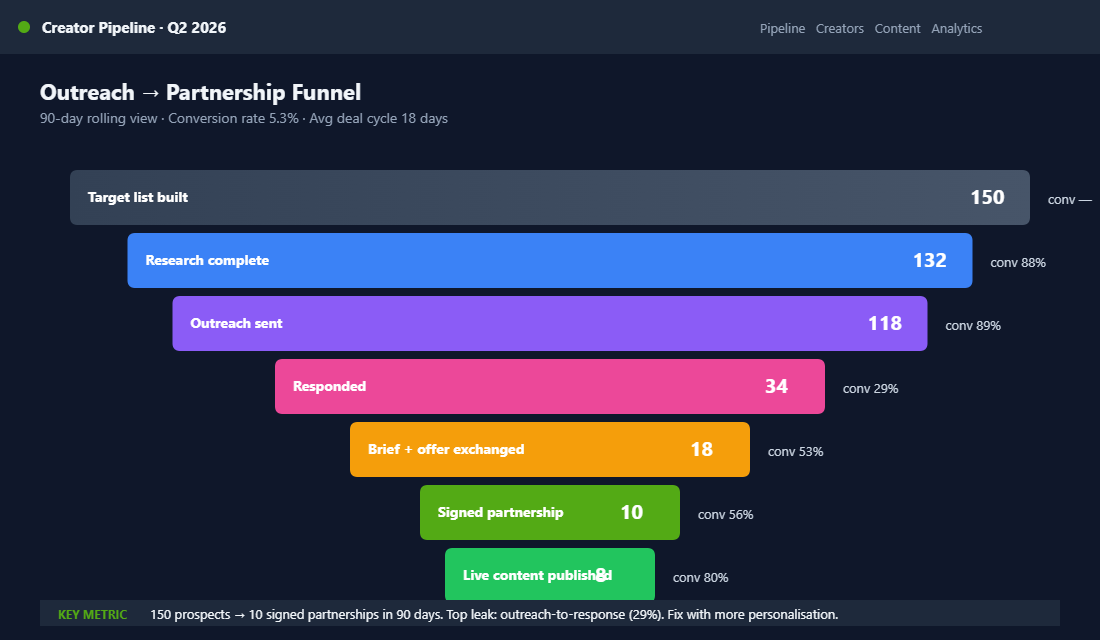
Aim to build a target list of at least 100-150 creators before you start outreach. Expect a 20-30% response rate on cold outreach if your offer is strong, and a 5-10% conversion rate from response to signed partnership. That’s your funnel.
Step 4: Structure the Deal So the Creator Is Motivated to Actually Drive Sales
Here’s the truth most brands avoid: a flat fee with no performance component puts zero pressure on the creator to actually sell anything. They post, they collect their cheque, they move on. You get a pretty asset and not much else.
The deals that actually drive revenue all combine three components: a base fee (enough to be respectful of their time), an affiliate/commission component (so they’re paid more if they drive more), and usage rights (so you can repurpose content into paid ads).
Here’s a realistic deal template for a micro-influencer (30k-80k Australian followers):
- Base fee: $500-$1,500. Covers 1x Reel + 3x Stories. Paid on content delivery.
- Product gift: $150-$300 retail value. Sent in advance. Makes the content authentic.
- Commission: 10-15% on all sales through their unique discount code. Paid monthly. No cap.
- Usage rights: 60-day paid ad usage across Meta and TikTok. Add $200-$500 for this. Most creators will agree.
- Whitelisting: optional add-on. Add $300-$800 for the ability to run ads from the creator’s handle directly. This is 10x more effective than running the same content from your brand account.
Commission structure is non-negotiable for us. The best creators we work with earn as much from commissions as they do from base fees, which means they’re posting their affiliate link three, four times a month instead of the one post you paid for. That’s the real win.
Step 5: Brief the Creator Properly (Or Get Generic Content)
A vague brief produces vague content. A great brief produces content that converts. The difference is worth thousands of dollars in revenue over the life of a partnership.
Every creator brief you send should include:
- The product context. What it does, who it’s for, what problem it solves. Three sentences max.
- The customer insight. What your best customers say they love most. Give them the exact quote from a review if possible, creators fold real customer language into captions better than anything you could write.
- The hook guidance. The first 3 seconds of the Reel determines 80% of its performance. Give them 2-3 hook examples that have worked for your brand.
- The “do” list. 3-5 specific things you want shown or said. “Show the product being used”, “mention Australian-made”, “include discount code in caption”.
- The “don’t” list. 3-5 things to avoid. Competitor mentions, specific claims you can’t substantiate, discount percentages that exceed your margin.
- Creative freedom statement. Critically important: end the brief with “Everything else is up to you, your audience trusts your voice, not ours.” This tells them you’re a pro, not a micromanager.
Keep the brief to one page. If it’s longer than that, you’re trying to control the creative. You can’t. The whole reason influencer content works is because it sounds like the creator. Micromanage the brief and you get content that flops.
Step 6: Measure What Actually Matters (Not Likes)
The reason most brands can’t scale their influencer program is because they don’t know what’s working. They see a Reel get 50k views and assume the campaign was successful. Meanwhile the affiliate code has zero redemptions and revenue didn’t move. This is why proper attribution matters so much.
Here are the six metrics you should track for every creator partnership:
- Unique discount code redemptions. The cleanest attribution signal. One code per creator, full stop.
- Affiliate link clicks + conversion rate. Track via a platform like GoAffPro, Refersion, or Shopify Collabs.
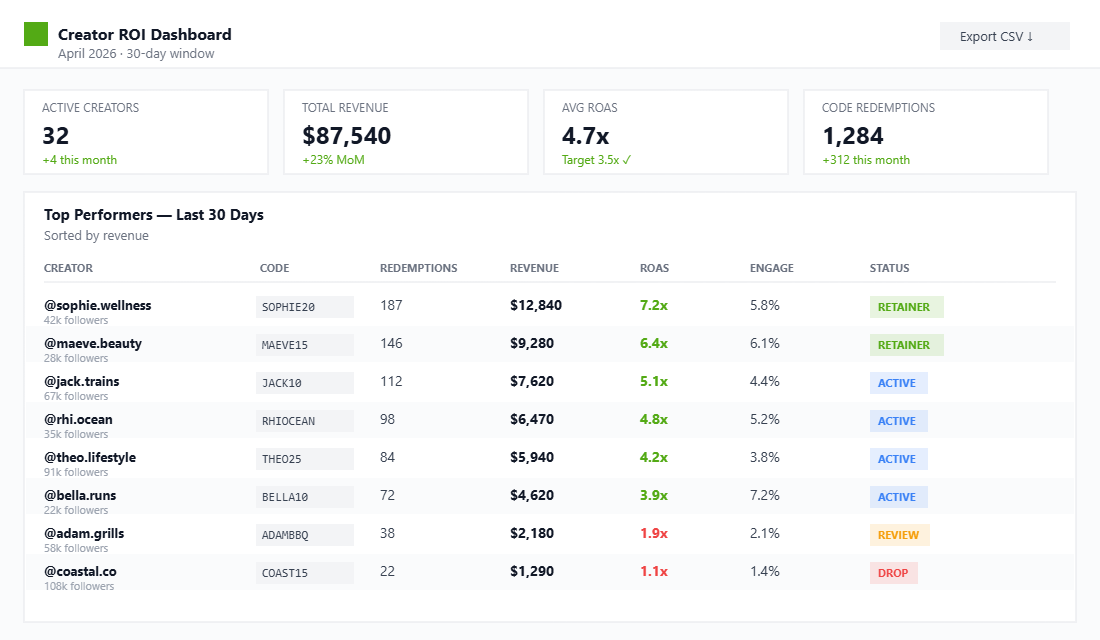
- Revenue per post. Total attributed revenue divided by number of posts delivered. Benchmark: micro-influencers should return $3-$8 per dollar spent within 30 days.
- Engagement rate. Not vanity, it’s a quality signal. Below 1% means the creator’s audience is fake or disengaged. Over 3% is excellent.
- Content quality score (1-10). Subjective but important. High-quality content gets repurposed into ads and drives compounding value.
- Incremental revenue lift. For ongoing partnerships, compare revenue in the 30 days before the partnership to 30 days after. This filters out attribution noise.
Build this into a simple spreadsheet or use a tool like GRIN to track it automatically. Review the data monthly. Double down on creators generating 3x+ ROAS. Drop creators returning under 1.5x after two campaigns. Ruthless with the math, generous with the relationship.
Step 7: Repurpose Creator Content Into Paid Ads (The Compounding Multiplier)
Here’s where influencer marketing stops being a single-channel play and starts becoming the engine for your entire performance marketing. Every creator partnership you sign should come with a plan to turn that content into paid ad fuel.
The data here is remarkable: creator-led ads typically outperform brand-produced ads by 30-60% on CTR and conversion rate. Meta’s own data on TikTok-style UGC ads shows similar patterns on Reels and Stories placements. A creator Reel that cost you $800 can generate $20,000+ in paid ad revenue if you’re running the usage rights and spending behind it properly.
The workflow looks like this:
- Collect all raw footage from the creator. Not just the final Reel, every clip, B-roll, voiceover. Most creators will send this if you ask. You’ll use it in 20 different ad variations.
- Whitelist the creator’s account via Meta Creator Studio. This lets you run ads from their handle to your targeting. These ads feel organic and consistently outperform branded ads.
- Build 3-5 ad variations from each piece of creator content. Different hooks, different lengths, different CTAs. Let the algorithm find the winner.
- Feed winners back into your Meta ads account structure as scaling creatives. A single strong creator piece can scale to $5k-$50k in monthly ad spend before it fatigues.
The brands scaling to eight figures on Meta right now aren’t running brand-produced video. They’re running endless variations of creator content, constantly refreshed, constantly optimised. This is why the usage rights clause in your creator contract is worth more than the base fee you paid.
Step 8: Build Long-Term Partnerships, Not One-Off Campaigns
The brands winning at influencer marketing aren’t running one-off campaigns. They’re running ongoing partnerships. Same 30-40 creators. Posting consistently. Building familiarity with their audiences over 6, 12, 18 months.
Think about it from the audience’s side. You see a creator mention a brand once, you might check it out. You see them mention it five times over six months, with real context, using the product in different ways, you’re going to buy. Frequency is the multiplier.
This is the playbook Australian brand Frank Body used to go from a $40k start-up investment to a global multimillion-dollar skincare business. They built deep relationships with hundreds of micro-creators, not one-off deals with celebrities. Every creator became a long-term brand storyteller, not a vending machine.
It’s the same model that took Gymshark from a garage start-up to a $1.4 billion valuation. They called their early creators “athletes”, put them on monthly retainers, flew them to events, and built a roster that now includes hundreds of long-term partners. They weren’t “influencers” to Gymshark. They were the brand’s public face.
The way to structure this for your Shopify store:
- Identify your top 10% of performing creators after 60 days. Those are the ones generating 3x+ ROAS.
- Offer them a monthly retainer. $500-$2,000/month for a committed number of posts, ongoing code activation, and exclusivity against direct competitors.
- Increase their commission rate. Top performers should be on 15-20% commission, not 10%. Pay for performance.
- Invite them to product launches, events, and brand decisions. Build genuine relationships. Ask for feedback on new products. Let them co-create.
- Send monthly performance updates. Let them see their own sales, conversions, and rank in your creator portfolio. Creators love data. Sharing it makes them invested.
After 12 months of running this loop, you’ll have a stable of 20-40 long-term creator partners who consistently drive 20-40% of your total revenue. That’s the endgame. And once it’s built, it compounds year after year, which is why we consider influencer marketing a Patrons play as much as a Promotion play.
The Compound Effect: Why This System Changes Everything
Here’s what most brands miss: influencer marketing done properly isn’t just one channel. It’s the engine for three channels at once.
Channel 1 is the direct revenue from creator posts and affiliate codes. That’s the obvious one. If you get your targeting and deal structure right, you should see $3-$8 back for every $1 spent.
Channel 2 is paid social. Creator content becomes the fuel for your Meta and TikTok ads, and those ads outperform brand content by 30-60% on CTR and conversion rate. Scaling creator content through paid amplification is where the real profit compounds.
Channel 3 is organic social and brand authority. Every creator mention is a third-party endorsement that builds trust. After 12 months of consistent creator activity, your organic engagement, branded search volume, and direct traffic all start to lift, and those compounding effects are harder to attribute but even more valuable long-term.
One input, your creator program, drives three outputs. That’s why the brands that nail this channel build such a deep competitive moat. Every month you run this system, it gets better. Creators get more familiar with your product. Ad accounts get more learning data. Audiences get more exposure. Your competitors can’t catch up because they’re still running one-off campaigns while you’ve built a compounding asset.
The Influencer Marketing Scorecard: Your 90-Day Starting Framework
Here’s the exact starting framework we give eCommerce Circle members in their first 90 days of building an influencer channel. Use it as a checklist:
- Days 1-14: Foundation. Write your creator avatar. Set up affiliate tracking (Shopify Collabs, GoAffPro, or Refersion). Build a tracking spreadsheet. Decide your base fee + commission structure.
- Days 15-30: Discovery. Build a target list of 150 creators. Prioritise 50 for first-wave outreach. Send personalised DMs or emails, never copy-paste.
- Days 31-60: First wave. Aim to sign 20-30 creators at micro-influencer tier. Send products. Ship briefs. Track first content going live.
- Days 61-75: First measurement cycle. Review revenue per creator. Identify top 20% performers. Start negotiating ongoing retainers with the winners.
- Days 76-90: Scale. Repurpose best-performing creator content into Meta and TikTok ads. Set up creator whitelisting. Open second wave of outreach focused on lookalikes of your top performers.
By day 90, you should have: 20-30 active creator partners, 3-5 repurposed ad creatives driving scaled paid revenue, a monthly measurement rhythm in place, and a clear view of what this channel can deliver over the next 12 months.
Where Most Brands Get Stuck
Every brand we’ve worked with in this channel hits the same three walls. Know them in advance so you can push through them faster.
- Wall 1: The outreach slog. Sending personalised outreach to 150 creators is brutal work. Most brands give up after 30. The fix: hire a VA for 10 hours a week specifically to run outreach. Cost: $300-$500/month. ROI: usually 10-20x within 90 days.
- Wall 2: The attribution doubt. After 60 days, you’ll see creator codes driving sales but you’ll wonder if those sales would have happened anyway. The fix: run a 30-day pause on one creator while keeping another active. The drop in revenue tells you the true incremental impact. Don’t skip this test.
- Wall 3: The scale ceiling. After you’ve signed 30-40 creators, finding more at the right quality gets harder. The fix: switch focus from discovery to deepening, monthly retainers, exclusivity deals, and creator-led product collabs. One long-term creator is worth 10 one-off deals.
The brands who push through all three walls end up with influencer marketing as their second or third-largest revenue channel inside 18 months. The ones who stop at wall one write off the channel as “not for us” and keep paying Meta double the CPM for half the trust. Which one do you want to be?
Disclosure and Compliance: The Rules Aussie Brands Keep Breaking
This is the section most influencer guides skip, and it is the one that can cost you real money. If you are paying, gifting, or giving any incentive to a creator in Australia, the resulting content is advertising, and it is regulated as advertising.
Two frameworks apply. The AANA Code of Ethics requires that advertising is clearly distinguishable as advertising to the average member of the audience. Australian Consumer Law, enforced by the ACCC, prohibits misleading or deceptive conduct, and that includes a creator implying they bought a product they were actually given.
What that means in practice is simple. The disclosure has to be upfront, in the creator’s own caption or spoken in the first few seconds, and readable without tapping “more”. Platform toggles like Instagram’s Paid Partnership label are good but not sufficient on their own. Ad Standards has repeatedly upheld complaints where the only disclosure was a buried hashtag.
- Use plain words: “Ad”, “Advert”, “Paid partnership with [brand]”, or “Gifted by [brand]”. Avoid ambiguous tags like #sp, #collab, #ambassador or #thanks, all of which have been found inadequate.
- Cover gifting too: free product with no cash payment still creates a commercial relationship that must be disclosed.
- Put it in the brief and the contract: do not leave disclosure to the creator’s judgement. Specify the exact wording and placement, and make payment conditional on it.
- Do not approve unsubstantiated claims: if a creator says your supplement “cures” something or your skincare “eliminates” wrinkles, you carry the risk. Give them a claims list of what they can and cannot say.
- Keep the receipts: archive the brief, the contract and a screenshot of the live post. If a complaint ever lands, the evidence trail is what protects you.
None of this hurts performance. The data across the market is consistent on this point: properly disclosed creator content converts at broadly the same rate as undisclosed content, because audiences already assume a commercial relationship exists. What you are buying with clean disclosure is not lower conversion, it is the removal of a regulatory and reputational risk that costs far more than the campaign is worth.
The Creator Tech Stack: What to Use at Each Stage
You do not need influencer software to run your first ten partnerships. You need it at about the point where tracking who was sent what starts eating an hour a week.
- Under 10 creators: a Google Sheet, Shopify discount codes with one unique code per creator, and manual gifting orders. Total cost, nothing. Do not over-build here.
- 10 to 50 creators: a Shopify gifting and seeding app such as Social Snowball, Gatsby or Aspire, typically AUD $150 to $600 a month. These automate code generation, gifting orders and payouts, which is where the admin time actually goes.
- Discovery: Modash or HypeAuditor for audience-quality checks, roughly AUD $150 to $500 a month. Use them primarily to screen for fake followers, and treat any account where under 60 percent of the audience sits in your target market as a pass.
- Attribution: unique discount code plus a UTM-tagged link per creator, read back in GA4 and Shopify reports. Do not rely on a single source. Cross-check code redemptions against GA4 sessions so you catch the buyers who saw the content but shopped organically later.
- Content rights and repurposing: get a written usage licence covering paid ads, ideally 6 to 12 months, before the content goes live. Retrofitting rights after a post performs well always costs more.
The stack matters less than the discipline of running one code per creator from day one. Without that, you will be arguing about attribution six months in with no way to settle it. If you want to push creator content further, the Shopify UGC Playbook covers turning it into a repeatable ad engine, the Creator Gifting Playbook details the seeding motion, and the Affiliate Program Playbook shows how to convert your best creators onto performance-based deals.
Bringing It All Together
Influencer marketing isn’t a channel you dabble in. Done properly, it’s a full system, audience research, tiered partnerships, smart deal structure, ongoing measurement, content repurposing, and long-term relationship building. The brands winning this channel right now are the ones who treat it as a strategic pillar, not a one-off spend.
Inside the eCommerce Circle, influencer marketing is one of the core Promotion pillars we help members build. We work through the creator avatar, outreach templates, deal structure, attribution setup, and ad-repurposing playbook with every brand on the program, because this is one of the highest-return channels available to a growing Shopify store right now.
If you’re ready to stop running disconnected influencer campaigns and start building a compounding creator engine for your brand, let’s talk. We’ll walk you through exactly what this looks like for your store and help you build the 90-day rollout plan.