Every week, another Shopify brand owner tells us they “tried Meta Ads and it did not work.” When we look at their account, the story is always the same: one campaign, broad targeting, a single creative, and a $50/day budget that they turned off after four days because the ROAS was 0.6x.
What’s in This Article
That is not Meta Ads failing. That is a lack of structure failing. The brands scaling to $50-100K months on Shopify are not spending more — they are spending smarter. They have a repeatable campaign structure that lets them test systematically, scale winners confidently, and cut losers fast.
Here is the exact framework we use inside eCommerce Circle to take brands from inconsistent ad results to predictable, profitable growth.
The Three-Tier Campaign Structure Every Shopify Store Needs
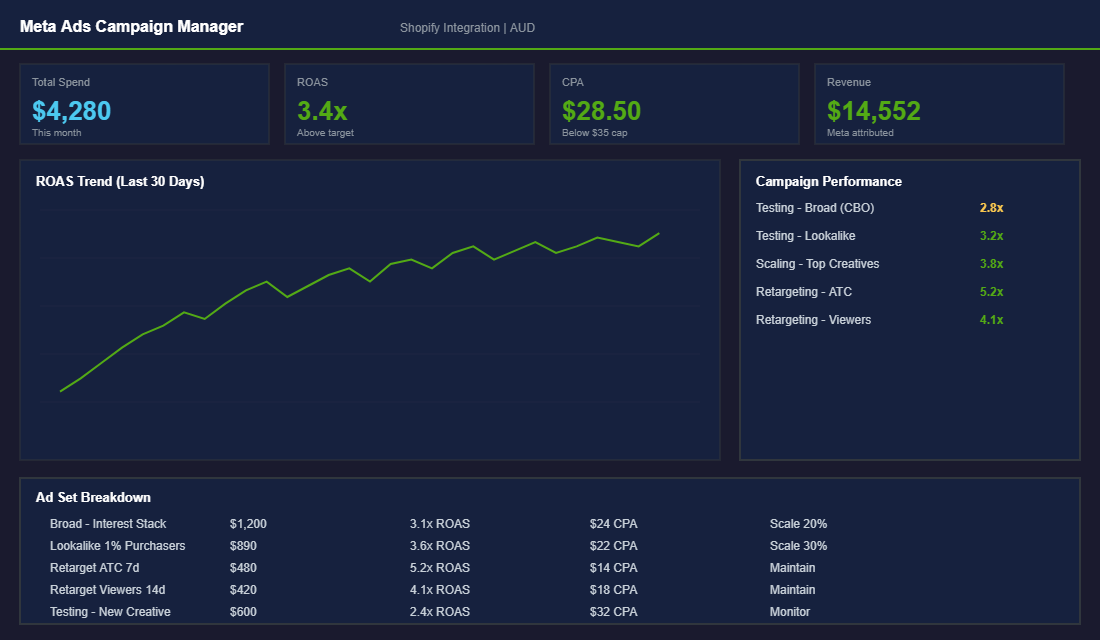
Forget complicated funnel structures with 15 ad sets. The most effective Meta Ads setup for Shopify stores at the $10-80K/month level uses three simple tiers:
- Tier 1: Testing Campaign (CBO). This is where new creatives and audiences get tested. Set a modest daily budget ($30-50/day) with Campaign Budget Optimisation letting Meta allocate spend to the best performers. Run 3-5 ad sets with different audiences, each containing 2-3 creatives. Let it run for 5-7 days before making decisions.
- Tier 2: Scaling Campaign. Winners from testing graduate here. These are your proven creatives running against your best-performing audiences at higher daily budgets. Scale gradually — increase budget by 15-20% every 3-4 days when ROAS is above target. Never double a budget overnight.
- Tier 3: Retargeting Campaign. This captures people who visited your site but did not buy. Separate ad sets for add-to-cart abandoners (7-day window), product page viewers (14-day window), and website visitors (30-day window). This tier should deliver your highest ROAS — typically 4-8x.
That is it. Three campaigns. Not twelve. The simplicity is the point — it gives you clear data, clear decisions, and clear scaling levers.
Creative Is the New Targeting (And Why UGC Wins)
Since iOS 14 gutted detailed targeting, Meta Ads success comes down to one thing: your creative. The algorithm has gotten remarkably good at finding buyers — if you give it creative that stops the scroll and communicates value in the first 3 seconds.
Here is what works right now for Australian Shopify brands:
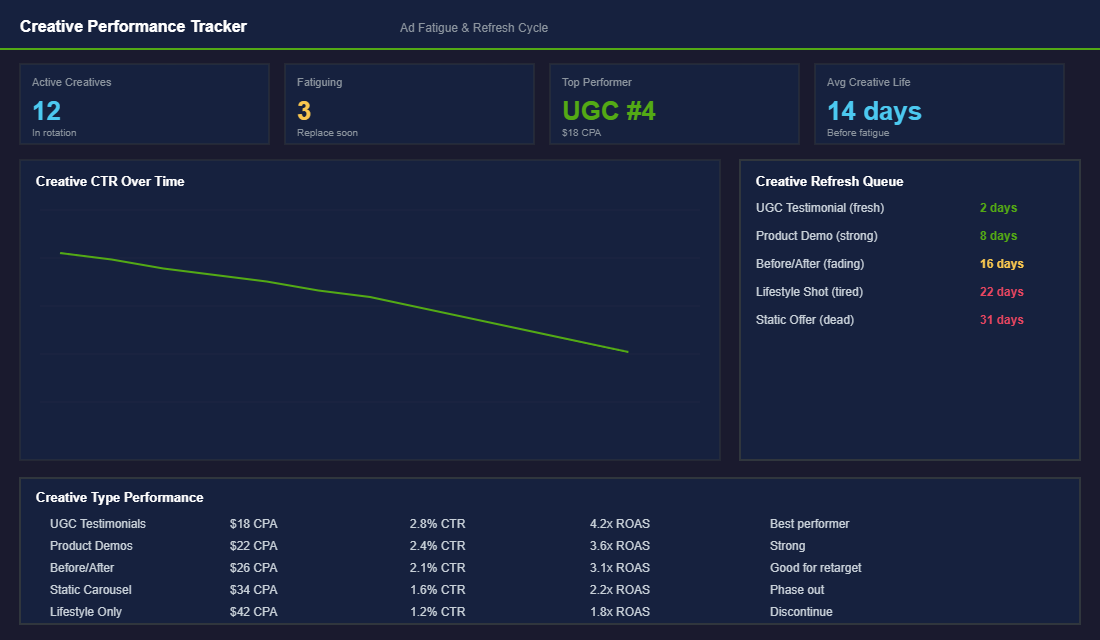
- UGC (User Generated Content) testimonials. Real customers talking about your product on camera consistently outperform polished studio content. Average CPA is 30-40% lower than branded content. You can source UGC creators on platforms like Billo or Insense for $100-200 per video.
- Product demonstration videos. Show the product being used, unboxed, or applied. Keep it under 30 seconds. The first 3 seconds need to hook attention — start with the result or the problem, not a logo animation.
- Before and after content. If your product creates a visible transformation, this is your strongest creative type. Works exceptionally well in skincare, home organisation, and fitness categories.
- Static carousels with benefit callouts. Not as sexy as video, but carousel ads with clear benefit-driven copy on each card still perform well for retargeting. Each card should address one objection or highlight one benefit.
The critical mistake is running the same creative until it dies. Every ad has a lifespan of roughly 10-21 days before fatigue sets in. You need a system for constantly refreshing creative — aim to launch 2-3 new creatives every week into your testing campaign.
The Scaling Rules: When to Push and When to Pull Back
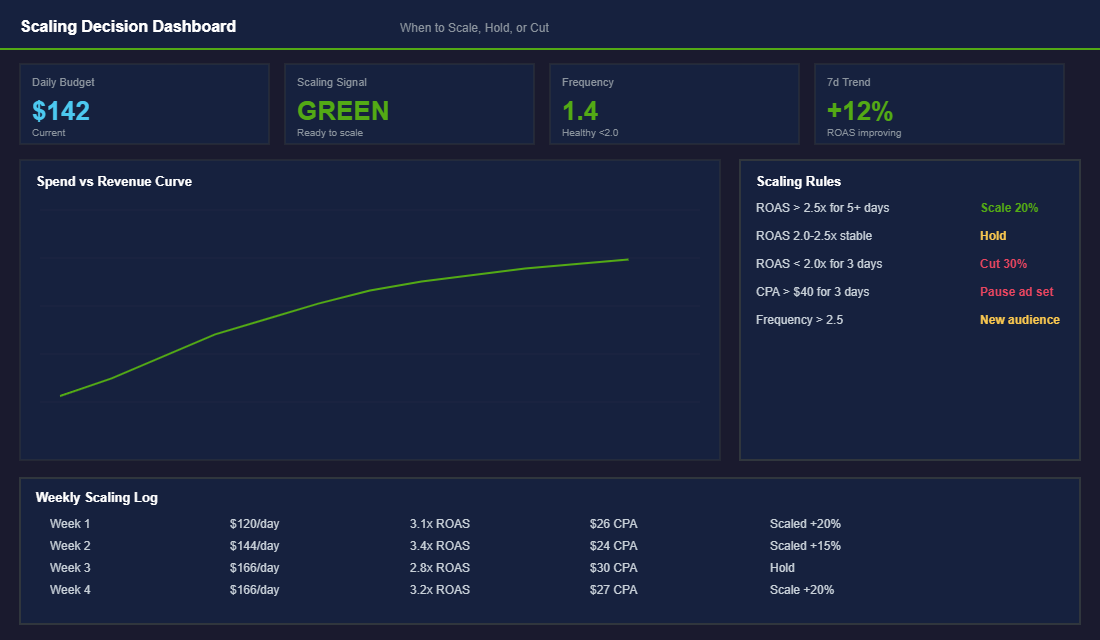
Scaling Meta Ads is where most Shopify brands get burned. They see a good day, get excited, triple the budget, and then watch their CPA skyrocket and ROAS crash. The algorithm needs time to adjust to budget changes, and aggressive scaling breaks the learning phase.
Follow these rules religiously:
- Scale by 15-20% every 3-4 days. Not 50%. Not 100%. Gradual scaling lets the algorithm adjust without resetting the learning phase.
- Only scale when ROAS is above target for 5+ consecutive days. One good day is noise. Five good days is a signal.
- Monitor frequency. When ad frequency exceeds 2.0, your audience is seeing the same ad too often. Time for new creative or new audiences.
- Cut fast when it is not working. If ROAS drops below your break-even point for 3 consecutive days, reduce budget by 30% or pause the ad set. Do not “give it more time” — that is a common excuse for burning money.
- Never scale and change creative simultaneously. One variable at a time. Scale a winner, or test new creative. Not both.
The Compound Effect: How Structured Ads Fund Everything Else
When your Meta Ads are structured properly and scaling predictably, it changes your entire business. You can forecast revenue with confidence. You can invest in inventory knowing the demand will be there. You can hire, expand product lines, and build out other channels because your core acquisition engine is reliable.
The brands inside eCommerce Circle that nail their Meta Ads structure typically reach $40-60K/month within 3-4 months of implementing this framework. More importantly, they get there profitably — with a blended ROAS of 2.5-3.5x that leaves real margin after all costs.
The Account Structure Mistakes That Quietly Cap Your Spend
Most Aussie stores under $200k a month do not have a targeting problem. They have a fragmentation problem. Twelve ad sets, each running $15 a day, none of them ever exiting the learning phase. Meta needs roughly 50 conversions per ad set per week to optimise properly. At $15 a day and a $60 CPA, you are feeding it seven. The algorithm is guessing, and you are paying for the guess.
Consolidate ruthlessly. One prospecting campaign, broad targeting, three to five creative concepts inside it. One retargeting campaign. That is the whole account for most stores doing under $100k a month. Every ad set you delete pushes more signal into the ones that remain.
Watch the edit trap too. Every meaningful change to an ad set, budget shifts above 20%, new creative, audience edits, resets the learning phase and burns 3 to 7 days of performance. If you are optimising daily you are permanently in learning. Set a rule: no structural edits inside a 72 hour window, and budget changes in increments of 20% or less.
And check where the traffic lands. A perfectly structured campaign pointing at a slow, generic collection page will lose to a mediocre campaign pointing at a purpose-built page every time. The landing page playbook covers the build; the rule of thumb is that ad-to-page message match is worth more than any audience setting Meta gives you.
What to Trust When Meta and Shopify Disagree
Meta says you did $42,000 last month. Shopify says $28,000. Both are right, and if you scale on the wrong one you will scale yourself broke.
Since iOS 14.5, Meta reports on a modelled 7-day-click, 1-day-view window and claims credit for anything it touched. Post-ATT, in-platform ROAS commonly overstates true contribution by 20 to 40%. GA4 swings the other way and under-credits paid social because it is last-click by default. Neither is lying. They are answering different questions.
Anchor on blended numbers instead. Take total revenue divided by total ad spend across every channel, your MER. If MER holds or climbs while you increase spend, the spend is working, whatever the platform dashboards say. Most healthy Aussie DTC stores run a blended MER between 3 and 5, with new-customer CAC sitting under a third of first-order AOV.
Then add one qualitative source. A single “how did you hear about us” question at checkout will tell you more about real attribution than a week of dashboard forensics, and it catches the channels no pixel sees. The post-purchase survey playbook walks through the exact three questions to ask and how to read the answers.
The Creative Cadence That Keeps Your CPMs Honest
Creative fatigue is the real reason accounts die, and it arrives faster than most operators expect. A winning ad in a small market like Australia typically holds for 3 to 6 weeks before frequency climbs past 3 and CPMs follow. Your job is not to find one great ad. It is to build a system that produces the next one before the current one fades.
Set a volume target and hold it. Four to six new creative concepts into testing every month, each with two or three hook variations, is enough to keep a store under $200k a month supplied. Track frequency weekly and treat 3.0 as the warning line, not the panic line.
- Hook first. The opening 3 seconds decide 80% of performance. Test five hooks against one body before you shoot anything new.
- Format spread. Run UGC testimonial, founder-to-camera, problem-solution demo, and static offer in parallel. Winners rotate by season.
- Kill fast, scale slow. Cut anything below half your target ROAS after 1,000 impressions. Increase budget on winners no faster than 20% every 48 hours.
- Bank the winners. Keep a swipe file of every ad that beat target, with its hook and offer noted. Most “new” winners are old winners re-shot.
If you want the production side of this, the UGC playbook covers sourcing creators without an agency retainer, and the creative fatigue guide covers spotting decline before it hits your CPA.
Where Your First ,000 a Month Should Actually Go
If you are starting from a standing start, the split matters more than the strategy. Put 70% into broad prospecting, 20% into retargeting, and hold 10% back for creative testing. That is roughly $70 a day prospecting, $20 retargeting, $10 testing.
The instinct is to weight retargeting heavily because the ROAS looks incredible. Resist it. Retargeting ROAS of 8 or 10 is mostly people who were going to buy anyway, and the audience is capped by the size of your prospecting pool. Starve the top of the funnel and your retargeting ROAS will look brilliant for about six weeks, then collapse when the pool runs dry.
Give it 30 days before you judge it. At $3,000 a month with a $60 CPA you will buy roughly 50 customers. That is barely enough data to read a trend, let alone make structural calls. Set a 30-day floor, review weekly against MER rather than daily against platform ROAS, and only then decide whether the offer, the creative, or the landing experience is the constraint.
Want Help Building Your Ad Engine?
Meta is still the fastest way to buy attention in Australia, but only when the structure, the measurement, and the creative pipeline are working together. Inside eCommerce Circle, paid acquisition is one of the core pillars we work on with every member, and most of the wins come from removing complexity rather than adding it. If you want a second opinion on your account before you scale spend, let us talk.