Ask most Shopify founders where their next 20% of revenue is coming from, and the answer is almost always the same: more ads, a bigger budget, a fresh creative push. New customers. The acquisition flywheel. The CAC graveyard.
What’s in This Article
Meanwhile, sitting quietly inside their Klaviyo account is a list of people who already bought once, fell in love with the product, and then drifted. No campaign chasing them. No automation to bring them back. Just radio silence, while the founder spends three to five dollars on Meta to win a stranger who has never heard of the brand.
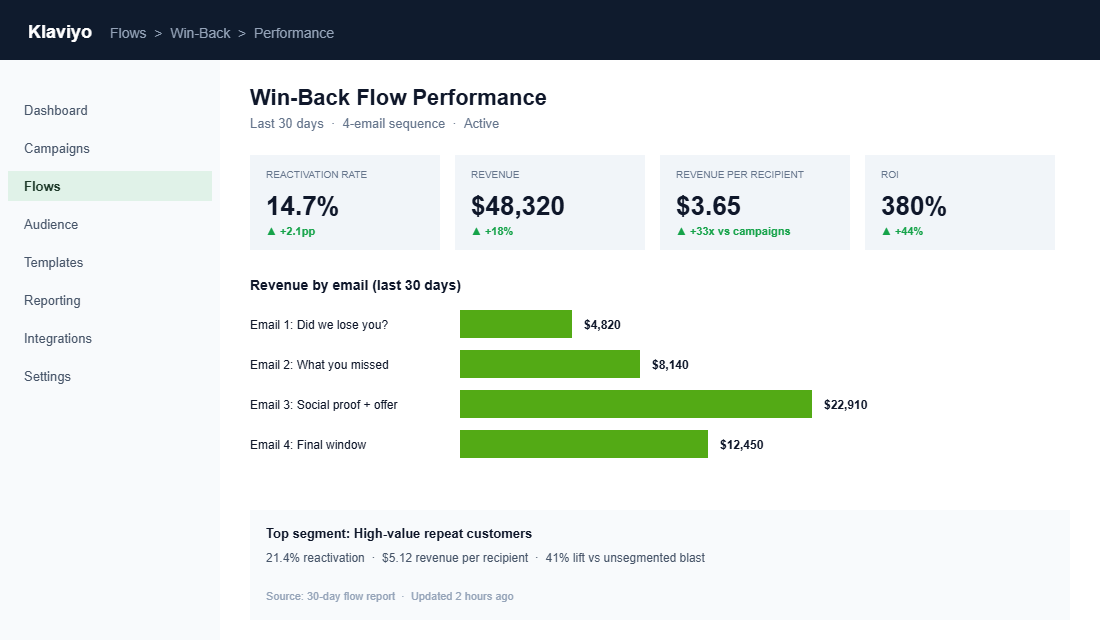
That is the single most expensive mistake we see when we audit Shopify stores doing 80k to 500k a month. Acquiring a new customer costs five to 25 times more than reactivating an existing one, and the probability of selling to a lapsed buyer sits at 60 to 70%, compared with 5 to 20% for a cold prospect. A well-built win-back sequence in Klaviyo can return 380% ROI and reactivate 15 to 25% of the people it touches. Most Aussie founders are leaving that money on the table because they never built the flow.
This is the win-back playbook we run inside eCommerce Circle. The same one we use to take a store from “we have no idea who our lapsed customers are” to a four-email sequence that drips revenue every single week on autopilot.
Why Win-Back Is the Highest ROI Flow in Your Klaviyo Account
Klaviyo’s own benchmarks tell the story better than we can. Their automated flows generate an average revenue per recipient of $3.65, compared with $0.11 for a standard email campaign. That is a 33x difference for the same person, the same product, the same brand. Flows beat campaigns because they hit people at moments of intent, not random calendar dates.
Inside the flow library, win-back is the unsung hero. Welcome flows usually get the spotlight (and they should, see our 5-email welcome flow breakdown for the playbook), but win-back has something welcome does not: a list of people who have already given you money. The hardest part of marketing, getting a stranger to trust you with a credit card, is already done. You just need to remind them you exist.
The reason it works comes down to behaviour. Existing customers are 50% more likely to try your new products and spend 31% more per order than a cold buyer. A 5% lift in retention can grow profits anywhere from 25% to 95%, because every retained customer is a CAC you do not have to pay twice. Win-back is the cheapest revenue you will ever generate.
Despite all of this, 44% of ecommerce businesses still prioritise acquisition over retention. The brands we see scaling past two million a year do the opposite. They squeeze every dollar of value out of their existing list before they spend a cent chasing new ones.
Stage 1: Define “Lapsed” Properly (the Segmentation Foundation Most Stores Skip)
If your win-back flow is firing 90 days after a customer’s last order regardless of category, you are burning the list. A coffee subscription customer should be considered lapsed at 35 days. A mattress brand should not even consider you lapsed until 18 months in. Defining lapsed correctly is the single biggest predictor of whether your flow will work or flop.
Here is the framework we use. Pull your data from Shopify, group orders by customer, and find the median time between first and second purchase. That number is your purchase cycle. Lapsed should be defined as roughly 2x the median purchase cycle, with the entry trigger sitting just before the 2x mark.
- Consumables (skincare, supplements, coffee, pet food). Purchase cycle 30 to 45 days. Win-back triggers at day 75 to 90.
- Apparel and accessories. Purchase cycle 90 to 120 days. Win-back triggers at day 180 to 240.
- Home and lifestyle. Purchase cycle 180 days. Win-back triggers at day 360.
- Considered purchase (furniture, appliances, electronics). Purchase cycle 365+ days. Win-back triggers at month 18 to 24.
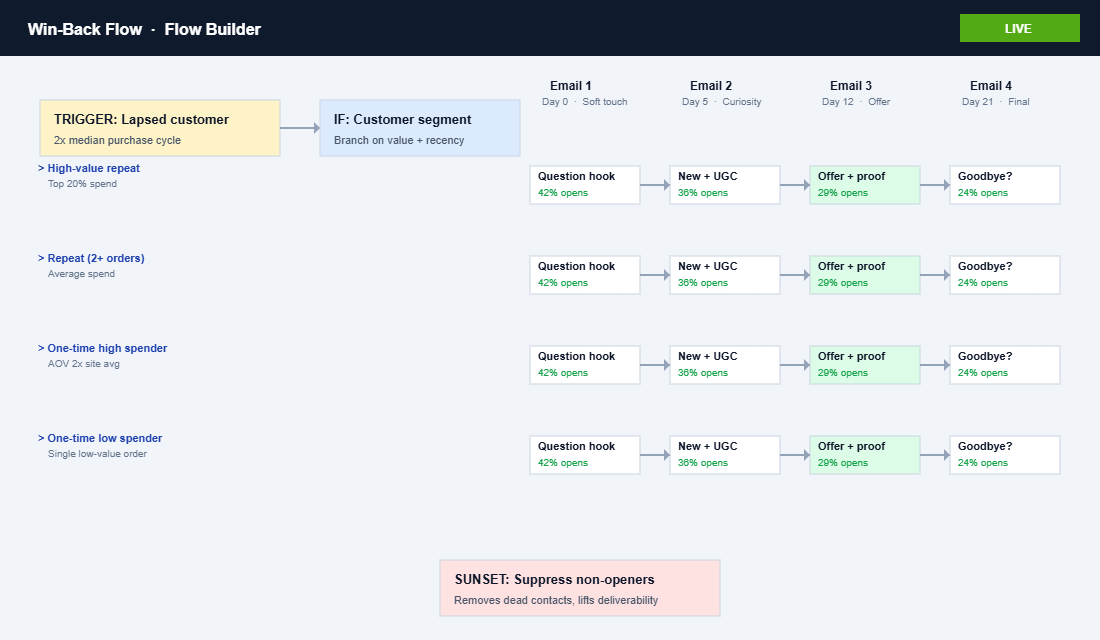
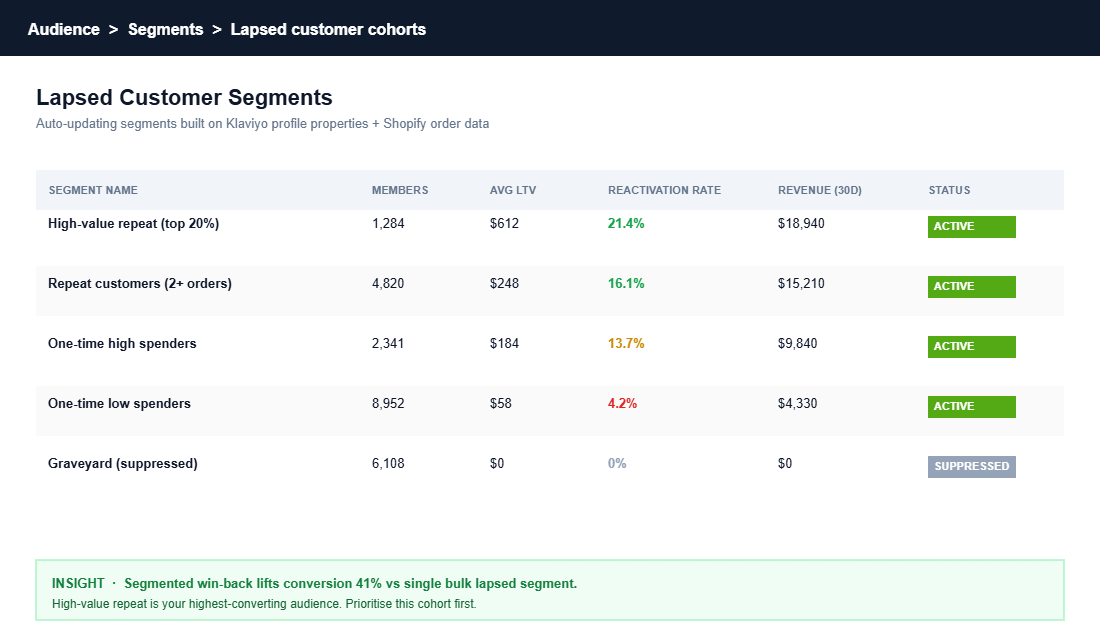
Then segment by value. Splitting lapsed customers by purchase history (one-time vs repeat, high-value vs low-value) lifts win-back conversion by 41% compared with unsegmented blasts. The four buckets we run for almost every brand we work with:
- High-value repeat (top 20% by spend, 2+ orders). These get the most personalised, premium message. No discount. A category preview, a loyalty-tier nudge, or early access to a new drop.
- Repeat (2+ orders, average spend). The bread and butter of the flow. Friendly check-in, soft product reminder, a small incentive in email three.
- One-time high spenders (single order, AOV above 2x site average). Highest potential. Heavier offer, plus a “we noticed you tried X, here is what pairs with it” angle.
- One-time low spenders. The cheapest segment to test on. If they convert at 2%, leave them in. If they ghost the whole sequence, suppress them.
If you are not already using purchase recency and value to segment, our Top 10% Customer Strategy guide walks through how to identify and protect the small group of buyers who drive 60% of your revenue. Win-back is the other side of that same coin.
The 4-Email Win-Back Sequence That Actually Reactivates
The biggest mistake we see in win-back flows: a single email, with a 15% off code, sent the day a customer hits lapsed status. That is not a sequence. That is a flare. The brands hitting 14 to 18% reactivation rates use a multi-touch flow that escalates over four to six weeks.
Here is the four-email sequence we install. Note that none of the first three emails lead with a discount. Discount-first win-backs train your list to wait for the next markdown. Build the emotional connection first, then bring the offer.
Email 1 (Day 0): The “Did We Miss Something?” Soft Touch
This email opens the door. No selling, no offer, just a personal question. The job is to find out why they stopped and to make them feel seen.
- Subject line patterns that work: “{First name}, did we lose you?” or “A quick question about your last order” or “We have not seen you in a while, {first name}”.
- Body structure: Two short paragraphs. Acknowledge the time gap, ask one direct question (was it the product, the delivery, the price, or just life). Optional: a one-question survey link with three radio buttons.
- CTA: Soft. “Tell us what happened” or “Browse what is new”. Never a discount.
Email 1 typically sees 38 to 45% open rates because the curiosity hook is strong and the sender is a brand the customer already trusts. Conversions on this email alone usually sit at 1 to 2%, but the real value is the survey data and the engagement signal it feeds back into your segments.
Email 2 (Day 5): The “Here Is What You Missed” Curiosity Email
Five days after Email 1, switch gears. Now you are showing what has changed since they last shopped. New products, new bundles, a reformulation, a press mention, a customer review they would care about. The angle is FOMO without the cheese.
- Subject line patterns: “Three new things since you last shopped” or “{First name}, we have been busy” or “You might have missed these”.
- Body structure: Three product cards or three small content blocks. Lead with the new or improved hero product. Reference the customer’s last purchase category for personalisation (“Since you tried our daily moisturiser, we have launched the matching SPF…”).
- CTA: “See what is new” linking to a curated collection page, not the homepage.
Emails featuring products related to a customer’s purchase history convert at 2.1x the rate of emails featuring generic best-sellers. If your Klaviyo data is connected properly, this email writes itself with dynamic blocks pulled from the customer’s last category.
Email 3 (Day 12): The Social Proof + Soft Offer
By Email 3 the people still opening are interested. They have not bitten yet, so it is time to bring an offer, but pair it with reassurance. Lead with a UGC review, a press feature, or a “customer favourite” angle. The discount sits below the social proof, not above it.
- Subject line patterns: “{First name}, 4.8 stars from 2,300 customers” or “This is what our regulars are reordering” or “The bestseller you have not tried yet”.
- Offer: 10 to 15% off, usually with a free shipping fallback for Aussie addresses. Time-limit it to 72 hours.
- CTA: “Claim your reorder discount” linking direct to the customer’s last category, with the code pre-applied via Shopify URL parameters.
Always pre-apply the discount in the link (?discount=BACK15) so the customer never has to copy and paste. Friction kills win-back conversion. Test this in incognito before you push the flow live.
Email 4 (Day 21): The Final Window
This is the close. Direct, honest, slightly cheeky. The job is to give one last reason to act and to set up the sunset (the suppression that follows for people who never opened).
- Subject line patterns: “{First name}, last chance before we stop emailing” or “Should we say goodbye?” or “Closing your loyalty account in 48 hours”.
- Body: One paragraph. Acknowledge the goodbye. Restate the offer (now bumped to 20% off, or add a free gift over a $90 spend). Include one customer quote from someone who came back.
- CTA: “Keep me on the list” linking to checkout-ready cart.
The “should we say goodbye” framing has been shown to lift conversion 25 to 35% compared with another generic “last chance” subject line, because it triggers loss aversion. People who would have ignored the email reactivate just to keep the relationship open.
Two Australian Brand Examples Worth Stealing From
Who Gives A Crap runs one of the most copied win-back emails in the country, and for good reason. The hero is a flowchart with the subject line “Don’t fight the flow”. It opens with a question (“Do you have a bum?”) and walks the customer through a decision tree where every path ends with “buy more loo roll”. Personality dialled to 11, humour throughout, zero apologetic tone. The reason it works: it makes the reader smile and breaks the pattern of every other discount-led win-back in their inbox. Subscribers who cancelled because “we have more toilet paper than we need” get re-engaged through brand voice, not price.
Frank Body stitches its win-back into a wider loyalty programme. Customers who lapse get a “your Frank points are about to expire” email, which leans on loss aversion plus the gamified status they have built up. It is technically a points expiry reminder, but functionally it is a win-back trigger, and it converts at 3 to 4x the rate of a generic reactivation email because the customer feels they are losing something they earned.
If your brand has a loyalty programme (and most Aussie brands over a million in revenue should), wire your points expiry directly into the win-back flow. Two reasons to come back are better than one.
The Sunset Step Almost Nobody Builds (and Why It Pays for Itself)
The fifth step of your win-back flow is not an email. It is a suppression action. After Email 4, if a customer has not opened a single email in the sequence, mark them as graveyard and remove them from all marketing sends. Most stores never build this step. They keep emailing dead contacts forever, dragging down sender reputation and inflating their Klaviyo bill.
Pruning unengaged contacts lifts inbox placement across the entire list. We have seen Aussie brands recover deliverability and lift campaign open rates by 8 to 12 percentage points within four weeks of building the suppression step, simply because the algorithms at Gmail and Outlook reward senders with high engagement rates.
Here is the conditional split logic to build inside Klaviyo:
- If “Opened Email” in last 30 days is 0: apply tag “graveyard” and add to suppression segment.
- If “Opened Email” in last 30 days is 1 or more: tag “engaged but not yet purchased” and add to a long-term nurture segment that gets only your best campaigns (sale events, new product launches).
This is also where you save real money. A typical Aussie Shopify brand on the $150/month Klaviyo plan often has 20 to 30% of their list completely dead. Suppressing those contacts can drop you to a smaller billing tier overnight without losing a single dollar of revenue.
Subject Lines That Beat the Generic Discount Drop
If your win-back subject lines look like “20% off, today only” you are competing with every other brand in the inbox. The win-back inbox is a hyper-saturated category. Customers know the playbook and they tune it out.
The patterns we test and rotate across the four emails:
- Question subject lines. “Did we lose you?” “What happened?” “Was it something we did?” Curiosity beats clarity in the first email of a sequence.
- Personalised time references. “It has been 92 days, {first name}” or “Your last order was in March”. Specificity feels like a one-to-one message, not a blast.
- Identity subject lines. “You are still on the VIP list” or “Your spot is being held”. These trigger sunk-cost reasoning.
- Loss-framed subject lines for Email 4. “Should we say goodbye?” “Closing your account in 48 hours” “Last call before we remove you”. Loss aversion lifts opens by 25 to 35%.
Avoid emoji-heavy subject lines for win-back. They underperform plain text by 5 to 10% on this flow specifically, because lapsed customers are quicker to label promotional-feeling email as spam. Save the emojis for the abandoned cart flow.
The Pre-Empt Layer: Stop Customers Lapsing Before Win-Back Has to Fire
Win-back is the safety net. The cheaper play is to catch customers before they fall through it. For every 100 customers who hit your lapsed trigger, roughly 60 to 70 drifted for a reason you could have addressed a month earlier: they ran out and forgot, they hit a delivery hiccup, or nobody gave them a reason to come back at the moment they were ready.
- Replenishment reminder at 80% of the purchase cycle. If your median reorder gap is 40 days, fire a “running low?” email at day 32 with a one-tap reorder link. Brands that add this flow typically see 8 to 12% of recipients reorder before they ever qualify as lapsed, which shrinks the pool win-back has to work on. The timing maths is in our replenishment flow guide.
- Fix the transactional emails that shape the first impression. The shipping confirmation and delivery email are opened 70 to 80% of the time, the highest open rate in your account. A customer who gets a plain Shopify default and then hears nothing for six weeks is a lapse waiting to happen. Our notification email audit covers the eight templates worth rewriting.
- A post-purchase check-in at day 14, not day 45. One plain-text email from the founder asking “how is it going?” surfaces the delivery and product issues that quietly turn into churn. Route replies to a real inbox and answer them within a day.
- Subscribers get a save flow, not a win-back. If you run subscriptions, a cancelled subscriber is a different problem to a lapsed one-off buyer. Intercept the cancel with a pause or swap option before they leave; the steps are in our subscription save flow.
Measure the pre-empt layer with one number: the share of customers who reach the lapsed trigger each month, divided by the customers who bought in that cohort. For a consumables brand that number should fall from 55 to 65% down to 40 to 45% within a quarter of switching these on. Every point it drops is a customer win-back never has to pay to recover.
The Compound Effect: How Win-Back Plugs Into the Rest of Your Email Engine
Win-back is not a standalone hack. It works because of the flows on either side of it. Your welcome flow brings new buyers in. Your post-purchase flow shapes the first 30 days. Your replenishment and review flows keep them moving. And win-back catches the ones who drift past the replenishment window without ordering.
The compound effect plays out like this. A welcome flow lifts first-order revenue by 8 to 12%. A solid post-purchase flow lifts second-order rate from 27% to 35 to 40%. Replenishment recovers another 10 to 15% of customers who would otherwise lapse. And win-back catches the remaining 20 to 30% before they slip away forever. Stack all four and you do not just have an email programme. You have a customer retention machine that runs without a marketer touching it.
The brands we see hitting 35 to 45% of revenue from email and SMS (rather than the typical 20 to 25%) all have one thing in common: a complete flow stack with no gaps. Most stores have a welcome and an abandoned cart flow, and that is it. Adding win-back is usually the fastest path to closing the gap, because the data is already in Klaviyo. You just need to turn it on.
Your 7-Day Win-Back Build Plan
Here is the build plan we hand to founders inside the Circle. Block out a week, work through it in order, and you will have a functioning sequence live by Friday afternoon.
- Day 1. Pull median purchase cycle from Shopify (Reports → Orders → Repeat customer rate). Set your lapsed trigger to 2x that number.
- Day 2. Build the four lapsed segments in Klaviyo (high-value repeat, repeat, one-time high spender, one-time low spender). Tag them.
- Day 3. Draft Email 1 and Email 2 copy. Both no-discount. Use the question and curiosity patterns above.
- Day 4. Draft Email 3 and Email 4 copy. Build your two discount codes (15% and 20%) in Shopify with proper expiry and customer limits.
- Day 5. Design templates in Klaviyo. Keep them dead simple. Plain text or single-column with one hero image. Win-back rarely needs heavy design.
- Day 6. Build the flow with conditional splits per segment. Add the sunset suppression at the end. Test the flow on yourself with a fake lapsed contact.
- Day 7. Switch flow to live. Set a calendar reminder to review reactivation rate and revenue in 30 days. Iterate from there.
The first 30 days of data will tell you which segment converts best, which email gets opened most, and which subject line is your hero. From there it is just optimisation. Same flow, getting sharper every quarter.
The Real Lesson: Reactivation Is a Margin Decision, Not a Marketing One
If you remember nothing else from this article, remember this: every lapsed customer you do not try to win back is a CAC you have to pay again from scratch. Your Meta ads do not know that customer already bought once. Your TikTok bidding does not factor in their lifetime value. The only place that information lives, and the only place you can act on it cheaply, is your email flows.
Build the four-email sequence. Define lapsed properly. Segment by value. Suppress the dead weight. The revenue is sitting there in your Klaviyo account waiting for you to switch the flow on.
Win-Back Subject Line Frameworks That Beat “We Miss You”
“We miss you” gets 14-18% open rates on warm lists and worse on cold. Aussie founders who beat the benchmark are running three subject-line frameworks instead, each tied to a specific psychological angle. Pick one per segment, A/B test the second variant each quarter.
- The Curiosity Loop: “{firstname}, did you ever try this?” / “Quick question about your {product category}”, opens at 28-34% on 120+ day lapsed segments.
- The Specific Identity Anchor: “For our 2024 customers only” / “Reserved for the {neighbourhood/state} crew”, opens at 32-38% when the segment ties to a real shared cohort.
- The Reciprocity Plant: “We owe you something” / “Not an ad, a gift”, opens at 30-36% but only works once a year. Use it for the final reactivation push, never the first email.
Stay away from emojis in the subject line, Klaviyo data across Aussie ecom shows emoji subject lines underperform by 4-6% on lapsed segments specifically. They read as “marketing email” when you want to look like a human being.
The Win-Back Tool Stack: Klaviyo, PostScript, and the Decision Tree
You do not need a new platform. Most Aussie founders we coach run the entire win-back flow on what they already have. Klaviyo handles the email side (sequenced flow, conditional splits, sunset suppression), expect AUD $90-450/month at typical Shopify list sizes. PostScript or Klaviyo SMS picks up the final push with a single text on day 28, SMS reactivation rates run 2-3x email but cost roughly 8-12c per send, so budget $200-600 per 5,000 lapsed contacts.
If you are scaling past $100K/month and running heavy retention, layer in a tool like Black Crow AI or Repeat to predict when each lapsed customer is most likely to reopen. Trigger the flow on intent signals, not just calendar days. The pickup we see is a 15-25% lift in reactivation rate versus a fixed-day-based sequence.
Pair this with proper RFM segmentation and you are running a true predictive retention engine, not a quarterly “we miss you” blast.
Inside eCommerce Circle, the win-back flow is one of the first six flows we install with every member, because it pays back the fastest. If you want a second opinion on yours, or you have not built one yet and want a shortcut to the version we run, let us talk.