You have probably rewritten your product descriptions twice this year. You may have started a blog you update when you remember. Meanwhile the pages built to pull the most qualified buyers into your store sit almost untouched: your collection pages.
What’s in This Article
Organic search drives around 53% of all website traffic, and for most Shopify stores the collection page is the asset designed to rank for the searches that arrive with a credit card already out. “Womens linen dresses.” “Merino base layers.” “Refillable candles.” Yet most founders treat a collection as a grid of products with a one-line heading, then move on to the next ad test.
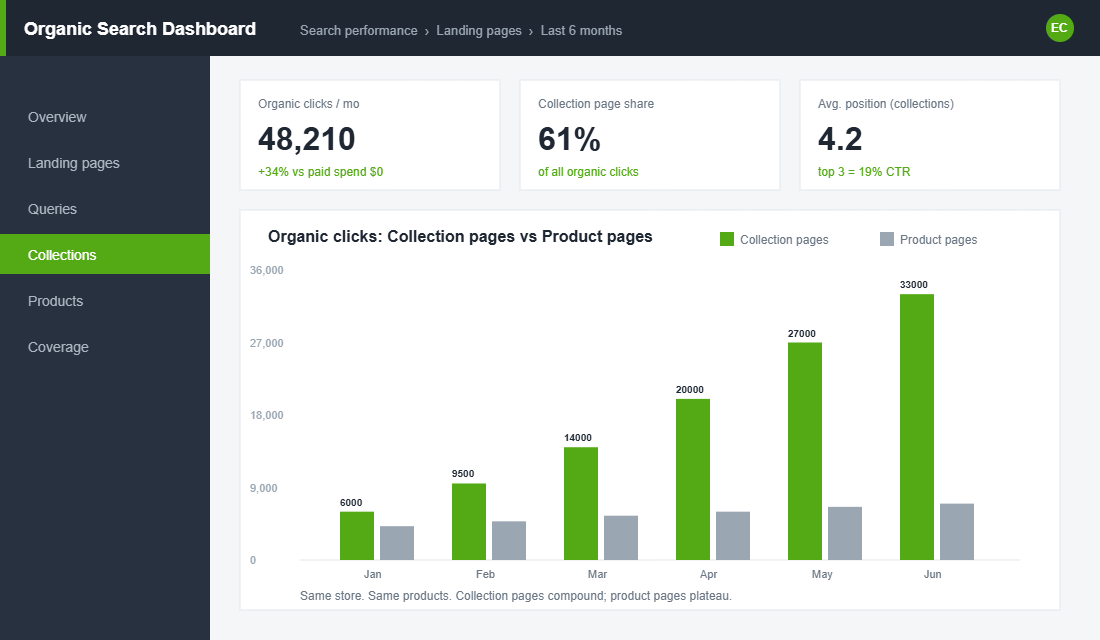
That neglect is the opportunity. Optimising collection pages first has been shown to generate 40% more organic traffic within six months than starting with product pages. This is the 6-part system we use with Aussie founders to turn thin category grids into pages that rank for the keywords that actually sell.
Why Your Collection Pages Outrank Everything Else You Publish
Three forces stack in favour of collection pages, and once you see them you cannot unsee them.
Intent match. When someone searches “mens running shoes” they want options to compare, not a single SKU. Google knows this, so it serves category-style pages for commercial head and mid-tail terms. Your collection page is the only asset on your store purpose-built to answer that query.
Volume. A collection keyword can carry ten times the monthly search volume of any single product term. Well optimised collection pages can rank for keywords that drive 5 to 10 times more traffic than individual product pages. You are fishing in a much bigger pond with the same bait.
The new CTR reality. The click-through rate for the number one organic result fell to roughly 19% in 2025, down from 28% the year before, as Google AI Overviews expanded across the results page. Of 200,000 keywords in one study, 172,855 triggered an AI Overview by May 2025. Ranking fourth is no longer a soft landing. You need the top three, and collection pages are your best shot at getting there for commercial terms. For the AI-answer side of this shift, see our Shopify AEO Playbook.
The stakes are local and large. Australians spent AU$82.6 billion online in 2025, up 13.9% year on year. Every category term you own is a slice of that spend you are not renting from Meta each month.
Part 1: Map Every Collection to One Commercial Keyword
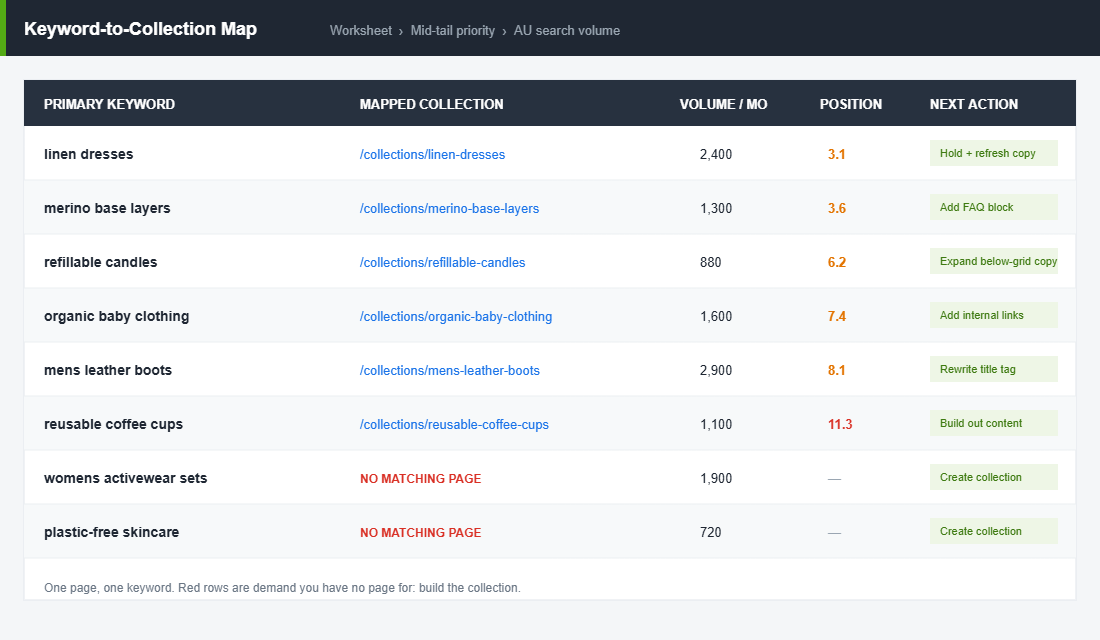
Most stores have collections fighting each other. “Dresses”, “Summer Dresses” and “Linen Dresses” all chase overlapping terms, so Google cannot tell which one to rank and ends up trusting none of them. The fix is a discipline: one page, one primary keyword.
Build a simple map before you touch a single page. List every collection URL, the one primary keyword it should own, the monthly search volume, and where you currently rank. That single sheet shows you your wins, your gaps, and your wasted pages in one view.
Sort your targets into intent tiers. Head terms (“dresses”) are high volume and brutally competitive. Long-tail terms (“black linen midi dress”) are easy but thin. The mid-tail (“linen dresses”, “merino base layers”) is the sweet spot for stores between $40k and $500k a month: enough volume to matter, enough specificity to actually rank.
Then build collections for the searches you are missing entirely. Premium sleepwear brand Printfresh discovered their site structure was missing roughly 73% of category-level searches for their own product types. After expanding their collections to match how people actually searched, organic traffic rose 55% and collection pages drove a 26.9% increase in organic revenue. They did not add products. They added the right pages.
Part 2: Write Copy That Earns the Ranking
Thin content is the number one problem on Shopify collection pages. Google has said it plainly: when a category page has nothing but a grid of product links, ranking it is hard. Adding 300 or more words of genuinely useful, unique content to a collection page has been shown to lift rankings by around 30%.
Placement matters as much as word count. Use two blocks, not one wall of text.
- A short intro above the grid (40 to 60 words). This is for the shopper and for your search snippet. Lead with the primary keyword, set up the range, and get out of the way fast so products are still visible.
- A longer block below the grid (250 to 350 words). This is where depth lives without pushing your products down the page. Answer the real buyer questions: how to choose, materials, sizing, care, and Australian shipping and returns.
Write it like the person in store who actually knows the range, not like a robot stuffing a keyword every second line. Use natural variants of the term, link to your two or three hero products, and link across to related collections. The goal is a page a buyer would thank you for, that also happens to give Google the context it needs.
Part 3: Fix the Technical Traps Shopify Creates
Shopify is a brilliant platform, but it generates duplicate and thin URLs by default. Left unchecked, those pages dilute your authority and confuse Google about which version of a page to rank. Four traps catch almost every store.
- Duplicate product paths. The same product can live at /collections/dresses/products/linen-midi and at /products/linen-midi. Confirm your theme sets the canonical tag on products to the clean /products/ URL so signals consolidate to one page.
- Faceted navigation. Filter and sort combinations spin up endless near-duplicate, thin URLs. Keep filtered URLs out of the index, and only build a dedicated collection for a filter combination when it has real search demand behind it.
- Automated tag pages. Tag-based and automated collections quietly create low-value URLs. Noindex the junk so your crawl budget flows to the pages that matter.
- Pagination. Make sure paginated collection pages are crawlable and that every product remains reachable within a few clicks of the homepage.
Technical SEO and site speed sit next to each other here. A collection page that ranks but loads in six seconds leaks the traffic it earns. If page speed is your weak point, pair this work with our Shopify Mega Menu Framework for the navigation side of the same problem.
Part 4: Build Internal Links That Flow Authority to Collections
A collection page in isolation is a page Google struggles to value. Internal links are how you tell search engines which collections matter most, and they are the lever most founders never pull.
- Your mega menu is your strongest internal link. Link to your priority collections with descriptive anchor text. “Linen Dresses” beats a generic “Shop” link every time, because the anchor text tells Google what the destination is about.
- Turn on breadcrumbs. They reinforce your site structure for crawlers and can earn you a breadcrumb trail in the search result itself, which lifts click-through.
- Add contextual links. From blog posts, from product pages, and from related collections, link the keyword phrase to the matching collection. A “linen dresses” mention in any article should point straight to that collection.
- Link from the homepage. Your homepage carries the most authority. Spend some of it deliberately on your top three to five revenue collections.
Part 5: Win the Search Snippet With Titles, Meta and Schema
You can rank third and still lose the click if your snippet is weak. The snippet is where ranking turns into traffic, so treat the title tag and meta description as conversion copy, not an afterthought.
- Title tag formula. Primary keyword, then a qualifier or benefit, then your brand. “Linen Dresses | Breathable Australian Summer Styles | Brand”. Keep it under about 60 characters so Google does not truncate it.
- Meta description. Write 150 to 160 characters that include the keyword and a real reason to click: range size, free Australian shipping, easy returns. This is ad copy for a free placement.
- Structured data. Add BreadcrumbList and ItemList schema so Google understands the page is a category listing. Some stores add FAQ schema built from the buyer questions in their below-grid copy to win more snippet real estate.
This is the same discipline that gets your store quoted inside AI answers rather than skipped. Clear structure, honest copy, and schema do double duty across classic search and AI Overviews.
Part 6: Measure in Google Search Console and Compound the Wins
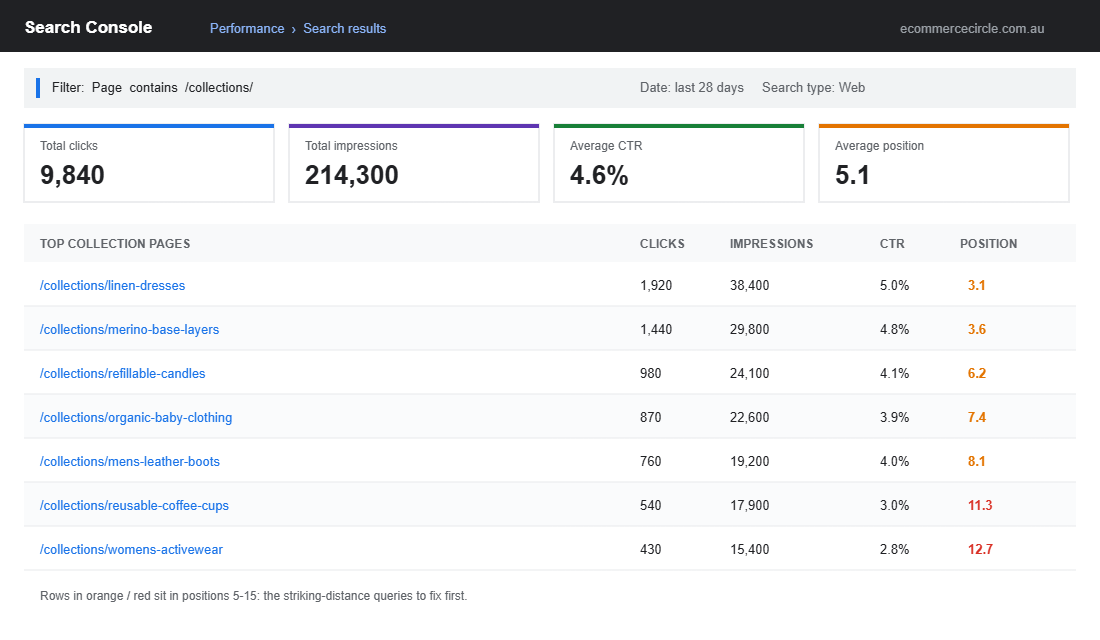
You cannot improve what you do not watch, and the best tool for collection SEO is free. Google Search Console shows you the exact queries bringing people to each page, your average position, and your click-through rate. Here is the setup that takes about fifteen minutes.
- Add your store as a property. Verify ownership with the HTML tag method in theme.liquid, or via your DNS record if you manage the domain.
- Submit your sitemap. Enter yourstore.com.au/sitemap.xml under the Sitemaps report so Google can find every collection.
- Isolate collections. In Performance, open the Pages tab and add a filter for URLs containing /collections/. Shopify uses clean paths, so this instantly separates collection performance from products.
- Hunt striking-distance queries. Sort by impressions and find queries ranking in positions 5 to 15. These are page one and two terms that are one push away from the top of page one, where roughly 19% of clicks live. Improve the copy, internal links and snippet for those pages first.
Pair Search Console with a keyword tool for volume. Ahrefs or Semrush if you have a budget, the free Google Keyword Planner if you do not. Then re-check every 30 days. The pages you nudged from position 9 to position 4 last month are this month’s traffic, and the next batch is waiting in the report.
The Compound Effect: Why the Six Parts Work as One System
Each part is useful alone, but the real power comes from running them together. A keyword map with no copy is a plan with no fuel. Great copy on a page Google cannot find through internal links is authority left on the table. A perfect snippet with no measurement is just guessing in a nicer font. Stack all six and they multiply.
The proof is dramatic when stores commit. One outdoor retailer rebuilt detailed category pages during a site migration and saw a 5,642% increase in non-brand category page traffic within four months, alongside a 126% overall lift in organic traffic. Same brand, same products, far better collection pages.
The part that should change how you spend your time is this: organic stacks, paid resets. Your Performance Max budget drops back to zero on the first of every month. A collection page sitting in the top three keeps delivering buyers next month, next quarter, and next year, for no extra spend. That is the difference between renting traffic and owning an asset.
Your Collection Page SEO Checklist
Run this on your top ten revenue collections this week. Most stores find at least three quick wins on page one of the list.
- Map it. One collection, one primary mid-tail keyword, with volume and current position recorded.
- Find the gaps. List the category searches you have demand for but no matching collection, then build those pages.
- Add the copy. A 40 to 60 word intro above the grid and a 250 to 350 word block below it, answering real buyer questions.
- Clean the technical traps. Product canonicals point to /products/, filter URLs stay out of the index, tag-page junk is noindexed, pagination is crawlable.
- Wire the internal links. Mega menu, breadcrumbs, contextual links and homepage all point to priority collections with descriptive anchor text.
- Sharpen the snippet. Keyword-led title under 60 characters, a 150 to 160 character meta description with a reason to click, and BreadcrumbList plus ItemList schema.
- Measure and repeat. Filter Search Console to /collections/, fix the positions 5 to 15 first, review every 30 days.
Collection pages are the rare SEO project where the work you do once keeps paying. Most of your competitors will keep polishing product descriptions and ignoring the pages built to win the searches that convert. That is exactly why this is worth your next focused afternoon.
Three Mistakes That Quietly Cap Your Collection Rankings
Even founders who do the work above often leave traffic on the table with three avoidable mistakes. Each one is common, and each one is fixable in an afternoon.
- Letting collections compete with each other. If three pages all target “candles”, Google splits its trust between them and ranks none well. This is keyword cannibalisation. Give each page a distinct primary term, and where two overlap, merge them or redirect the weaker one into the stronger.
- Burying the copy at the very bottom in tiny grey text. Hiding 300 words in a collapsed accordion or 10px font tells Google you do not really mean it, and gives the shopper nothing. Keep the intro visible above the grid and make the below-grid block genuinely readable.
- Deleting collections that lapse instead of redirecting them. When a seasonal collection ends, a deleted URL returns a 404 and you lose every backlink and ranking it earned. Redirect the old URL to the closest live collection with a 301 so that hard-won authority carries forward.
Fixing these three is often worth more than building new pages, because you are recovering rankings you have already paid for in time and links. Audit your collection list once a quarter and these problems rarely build up.
A 30-Day Rollout That Actually Gets Done
The reason most collection SEO never happens is that it gets framed as a giant project. Break it into a 30-day sprint and it becomes a series of small, finishable jobs.
- Week 1: Map and gap. Build the keyword-to-collection sheet for your top 20 collections, pull current positions from Search Console, and list the missing pages worth creating.
- Week 2: Copy. Write the intro and below-grid block for your top five revenue collections. Five pages, done properly, beats twenty done halfway.
- Week 3: Technical and links. Clean canonicals and filter URLs, then wire your mega menu, breadcrumbs and homepage links to those five pages.
- Week 4: Snippets and measure. Rewrite titles and meta descriptions, add schema, and set a recurring monthly Search Console review so the work keeps compounding.
By the end of one month you will have five fully optimised collection pages and a repeatable system for the rest. That beats a vague intention to “do SEO one day” every single time.
Where This Fits in Your Growth
Inside eCommerce Circle, organic search and collection architecture is one of the core pillars we work on with every member, because it is one of the few channels that gets cheaper as you grow. If you want a second opinion on yours, let’s talk.