You have built a Shopify store doing somewhere between $40k and $500k a month. The site converts, the ads work most weeks, and your email list is finally paying its rent. Then a customer messages you on Instagram asking the one question you cannot answer well: “Where can I actually try this before I buy?”
What’s in This Article
Most online founders treat that question as a nuisance. The smart ones treat it as a signal. The data is not subtle here. Shoppers who buy both online and in person are worth around 30% more over their lifetime than single-channel buyers, they spend roughly 16% more per order, and they shop about 70% more often. The brands that win the next three years are not the ones with the cleverest ad account. They are the ones present where their customer already is, online and offline, without doubling their workload.
This is the playbook we walk Aussie DTC founders through when they ask whether they should add a market stall, a pop-up, a stockist deal, or a permanent store. It is a 5-step system that adds a retail channel without cannibalising your online margin, and it runs on tooling you already pay for. Skip steps and you end up with dead stock in a back room and a lease you regret. Follow them in order and you build a second profit channel that makes your first one stronger.
Why Online-Only Brands Leave 30% of Lifetime Value on the Table
Single-channel thinking has a ceiling, and you can feel it the moment your customer acquisition cost stops behaving. When the only way a customer can experience your brand is through a 5-inch screen and a courier, you are competing on the same crowded auction as everyone else, paying more each quarter for the same attention.
Offline changes the maths in three ways. It lifts the value of the customers you already have, it lowers the cost of the next ones, and it turns your product into something people can touch, which matters more than founders like to admit. Companies with strong omnichannel engagement retain around 89% of their customers. Those with weak engagement retain closer to 33%. That gap is not a rounding error. It is the difference between a brand that compounds and one that has to refill a leaking bucket every month.
Two Aussie brands make the point better than any chart. Frank Body started as a pure online play built on Instagram and a coffee scrub, then moved into Mecca, Boots and Cult Beauty, using retail shelves as paid discovery that feeds the website. Who Gives A Crap spent years as a DTC darling, then pushed into grocery retail with partners like Waitrose and Ocado and reportedly doubled profit through the move. Neither abandoned online. They used physical presence to make online work harder.
The reason this is a Platform topic and not just a marketing one: omnichannel only pays off when your systems are unified. A pop-up that runs on a separate till and a spreadsheet is a hobby. A pop-up that shares one catalogue, one stock pool and one customer record with your Shopify store is a channel. The rest of this playbook is about building the second thing, not the first.
Step 1: Choose Your First Offline Channel (Do Not Sign a Lease Yet)
The most expensive mistake in this whole process is starting with a permanent store. A retail lease in a decent Australian strip is $60k or more a year before you have sold a single unit, and you sign away your flexibility on day one. Almost no online brand should start there. You start where the cash at risk is low and the learning is high, then you graduate.
There are four realistic entry points, and they are not equal:
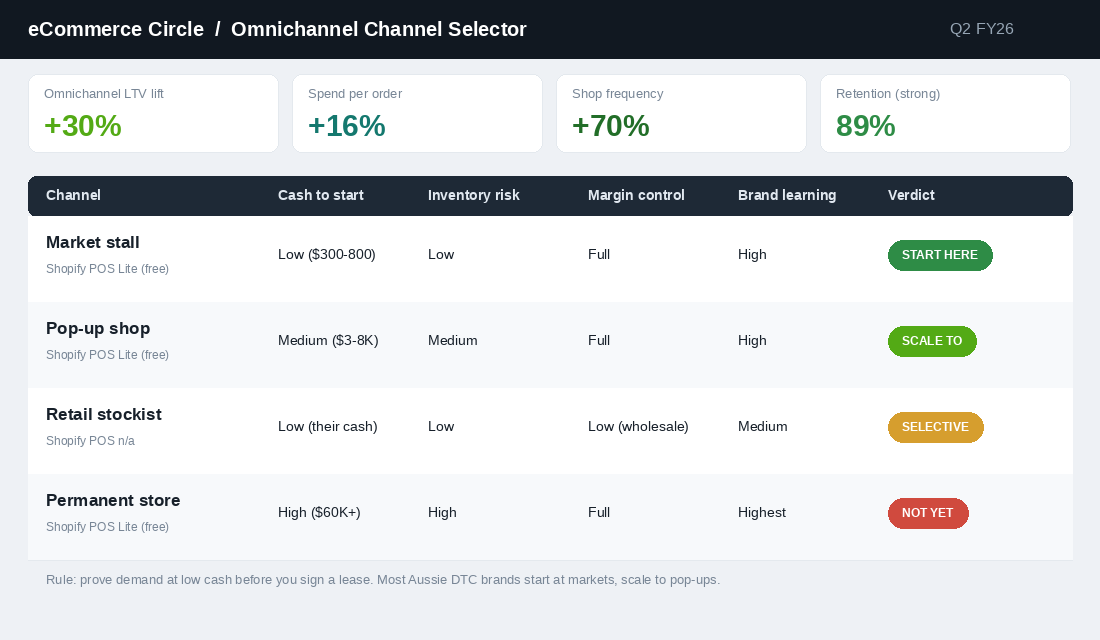
- Market stall. The cheapest way to put your product in front of a paying human. A weekend stall at a Melbourne or Sydney market costs a few hundred dollars in site fees. You learn your pitch, your bestsellers and your price tolerance in real time. This is where most Aussie DTC brands should start.
- Pop-up shop. A short lease in a mall kiosk or a vacant shopfront for a week to a month. Budget $3k to $8k all in. This is the channel to scale to once markets prove demand, and it is where the omnichannel loops below really start to earn.
- Retail stockist. Selling through someone else’s store on wholesale terms. Their cash funds the stock and the floor space, but you give up margin and the direct customer relationship. Use it selectively for reach, not as your core.
- Permanent store. The highest cash, highest risk and highest brand payoff. Earn the right to it with two or three profitable pop-ups first, not a hunch.
Score each option against four things before you commit: cash to start, inventory risk, margin control and brand learning. The channel that wins for a $40k a month skincare brand is rarely the one a $400k a month apparel brand should pick. Use the selector below as your decision frame, and be honest about which row you are actually ready for.
One more rule. Choose a channel that matches your product’s buying decision. Considered, tactile products (apparel, fragrance, homewares) reward pop-ups and stores because trial closes the sale. Low-consideration consumables can do well at markets and through stockists where convenience and impulse drive the basket. If you sell something nobody needs to touch, lean toward stockists and events rather than a store of your own.
Step 2: Set Up Shopify POS as Your One Source of Truth
Here is the part that separates a channel from a mess. Whatever you sell in person has to run through the same system as your website, or you will oversell stock, lose the customer data, and spend Sunday night reconciling two sets of numbers. Shopify POS is the tool, and the good news is you are already paying for the foundation.
Shopify POS Lite vs POS Pro
Shopify POS Lite is included free with every Shopify plan. It handles payments, basic inventory, customer capture and receipts, and it is genuinely all a market stall or a first pop-up needs. POS Pro is the paid tier at roughly $129 AUD a month per location, and it adds the features that make omnichannel pay: buy online pick up in store, ship from store, cross-location returns, saved carts, demand forecasting, staff accounts with performance tracking and daily reporting. The honest advice: start on Lite, upgrade to Pro the day you open a location people will pick up from or return to.
Hardware That Actually Travels
You do not need a full retail counter to start. The POS Go is an all-in-one handheld that scans, takes card and prints, which is ideal for a market stall or a roving pop-up. For a fixed pop-up or store, a tap-to-pay terminal (around $349) plus an iPad covers most setups. Card present fees in Australia sit in the 2.4% to 2.7% range depending on plan, which you fold into your retail pricing rather than absorb.
The 6-step setup before your first sale
- Add a new Location in Shopify admin for each selling point (Pop-up: Bondi Markets, Flagship: Fitzroy). This is what keeps stock honest.
- Install the Shopify POS app on the device that will take payments and log in to that location.
- Allocate stock to the new location from your existing catalogue. Do not create duplicate products. One product, stock split across locations.
- Turn on customer capture at checkout so every in-person buyer can be emailed a receipt and added to your list.
- Set POS payment with your reader and confirm a $1 test transaction reconciles in admin.
- If you are on Pro, switch on BOPIS and ship from store so the location can fulfil online orders too.
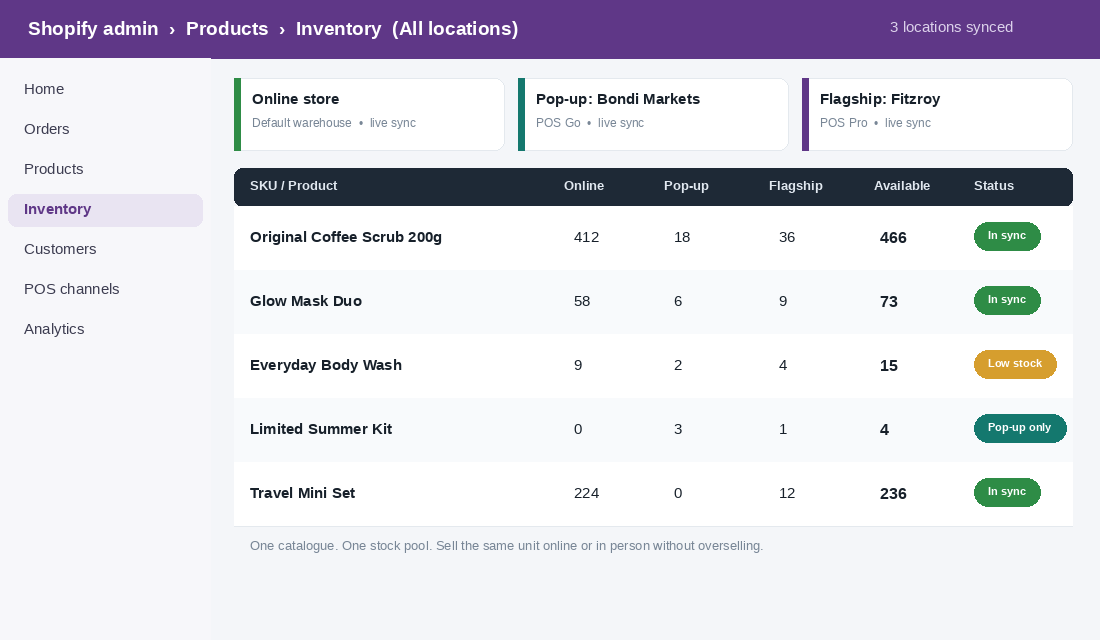
When this is set up correctly, the unit you sell at the Bondi market on Saturday disappears from your online available count instantly. That single fact is what makes everything in Step 4 possible.
Step 3: Unify Inventory and Customer Data Across Channels
Most failed retail experiments die here, quietly, because the founder treated the pop-up as a separate business. Two stock pools means you stock out online while units sit in a tub at an event, or you promise a customer something the website already sold. Two customer lists means you spend money re-acquiring people you already met in person. The whole advantage of building on Shopify is that you do not have to run anything twice.
Get three things right:
- One catalogue, one stock pool. Every product exists once, with inventory allocated by location. Your available-to-sell number is always the truth, whether the order comes from an ad or a market stall.
- One customer record. The person who buys a sample at your pop-up and reorders online next month should be the same profile, not two strangers. POS customer capture plus your email platform (Klaviyo for most Aussie brands) makes this automatic.
- One inventory rhythm. Retail eats cash differently to online. You pre-buy stock for an event and wait to sell it, which stretches your working capital. Plan that against your numbers before you commit, the same way you would for any stock decision.
That last point is where founders get caught. A strong pop-up can tie up $15k in stock for a month. If your cash conversion cycle is already tight, a retail push can starve your online ad budget at exactly the wrong time. Map it first. We covered the mechanics of freeing up that trapped stock cash in the Cash Conversion Cycle playbook, and the principles apply directly when you are funding inventory for two channels instead of one.
If you are already thinking about expansion, treat geographic and physical expansion as siblings. The same discipline that governs launching a new country through Shopify Markets applies to launching a new physical location: validate demand cheaply, keep one back end, and do not localise yourself into chaos.
Step 4: Engineer the Omnichannel Loops That Multiply Lifetime Value
This is the step that turns retail from a vanity project into a profit engine. A pop-up that just sells units is fine. A pop-up wired into your online store creates loops where each channel feeds the other, and those loops are where the 30% lifetime value lift actually comes from. There are four worth building from day one.
Loop 1: Buy online, pick up in store (BOPIS)
BOPIS is the highest-return loop in retail right now. In the US it accounts for over US$154 billion in sales, around 10.5% of ecommerce, and it is growing about 13.6% a year, faster than ecommerce overall. The reason founders love it: 85% of pick-up shoppers buy something extra when they come in to collect. You sell the order online at full margin, then the collection visit becomes a second sales opportunity at zero acquisition cost. Turn it on the moment you have a fixed location.
Loop 2: Ship from store and endless aisle
With POS Pro, your pop-up or store can fulfil online orders and your in-person customer can buy anything in your full catalogue even if it is not on the shelf. The customer at your Fitzroy pop-up who wants a colourway you did not bring can order it on the spot, paid in store, shipped from the warehouse. No lost sale, no “check the website later” that never happens.
Loop 3: In-store email and SMS capture
Every in-person buyer is a list subscriber you have not asked yet. A good pop-up captures the email or mobile of roughly a third of buyers through the POS receipt prompt. Those people convert online at a far higher rate than a cold ad click because they have already held your product. This is the cheapest list growth you will ever do.
Loop 4: The post-event online lift
A pop-up does not just sell at the table. Brands consistently see an online sales bump in the postcode around an event for weeks afterward, as people who saw the stall but did not buy convert later online. Track it. It is real revenue that single-channel attribution will miss entirely.
These loops also strengthen retention, which is the quiet compounding engine. The omnichannel customer who can buy your way, collect your way and reach you in person churns less. Tie that to your loyalty programme so points and tiers work the same in person as online, and you give your best customers no reason to shop anywhere else. If you have not built that yet, the loyalty programme blueprint is the companion piece to this one.
Step 5: Run Each Channel on Its Own P&L (Protect Your Margin)
Retail has different economics to online, and the founders who get burned are the ones who blend the numbers and convince themselves it is working when one channel is quietly subsidising another. Run each channel on its own profit and loss, every month, with brutal honesty.
For each offline channel, account for the real costs, not just the obvious ones:
- Direct costs: site or lease fees, staff or your own time, card-present fees (2.4% to 2.7%), and the POS Pro subscription per location.
- Stock costs: the cash tied up in event inventory, plus the cost of anything you bring back unsold and have to clear.
- Cannibalisation check: are you genuinely adding revenue, or moving sales you would have made online anyway? A pop-up in your home suburb can cannibalise. One in a city you do not ship to fast adds.
The number that tells the truth is contribution per channel per hour of founder attention. A market stall that nets $800 on a Saturday but costs you a full day is a different decision once you value your own time. Scale the channels that show real incremental contribution, and kill the ones that only look busy. Retail should make your blended margin better, not worse.
The Compound Effect: How the Channels Feed Each Other
Run the five steps and the channels stop being separate. They become one system where each part makes the others stronger. Picture a Melbourne skincare brand doing $2 million a year online with an $84 average order value, 1.7 orders per customer per year and a 12-month customer value of $143.
They start markets in spring, scale to a pop-up by summer, then add two retail stockists. Their omnichannel customers now average a $97 order, 2.9 orders a year, and a 12-month value near $281, with retention climbing from 41% to 68%. The pop-up captures emails that convert online. BOPIS turns collection visits into extra baskets. The retail shelves act as paid discovery that lifts website traffic in those postcodes. Online keeps growing while two new revenue lines stack on top.
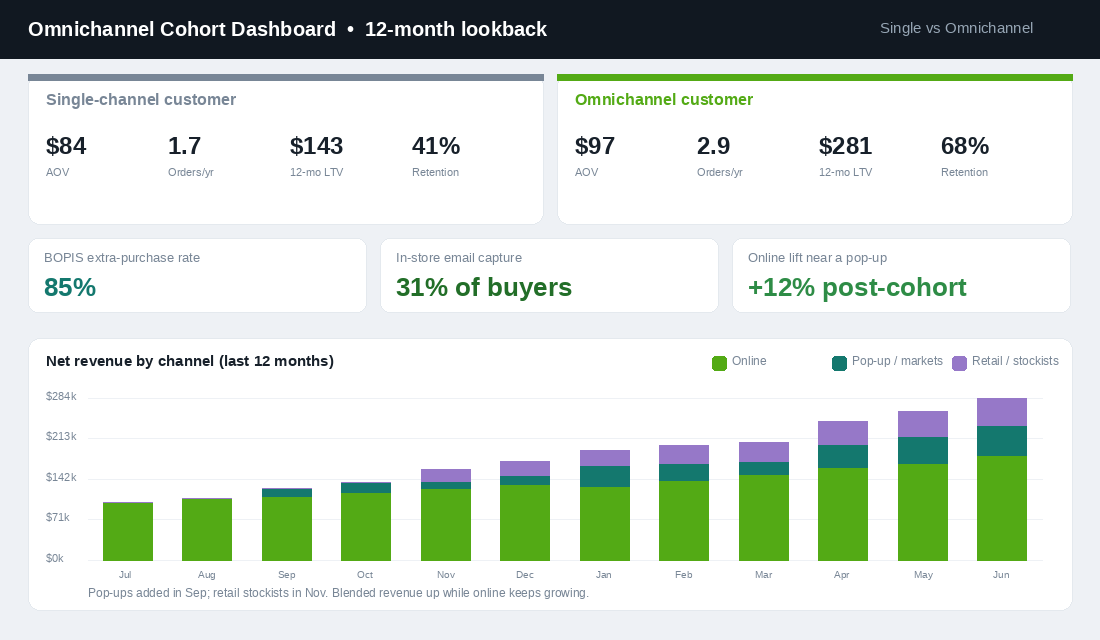
That is the whole game. You are not trading online revenue for offline revenue. You are using physical presence to raise the lifetime value of every customer and lower the cost of the next one, while building a brand people can actually touch. The 30% lift is not a marketing slogan. It is what happens when one customer can buy from you three ways and you have the systems to make that effortless.
Three Failure Modes That Sink Retail Expansion
- Starting with a lease. Signing a permanent store before you have proven demand at a market or pop-up. You lock in your biggest cost before you have any evidence. Earn the store.
- Running two systems. A separate till, a separate spreadsheet, a separate customer list. This guarantees overselling, lost data and reconciliation pain. One Shopify back end or do not bother.
- Blending the P&L. Letting a glamorous pop-up hide the fact it loses money once you count stock, time and cannibalisation. Measure each channel alone, monthly, and be willing to cut.
Your 30/60/90-Day Omnichannel Rollout
Print this and work it in order. Do not jump ahead.
- Days 1 to 30 (Validate cheaply): Pick your first channel using the selector. Book one or two market stalls. Set up Shopify POS Lite, add a location, allocate stock, turn on customer capture. Run your first event and record bestsellers, price tolerance and emails captured.
- Days 31 to 60 (Build the loops): If markets proved demand, book a 1 to 4 week pop-up. Upgrade to POS Pro. Switch on BOPIS and ship from store. Connect POS customer capture to Klaviyo so in-person buyers enter your flows. Tie loyalty to in-person purchases.
- Days 61 to 90 (Measure and decide): Build a per-channel P&L including stock, time and card fees. Check cannibalisation by postcode. Track the post-event online lift. Scale the channel with real incremental contribution, cut what only looks busy, and decide whether a stockist or a permanent store has earned its place.
Adding a profitable offline channel is one of the highest-impact moves available to an online brand that has hit a ceiling, but only when the systems underneath it are unified. Inside eCommerce Circle, omnichannel strategy is one of the core pillars we work on with every member. If you want a second opinion on whether retail, pop-ups or stockists are the right next channel for your store, let’s talk.