You built your Shopify store so you would never have to hand a marketplace a slice of every sale. Total control of the brand, the data, the customer relationship. That instinct served you well. And then Amazon Australia quietly became too big to ignore.
What’s in This Article
The numbers tell the story. Ecommerce intelligence firm Pattern estimates total retail activity across Amazon’s Australian marketplace hit AUD $6.2 billion, growing 26.5% year on year. Amazon now reaches 8.8 million active Australian shoppers after 11% growth in mid-2025. That is roughly one in three Australians, and a decent chunk of them are your customers.
Most Shopify founders respond in one of two ways, and both are wrong. The first group refuses to list at all, watching resellers and copycats soak up their brand searches on Amazon. The second group dumps their entire catalogue onto the marketplace with no pricing architecture, no listing strategy, and no channel P&L, then wonders why their DTC store started bleeding orders.
There is a third path. Treat Amazon as a deliberate second channel with its own margin maths, its own catalogue rules, and its own scorecard. That is what this playbook covers: the 5-step system we use with eCommerce Circle members to decide whether Amazon deserves their stock, and how to run it without cannibalising the DTC engine they spent years building.
Why Amazon Australia Is Now a Serious Channel (The Numbers)
Five years ago you could dismiss Amazon AU as a half-built experiment. Not anymore. Amazon holds 7.5% of Australia’s online retail market, and Pattern projects it could account for one in five online retail dollars by 2035 if the current trajectory holds.
Trust has flipped too. 64% of Australians now identify Amazon as the most trusted marketplace for product quality, up 7% year on year. Prime subscription revenue surged 38.8% to around $480 million locally, which means millions of Aussie households have already paid for fast shipping and will default to wherever that benefit applies.
The advertising side is growing even faster. Amazon’s local ad revenue rose 62% year on year, making it the fastest-growing ad platform in the country. Translation: early movers in most categories still pay sensible CPCs, and that window is closing.
Here is the strategic point most founders miss. A growing share of product searches now start on Amazon rather than Google. If your brand does not appear, the customer does not conclude you are exclusive. They conclude you do not exist, and they buy the competitor sitting in position one.
Step 1: Run the Channel Maths Before You Touch Seller Central
Amazon is a margin-hungry channel and you need to see the damage on paper before you commit stock. Three costs stack up on every order.
- Referral fees. Amazon takes between 6% and 15% of the total sales price depending on category. Most consumer categories sit at 11% to 15%, calculated on the full amount the buyer pays including shipping.
- Fulfilment fees. If you use Fulfilment by Amazon (FBA), you pay a per-unit pick, pack and ship fee based on size and weight, plus monthly storage. Bulky goods get expensive fast.
- Advertising. Budget for Sponsored Products from day one. Organic rank on a fresh listing is close to zero, so ads carry the early volume.
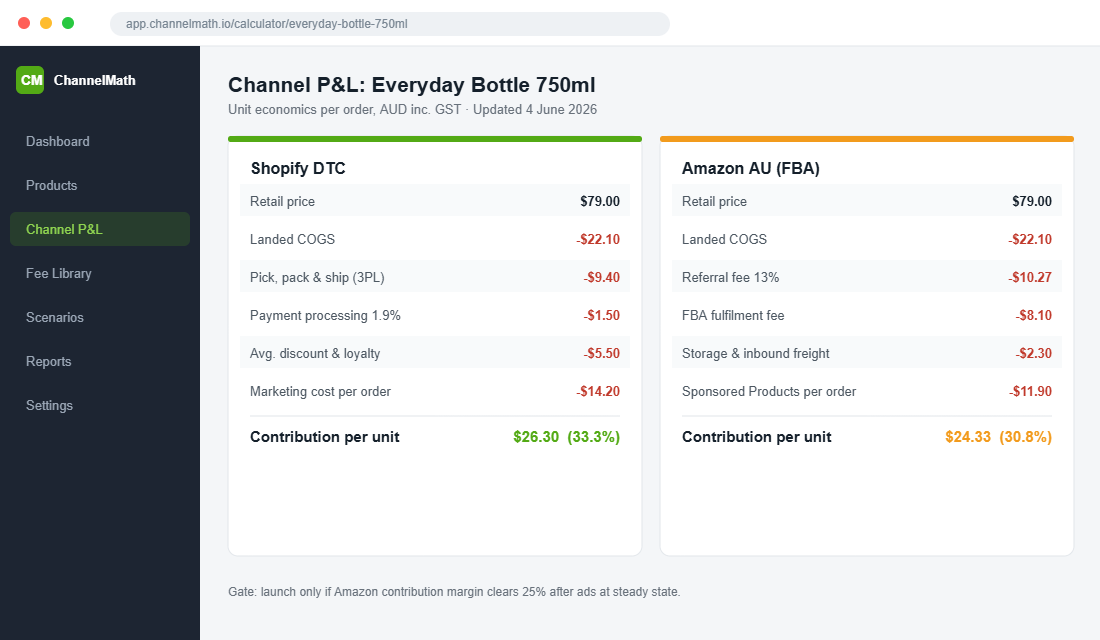
The compression is real. A product earning a 55% gross margin on your Shopify store typically lands at 30% to 35% on Amazon before a single advertising dollar. That is not a reason to avoid the channel. It is a reason to model it honestly, the same way you would before signing a wholesale deal.
Build a per-unit channel P&L for your top five SKUs: retail price, landed COGS, referral fee, FBA fee, storage allowance, and a realistic ad cost per order. If you have never broken your DTC margins down to this level, run the contribution margin audit first so you are comparing like with like.
The gate: a SKU only launches on Amazon if it clears 25% contribution margin after ads at steady state. Below that you are renting revenue, not building a channel.
Step 2: Decide What Amazon Gets (And What It Never Gets)
The single biggest cannibalisation mistake is listing your full catalogue at identical prices. Do that and you have given your existing customers a reason to buy through Amazon instead of your store, where you lose the email address, the post-purchase flow, and 15% of the margin. Catalogue architecture is how you prevent it.
Think of your range in three tiers.
- Amazon gets your hero acquisition SKUs. Your best-known products, the ones people search for by name or category. These are your billboard on the marketplace. Their job is to win new customers who were never coming to your site.
- Amazon gets marketplace-only formats. Twin packs, bundle sizes, or colourways that do not exist on your Shopify store. Different formats mean no direct price comparison, which protects both channels. A skincare brand might sell the 50ml jar on Amazon and reserve the 100ml and the routine bundle for DTC.
- Amazon never gets your retention engine. Subscription products, loyalty-tier exclusives, limited drops, and new launches stay on your store. These are the reasons customers come direct, and they need to stay that way.
On pricing, hold strict parity on identical SKUs. Never undercut your own store on Amazon, and never let Amazon sit cheaper for long either, because Amazon’s systems can suppress your Buy Box if your own site runs a lower price. The cleanest approach: same RRP everywhere, with your DTC advantage delivered through bundles, loyalty points and subscriber pricing rather than sticker price.
If you already run a wholesale channel, this logic will feel familiar. It is the same discipline we cover in the wholesale channel playbook: every channel gets a defined job, a defined range, and rules that stop it eating the others.
Step 3: Set Up Listings That Defend the Brand, Not Just Describe the Product
An Amazon listing is not a product page. It is a shelf position in the most competitive retail environment in the country, and you need to fortify it before you drive a single click.
Start with Brand Registry. You need a registered trademark with IP Australia (budget roughly $250 to $400 per class and a few months of processing if you have not filed yet). Brand Registry gives you A+ content, your own Brand Store, Sponsored Brands ads, and the tools to kick counterfeit sellers off your listings. Listing without it is playing the game with one hand tied.
Then build the listing in this order:
- Title formula. Brand + product name + key attribute + size or count. Front-load the term shoppers actually search, because mobile truncates everything after about 80 characters.
- Five benefit-led bullets. Lead each bullet with the outcome, then the feature. Write for the skimmer deciding between three tabs.
- A+ content below the fold. Comparison charts, lifestyle imagery, brand story modules. Listings with strong A+ content consistently convert better because they answer objections the bullets cannot.
- Backend search terms. Fill every character with synonyms and common misspellings. Australians search “drink bottle”, “water bottle” and “flask” for the same product.
Reviews are the moat. Enrol new listings in Amazon Vine for your first reviews, then let your post-purchase quality do the work. Do not pay for reviews and do not put incentivised review cards in the box. Amazon suspends accounts for it, and losing the channel overnight hurts far more than a slow review ramp.
Step 4: Win the Traffic Game Without Buying Junk Clicks
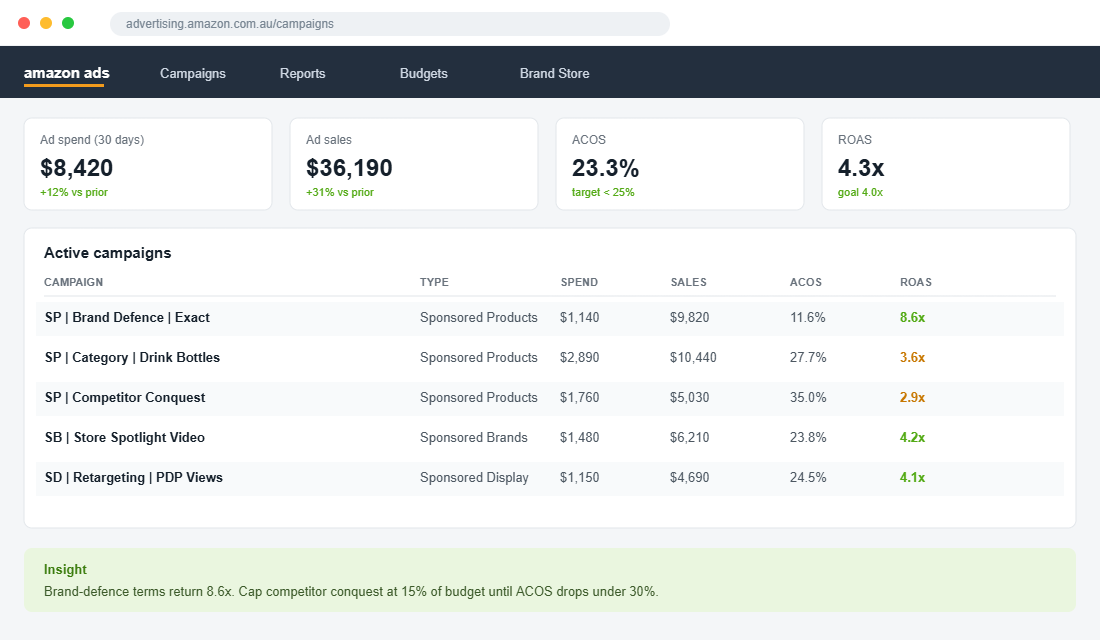
Amazon is a search engine with a checkout attached. Rank and relevance decide who wins, and ads buy you the data and velocity to get there. The brands doing this well in Australia run a three-tier campaign structure.
- Tier 1: Brand defence. Exact-match campaigns on your own brand name. These are the cheapest, highest-converting clicks you will ever buy, and they stop competitors conquesting your customers. Expect single-digit ACOS here.
- Tier 2: Category terms. The head and mid-tail searches where new customers live. This is where most of your budget goes, and where you accept a higher ACOS as a customer acquisition cost.
- Tier 3: Competitor conquest. Targeting rival listings and brand terms. Run it small, cap it at around 15% of budget, and kill it if ACOS stays above your contribution ceiling.
The local proof is strong. Aussie furniture brand Koala started selling on Amazon AU in 2021 and doubled its Amazon sales year on year by 2023, using Sponsored Products, Sponsored Brands video and a Brand Store. During Prime Big Deal Days the brand pulled a 4x return on ad spend against its weekly goal. Bondi Sands went further: after fixing listing and Buy Box issues and layering a full-funnel ads strategy, the tanning brand lifted Amazon sales 258%, with product page traffic up 57% and a 461% ROAS against a 400% target.
Plan your calendar around Amazon’s tentpole events: Prime Day in July, Prime Big Deal Days in October, then Black Friday and Cyber Monday. Traffic on those days multiplies, and shoppers arrive pre-committed to buying. A deal badge plus a defended listing is how smaller Aussie brands punch above their weight.
Step 5: Run the Channel Without Breaking Your DTC Engine
Operations is where Amazon experiments quietly die. Stock-outs reset your organic rank, slow shipping tanks your seller metrics, and messy settlement data turns your bookkeeping into soup. Lock down four things.
Fulfilment model. FBA wins for most brands because the Prime badge lifts conversion materially and Amazon handles the customer service you do not want. Keep merchant fulfilment for bulky, slow-moving or personalised SKUs where FBA storage maths does not work.
Inventory discipline. Hold 6 to 8 weeks of FBA cover on hero SKUs and set a reorder trigger at 4 weeks. Never starve your DTC store to feed Amazon. If stock is tight, your own store wins, full stop.
Sync the catalogue properly. The tool to start with is Shopify Marketplace Connect, the free first-party app. Setup takes an afternoon:
- Install Marketplace Connect from the Shopify App Store and open it from your admin.
- Connect your Amazon Seller Central account (you will need a Professional plan, $49.95/month in Australia).
- Map your Shopify products to Amazon listings, or create new ASINs from your product data.
- Set pricing rules per channel so an RRP change on Shopify flows through automatically.
- Turn on inventory sync so FBA and Shopify never oversell the same unit.
Clean accounting. Amazon pays you in lumpy fortnightly settlements with fees netted out. Pipe them through A2X into Xero so revenue, referral fees and FBA charges land in separate accounts. Without it you cannot see channel profitability, and Step 1’s margin gate becomes a guess.
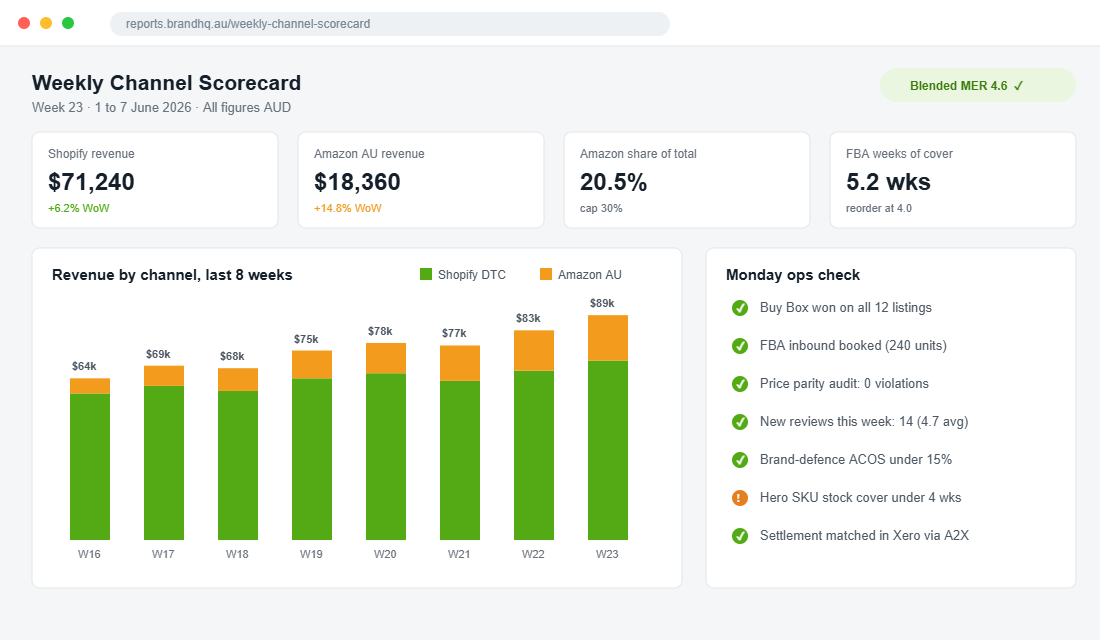
Then review one page weekly: revenue by channel, Amazon’s share of total, blended MER, and weeks of FBA cover. Cap Amazon at around 30% of total revenue. Past that point you are building someone else’s asset with your best products.
The Compound Effect: When Both Channels Feed Each Other
Run the five steps as a system and something useful happens: the channels stop competing and start compounding.
Amazon becomes your acquisition surface. Shoppers who would never have clicked a Meta ad discover you through a category search, get a flawless Prime delivery, and remember the brand. A meaningful slice of them google you afterwards, land on your Shopify store, and find the bundle, the subscription and the loyalty program that Amazon never sees. Marketplace customer today, owned customer tomorrow.
It works in reverse too. Your DTC brand marketing lifts your Amazon conversion rate, because shoppers who recognise a brand click it and buy it at a higher rate than strangers. Higher conversion lifts organic rank. Better rank lowers your dependence on ads, which repairs the channel margin you modelled in Step 1. Meanwhile your hero listings sit on the shelf where 8.8 million Australians are already shopping, defending shelf space that a competitor or grey-market reseller would otherwise occupy.
That is the real answer to the cannibalisation fear. Done with discipline, Amazon does not eat your store. It feeds it.
The Cash Cycle Nobody Warns You About: Amazon Pays You Later Than Shopify Does
The margin gate in Step 1 tells you whether Amazon is profitable. It does not tell you whether you can afford it. Those are different questions, and the second one catches more Aussie founders than the first.
On Shopify Payments you see money two to three business days after the order. On Amazon Australia the standard settlement runs on a 14-day cycle, and Amazon holds a rolling reserve against returns and chargebacks, so a meaningful slice of each payout sits in “unavailable balance” for another week or two. Add the FBA inbound leg, where stock you have paid your supplier for spends 7 to 14 days travelling to and being received at the Sydney or Melbourne fulfilment centre before it can sell, and you are routinely 45 to 60 days from paying for stock to seeing the cash.
For a brand doing $40K a month on Amazon at a 45% cost of goods, that is roughly $30K to $40K of working capital permanently parked in the channel. If your DTC engine was running on a 25-day cash cycle, you have just doubled it for every unit you send to Amazon.
Three settings that shorten the cycle
- Turn on daily disbursement once your account qualifies (usually after 90 days of clean selling history). It does not remove the reserve, but it stops the fortnightly cliff.
- Keep FBA stock at 4 to 6 weeks of cover, not 12. Amazon charges monthly storage per cubic metre and a long-term fee on anything sitting more than 180 days, so overstocking costs you twice: in cash tied up and in fees.
- Send smaller, more frequent inbound shipments. Two shipments a month instead of one halves the stock that is “paid for but not yet sellable” at any moment.
Build the allocation rule before the first shipment
Decide in advance what share of each production run Amazon gets, and make it a rule, not a feeling. A common starting split is 20% of units to FBA, reviewed monthly against sell-through, with DTC always holding priority on hero SKUs. The stock allocation playbook walks through how to run that decision across channels without starving your own store in the run-up to peak.
And model the true unit cost before you set the split. Amazon referral fees of 6 to 15%, FBA pick-and-pack, inbound freight and storage all sit on top of the landed cost you already carry. Founders who run the landed cost calculation properly usually find Amazon needs a 10 to 15 point higher gross margin than DTC just to break even on cash, which is exactly why the channel only earns a bigger slice of stock as it proves itself.
The short version: Amazon Australia can add a second revenue engine. It cannot add a second bank account. Fund the channel from the start as a 60-day cash commitment and it stops being a nasty surprise in month three.
The Amazon Australia Launch Checklist
Steal this as your go/no-go framework. Work through it in order and do not skip gates.
Before you list:
- Per-unit channel P&L built for your top 5 SKUs, and each launching SKU clears 25% contribution after ads
- Trademark filed or registered with IP Australia, Brand Registry application ready
- Catalogue tiers decided: hero SKUs in, marketplace-only formats created, retention products excluded
- Pricing parity rules written down, including how you will handle sale events on each channel
- 12 weeks of stock available without starving your Shopify store
At launch:
- Listings built with the title formula, five benefit bullets, A+ content and full backend search terms
- Brand Store live, Vine enrolment done, FBA inbound shipment booked
- Three-tier ad structure live with brand defence on exact match from day one
- Marketplace Connect syncing inventory and pricing, A2X feeding Xero
First 90 days:
- Weekly scorecard reviewed every Monday: channel revenue, Amazon share, blended MER, weeks of cover
- ACOS by tier trending toward target (under 15% defence, under 30% category)
- Review velocity building and Buy Box held on every listing
- Decision logged at day 90: scale, hold, or exit with a stock rundown plan
The founders who win on Amazon Australia are not the ones who rushed there first. They are the ones who arrived with a margin gate, a catalogue plan and a scorecard, then let the channel earn a bigger slice of stock as it proved itself.
Inside eCommerce Circle, channel strategy is one of the core pillars we work on with every member, including the maths on whether Amazon deserves your stock at all. If you want a second opinion on yours, let’s talk.