Somewhere in the last three years, growth got expensive. Meta CPMs hit an all-time high of $22.98 USD in Q4, Google Shopping clicks jumped 33.7% in 2025, and the average DTC brand now pays close to 60% more to acquire a customer than it did five years ago.
What’s in This Article
Most founders respond the only way the ad platforms want them to: spend more. Better creative, broader audiences, bigger budgets. The treadmill speeds up and the margin gets thinner.
The brands pulling away from the pack made a different bet. They stopped renting attention and started building a place their customers actually want to belong to. LSKD, the Queensland activewear brand, runs a 95,000-member private Facebook group, holds a repeat customer rate of around 60%, and has grown past $150 million in annual sales. The average Shopify store repeats at 28.2%. That gap is not better ads. It is community.
This playbook breaks down the 5-part system for building a brand community around your Shopify store: where to host it, how to get customers in, what to post, how to turn members into your marketing engine, and how to measure whether it is actually paying for itself.
Why a Community Beats a Bigger Ad Budget
Every audience you build on Meta, TikTok, or Google is rented. The platform owns the relationship, sets the price of reaching it, and changes the rules whenever it suits them. A community is the opposite. You own the member list, you control the reach, and the cost of talking to your best customers tonight is zero.
The retention maths is where it gets interesting. After a first purchase, the average customer has roughly a 27% chance of coming back. Once they make a second purchase, the probability of a third jumps to 54% or higher. Anything that reliably moves customers from order one to order two has an outsized effect on lifetime value, and a community is one of the few levers that works on that exact gap.
Existing customers also spend around 67% more than new ones over time. So a community is not a feel-good branding exercise. It is a margin strategy: more repeat orders without more ad spend, plus a constant stream of feedback, reviews, and content that makes every other channel cheaper.

Part 1: Choose the Home Base (Owned Beats Rented)
Your community needs one home. Brands that scatter effort across a Facebook group, a Discord, an Instagram broadcast channel, and a half-built forum end up with four ghost towns instead of one busy room.
For most Aussie Shopify brands between $40k and $500k a month, the answer is a private Facebook group. Your customers are already there, it costs nothing, the notification engine does the heavy lifting, and the entry questions let you capture the one thing you need: the member’s email address.
- Private Facebook group. The default choice. Free, familiar, and frictionless. The trade-off is that it still lives on rented land, which is why you capture emails at the door.
- SMS VIP club. LSKD treats SMS as a two-way channel, not a broadcast cannon. Great as a second layer for drops and early access once the group has momentum.
- Dedicated platform (Circle, Discord). Full ownership and no algorithm, but you are fighting for a new habit. Best saved for brands with an obsessive niche: think specialty coffee, fishing, or trading cards.
One naming rule: name the group around the identity, not the brand. “The 4WD Touring Australia Crew” will outgrow “BrandName Customers” every time, because people join for who they are, not for who you are.
Part 2: Design the Entry Ritual (The First 14 Days Decide Everything)
A community lives or dies on what happens in a new member’s first two weeks. A member who posts or comments in week one becomes a regular. A member who joins and sees nothing relevant becomes a number on a vanity dashboard.
Build the invitation into the moment your customer is most excited: right after purchase. The second email in your post-purchase flow (day 3 to 5, while they are waiting for the parcel) should sell the group like a product: what they get, who is inside, and why it is customers only.
- Gate the door with 3 entry questions. Ask what they bought, what they want help with, and for their email address so you can send the member-only perks.
- Pin a welcome post that tells new members exactly what to do first: introduce yourself, answer this week’s question, grab the member discount.
- Prompt an action inside 48 hours. A welcome comment from the founder with a genuine question gets 3 to 5 times more new-member replies than a generic “welcome aboard”.
- Tag them in Klaviyo. Set a custom profile property like community_member: true the moment they join. Every retention number you track later depends on this one step.
The pattern matters because of where it sits in the customer lifecycle. The window between first and second purchase is where most brands lose the customer entirely. Your community fills that silence with belonging instead of discount codes.
Part 3: Run a Content Cadence You Can Actually Sustain
The number one reason brand communities die is not a lack of members. It is a founder who posted daily for three weeks, burned out, and went quiet for two months. The group reads the silence as permission to leave.
The fix is a cadence you can hold for a year: three to four posts a week, on a repeating rhythm, planned a fortnight ahead. The repetition is a feature. Members start showing up for Wednesday’s question the way they show up for a favourite show.
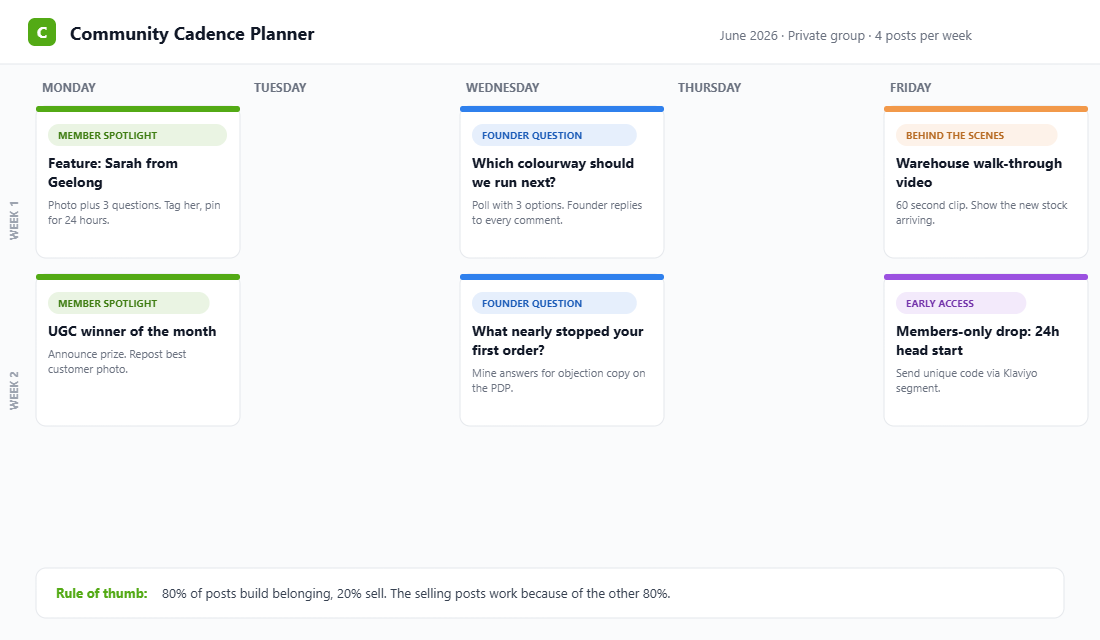
- Monday: member spotlight. Feature one customer, their photo, and their story. This is the post members screenshot and share.
- Wednesday: founder question. Ask one real question about products, problems, or what to build next. LSKD mines its group and surveys for exactly this kind of product feedback.
- Friday: behind the scenes or early access. Warehouse walk-throughs, sample unboxings, member-only 24-hour head starts on new drops.
Hold the 80/20 rule: 80% of posts build belonging, 20% sell. The selling posts only work because of the other 80. And the founder needs to be visible. Twenty minutes a day replying to comments outperforms any amount of scheduled content, because people join groups for access to the human behind the brand.
Part 4: Turn Members Into Your Marketing Engine
A healthy community does not just retain customers. It manufactures the assets your acquisition channels are starving for: reviews, photos, video, and word-of-mouth.
Frank Body wrote the local masterclass on this. The Melbourne skincare brand pushed the hashtags #thefrankeffect and #letsbefrank on its packaging and channels, celebrated customer photos with monthly prizes, and collected more than 100,000 pieces of customer content while growing to $20 million in revenue and roughly 700,000 Instagram followers. The product photos sold the product better than the brand ever could.
Inside your own community, the engine looks like this:
- Run a monthly UGC prize. Best customer photo or video wins store credit. Announce the winner in the group, then repost everywhere.
- Ask permission to whitelist. Member content with a real face and a real loungeroom regularly beats studio creative on Meta. One question in the comments gets you the rights.
- Pipeline reviews. Members who engage in the group convert to reviewers at a far higher rate than cold email requests. Ask the engaged ones first.
- Seed your referral program. Members are pre-sold advocates. If you have not built that engine yet, the Shopify Referral Program Playbook covers the 5-layer system.
Part 5: Measure Community Like a Channel
If you cannot see the community in your numbers, you will quietly stop investing in it the first busy month. So measure it the way you would measure a paid channel: with a control group and three core metrics.
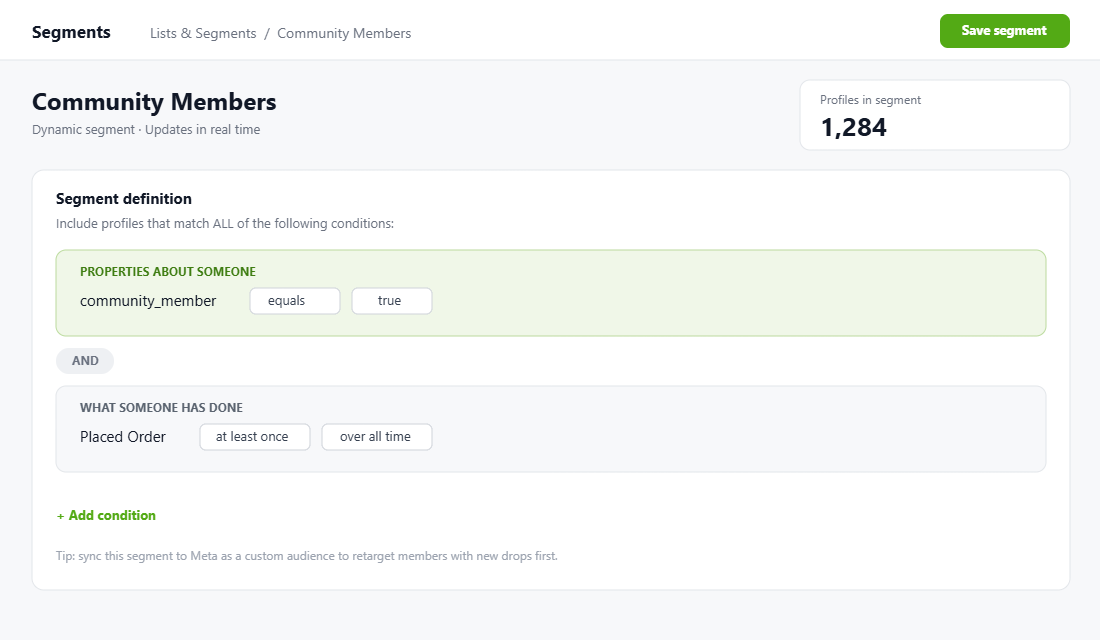
The Klaviyo property you set in Part 2 makes this simple. Build a Community Members segment and compare it against everyone else on repeat purchase rate, lifetime value, and average order value.
- Member vs non-member repeat rate. The headline number. A working community should show members repeating at 1.5 to 2 times the rate of non-members.
- Monthly active percentage. Aim for 20 to 30% of members commenting, posting, or reacting each month. Total member count is a vanity metric; active percentage is the health metric.
- Member LTV at 6 and 12 months. Loyalty and community members typically generate 12 to 18% more revenue than non-members, and around 83% of companies that measure loyalty investment report positive ROI, averaging about 5.2 times return.
Review the numbers every 90 days. If members do not look different from non-members after two quarters, the problem is almost always Part 2 or Part 3: people are joining and meeting silence.
The Starter Stack: A Facebook Group Wired Into Klaviyo
You do not need new software to run this playbook. The starter stack is a free private Facebook group wired into the Klaviyo account you already have. Here is the setup, start to finish:
- 1. Create the private group. Name it around the customer identity. Switch on the three entry questions and make the email question mandatory in spirit: “Leave your email so we can send member-only perks.”
- 2. Add the invitation to your post-purchase flow. Email two, day 3 to 5 after purchase. One job: sell the group.
- 3. Tag members in Klaviyo. Each week, take the new-member emails from the entry questions and set community_member: true on those profiles. A VA can do this in 15 minutes a week, or an app like Group Leads automates it.
- 4. Build the segment. Properties about someone: community_member equals true. Then clone your reporting dashboards with this segment as the filter.
- 5. Pin the welcome post and load the calendar. Two weeks of cadence scheduled before you invite a single member.
The 30-Day Community Launch Checklist
Here is the framework to take this from idea to live in 30 days. Save it, then work one week at a time.
- Week 1: Foundations. Pick the platform. Name the group around the identity. Write the 3 entry questions, the pinned welcome post, and the group rules. Privately invite 10 to 15 of your best customers so the room is warm before launch.
- Week 2: Invitations. Add the invite to your post-purchase flow. Add a QR card to every parcel. Send a one-off invitation to your top 10% customers from the founder’s own email.
- Week 3: Rhythm. Load a fortnight of cadence posts. Block 20 founder minutes a day for replies. Run the first member spotlight and the first founder question.
- Week 4: Measurement. Set the Klaviyo property and segment. Record baseline repeat purchase rate, member count, and active percentage. Set the 90-day targets: 20%+ monthly active, member repeat rate at 1.5x non-members.
The Four Mistakes That Kill Brand Communities
Most failed brand communities die from the same four wounds. Check your plan against this list before you launch, and again at the 90-day review.
Mistake 1: Treating the group as another broadcast channel. If every post is an offer, members learn to scroll past you the same way they scroll past your ads. The group becomes a discount noticeboard with worse reach than email. The 80/20 rule from Part 3 exists precisely because the selling only works inside a room people enjoy being in.
Mistake 2: Launching to everyone at once. A group of 800 strangers and no conversation is a worse first impression than no group at all. Seed the room with 10 to 15 of your warmest customers first, get two weeks of genuine conversation flowing, and only then open the post-purchase invitations. New members copy the behaviour they see on arrival.
Mistake 3: Delegating the founder away too early. A VA can schedule posts, approve members, and chase entry-question emails. What a VA cannot do is be the founder. Members join for proximity to the person who built the thing. Keep the 20 daily minutes of founder replies for at least the first six months, then taper as member-to-member conversation takes over.
Mistake 4: No bridge back to the store. The opposite failure to mistake 1. Some founders get so protective of the vibe that the community never touches revenue: no early access, no member pricing, no UGC pipeline, no Klaviyo property. Then the first tough quarter arrives, the group looks like a cost, and it gets abandoned. The bridge is not spam. It is the measurement loop from Part 5 plus a members-first launch calendar.
What good looks like at each milestone
- Day 30: 50 to 150 members for a store doing 300+ orders a month, welcome post reply rate above 60%, founder has replied to every introduction.
- Day 90: 20%+ monthly active, first UGC prize awarded, community invite sitting in the post-purchase flow with a 15 to 25% click-to-join rate.
- Day 180: member repeat purchase rate at least 1.5x non-members, first members-only early access drop completed, member content running as Meta creative.
- Day 365: community contributes a measurable share of repeat revenue, and at least one product decision per quarter traces back to a founder question in the group.
Miss a milestone and the diagnosis is usually upstream: a day-90 active rate problem is a cadence problem, and a day-180 repeat rate problem is almost always an entry ritual problem. Fix the part, not the symptom.
The Moderation Layer: Rules, Roles and What To Do When a Post Goes Sideways
Nobody plans for moderation until the first angry post lands at 9pm on a Friday. A community with 500 members generates roughly 15 to 30 pieces of member content a week, and somewhere in that stream will be a delayed parcel complaint, a rival brand mention, or two members arguing about sizing. How you handle the first three of those sets the tone for the next three years.
Write five rules, not twenty. Members only, be decent to each other, no reselling or spam, keep support issues in DMs to the team, and the founder has the final say. Pin them, restate them in the welcome post, and enforce them the same way every time. Facebook lets you attach a rule to every removed post, so members see a reason rather than a disappearance.
- Recruit two member moderators by day 90. Pick the members who already answer questions before you do. Give them a badge, a monthly product credit of around $50, and a shared inbox for reports. Brands running this model typically see the founder’s daily reply time fall from 20 minutes to under 10 without engagement dropping.
- Set a public response SLA. Every member question gets a reply from the team within 4 business hours, and every support complaint gets moved to a DM inside 30 minutes. Complaints handled fast and in the open convert to loyalty more often than complaints that never happen, because the rest of the room watches you fix it.
- Never delete a fair complaint. Reply in the thread, own the miss, fix it, then post the outcome. Deleting it is the single fastest way to lose the trust of the 90% of members who never post but read everything. The same principle drives the negative review playbook: a visible recovery is worth more than a clean feed.
- Moderate the algorithm, not just the people. Facebook throttles group reach when posts get reported or when a link-heavy post pattern looks like spam. Keep external links to one per post, put product links in the first comment, and use the group’s native poll and event features because those get preferential distribution.
One more piece of structure worth adding once the room is warm: tie community status to your loyalty tiers. Members who hit your top tier get a named role in the group, first access to founder Q&As and a say in the next product vote. It costs nothing, it gives the loyalty program a social layer that points alone never create, and it gives the rest of the group something visible to aim for.
The Compound Effect
Here is what makes this system worth the effort. Each part feeds the next, and the whole loop feeds every other channel you run.
The home base captures your best customers at their happiest moment. The entry ritual converts them from buyers into members. The cadence keeps them close between orders, which is exactly the window where brands normally lose people and end up paying for a win-back flow to drag them home. The marketing engine turns their enthusiasm into the photos, reviews, and referrals that cut your acquisition costs. And the measurement loop proves the whole thing in dollars, which is what keeps you investing when the quarter gets busy.
Paid ads stop the moment you stop paying. A community keeps compounding: every member spotlight, every founder reply, every parcel QR card adds to an asset the platforms cannot reprice and competitors cannot copy. That is what a moat looks like for a DTC brand in 2026.
Inside eCommerce Circle, retention systems like this are one of the core pillars we work on with every member. If you want a second opinion on yours, let’s talk.