Most flash sales are a sugar hit. The founder panics about a slow month, slaps 30% off sitewide, blasts one email, and watches revenue spike for a day. Then the hangover arrives: margin is gone, full-price sales stall for a fortnight, and a chunk of the customer list quietly decides to never pay full price again.
What’s in This Article
Run properly, a flash sale is a different animal. Experian’s email research found that flash sale campaigns with a 3-hour window achieved 59% higher transaction-to-click rates than longer promotions, and limited-time offers consistently outperform evergreen discounts at the same depth. The compression is the point. Urgency does the selling for you.
The difference between a sugar hit and a strategic lever is structure. After working with hundreds of Aussie Shopify founders inside eCommerce Circle, we have seen both versions up close. This playbook is the structured version: a 5-phase system that runs over 72 hours, protects your margin floor, and leaves your full-price credibility intact when the timer hits zero.
Why Most Flash Sales Backfire in the Australian Market
Australian shoppers are already trained to wait. The Australia Post eCommerce Report 2026 found that 73% of Aussie shoppers now wait for sales events before buying, 81% shop around for the best deal, and Gen Z, Millennial and Gen X shoppers expect discounts of 20 to 30% during sale events. Online spend hit $82.6 billion in 2025, up 14% year on year, but a growing share of it flows through discount windows.
That environment punishes lazy discounting. If your store runs a “flash sale” every second weekend, it is not a flash sale. It is your real price list with extra steps, and your customers know it. The moment your audience believes another discount is always around the corner, your full-price conversion rate starts decaying.
The fix is not avoiding flash sales. It is running them rarely, with a real reason, real scarcity, and a hard close. Roughly 60% of shoppers say fear of missing out influences their purchase decisions, but FOMO only works when the “missing out” part is true. Every phase below exists to keep it true.
Phase 1: Pick a Real Trigger and Ring-Fence the Stock
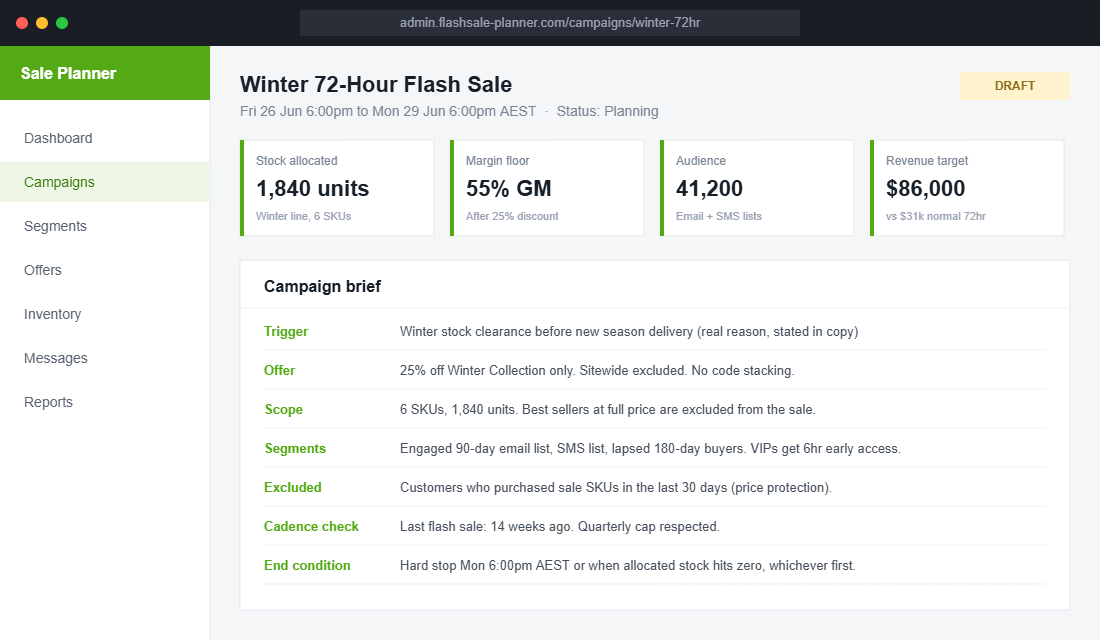
Every flash sale needs a reason the customer can believe. “We felt like it” trains discount-waiting. “Winter stock has to move before the new season delivery lands” is honest, specific, and gives the discount a natural expiry. The best triggers are operational truths: end of season, warehouse move, a discontinued line, a milestone like your 5th birthday.
Then ring-fence the stock. A flash sale should cover a defined pool of units, not your whole catalogue. Pull the SKU list, check weeks-of-cover, and allocate only the inventory you genuinely want gone. Your best sellers stay at full price. That single exclusion protects more margin than any other decision in this playbook, because it stops your hero products from being repriced in the customer’s head.
- Write the brief first. Trigger, SKU list, unit count, sale window, segments, exclusions, end condition. One page. If you cannot write the trigger in one honest sentence, you do not have a flash sale, you have a panic.
- Set the window at 48 to 96 hours. Long enough to reach your whole list across timezones and work schedules, short enough that urgency stays real. We use 72 hours, Friday 6pm to Monday 6pm AEST, as the default.
- Define the hard stop. The sale ends at the published time or when allocated stock sells out, whichever comes first. Never extend. One extension teaches your list that deadlines are theatre.
If you are not sure which SKUs deserve clearing, your inventory data already knows. Our inventory forecasting playbook walks through the weeks-of-cover maths that flags slow movers before they become dead stock.
Phase 2: Build the Offer Maths Before the Creative
Australian shoppers expect 20 to 30% off during sale events, so a 10% flash sale mostly annoys people. But depth without maths is how founders donate their quarter to the customer. Before you pick a number, work out your margin floor: the discount level at which contribution margin per unit still covers pick, pack, shipping subsidy and payment fees with profit left over.
The working is simple. Take landed cost, add fulfilment cost per order divided across average units, add the payment fee, subtract the lot from your discounted price. If a $90 product costs $31 landed and $9 to fulfil its share of an order, a 25% discount to $67.50 still leaves roughly $25 of contribution. A 40% discount to $54 leaves about $12, and suddenly free shipping or a returns spike can push the sale underwater.
- Pick one discount depth and hold it. 25% off the ring-fenced collection beats a confusing ladder of 15/20/30. One number is easier to message and easier to defend.
- No stacking. Flash sale pricing excludes welcome codes, loyalty discounts and gift-with-purchase. State it in the fine print. Stacked discounts are where margin goes to die.
- Use an automatic discount, not a code. Shopify’s automatic collection discount removes checkout friction and stops code leakage to coupon sites. Codes from your last campaign will be on Honey within hours; automatic discounts never leak.
- Model the cannibalisation. Assume 20 to 30% of flash sale buyers would have bought anyway at full price. If the numbers only work when every order is incremental, the offer is too deep.
Phase 3: The 72-Hour Message Sequence (Where the Revenue Actually Comes From)
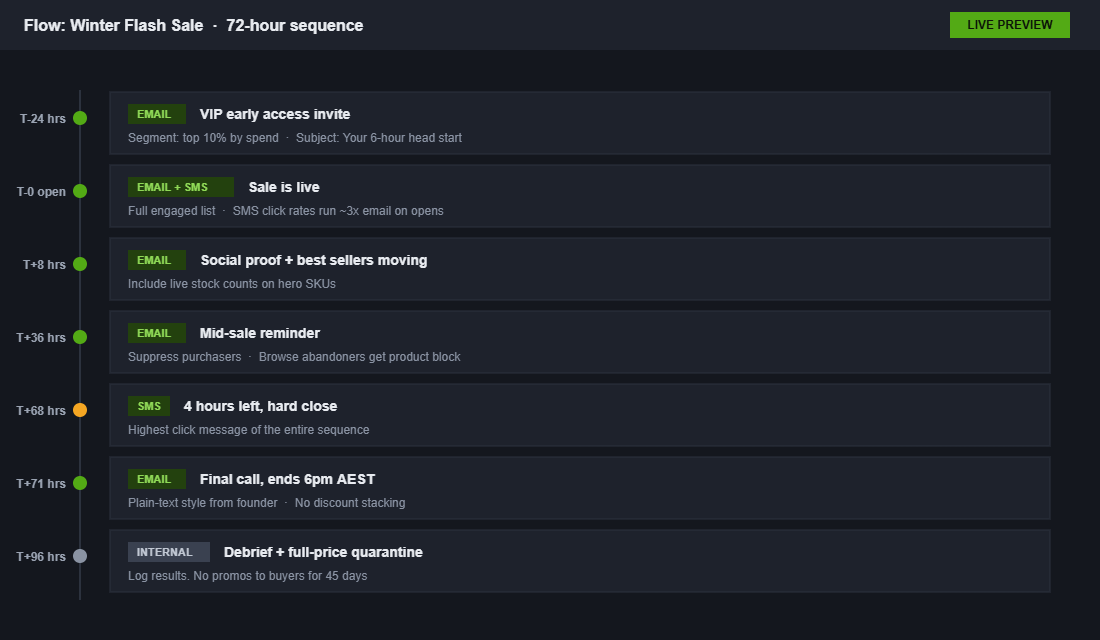
A flash sale is a messaging campaign with a shop attached. In the debriefs we run with members, email and SMS typically drive 55 to 70% of flash sale revenue, with the open and the close contributing more than half of that between them. The middle of the sale is quiet. Plan for the U-shape instead of panicking at hour 30.
The sequence that works is seven touches over roughly four days:
- T-24 hours, VIP early access email. Your top 10% of customers by spend get a 6-hour head start. VIPs buying early is also your live test that the discount, collection page and checkout all work.
- T-0, launch email plus SMS. Send both within minutes of opening. SMS earns its keep here: Klaviyo’s benchmarks put strong SMS click rates at triple a typical email campaign, and time-sensitive sends are exactly where the channel shines.
- T+8 hours, social proof email. “The chunky knit is nearly gone” with live stock counts on hero SKUs. Display real numbers only when they are genuinely low; under 10 units is the threshold where scarcity reads as real.
- T+36 hours, mid-sale reminder. Suppress everyone who has purchased. Browse abandoners get a product block of what they viewed.
- T+68 hours, the 4-hours-left SMS. Reliably the highest click-through message of the entire sequence.
- T+71 hours, final call email. Plain-text style, from the founder, one link. It reads like a note, not a campaign, and it converts like one too.
- T+96 hours, internal debrief. Not customer-facing, but scheduled like a send so it actually happens. More on this in Phase 5.
Two existing systems make this sequence dramatically stronger. Your abandoned cart flow needs a temporary sale-aware variant so cart reminders mention the deadline, and your SMS program needs quiet hours respected: nothing before 9am or after 8pm local time, which in Australia also keeps you on the right side of the Spam Act.
Phase 4: Prep the Store So Urgency Is Visible (and the Site Stays Up)
Gymshark learned the infrastructure lesson the hard way. On Black Friday 2015 their self-hosted Magento store collapsed under sale traffic and stayed down for eight hours, costing an estimated $143,000 in lost sales and pushing the brand to rebuild on Shopify. Their later “Blackout” sale campaigns helped drive 197% year-on-year holiday revenue growth. Same brand, same audience, different preparation.
You are unlikely to crash Shopify itself, but apps, themes and discount logic all break under sale conditions if untested. On-site urgency also needs to be built, not implied. Countdown timers lift conversion by 8 to 32% across ecommerce studies, and they cost nothing to add.
Tool setup: Hextom Countdown Timer Bar. It is the simplest way to get a sitewide deadline live without touching theme code. Setup takes about ten minutes:
- Install Hextom Countdown Timer Bar from the Shopify App Store (free plan available, paid from about USD $10/month for targeting rules).
- Create a new timer, choose “Fixed end date” and set your hard close in AEST, for example Monday 6:00pm.
- Write the bar copy with the offer and the deadline: “25% off the Winter Collection. Ends Monday 6pm AEST.” Skip exclamation marks; the timer is the urgency.
- Set display rules to show on the sale collection, product pages and cart. Set the button link straight to the sale collection.
- Style it with your brand colours, turn on mobile display, and schedule the bar to auto-hide at the close so you never show an expired sale.
Beyond the timer: build a dedicated sale collection page, add “final hours” badge swaps for the last day, test the automatic discount with a real card, and check your top three landing pages on a phone. The Australia Post report puts the majority of Aussie online purchases on mobile, and a broken mobile cart during a 72-hour window has no time to be found and fixed.
Phase 5: Close Hard, Then Debrief Like It Mattered
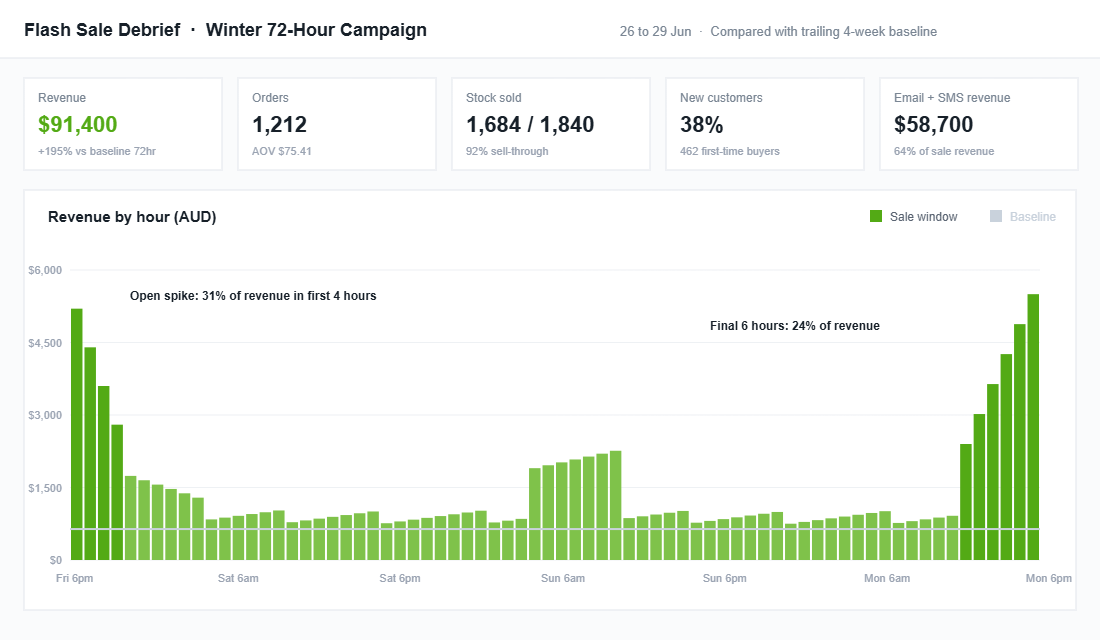
The close is where discipline pays. At the published end time, the discount switches off, the timer bar disappears, and any remaining sale stock goes back to full price or into the outlet. Someone will email asking for “one more day”. The answer is a polite no. Your next flash sale’s performance is being decided by how this one ends.
Within 72 hours of closing, run the debrief while the data is fresh. Six numbers tell the story:
- Total revenue vs a normal 72-hour baseline. The headline lift, but only the start of the story.
- Sell-through on ring-fenced stock. 80%+ means the trigger and depth were right. Under 50% means the offer or the audience missed.
- Contribution margin per order. Revenue spikes are vanity if contribution fell off a cliff.
- New customer share. First-time buyers acquired on discount need a full-price second purchase inside 90 days to be worth keeping. Watch the cohort.
- Email and SMS revenue share. If owned channels drove less than half the sale, your list is underpowered for this play.
- Full-price sales in the 14 days after. The training-effect check. A deep post-sale slump means you went too broad or too deep.
The Guardrails That Stop Flash Sales Eroding Your Brand
Princess Polly is a useful study in containment. Their sharpest offers, the buy-one-get-one events and flash discounts, live inside their app, with early access and app-only pricing pushed through notifications. The public storefront keeps its pricing integrity while the most engaged audience gets the deals. You do not need an app to copy the principle: fence your best offers to owned channels and let the open web see full price.
- Cap the cadence. Three or four flash sales a year, maximum. A quarterly rhythm is frequent enough to matter and rare enough to stay believable.
- Vary the trigger and the stock. Same sale, same SKUs, every quarter becomes a schedule your customers learn. Rotate seasons, lines and occasions.
- Protect recent full-price buyers. Exclude anyone who bought a sale SKU in the past 30 days, or proactively offer them the difference as store credit. One goodwill gesture beats a chargeback and a one-star review.
- Quarantine buyers post-sale. No promotional sends to flash sale purchasers for 45 days. The next thing they hear from you should build the relationship, not discount it again.
- Honour Australian Consumer Law. A “was/now” price is only legal if the product genuinely sold at the “was” price for a reasonable period. The ACCC has prosecuted retailers over fake markdowns; do not be the case study.
Picking Your Window in the Australian Promotional Calendar
Timing a flash sale in Australia means working around the big public events rather than inside them. EOFY in June, Click Frenzy in May and November, and the Black Friday to Cyber Monday block are already wall-to-wall discounts. Your 25% off competes with everyone’s 25% off, ad costs spike, and the sale reads as participation rather than occasion. With 40% of Gen Z shoppers already holding out for Black Friday and Click Frenzy, those weeks are the worst possible time to teach your list anything new.
The strongest flash sale windows are the quiet quarters. Late January after the returns dust settles. The March to April shoulder before Mother’s Day campaigns begin. Late July and August, when winter stock needs clearing and inboxes are calm. A quarterly rhythm built on those gaps gives you three to four clean windows a year where your deadline is the only one your customer is looking at.
Day and time matter less than founders think, with one exception: paydays. Launching on the Friday after the mid-month pay cycle, opening at 6pm when people are off the clock and on their phones, consistently outperforms a Monday morning open. The 72-hour Friday-to-Monday window also banks both weekend browsing peaks that the Australia Post data shows dominate Aussie online shopping behaviour.
One more timing rule: never run a flash sale to rescue a bad month after the month is already lost. A sale planned two weeks out with clean stock and a real trigger makes money. A sale launched in 48 hours of panic discounts whatever happens to be in the warehouse, and your audience can smell the difference.
How the Five Phases Compound
Each phase on its own is unremarkable. A brief, some maths, an email sequence, a countdown bar, a spreadsheet. Together they form a loop that gets stronger every quarter. The trigger keeps the discount believable, so urgency keeps working. The ring-fence protects hero SKU pricing, so full-price conversion holds between sales. The message sequence grows your owned channels, so each sale needs less paid traffic than the last. The debrief tells you exactly which lever to adjust next time.
That is the real difference between brands that use flash sales and brands that are used by them. One is running a system with a quarterly revenue spike built in. The other is renting revenue from their own future at 25% interest.
Your 72-Hour Flash Sale Checklist
Steal this and run it as a checklist for your next sale:
- 2 weeks out: Write the one-page brief. Trigger, SKU list, units, window, depth, segments, exclusions, hard stop.
- 1 week out: Confirm margin floor maths. Build the sale collection. Set up the automatic discount. Install and configure the countdown bar.
- 3 days out: Draft all 7 sequence messages. Build the sale-aware cart flow variant. Test discount and checkout with a real card on mobile.
- 1 day out: VIP early access send. Watch the first orders as a live systems test.
- Launch: Email plus SMS within minutes of opening. Monitor stock counts on hero sale SKUs.
- Mid-sale: Social proof send at hour 8, reminder at hour 36 with purchasers suppressed.
- Close: 4-hours-left SMS, final call email, then hard stop. Timer off, prices back, no extensions.
- 72 hours after: Debrief the six numbers. Log what changes next quarter. Quarantine buyers for 45 days.
Inside eCommerce Circle, promotional discipline like this sits in the Practice pillar we work on with every member: the calendars, SOPs and playbooks that turn one-off wins into repeatable systems. If you want a second opinion on your promotional calendar before your next sale, let’s talk.