You have spent thousands getting a shopper to your product page. The ad worked, the photography looks sharp, the copy is tight. Then they scroll down, see three reviews from 2023, and quietly close the tab. That silent exit is the most expensive thing happening in your store right now, and most Aussie founders never see it in their analytics.
What’s in This Article
Here is the uncomfortable truth. Around 9 in 10 shoppers read reviews before they buy, and 88% trust online reviews as much as a recommendation from a friend. Reviews now influence about 32% of purchases, ahead of discounts and coupons. Yet most stores treat reviews as a widget they installed once and forgot, not as the conversion engine it actually is.
The brands winning in Australia right now do the opposite. They treat social proof as a system: collect it relentlessly, display it where the decision happens, and turn customer photos into content that does the selling for them. This playbook breaks that system into five layers you can build this month, plus the one compliance line you cannot afford to cross with the ACCC watching.
The Reviews Gap Most Aussie Stores Never Close
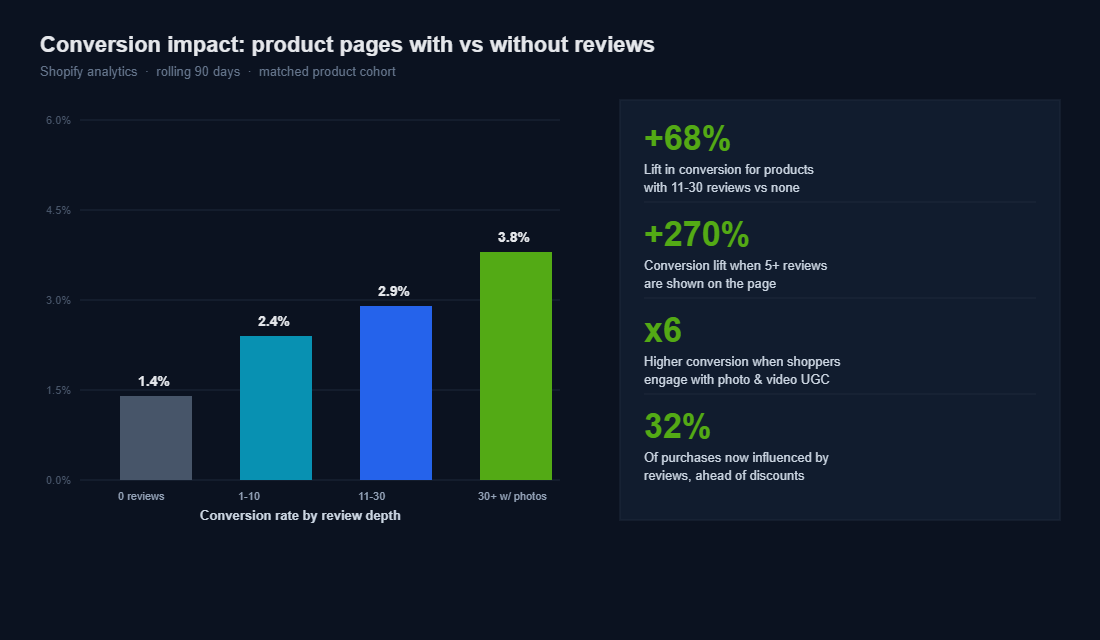
Reviews are the cheapest conversion lift available to a Shopify store, and almost nobody maxes it out. The data is not subtle. Products with 11 to 30 reviews convert roughly 68% higher than products with none. Simply showing five or more reviews on a page has been measured to lift conversion by up to 270%. On higher priced products, where the buyer needs more reassurance, reviews can lift conversion even harder.
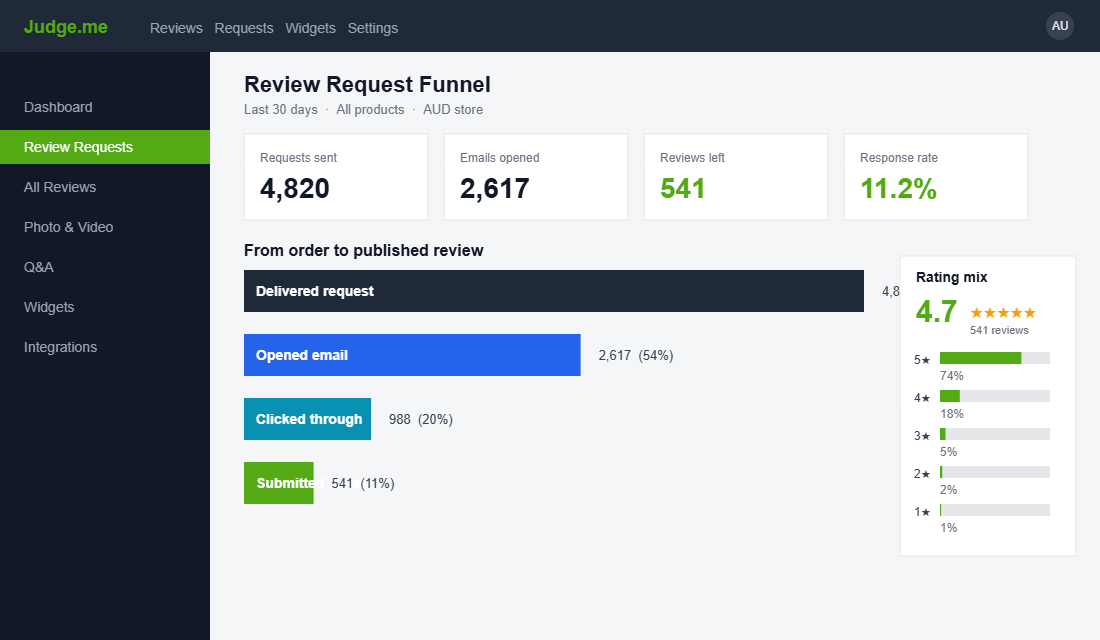
So why the gap? Because collecting reviews feels passive. You install Judge.me or Okendo, an automated email goes out, and a trickle of reviews shows up. A trickle is not a system. A 4,000 order per month store sending lazy review requests might pull a 2 to 3% response rate. The same store with a tuned request flow pulls 10 to 12%. That is the difference between 100 new reviews a month and 450.
The funnel below is what a healthy review operation looks like. Notice that the leak is not at the ask, it is at the click. Most founders obsess over the email subject line and ignore the one thing that actually moves response rate: when you send the request and how little friction sits between the tap and the submitted star rating.
Layer 1: Collect (The Post-Purchase Ask That Actually Gets Answered)
Most review requests fail because they are sent at the wrong moment to the wrong inbox with too much friction. Fix those three things and your response rate doubles without touching the copy.
Time the request to the unboxing, not the dispatch. A review email that lands while the parcel is still on a truck in transit gets ignored. Set the delay to fire a few days after delivery, when the customer has actually used the product. For most Aussie stores shipping domestically, that means 7 to 10 days after the order, longer for considered purchases like furniture or skincare where the result takes time to show.
Ask for the star rating inside the email itself. The single biggest friction killer is letting the customer tap a star straight from the inbox rather than clicking through to a form first. Judge.me and Okendo both support in-email star selection. One tap commits them, and the written review form opens with the rating already locked in. This alone is often the difference between a 4% and a 10% response rate.
Stack the channels. Email is the default, but an SMS follow-up to non-responders 5 days later can add another 30 to 40% of reviews on top. If you already run a post-purchase flow, add a review request as a branch rather than a separate broadcast. Pair it with your welcome and lifecycle email work so the ask feels like part of the relationship, not a cold favour.
The incentive question
A small incentive lifts response rates, but it is where founders walk into legal trouble. You can offer a reward for a review. You cannot make that reward conditional on the review being positive, and you must not hide that an incentive was given. The safe pattern: offer entry into a monthly prize draw or a small store credit for any honest review, positive or negative, and state plainly that the incentive applies regardless of rating. More on the compliance detail in Layer 5.
Layer 2: Display (Put The Proof Where The Decision Happens)
Collecting reviews is wasted effort if you bury them. The decision to buy happens in a three second window near the add to cart button, not in a reviews tab at the bottom of the page that 80% of visitors never scroll to.
There are four placements that earn their spot, and a store running all four will out-convert a store that just dumps reviews at the page foot.
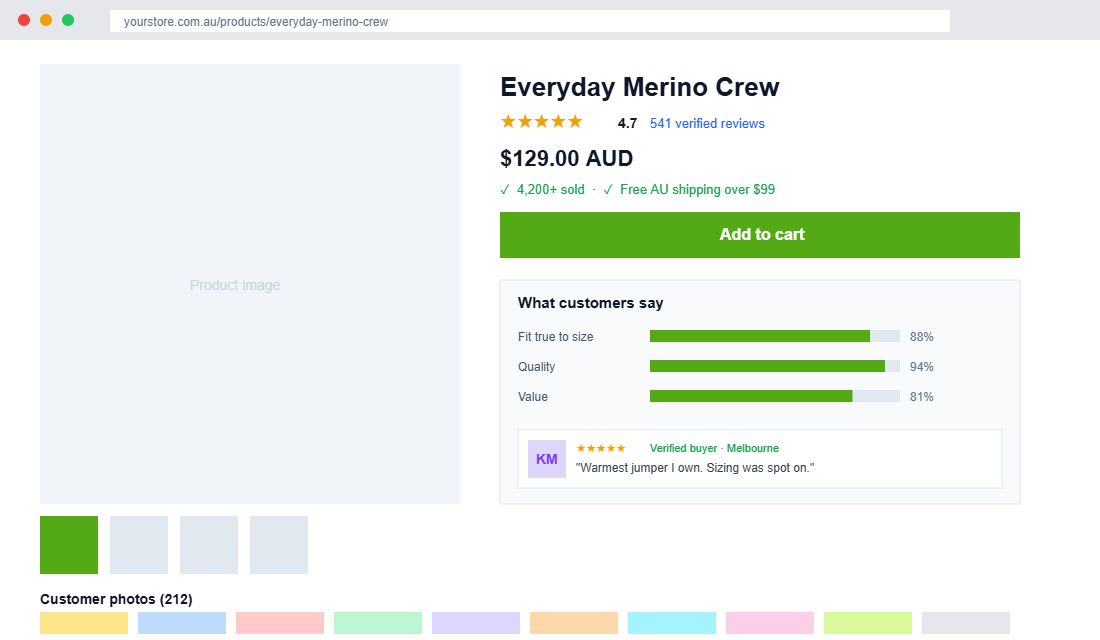
- Star rating under the product title. A single line, stars plus the count, plus a link that jumps to the full reviews. This is the highest value pixel on the page. Seeing 4.7 stars and 541 reviews before the price does more work than any badge.
- A review summary block above the fold. Aggregate the themes: fit, quality, value. A shopper deciding on sizing wants to know other people found it true to size without reading 40 reviews to figure it out.
- Inline photo reviews near add to cart. One or two verified customer photos beside the buy button reassure better than any studio shot, because the buyer knows they are real.
- Recent and relevant first. Sort so the newest reviews show on top. Products with recent reviews convert better than those carrying only old ones, because freshness signals the product is still loved today.
The layout below shows what this looks like in practice. The star rating sits under the title, a summary block answers the top objections, and a verified buyer photo from Melbourne sits right where doubt creeps in. None of this requires custom development. Both Judge.me and Okendo ship these as drag-in theme blocks.
One more thing most stores miss. Pipe your aggregate rating into structured data so Google shows the star snippet in search results. Judge.me adds review schema automatically, which can lift your organic click-through rate before a shopper even reaches the page. If you are already investing in product page copy that sells, the star snippet is the free amplifier sitting on top of it.
Layer 3: Photos And Video (The UGC That Out-Converts Everything Else)
Text reviews build trust. Customer photos and video close the sale. When shoppers actively engage with user generated content on a product page, conversion can run up to six times higher than for visitors who do not. The reason is simple: a studio image shows the product at its best, a customer photo shows it as it really arrives, and the buyer trusts the second one more.
This is where Aussie brands have a genuine edge, because our market loves authenticity over polish. Melbourne skincare brand Frank Body built early growth almost entirely on customer photos and the #thefrankeffect hashtag, turning buyers into a content engine long before UGC was a marketing term. The lesson holds for any category: the photo your customer took in their bathroom or living room will often out-sell the one your photographer took in a studio.
To get photo and video reviews flowing, you have to ask for them specifically and make it effortless.
- Request a photo in the review form, not as an afterthought. A prompt that says “show us how it looks” with a single upload button lifts photo submission rates noticeably.
- Offer a slightly larger incentive for a photo or video review than for text alone, applied to any honest submission regardless of rating.
- Build a visual gallery on the product page and the homepage. Okendo and Junip both render shoppable UGC galleries that pull in Instagram content alongside review photos.
- Reuse the best UGC in ads and email. A five star review with a real customer photo makes a high performing Meta ad creative and a powerful section in your post-purchase and referral flows.
If your customer photos are thin because the product itself does not photograph well in the wild, that is a signal worth heeding. Fix the gap at the source with stronger product photography first, then let UGC layer the authenticity on top.
Layer 4: Respond And Mine (Reviews Are Free Product Intelligence)
Reviews are not just a conversion asset. They are the cheapest research panel you will ever own. Every review is a customer telling you, unprompted, what they love, what confused them, and what nearly stopped them buying. Most founders read them for ego and miss the gold.
Respond to negatives in public, fast. A public, calm, helpful reply to a one or two star review reassures the next 100 shoppers far more than a wall of five star reviews ever could. It shows you stand behind the product. Never delete a genuine negative review to make the average look better. Beyond being a trust killer when spotted, selectively suppressing honest reviews can breach Australian Consumer Law.
Mine the language for your copy. The exact phrases customers use in reviews are the phrases that convert. If buyers keep writing “warmest jumper I own”, that line belongs in your product description and your ad copy. You are not guessing at messaging, you are quoting your market back to itself.
Tag recurring themes into your roadmap. Three reviews mentioning the sizing runs small is a product page note. Twenty reviews saying it is a supplier conversation. Reviews surface the fixable issues that quietly cap your conversion rate, the same way a structured survey does, only continuously and for free.
Layer 5: Stay On The Right Side Of The ACCC
Fake and misleading reviews are squarely in the ACCC’s sights. Misleading or deceptive conduct is already prohibited under the Australian Consumer Law, and from 28 March 2026 the maximum penalties for breaches increased. The government is also progressing dedicated unfair trading practices laws that take direct aim at manipulated reviews. The bar is rising, not falling, so build clean from day one.
Four rules keep you safe and, conveniently, also build more trust:
- Only publish genuine reviews from real customers. No writing your own, no buying them, no review swaps with other brands. Verified buyer badges exist for exactly this reason. Use them.
- Disclose every incentive. If a review was given in exchange for a discount, entry into a draw, or store credit, that has to be clear. Make incentives available for any honest review, never conditional on a positive one.
- Do not selectively hide negatives. Filtering out unfavourable reviews to inflate your rating is the classic trap. Respond to them instead.
- Keep testimonials current and accurate. A glowing review about a product or policy that no longer exists can mislead. Retire it.
Picking Your Tool: Judge.me vs Okendo
You do not need an expensive platform to run this system well. The choice comes down to how much your brand leans on visual presentation.
Judge.me is the workhorse. It has a genuinely useful free plan, paid plans from around 15 US dollars a month with unlimited reviews, photo and video reviews, Q&A, automated requests, and SEO schema built in. For most stores under roughly 50,000 dollars a month in revenue, it does everything in this playbook.
Okendo (used by a long list of design-led brands) starts higher, around 29 US dollars a month and up, and earns it if presentation is a core part of your brand. It adds customer attribute reviews (skin type, fit, size), polished UGC galleries, and tight Klaviyo integration for segmenting on review behaviour. If you are a beauty, fashion, or premium brand where the review experience needs to look as good as the rest of the site, it is worth the step up.
Your 30-minute Judge.me setup
- Install and import. Add Judge.me from the Shopify App Store and import any existing reviews from your previous app or a CSV so you do not start from zero.
- Set the request timing. Under review requests, set the send delay to 7 to 10 days after fulfilment and enable in-email star rating so customers can rate with one tap.
- Drop in the widgets. Add the star rating block under your product title, the review widget below the description, and the all-reviews carousel to your homepage using the theme editor blocks.
- Turn on photo reviews and Q&A in settings so customers can upload images and ask questions others can answer.
- Enable rich snippets so your aggregate rating shows in Google results, then send your first request batch to the last 60 days of orders.
The Compound Effect
Each layer helps on its own. Together they create a flywheel that is hard for competitors to copy. More requests sent means more reviews collected. More reviews displayed at the decision point means higher conversion. Higher conversion on the same ad spend means more orders, which means more review requests, which means more reviews. The wheel turns faster every month.
The photo and video layer adds a second loop. UGC lifts conversion on the page, then doubles as ad creative and email content that brings in new buyers at a lower cost, who then become the next cohort of reviewers. The brands that look like they have unfair organic momentum usually just started this loop 12 months earlier than everyone else.
None of it requires a bigger ad budget. It requires treating social proof as core infrastructure, not a plugin. A store doing 200 orders a month that lifts product page conversion from 1.4% to 2.4% with reviews is not having a good month. It has structurally changed the economics of every campaign it will ever run again.
Your Product Reviews Audit Checklist
Run your store against this list. Every box you cannot tick is conversion you are leaving on the table.
- Collect: Review requests fire 7 to 10 days after delivery, with one-tap star rating inside the email, and an SMS follow-up to non-responders.
- Response rate: You know your number, and it is climbing toward 10%, not stuck at 3%.
- Display: Star rating and count sit under the product title, not buried in a tab.
- Summary: A themed summary block answers the top objections (fit, quality, value) above the fold.
- Photos: Verified customer photos appear near add to cart and in a homepage gallery.
- Freshness: Reviews sort newest first, and your top products all have recent reviews.
- Schema: Aggregate rating shows as a star snippet in Google search results.
- Respond: Every negative review has a calm, public reply. None are deleted.
- Mine: Customer phrases feed your product copy and ad creative.
- Compliance: Only genuine reviews, every incentive disclosed, no positive-only conditions, no selective hiding of negatives.
Work top to bottom. Most founders find three or four quick wins in the first hour, and the collect and display layers alone usually move the conversion number within a fortnight.
Make Reviews The Asset They Should Be
Reviews are the rare growth lever that costs almost nothing and compounds forever. The traffic is already arriving. The customers are already happy. The only question is whether you are capturing that goodwill and putting it to work at the exact moment the next shopper is deciding.
Inside eCommerce Circle, building a social proof system like this is one of the core pillars we work on with every member. If you want a second opinion on how your product pages are converting, let’s talk.