End of financial year is the most under-planned sale on the Australian retail calendar. Black Friday gets a three-month run-up, a war room and a spreadsheet for every channel. EOFY gets a panicked email on the 29th of June with a flat 30% off code slapped across the whole store.
What’s in This Article
That is a shame, because the money is real. The Australian Retailers Association and Roy Morgan put EOFY spending at around 10.7 billion dollars last year, with roughly one in four Australians planning to shop the sales. Clothing, footwear and accessories led intent at 34%, ahead of appliances at 15% and electronics at 12%. Your customers are already in buying mode. The question is whether you take that demand and turn it into profit, or whether you hand it over at a discount so deep you would have been better off closed.
Most founders run EOFY on vibes. The good ones run it as a system: a clear goal, a discount mechanic that protects margin, an offer built properly in Shopify, and an email sequence that sells to the right people in the right order. This is that system. Six steps, the maths behind each one, and a checklist you can run before you schedule a single send.
The EOFY Maths Most Founders Get Wrong
Here is the trap. A discount does not cost you the discount percentage. It costs you a multiple of it, because it comes straight off your margin, not your revenue. On a product carrying a standard retail margin, a 20% discount can wipe out 40 to 60% of your profit on that order. The discount is small. The damage is not.
Run the numbers on a 69 dollar product with a 60% gross margin. At full price you keep about 41 dollars. Take 20% off and your selling price drops to 55.20, but your unit cost has not moved, so your gross profit falls to roughly 27.60. To bank the same total gross profit you made before the sale, you now need to sell about 50% more units. A 30% discount on that same product needs you to roughly double your volume just to stand still.
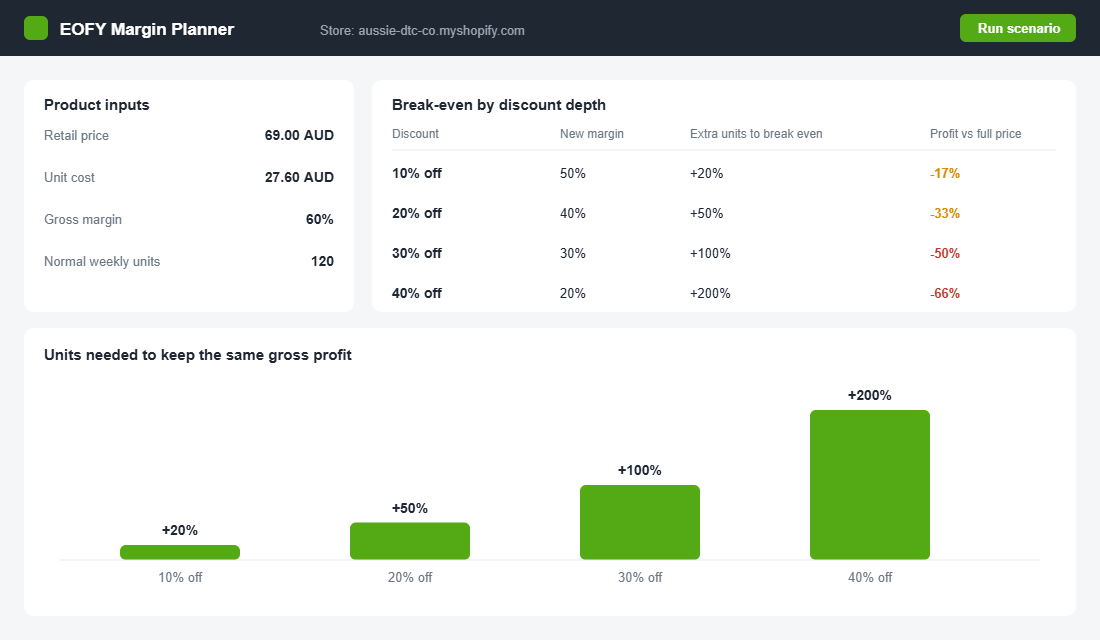
This is why a flat sitewide percentage is the worst EOFY offer you can run. You are giving your highest-margin products the same treatment as your tightest ones, and you are handing money to customers who would have bought anyway. Before you decide on a number, you need to know your true per-order economics. If you have not mapped that yet, start with our Shopify contribution margin playbook, because every decision below depends on knowing what each order actually leaves in the bank.
Step 1: Decide What the Sale Is Actually For
You cannot design an offer until you know what job it is doing. There are three EOFY goals, and they each demand a different sale. Pick one as primary. Trying to do all three at once is how you end up with a flat code and a bad month.
- Clear dead stock. You are carrying slow movers tying up cash before the new financial year. The goal is liquidation, so deeper discounts are fine because the alternative is writing the stock off. Discount hard on those SKUs only, never the whole catalogue.
- Bank cash before 30 June. You want a revenue spike to close the year strong or fund a stock reorder. The goal is volume on healthy-margin lines, so the discount stays shallow and the mechanic does the lifting.
- Acquire customers cheaply. EOFY traffic is high-intent and ad costs ease off after the BNPL and toy rushes. The goal is first orders you can keep, so the offer targets new buyers and the real return comes from the second purchase.
Write your goal at the top of the plan in one sentence. “Clear 18,000 dollars of winter stock at cost-plus-ten.” “Add 30,000 dollars of revenue on bestsellers.” “Acquire 400 new customers under a 25 dollar cost per acquisition.” Everything downstream gets measured against that sentence.
Step 2: Choose a Mechanic That Protects Margin
The blanket percentage is lazy. There are smarter mechanics that lift average order value while you discount, so the basket grows enough to carry the markdown. The data backs this up: targeted, deeper offers on the right products consistently outperform shallow sitewide cuts, and EOFY shoppers tend to trade up when the structure rewards it.
- Tiered spend thresholds. Spend 120 dollars get 10% off, spend 180 get 15%, spend 260 get 20%. The discount grows with the basket, so your blended discount stays well under the top tier and AOV climbs. This is the highest-leverage EOFY mechanic for most stores.
- Bundle and save. Pre-built sets at a fixed saving. You control the margin on the bundle, the customer feels the value, and you move multiple units per order. Ideal for consumables and gifting categories.
- Gift with purchase. A free add-on over a spend threshold instead of a discount. It protects your headline price, costs you cost-of-goods rather than full margin, and clears the exact stock you choose.
- Deep markdown on a clearance collection. Quarantine the dead stock in its own collection and discount it hard. The rest of the store stays at full price or on the gentle tiered offer.
If lifting basket size is the priority, pair your mechanic with a smart free-shipping threshold so the two work together rather than against each other. Our free shipping threshold playbook walks through where to set that line without bleeding margin.
Step 3: Build the Offer Properly in Shopify
Most discount disasters are configuration disasters. A code that stacks with an existing automatic discount. A sale that never ends because nobody set the end date. A storewide percentage that quietly applies to gift cards. Build it once, build it tight, and schedule it so it runs itself. Here is the tiered automatic discount setup using native Shopify, no app required.
- Discounts, then Create discount, then Amount off order. Choose Automatic so it applies at checkout without a code. Codeless offers convert better because there is no empty field for the customer to abandon over.
- Set your tiers. Add a minimum purchase amount for each tier (120, 180, 260) with the matching percentage. Shopify applies the highest tier the basket qualifies for.
- Exclude what should never discount. Carve out your newest arrivals, your single best full-price seller, and gift cards. Use collections to control exactly what is in and out.
- Turn off stacking. Set combinations so the automatic discount does not stack with shipping or product codes unless you have modelled that the combined offer still clears margin.
- Schedule start and end. Set an exact start (a VIP early window the day before) and a hard end at 11:59pm on 1 July. A countdown that means something converts. A sale with no end teaches people it will always be there.
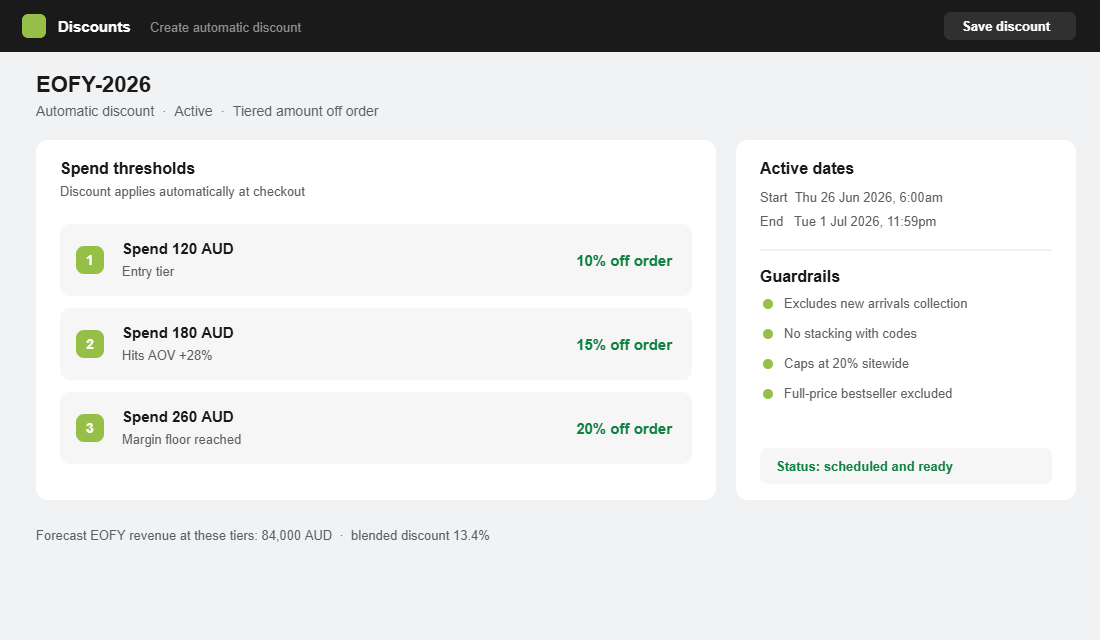
Before you set it live, run one test order at each tier and check the price that lands at checkout against your margin model. Two minutes of testing saves you from a five-day sale running at a number you never intended.
Step 4: Segment and Sequence the Email
Email is where EOFY is won, and it is where most stores leave the most money on the table. If your email program is not driving 30 to 40% of total revenue, it is underperforming, and a sale period is exactly when that gap shows. The mistake is one giant blast to the whole list with the same message. The fix is segmentation and sequence.
Build the campaign in Klaviyo around who the person is, not just what the sale is. A five-email sequence over the sale window, sent to different segments at different moments, will out-earn a single blast every time. Segmented campaigns regularly hit 40 to 60% open rates against 18 to 25% for an undifferentiated send.
- VIP and repeat buyers get early access the day before. They reward exclusivity and they spend more, so let them shop first.
- Engaged in the last 90 days get the main sale-opens email. Warmest non-VIP segment, highest conversion on the core offer.
- Lapsed 90 to 180 days get a win-back angle. EOFY is the reason to come back, so lead with the saving, not the news.
- New subscribers get a welcome-led version of the offer. Welcome content already pulls the highest open rates of anything you send, so ride that attention.
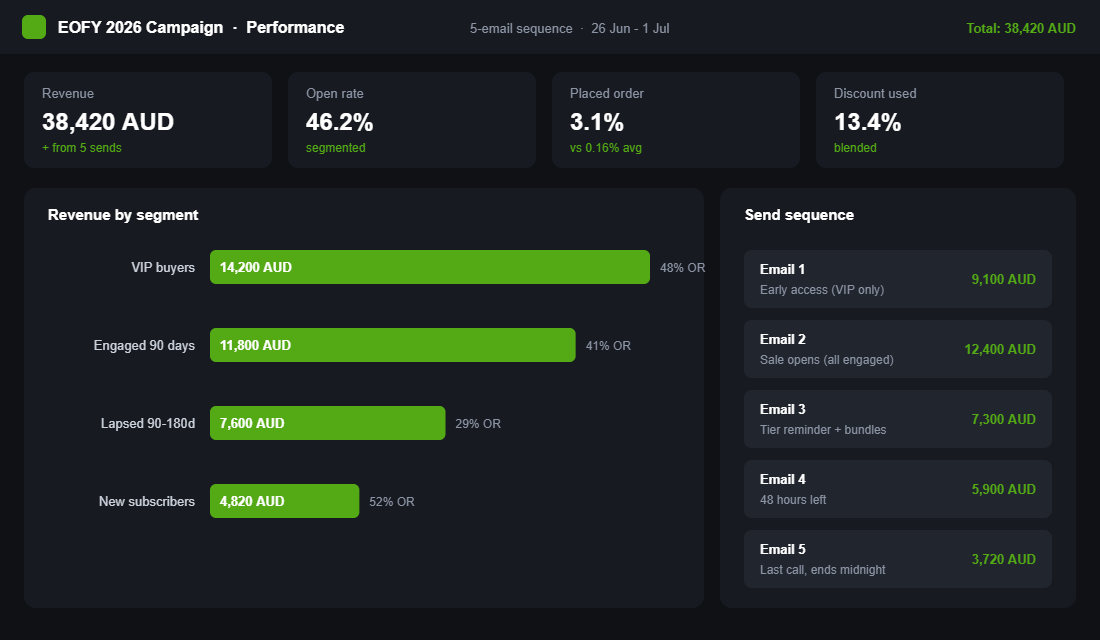
Stack the sequence over the window: early access, sale opens, a tier-and-bundle reminder mid-sale, a “48 hours left”, and a “last call, ends midnight”. That final urgency email is routinely the second-highest earner of the whole sequence. For the full cadence approach, our email campaign calendar shows how this fits the rest of your year so EOFY is not a one-off scramble.
Step 5: Set Guardrails Before You Go Live
The single biggest long-term cost of EOFY is not the margin on the sale. It is what frequent, predictable discounting does to your full-price business. Discount too often and you train customers to wait. Stores that discount constantly see full-price conversion decline over six to twelve months, carts abandoned to wait for a code, and unsubscribes the moment a sale ends. The rule of thumb from the operators who hold margin: no more than two to four major discount events a year.
So put guardrails around the sale that protect the business on the other side of it.
- Cap the blended discount. Decide your maximum average discount across all orders (say 15%) and watch it daily. The tiered mechanic should keep you well under your top advertised number.
- Protect your hero product. Your single best full-price seller does not need the discount to sell during EOFY. Exclude it and keep that margin intact.
- Make the sale end, hard. A real deadline drives the last-day spike. A rolling “extended again” sale teaches people your prices are fiction.
- Hold a margin floor on clearance. Even dead stock has a number below which you would rather hold it. Set it before emotion takes over on day four.
Step 6: Plan the Day After the Sale Ends
A discount buys a transaction. Retention buys a business. The whole point of acquiring customers cheaply at EOFY is that the second order comes at full price, and the third, and the fourth. If you do nothing after 1 July, you have simply bought revenue at a markdown.
Build the bridge before the sale even starts. Every EOFY buyer should drop into a post-purchase flow that thanks them, sets expectations, and gives a reason to come back at full price (not another discount, but genuine value: how to use the product, what pairs with it, what is coming next). New customers acquired during a sale convert again best when the follow-up arrives within the first two weeks, while the brand is fresh. That second purchase is where EOFY actually pays for itself.
How the Pieces Compound
Run these in isolation and you get a decent sale. Run them as one system and the numbers stack. The clear goal stops you discounting the wrong stock. The tiered mechanic lifts AOV so the basket carries the markdown. The Shopify build stops leaks and creates real urgency. The segmented sequence puts the right offer in front of the right buyer at the right hour. The guardrails protect the full-price business you go back to in July. And the post-sale flow turns one-time bargain hunters into repeat customers.
Two Australian DTC brands show the contrast. The first runs a flat 40% storewide every EOFY, every Black Friday, and a “flash sale” most months in between. Revenue looks fine. Margin is thin and full-price weeks are dead, because the customers have been trained perfectly to wait. The second runs a tiered EOFY offer once, excludes its hero range, sequences five emails across four segments, and pushes every new buyer into a post-purchase flow. Same traffic, similar headline revenue, but it keeps far more of the profit and walks into July with customers who still pay full price. That gap is the whole game.
Your EOFY Profit Checklist
Run this before you schedule a single send. If you cannot tick every line, you are not ready to go live.
- Goal written in one sentence. Clearance, cash, or acquisition. Pick one as primary.
- True per-order margin known on every product entering the sale.
- Mechanic chosen that lifts AOV (tiered, bundle, or gift with purchase) rather than a flat sitewide cut.
- Offer built and test-ordered in Shopify at every tier, with exclusions and stacking locked down.
- Hard start and end dates scheduled. No open-ended sale.
- List segmented into VIP, engaged, lapsed, and new, with a tailored message for each.
- Five-email sequence written including a last-call deadline send.
- Blended discount cap set and a plan to watch it daily.
- Hero product excluded from the discount.
- Post-purchase flow live so EOFY buyers get a reason to return at full price.
EOFY rewards the operators who plan it like a campaign and punishes the ones who treat it like a panic. The demand is there, the intent is high, and the customers are ready. Whether they leave you with profit or just turnover comes down to the six steps above.
Inside eCommerce Circle, building profitable promotional plans like this is one of the core pillars we work on with every member. If you want a second opinion on your EOFY offer before it goes live, let’s talk.