You paid good money to win that customer. They bought once. Then nothing. For a brand selling coffee, supplements, skincare or pet food, that silence is a slow leak that quietly caps your growth, no matter how much you spend at the top of the funnel.
What’s in This Article
Most founders respond by chasing the next first-time buyer. The second order is treated as something that just happens on its own. It does not. The reorder is a moment you have to engineer, and the brands winning consumables in Australia engineer it on purpose.
They do one boring thing well. They remind the right customer to reorder at the exact moment they are running low, with a one-tap path back to checkout. The numbers behind this are hard to argue with: the probability of selling to an existing customer sits at 60 to 70 percent, versus 5 to 20 percent for a cold prospect, according to the data popularised in Marketing Metrics. Replenishment is the cheapest revenue in your entire store, and this playbook shows you the five triggers to build it.
Why replenishment is the highest-ROI flow you are probably not running
Here is the uncomfortable benchmark. The average ecommerce repeat purchase rate is roughly 28 percent, and one analysis across more than 156,000 DTC customers found only 18.8 percent placed a second order inside a 12 month window. For consumables that figure should be far higher. Categories like groceries and pet supplies regularly clear 40 percent, because the product genuinely runs out.
So when a consumable brand sits at 20 percent repeat, the problem is almost never the product. It is that nobody asked the customer to come back at the right time. The need was real. The reminder was missing.
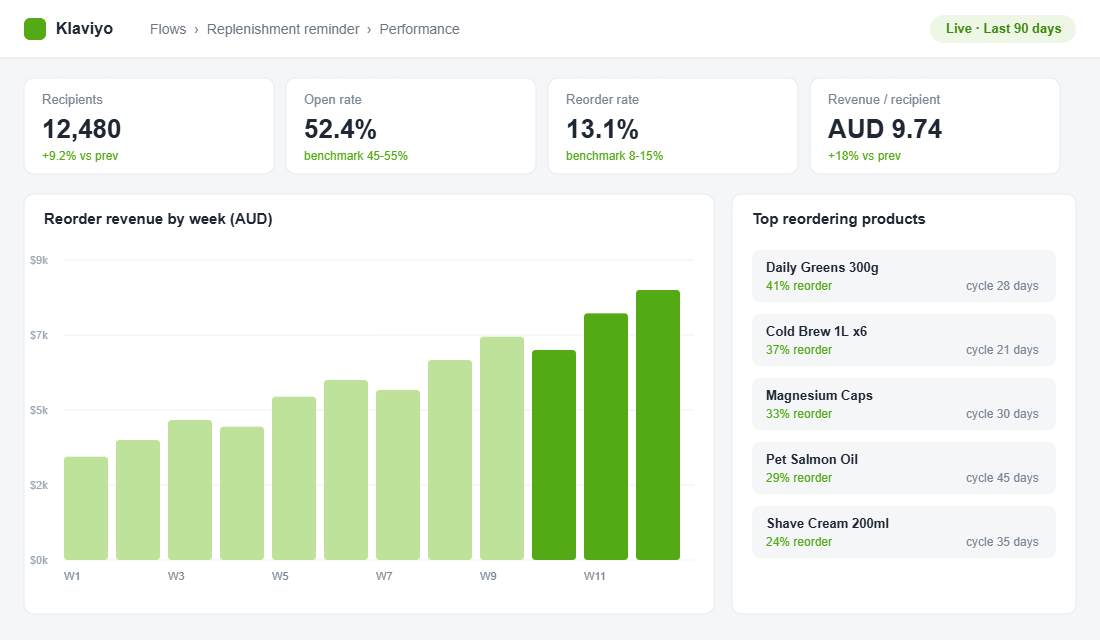
A replenishment email is not a subscription charge and it should never feel like one. It is a nudge that lands a few days before the jar, bag or bottle runs out, carrying a button that takes the customer straight back to a pre-filled checkout. Klaviyo’s own flow benchmarks put these emails at 45 to 55 percent open rates and 8 to 15 percent reorder rates, with revenue per recipient sitting somewhere between AUD 3 and AUD 15 depending on basket size.
Leave it out and you are not at zero, you are negative. Missing automations like replenishment account for an estimated 15 to 25 percent of email revenue that most brands simply never capture. That is not a rounding error. For a brand doing AUD 1m a year, it is a six-figure line you are choosing to ignore.
Trigger 1: Find the real consumption cycle and stop guessing
The whole flow lives or dies on timing. Send the reminder too early and you look pushy and out of touch. Send it too late and the customer has already topped up at the supermarket, or worse, drifted to a competitor who asked first.
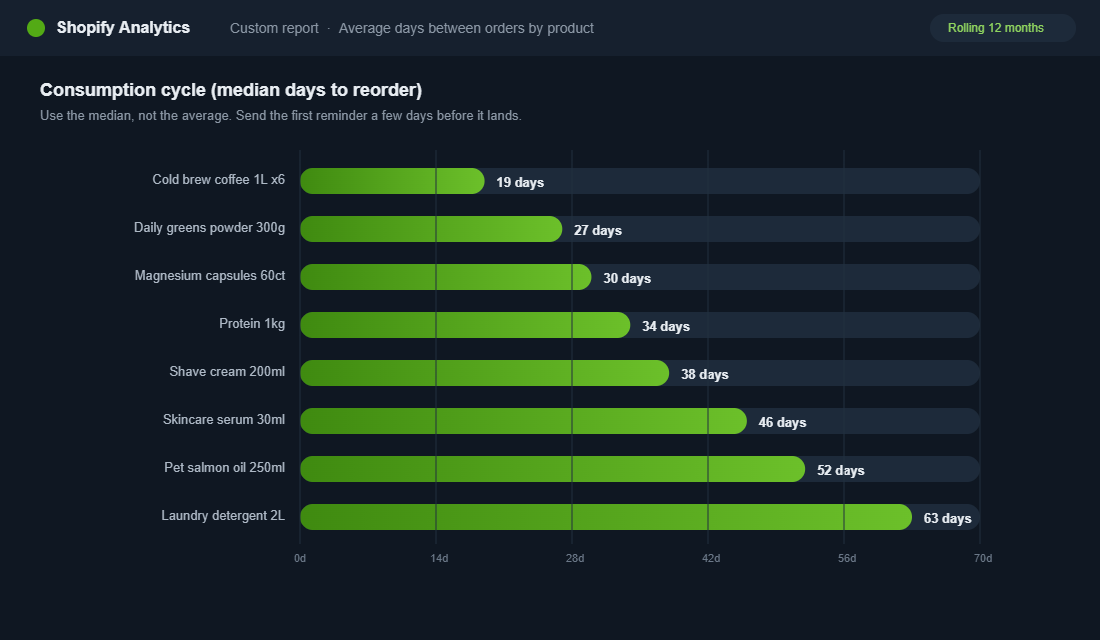
The fix is to measure, not guess. Pull the median number of days between a customer’s first and second order, and do it by product, not store-wide. Use the median rather than the average so a single bulk-buyer or a one-off gifter does not drag the number out of shape.
In practice that means heading to Shopify admin, then Analytics, or exporting your orders and calculating days-to-reorder per SKU in a spreadsheet. The cycles vary wildly. A 1 litre cold brew six-pack might reorder at 19 days, a 60-count magnesium at 30 days, a 250ml pet salmon oil at 50. One blanket “it has been 30 days” rule would be wrong for nearly every product you sell.
Set the first reminder to fire at the cycle minus 3 days. You want to arrive just before the empty shelf, while the customer still has a day or two of product left and zero panic. There is an Australian wrinkle here too: factor in domestic shipping. If delivery to regional WA or the NT runs 5 to 7 days, your reminder has to land earlier still so the restock arrives before they actually run dry.
Trigger 2: The three-email sequence that does the work
One email is a reminder. A short sequence is a system. Three messages, spaced to the customer’s cycle, will out-earn a single send every time because most people need a second or third prompt before they act.
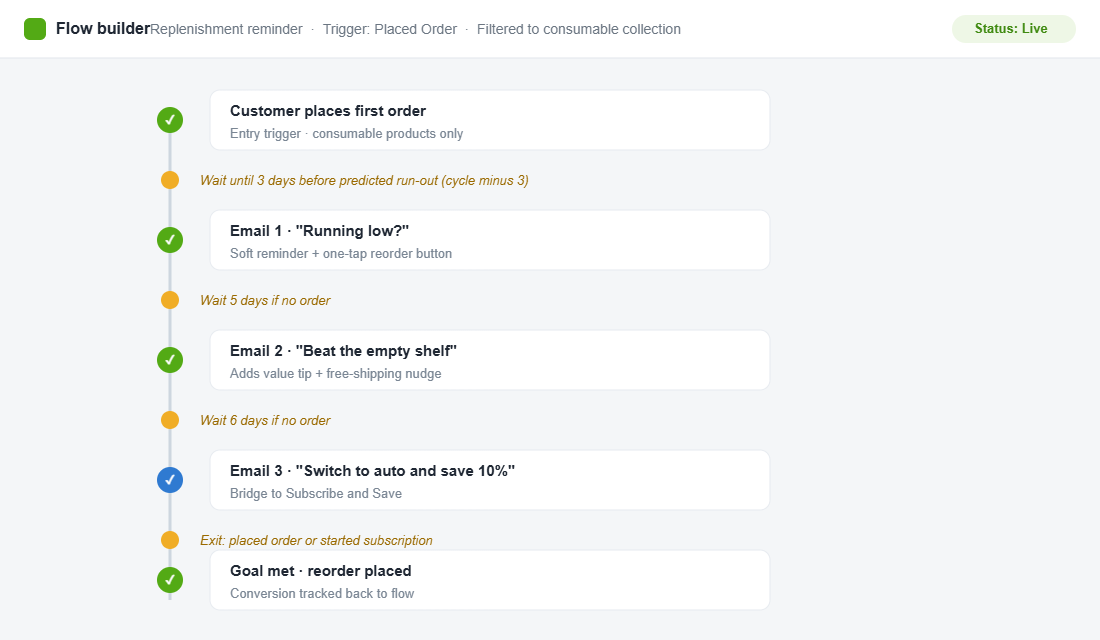
- Email 1, at cycle minus 3 days. Subject: “Running low?” One job only. A friendly reminder and a reorder button that re-adds the exact items they bought. No discount here. You do not want to train people to wait for a code.
- Email 2, five days later if no order. Subject: “Beat the empty shelf.” Add a usage tip or a line of social proof, then a soft nudge like free shipping over your threshold. You are removing the last small reason not to act.
- Email 3, six days later if still no order. This is the upgrade ask. Offer Subscribe and Save at around 10 percent to convert a manual reorderer into recurring revenue, so you never have to send the reminder again.
Keep the copy disciplined. Subject lines under six words. Name the actual product they bought inside the email, not a generic “your favourites”. One primary call to action per message. The moment you add a second competing button, your click rate splits and your reorder rate drops with it.
Trigger 3: Make reordering a one-tap action
The single biggest leak in most replenishment flows is friction. If your email drops the customer on the homepage to go hunting for the product all over again, you have lost half of them between the click and the cart. Every extra tap is a place to bleed conversions.
Shopify gives you a free fix: cart permalinks. A URL in the format /cart/VARIANTID:QTY pre-fills the cart with the exact items and quantity, then you can send the customer straight to checkout. For a logged-in customer with a saved address, that can mean a two-tap reorder from inbox to confirmation.
- Grab the variant ID for each consumable product from the Shopify admin product page URL or your export.
- Build the permalink as yourstore.com/cart/VARIANTID:1 and append your tracking parameters so the flow gets credit.
- Wire it into Klaviyo using the event properties from the customer’s last order, so the button always points at what they actually bought.
- Send returning customers straight to checkout rather than the cart page wherever you can. Speed is the whole point.
This one change routinely moves the needle more than any subject-line tweak. The customer already wants the product. Your job is to get out of their way.
Trigger 4: Segment by product, not by store
A store-wide “it has been a month, come back” blast is the lazy version, and it underperforms badly. A daily coffee drinker and a buyer of 2 litre laundry detergent are on completely different clocks. Treating them the same guarantees you are early for some and late for most.
Build the flow filtered to your consumable collection first, then branch by product or product type so each customer is timed to their own cycle. This is the difference between a flow that scrapes the bottom of the 8 percent benchmark and one that pushes well past it.
- Suppress current subscribers so you never nag someone who already has product arriving automatically.
- Suppress anyone with a recent open order to avoid double-reminding a customer mid-delivery.
- Suppress hard churners and obvious one-off gifters so the flow stays relevant and your sender reputation stays clean.
This connects directly to your wider retention work. If you have not mapped how your reorder logic feeds long-term value yet, our customer lifetime value playbook walks through the maths, and the repeat purchase playbook covers the broader second-order strategy this flow plugs into.
Trigger 5: Bridge manual reorders into subscription
A replenishment flow and a subscription program are not competitors. They are two stages of the same funnel. The flow proves the habit exists. The subscription locks the habit in and removes your reminder cost entirely.
The highest-intent moment to make the pitch is right after a customer has reordered through the flow twice. They have shown you, with their wallet, that this product is part of their routine. Returning customers already spend around 67 percent more than first-timers, so converting that proven repeater into a subscriber is some of the most valuable work you can do. Our subscription playbook covers how to structure the offer and cut early churn.
Two Australian brands show the model working. Who Gives A Crap built a category-leading business on a dead-simple replenishment cadence, shipping toilet paper every 8, 12 or 16 weeks so a box arrives before the last roll runs out. Vitable turned one-off vitamin buyers into 30-day recurring packs by matching the reorder window to the exact pill count in the pack. Neither relies on clever discounting. Both win because the cadence matches real consumption rather than a marketing calendar.
How to build it in Klaviyo, step by step
Klaviyo is the most direct way to ship this on Shopify, because it already receives the order events you need. Here is the build, start to finish:
- Connect Shopify so Klaviyo is receiving Placed Order and Ordered Product events. Confirm they are firing under Metrics before you build anything.
- Create a flow with the trigger set to Placed Order, then add a flow filter limiting it to your consumable collection so non-consumable buyers never enter.
- Add a time delay set to your product’s cycle minus 3 days. If you have enough order history, you can instead use Klaviyo’s predicted “Expected Date of Next Order” to time it per customer automatically.
- Add Email 1, then a conditional split on “has placed an order since starting this flow” so anyone who reorders exits cleanly and never sees the next message.
- Add a 5 day delay, then Email 2, another conditional split, a 6 day delay, then Email 3 with the subscription offer.
- Set the flow conversion metric to Placed Order and switch each email Live one at a time, so you can read the open and reorder rates per message and fix the weak link.
Five mistakes that quietly kill replenishment flows
Most replenishment flows do not fail loudly. They underperform quietly, sitting at a 6 percent reorder rate when they should be at 14, and the founder assumes “email just does not work for us”. It almost always traces back to one of these five errors.
- Using a store-wide timer. One 30 day delay for every product means you are early for fast consumables and weeks late for slow ones. Both lose the sale. Time to the SKU, every time.
- Leading with a discount. Open the flow with 15 percent off and you train customers to delay every reorder until the code arrives. You have manufactured your own margin problem. Earn the order at full price first.
- Sending to the homepage. A reminder that does not pre-fill the cart wastes the intent you just created. If they have to search for the product again, a large share simply will not bother.
- Forgetting to suppress subscribers. Nagging someone who already has product arriving on auto-ship makes you look like you do not know your own customer. It erodes trust and your sender reputation.
- Never reading the per-email numbers. If you cannot see which of the three emails is carrying the flow, you cannot fix the weak one. Turn them Live one at a time and watch each metric.
Fix these five and most brands see their reorder rate climb back inside or above Klaviyo’s 8 to 15 percent benchmark within a single cycle, with no new traffic and no new spend.
What good looks like: the numbers to watch
A replenishment flow is one of the few things in your store you can hold to a clean, public benchmark. Here is the scoreboard to judge yours against, and what each number is telling you.
- Open rate: 45 to 55 percent. Below this and your timing or subject line is off, or you are emailing people who have already lapsed too far. These are warm buyers, so opens should be high.
- Reorder rate: 8 to 15 percent. The headline metric. Under 8 percent points to a timing or friction problem. Above 15 percent means your cycle data is sharp and your reorder button is doing its job.
- Revenue per recipient: AUD 3 to 15. Track this per product. It tells you which SKUs deserve their own dedicated branch and which can share a cycle.
- Flow share of email revenue. Across a healthy program, automated flows should drive 50 to 60 percent of total email revenue. Replenishment alone often becomes a top-three contributor for consumable brands.
Set a calendar reminder to review these every month. Consumption cycles drift as your product mix and customer base change, and a flow you set and forgot a year ago is almost certainly mistimed today. Treat the cycle data as living, not fixed.
The compound effect: why this becomes your most reliable revenue line
A single reminder feels small. Run it across every consumable SKU, for every customer, every month, and it becomes the most predictable revenue line you own, because it is tied to a real-world clock that never stops ticking.
Watch how the triggers stack. A tight, product-level cycle (Trigger 1) feeds a sharp three-email sequence (Trigger 2). Zero-friction reordering (Trigger 3) converts the clicks. Smart segmentation (Trigger 4) makes every send relevant. And the subscription bridge (Trigger 5) graduates your best repeaters into recurring revenue. Each layer lifts the one before it.
The prize is enormous relative to the effort. Increasing customer retention by just 5 percent can lift profit anywhere from 25 to 95 percent, the finding from Bain and Frederick Reichheld that still holds. And because it costs up to seven times more to acquire a new customer than to keep an existing one, replenishment is the cheapest lever you have to move that number. You are not buying the revenue. You are simply collecting demand you already created.
Your replenishment flow build checklist
Work through these in order. If you can tick all eight, you have a flow that will quietly earn for you every single month:
- Calculated the median days-to-reorder for each consumable SKU (not a store-wide average).
- Set the first reminder to fire at cycle minus 3 days, adjusted for your shipping times.
- Built three emails: soft reminder, value nudge, subscription offer.
- Wired a one-tap reorder button using Shopify cart permalinks.
- Filtered the flow to your consumable collection and branched by product.
- Suppressed existing subscribers, open recent orders and hard churners.
- Set the conversion metric to Placed Order and turned emails Live one at a time.
- Added a clear path from two manual reorders into Subscribe and Save.
Where this fits
Inside eCommerce Circle, retention and the reorder engine are one of the core pillars we work on with every member, because it is almost always the fastest profit available to an established store. If you want a second opinion on your replenishment flow and where it is leaking, let’s talk.