You are the bottleneck. Not the ad account. Not the theme. Not the supplier in Yiwu. You.
What’s in This Article
If your Shopify store stops the moment you stop, you do not own a business yet. You own a high-paying, high-stress job that happens to come with inventory and a Klaviyo login. And the data says you are coping with it worse than you tell yourself at dinner. In a 2025 survey of small business owners, 57% reported burnout and 76% reported ongoing stress or anxiety. Beyond Blue found small business owners are the most burnt-out group in the country, with 35% feeling burnt out often or always, compared with 26% of full-time employees.
Here is the part most founders get backwards. They treat hiring help as something you earn once you are big. Wrong way round. You stay small because you refuse to hire. The Aussie brands that punch past 100k a month are not run by superhumans answering tickets at 11pm. They are run by operators who hired their first virtual assistant at 40k a month and never went back. This is the playbook for doing exactly that, without the bad hire, the awkward handover, or the feeling that it is faster to just do it yourself.
Why “I just do it all myself” is a growth ceiling, not a flex
Every task in your business sits in one of four buckets: founder-only work that only you can do, high-value work that drives revenue, low-value admin that anyone competent can do, and work you should not be touching at all. The problem is not that you do low-value work. The problem is that low-value work is the easiest to start and the hardest to stop, so it quietly eats your week.
When founders actually audit their time, the picture is ugly. The average operator gets back 13 to 15 hours a week the moment they hand the right tasks to a VA. That is not a productivity hack. That is two working days you are currently spending on order-status emails and listing uploads that a trained assistant could clear at a fraction of your effective hourly rate.
The maths is brutal once you see it. If your business pays you the equivalent of 150 dollars an hour in owner earnings, every hour you spend on a task worth 9 dollars an hour is a 141 dollar unforced error. Do that 30 times a week and you have engineered your own ceiling. The fix is not working harder. It is getting the cheap, repeatable work off your plate so your expensive hours go where only you can add value.
Step 1: Run a brutal time audit before you hire anyone
You cannot delegate what you have never named. For one full week, log everything you do in 30-minute blocks. Be honest, including the doomscrolling disguised as “competitor research”. Then tag each task into the four value tiers above. Most founders are genuinely shocked to find more than half their week sitting in the bottom two tiers.
This audit becomes your hiring brief. The dense cluster of low-value tasks is your first role. The “should not touch” pile is your second. Do not skip this step and hire a vague “general VA to help out”. Vague roles produce vague results and a VA who waits to be told what to do, which just moves the bottleneck back to you.
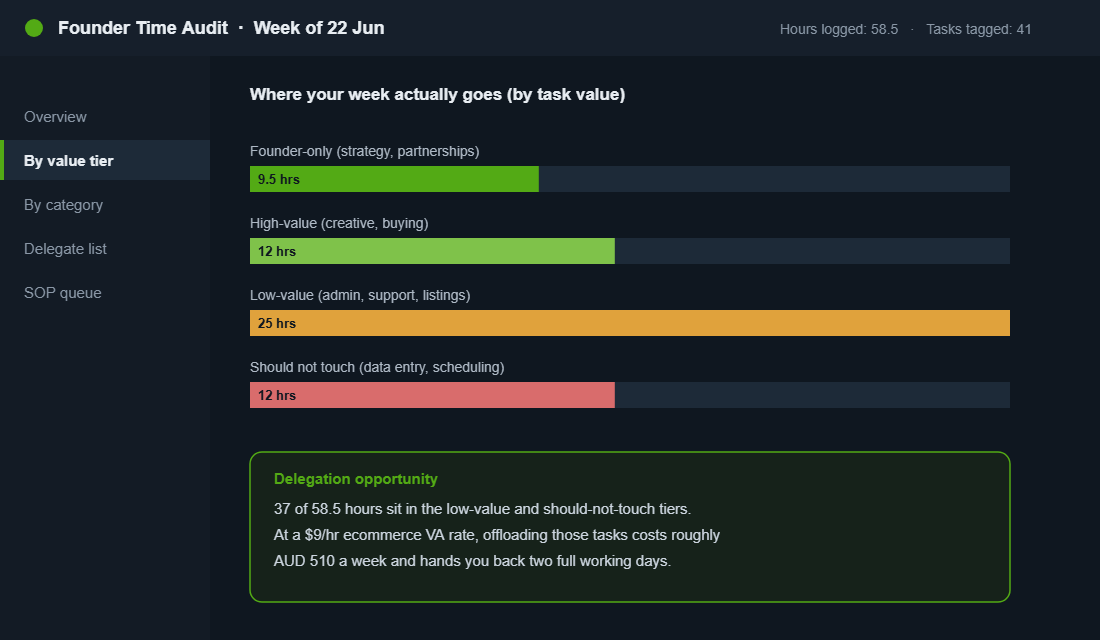
Run the numbers at the bottom of your audit. If 35 to 40 hours a week are delegatable and a capable ecommerce VA costs 6 to 10 dollars an hour, you are looking at roughly 250 to 400 AUD a week to reclaim two full days. That is the single best leverage trade in your business, and it is the one founders delay the longest.
Step 2: Hire one clear role, not “a bit of everything”
Your first hire should own one function end to end. For most Shopify stores between 40k and 500k a month, that function is customer support. It is high-volume, emotionally draining, easy to standardise, and it is almost certainly the thing dragging you out of strategic work three times a day.
A customer support VA can own order-status replies, shipping enquiries, returns and exchange requests, review and UGC outreach, and ticket triage by priority. You keep the judgement calls: refunds over a set threshold, angry escalations, anything that touches brand reputation. Everything else has a right answer that can be written down.
- Pick the densest cluster. Whatever tier-three tasks appear most often in your audit, that is role one.
- Define the boundary. Write down exactly what the VA decides alone and what gets escalated to you. Disputes are a perfect example: handing your chargeback response process to a trained VA removes a recurring time sink without giving away financial control.
- Name the outcome. “First response under 60 minutes, CSAT above 90%” beats “help with emails” every time.
Step 3: Write the SOP before you write the job ad
Real delegation is not assigning tasks and hoping. It is handing over a documented process so the work gets done to your standard without you in the room. McKinsey found organisations with well-documented standard operating procedures lift productivity by up to 25%, and the Aberdeen Group found standardised operations make a business 19% more likely to deliver consistent quality. Documentation is the difference between a VA who frees you and a VA who needs babysitting.
The fastest way to build SOPs is to record yourself doing the task. Open Loom, narrate one real customer-support ticket from open to resolved, and you have a training asset in eight minutes. Do that for your five most common ticket types and you have a support playbook. If you want the full system for turning what is in your head into repeatable process, our Shopify SOP playbook walks through it step by step.
A useful rule: never explain the same thing twice without recording it. The second time a question comes up is your signal to make an SOP, not to answer it again. This is also why your customer research matters here. The better you understand your buyer, the easier it is to write replies your VA can use as templates that still sound like your brand.
Step 4: Where Aussie founders actually find good VAs
There are two roads. Direct hire, where you find and manage the person yourself, and agency, where someone else handles vetting and replacement. Both work. Pick based on how much management capacity you have, not on price alone.
For direct hire, OnlineJobs.ph is the default for a reason. It has run since 2008, lists more than two million Filipino profiles, and uses a flat-fee model rather than taking a cut of wages. You pay a one-off fee of around 69 USD to unlock messaging and mark a worker as hired, then pay your VA directly through Wise or PayPal with no platform markup. Full-time ecommerce VAs there typically land between 400 and 2,500 AUD equivalent a month depending on experience.
- Post a specific job. Use your audit. Title it by function, list the exact tools (Shopify, Gorgias or Zendesk, Klaviyo), and state the hours of overlap you need with AEST.
- Add a screening question. Ask applicants to start their reply with a specific word or to answer a short scenario. It instantly filters out the copy-paste applicants.
- Shortlist on communication. For a support role, written English and tone matter more than years of experience. Read their messages like a customer would.
- Prefer Wise or PayPal for payment. Agree the rate in writing and set a regular pay cycle from day one.
Prefer a done-for-you path? Australian agencies like Virtual Elves and DotVA recruit, vet and train Filipino VAs for local businesses, with DotVA training its assistants on tools like Claude and ChatGPT in week one. You pay more per hour than direct hire, but you trade that premium for faster placement and a replacement guarantee if it does not work out.
Step 5: The paid test task that filters out 90%
Never hire off a CV and a nice interview. Hire off work. Once you have a shortlist of five or so, give each a small paid test task that mirrors the real job. For a support VA, send three sample tickets and your draft SOP, and ask them to reply as if they were live. Pay them for the hour. It is the cheapest insurance you will ever buy.
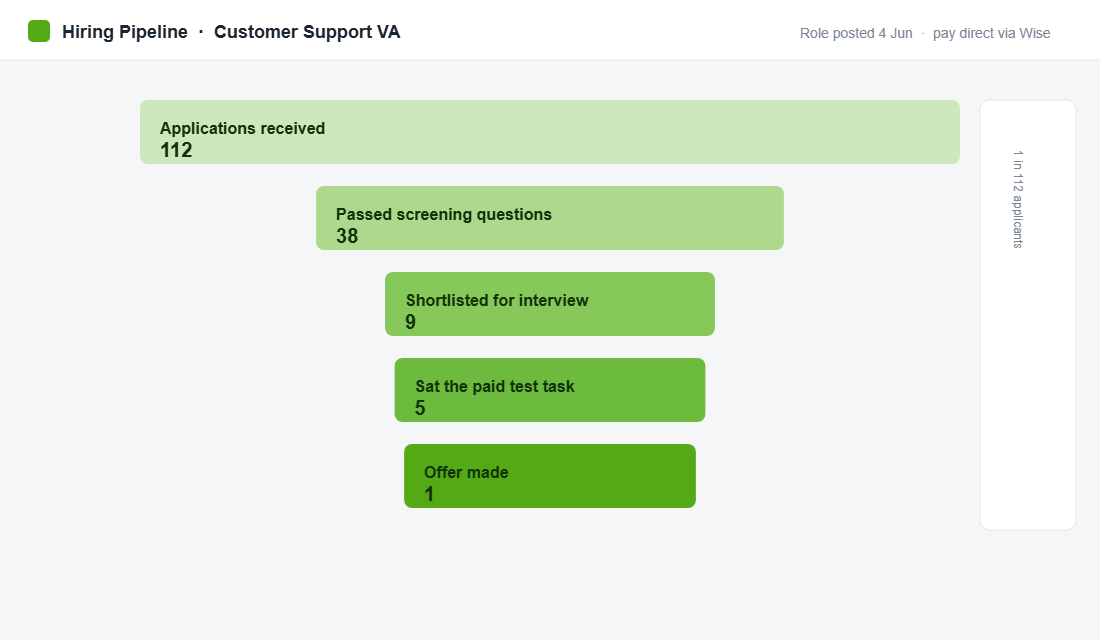
You are looking for three things: did they follow the SOP, did they ask smart questions when the SOP did not cover something, and did the writing sound like a human your customers would trust. One candidate almost always pulls clear of the pack. That is your hire. As the pipeline above shows, getting from a hundred-plus applicants to one strong offer is normal, and the test task is where the real signal lives.
Step 6: Onboard like the first 30 days decide everything
Most VA relationships fail in the first month, and almost always for the same reason: the founder hands over ten things at once, gets overwhelmed by the questions, decides it is faster to do it themselves, and quietly takes the work back. Do the opposite. Hand over one process at a time and do not add the next until the first is running clean.
- Week 1: one task only. Order-status and shipping replies. Daily 15-minute check-in over Loom or a quick call.
- Week 2: add returns and exchanges once week-one replies need no edits from you.
- Week 3: add review and UGC outreach, plus light Klaviyo flow QA.
- Week 4: review against the scorecard and confirm what they now own outright.
Record every correction as an SOP update, not a one-off message. Each fix should make the next month easier, not just patch today. By day 30, a good first hire is handling the bulk of your support volume and escalating only the genuine judgement calls.
Step 7: Manage by outcomes, with a one-page scorecard
The fastest way to recreate the bottleneck is to manage hours instead of outcomes. You do not care if your VA took 35 minutes or 50 to clear the queue. You care that first-response time is under your target, tickets are resolved, and customers are happy. Give every role three or four numbers and review them weekly in a 20-minute one-to-one.
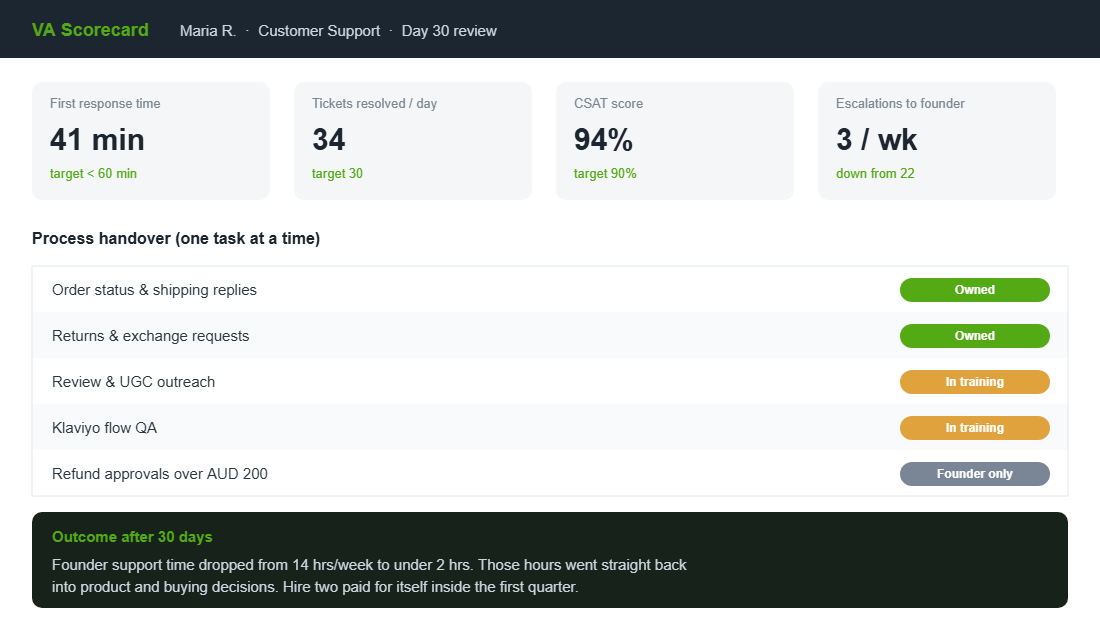
The scorecard does two jobs. It tells you the hire is working in numbers rather than vibes, and it gives your VA a clear definition of “good” they can hit without checking in with you. When founder escalations drop from twenty-something a week to a handful, you have your evidence. The bottleneck moved off you and onto a process.
The compound effect: one hire is how you build a team
Here is what actually happens after a good first hire, and why it matters more than the hours alone. You reclaim 13 to 15 hours a week. You put a chunk of that into the high-value work only you can do: buying, creative direction, partnerships, offers. Revenue ticks up. That extra contribution funds hire two, who takes the next cluster off your plate. Round and round.
That is the difference between a founder who is still answering tickets at 200k a month and one who has built a team and is working on the business. The first hire is not about saving money on labour. It is the first rep of the single most important skill in scaling: getting work out of your head and into someone else’s hands without dropping the standard.
Do it badly and you confirm your worst fear that no one can do it like you. Do it with an audit, an SOP, a paid test task and a scorecard, and you prove the opposite. The work was never the problem. The lack of a system to hand it over was.
What to hand over next, and what to keep forever
Once your first hire owns support, the temptation is to pile everything onto them. Resist it. The point of a first VA is to prove the system, not to build a one-person back office that becomes its own bottleneck. When the support role is running clean and your scorecard is green for a full month, look back at your audit and pick the next dense cluster.
For most Aussie stores the natural second wave is operations and merchandising: uploading and optimising product listings, updating collections, basic photo retouching, order and inventory reconciliation, and chasing suppliers on lead times. These are repeatable, rules-based, and they free your high-value buying and creative hours. The third wave is usually marketing support: scheduling content, building email and SMS campaigns to brief, and pulling weekly performance numbers into a simple report.
Some things never leave your desk, and naming them protects both of you. You keep brand and creative direction, pricing and margin decisions, supplier negotiation and terms, hiring, and any judgement call that could damage a customer relationship or your reputation. A VA who knows exactly where the line sits will move faster inside it, because they are not second-guessing whether something is theirs to decide.
Three mistakes that turn a great VA into a bad hire
Almost every “VAs do not work for me” story traces back to one of these. None of them are about the VA.
- Hiring before you have an SOP. If the process only exists in your head, you have not hired help. You have hired a second person who needs you constantly. Document first, hire second.
- Going too cheap on the wrong role. A 3 dollar an hour data-entry VA is fine for data entry. For a customer-facing support role where tone and judgement protect your brand, paying at the 8 to 10 dollar an hour end buys you someone who can actually represent you. Match the rate to the risk.
- Managing tasks instead of outcomes. The moment you start checking how long things took and re-approving every reply, you have rebuilt the bottleneck with extra steps. Set the numbers, review weekly, and let them work.
The founders who get this right are not better managers by nature. They simply treat the first hire as a skill to practise rather than a cost to minimise. Get one VA running well and the second, third and fourth get dramatically easier, because by then you are hiring into a system instead of into chaos.
Your First Hire Checklist
Save this and work it top to bottom. If you can tick every box, you are ready to make the hire that gives you your week back.
- Time audit done. One week logged in 30-minute blocks, every task tagged into four value tiers.
- Role defined. One function, end to end, usually customer support. Boundaries written down.
- SOPs recorded. Your five most common tasks captured on Loom with written steps.
- Job posted. Specific title, exact tools, AEST overlap, and a screening question to filter applicants.
- Paid test task sent. Real sample work to your shortlist, paid for, judged on SOP-following and written tone.
- 30-day onboarding plan. One process per week, daily check-ins in week one, corrections logged as SOP updates.
- Scorecard live. Three or four outcome metrics per role, reviewed in a weekly 20-minute one-to-one.
Inside eCommerce Circle, getting out of the day-to-day and building a team that runs without you is one of the core pillars we work on with every member. If you are the bottleneck in your own business and want a second opinion on what to offload first, let’s talk.