You have probably spent the last quarter watching your Meta CPMs climb. The cost to acquire a customer creeps up, your margin creeps down, and you refresh the ads manager like it owes you money. Most Aussie founders are stuck in exactly this loop.
What’s in This Article
Meanwhile the cheapest acquisition channel you will ever own is sitting in your customer list, completely untapped. Every happy customer you have shipped to knows three or four other people who would love your product. They already talk about you. They just have no reason to do it on purpose, and no easy way to do it at all.
That is what a referral program fixes. Not a discount banner. Not a “tell a friend” link buried in your footer.
A real, double-sided, properly incentivised system that turns word of mouth into a measurable channel with a cost per acquisition you actually control. Referred customers convert at three to five times the rate of paid traffic, and they cost roughly half as much to acquire. This is the five-part system we use to build one that pays for itself.
Why Referral Is the Channel Most Aussie Stores Never Build
Start with the trust gap. Around 92% of consumers trust recommendations from people they know more than any other form of advertising. No ad, no influencer, no clever hook competes with a mate saying “you have to try this”.
When your customer sends a friend, you are not buying attention. You are borrowing trust that already exists.
Then look at the economics. Across ecommerce, referral and affiliate channels run a blended CAC closer to $45 versus roughly $76 for paid search. Deloitte has put the saving at a 24% reduction in acquisition cost for brands that run referral properly. For a store spending $30k a month on paid, shifting even 15% of new customers to referral is real money back in the business.
The customers themselves are better, too. Referred customers spend around 25% more on their first order and carry roughly 16% higher lifetime value than customers from any other source. They arrive pre-sold, they churn less, and they refer again.
Word of mouth already influences about 13% of all sales. A referral program is simply how you stop leaving that 13% to chance.
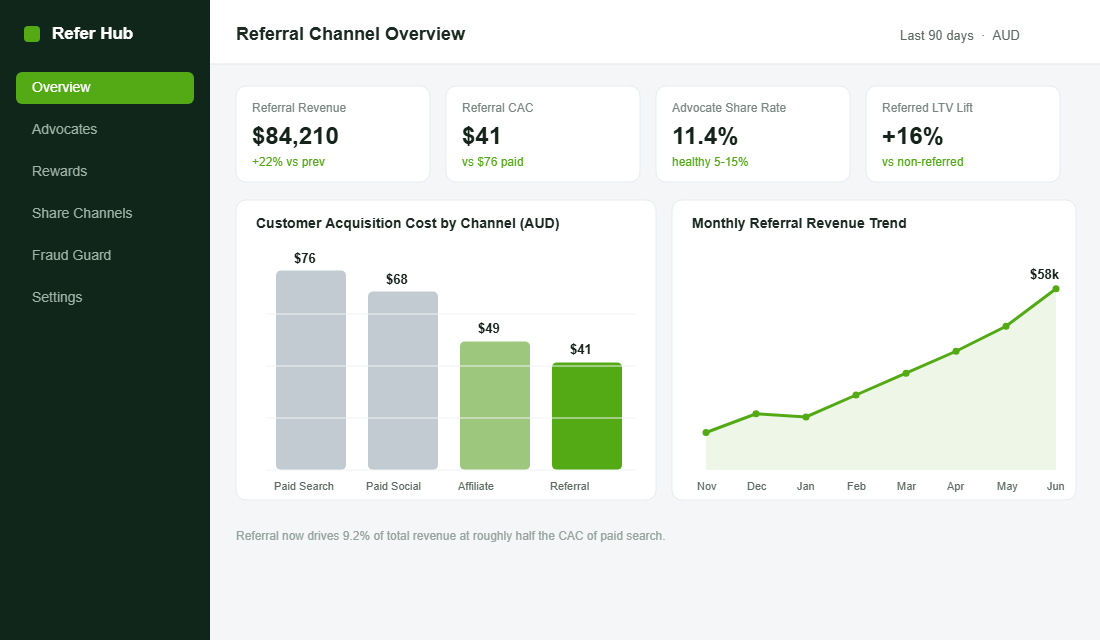
Here is the catch. A referral program is not a “set it and forget it” app you install on a Sunday night. The stores that win treat it like a system with five moving parts: the moment you ask, the offer you make, the friction you remove, the tool you run it on, and the guardrails that keep it profitable. Get those right and referral becomes the most reliable line on your acquisition report.
Part 1: Ask at the Peak of Goodwill, Not at the Checkout
Most stores ask for the referral at the worst possible moment. They slap a share widget on the order confirmation page, when the customer has paid but not yet experienced anything. There is no goodwill to spend yet. They paid, they want their parcel, and a “refer a friend” box just feels like you asking for more before you have delivered.
The peak of goodwill comes later. It is the moment the product lands and works. For a skincare brand that might be two weeks in, when skin actually looks better.
For a coffee subscription it is the second or third delivery, once the ritual has formed. Your job is to map that moment for your product and trigger the referral ask right there, not at the cart.
In practice that means a few well-timed touchpoints rather than one:
- The delivered-plus-X email. Trigger a referral email 7 to 14 days after delivery, timed to when the product has done its job. This single email is usually the highest-performing referral touchpoint a store owns.
- The post-review prompt. When a customer leaves a four or five star review, that is a verified happy customer. Show the referral offer immediately after they submit.
- The repeat-purchase moment. A second or third order is proof of love. Add the referral link to that order confirmation, because now the goodwill is real.
- The account and thank-you pages. Quiet evergreen placements that catch advocates whenever they come back.
This is the same logic that powers a good retention engine. If you have already mapped your post-purchase journey in our Shopify repeat purchase playbook, you already know where these high-goodwill moments sit. The referral ask just rides on top of them.
Part 2: Build a Double-Sided Offer the Maths Actually Supports
The single biggest decision is whether you reward one side or both. The answer is both. Double-sided programs, where the advocate and the friend each get something, outperform single-sided ones by two to three times on participation and referral volume.
A one-sided offer asks your customer to spam their friends for your benefit. A double-sided offer lets them give their friends a genuine gift, which is a far easier thing to send.
The cleanest structure to start with is “Give $20, Get $20”, or a matched percentage like 15% for both sides. Equal give and get signals fairness and is dead simple to explain. The advocate reward should be store credit, not cash, because credit pulls them back for another order and keeps the value inside your business. The friend reward should be a first-order discount that auto-applies, so there is zero friction to redeem.
Now the part most founders skip: run the numbers before you launch. The whole program lives or dies on whether a referred order is still profitable after both rewards. Map it out per order.
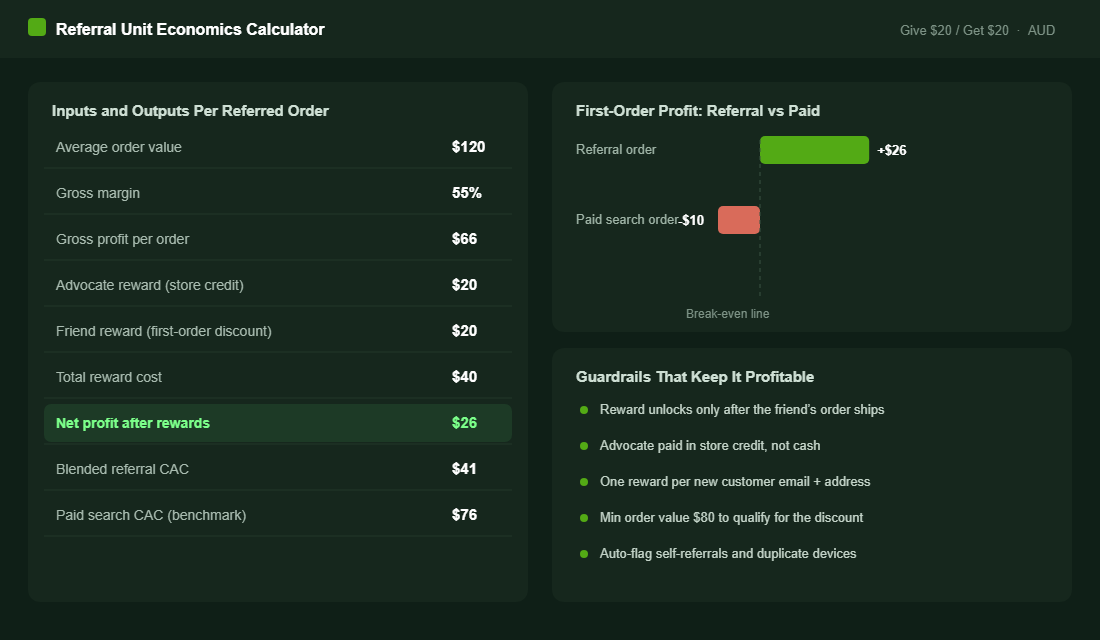
Work an example. Say your average order value is $120 and your gross margin is 55%, so you make $66 gross profit per order. Your total reward cost is $40 ($20 to the advocate, $20 to the friend).
That leaves $26 of profit on the very first referred order, before they ever buy again. Compare that to a paid-search customer who might cost you $76 to acquire on a first order that only generated $66 of margin.
Referral is profitable on day one. Paid often is not.
If your margin is thinner, do not abandon double-sided. Adjust the levers instead. Lower the reward to $10 or 10%, add a minimum order value of $80 to qualify, or pay the advocate only after the friend’s order ships.
The goal is a referred order that is at worst break-even on day one and clearly profitable once you factor in that 16% LTV lift. If you have not yet calculated your true customer economics, our customer lifetime value playbook walks through the exact maths.
Part 3: Kill the Friction Between “I Love This” and “Here Is Your Link”
A referral program fails quietly when sharing is even slightly hard. Every extra click, every “log in to your account to find your code”, every reward that takes a week to land, bleeds participation. The healthy share rate, the percentage of customers who actually share their link after buying, sits between 5% and 15%. The gap between a 4% program and a 12% program is almost always friction, not the offer.
Remove it on both sides of the loop. On the advocate side, make sharing a single tap:
- One-tap channels. Give them ready-made buttons for SMS, WhatsApp, email and a copy link. In Australia, SMS and WhatsApp convert hard, so do not bury them behind a social-only widget.
- Pre-written copy. Fill the share message for them. “I have been loving this, here is $20 off your first order” beats a blank box every time.
- A personal, memorable code. A short branded link like yourstore.com.au/r/AVA-7K2Q feels owned and is easy to text.
On the friend side, the discount must auto-apply when they land. Asking a new visitor to remember and type a code is where most referred traffic leaks away. The reward should also feel instant: store credit that appears in the advocate’s account the moment the friend’s order is confirmed, with an email telling them it landed.
Speed of reward is its own marketing. People refer again when the payoff feels real and fast.
Part 4: Pick a Tool and Configure It in an Afternoon
You do not need a developer for this. The Shopify app ecosystem has matured to the point where you can stand up a proper double-sided program in a single afternoon. The main contenders are ReferralCandy, Yotpo and Friendbuy, plus loyalty platforms like LoyaltyLion that bundle referrals in. For most Aussie stores between $40k and $500k a month, a dedicated referral app is the fastest path to a clean setup.
ReferralCandy is the common starting point. It is Built for Shopify certified, holds a 4.9 star rating across thousands of reviews, and is purpose-built for referral rather than bolted on. Plans start around $59 a month with a 14-day free trial, so you can validate the channel before committing.
Yotpo suits larger brands wanting deep analytics and multi-channel integration. Whichever you choose, the configuration logic is the same.
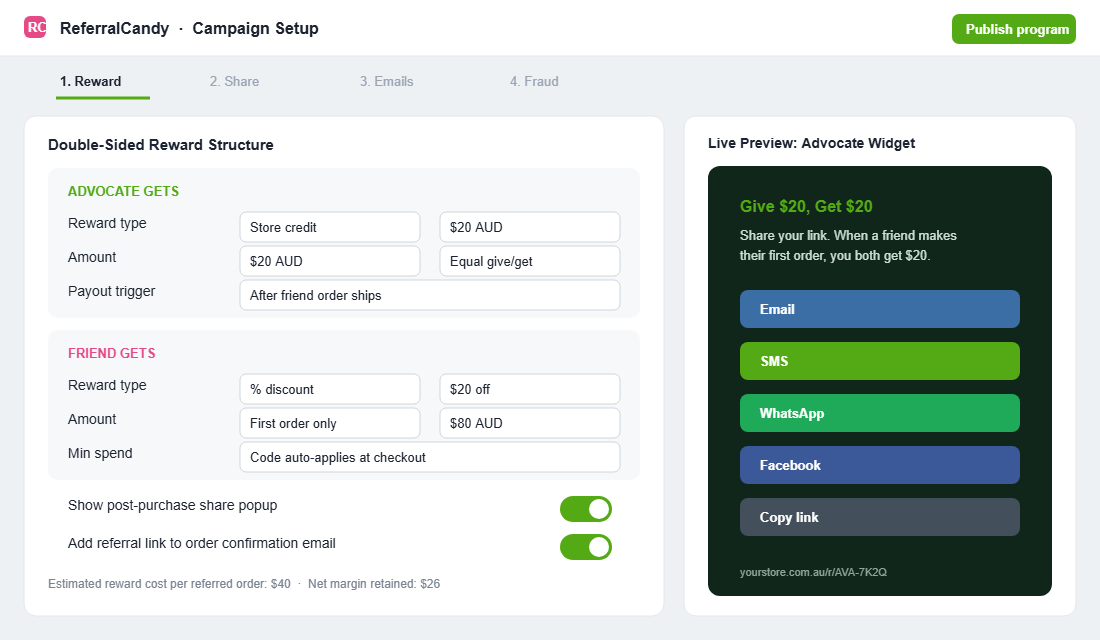
Here is the setup sequence to follow once the app is installed:
- Connect the store and confirm the discount sync. Authorise the app, then place a test order to confirm reward codes actually generate and redeem on your theme.
- Set the advocate reward. Choose store credit, set the amount to $20 AUD, and set the payout trigger to “after the friend’s order ships” so you never pay out on a refund.
- Set the friend reward. Choose a $20 or 15% first-order discount that auto-applies, and add a minimum spend of $80 to protect margin.
- Turn on the post-purchase popup and email link. Enable the share widget after checkout and inject the referral link into your transactional emails.
- Brand the widget. Match the colours to your store, write the headline as “Give $20, Get $20”, and pre-fill the share message.
- Schedule the delivered-plus-X email. Set the main referral email to fire 7 to 14 days after delivery, the peak-goodwill window from Part 1.
If you already run a points or loyalty program, do not treat referral as a separate island. The two compound. Our Shopify loyalty program playbook covers how to wire referral rewards into the same account experience so advocates see one balance, not two.
Part 5: Protect the Program and Track the Three Numbers That Matter
Once money is attached to an action, some people will game it. Self-referrals, fake accounts and discount stacking can quietly turn a profitable program into a leak. You do not need to be paranoid, you just need basic guardrails switched on from day one.
- Reward only on a shipped, paid order. Never pay the advocate at checkout. Pay after fulfilment so cancellations and refunds do not cost you.
- Block obvious self-referrals. Flag matching emails, addresses or devices between advocate and friend. Most apps do this automatically once enabled.
- One reward per new customer. Cap the friend discount to genuine first-time buyers and limit how many rewards a single advocate can earn in a week.
- Exclude referral codes from stacking. Stop the friend discount combining with site-wide sales, or your margin maths breaks.
Then measure ruthlessly, but only the numbers that move decisions. Three matter most. Share rate tells you if your ask and friction are right; aim for 5% and up. Referral conversion rate tells you if the offer lands; referred visitors should convert well above your site average, often 3 to 5 times paid traffic. Net profit per referred order tells you the program is actually making money, not just generating activity. If share rate is low, fix the moment and the friction.
If conversion is low, fix the offer. If profit is thin, adjust the reward or the minimum spend.
The Compound Effect: Why Referral Beats Every Other Channel Over Time
Each part on its own is useful. Together they create something paid media can never give you: a channel that gets cheaper as it grows. Paid acquisition gets more expensive at scale, because you exhaust your best audiences and bid against more competitors.
Referral does the opposite. More customers means more advocates, which means more referred customers, who become advocates themselves.
Watch the loop run. You ask at the peak of goodwill, so participation is high. The double-sided offer is profitable on the first order, so growth costs you nothing.
Friction is gone, so share rates climb. The tool runs it automatically, so it scales without your time. The guardrails keep it clean, so margin holds.
Every new cohort feeds the next. That is how Harry’s pulled in 100,000 waitlist signups in a single week before it even launched, using nothing but a milestone referral mechanic, and how brands like Casper and Away built referral into evergreen, double-sided engines rather than one-off campaigns.
The founders who win with referral are not the ones with the biggest discount. They are the ones who treat it as a system, review the three numbers monthly, and keep tightening the loop. Referred customers stick around longer and spend more, so every point of share rate you add today keeps paying you back for years.
Four Referral Mistakes That Quietly Kill Participation
Most underperforming programs are not broken, they are leaking. These are the four mistakes we see most often when we audit an Aussie store’s referral setup, and each one is a quick fix.
- Hiding the program. A referral page nobody can find earns nothing. Promote it in your post-purchase emails, your account menu, your packaging insert, and a footer link. The card needs to be in front of the customer at the moment they feel good about you.
- Rewarding only the advocate. Single-sided offers ask people to sell to their friends. Double-sided offers let them gift something. The second is socially easy, the first is not, and that gap is worth two to three times the participation.
- Making the reward feel far away. If the store credit takes a week to appear, or the friend has to hunt for a code, the loop dies. Instant, auto-applied, clearly confirmed rewards keep advocates referring again.
- Launching and walking away. Referral is not a campaign, it is a channel. Review the three numbers monthly, test one reward variation a quarter, and refresh the share copy when it goes stale.
Fix these before you spend a dollar trying to drive more traffic to the program. A tighter loop on your existing customers almost always beats pushing more people into a leaky one.
The Referral Maths: How to Set a Reward You Can Actually Afford
The most common referral mistake is picking a reward because it sounds generous, not because the numbers support it. Work backwards from what a new customer is worth to you.
Start with three inputs: your average order value, your contribution margin after COGS, shipping and payment fees, and your blended customer acquisition cost from paid ads. Then run this simple test.
- Contribution per first order. A $95 AOV at a 50% contribution margin is $47.50.
- Total referral cost. A $15 reward for the new customer plus a $15 credit for the referrer is $30, but the referrer credit is only redeemed around 50-60% of the time, so the real cost is closer to $23.
- Compare with paid CAC. If Meta is costing you $55 to acquire a customer, a referral customer at $23 is less than half the price, and they typically retain 15-25% better because they arrived with a friend’s recommendation.
As a rule of thumb, keep the total referral cost at or below 30-40% of first-order contribution. Anything higher and you are buying revenue at a loss, especially if your repeat rate is below 25%.
A Worked Example: Launching Referral at a 70K-a-Month Pet Brand
Imagine you run a Perth pet treats brand doing $70K a month with 900 orders and a 34% 90-day repeat rate. You install ReferralCandy at around $59 USD a month plus commission, and set a “Give $15, Get $15” offer on orders over $60.
You add the referral ask to three moments: the order confirmation page, a post-delivery Klaviyo email sent 10 days after fulfilment, and the loyalty page in the customer account. You skip the checkout ask entirely.
After 90 days, 6% of customers have shared their link, 14% of shared links convert, and referral is driving about 75 new customers a month. That is 8% of new customer volume at an all-in cost of roughly $24 per customer, against a Meta CAC of $58. Those 75 customers are also worth around $1,800 in first-month profit, with repeat purchases still to come.
The next step is to plug referral into your retention stack. Our 30-day post-purchase framework shows exactly when to ask, and the review engine guide pairs perfectly with it, because customers who leave a five-star review are your most likely referrers.
Your Referral Program Build Checklist
Work through this in order. Do not skip the maths step, and do not launch without the guardrails.
- Moment. Identify your peak-goodwill window and set the main referral email to fire there, 7 to 14 days after delivery.
- Offer. Choose a double-sided structure, start at Give $20 / Get $20 or matched 15%, advocate paid in store credit.
- Maths. Confirm net profit per referred order is at worst break-even after both rewards, using your real AOV and margin.
- Friction. Enable one-tap SMS, WhatsApp, email and copy-link sharing, pre-filled messages, and auto-applied friend discounts.
- Tool. Install a Built-for-Shopify referral app, configure both reward sides, and run a test order end to end.
- Guardrails. Pay only on shipped orders, block self-referrals, cap rewards, and exclude codes from stacking.
- Measure. Track share rate, referral conversion rate, and net profit per referred order every month, and adjust one lever at a time.
Build it once, wire it into the moments your customers already love you in, and you have an acquisition channel that compounds while your competitors keep renting attention from Meta.
Inside eCommerce Circle, building a profitable referral channel is one of the core pillars we work on with every member. If you want a second opinion on yours, let’s talk.