If you are not running post-purchase email flows, you are ignoring the most profitable segment of your email list: people who just gave you money. The post-purchase period – the 7-30 days after someone buys from your Shopify store – is the highest-engagement window in the entire customer lifecycle. Open rates on post-purchase emails regularly hit 60-70%, compared to 20-30% for standard campaigns. Yet most stores send a shipping confirmation and then radio silence until the next promotional blast.
What’s in This Article
That silence is a missed opportunity worth thousands of dollars per month. Post-purchase flows drive repeat purchases, generate reviews, reduce support tickets, increase customer satisfaction, and build the kind of brand relationship that turns one-time buyers into lifetime customers. The brands doing this well see 15-20% of their total email revenue come from post-purchase flows alone.
Here are the five post-purchase flows every Shopify store should be running in Klaviyo or Omnisend – with the exact timing, content, and strategy for each.
Flow 1: The Thank You and Education Sequence
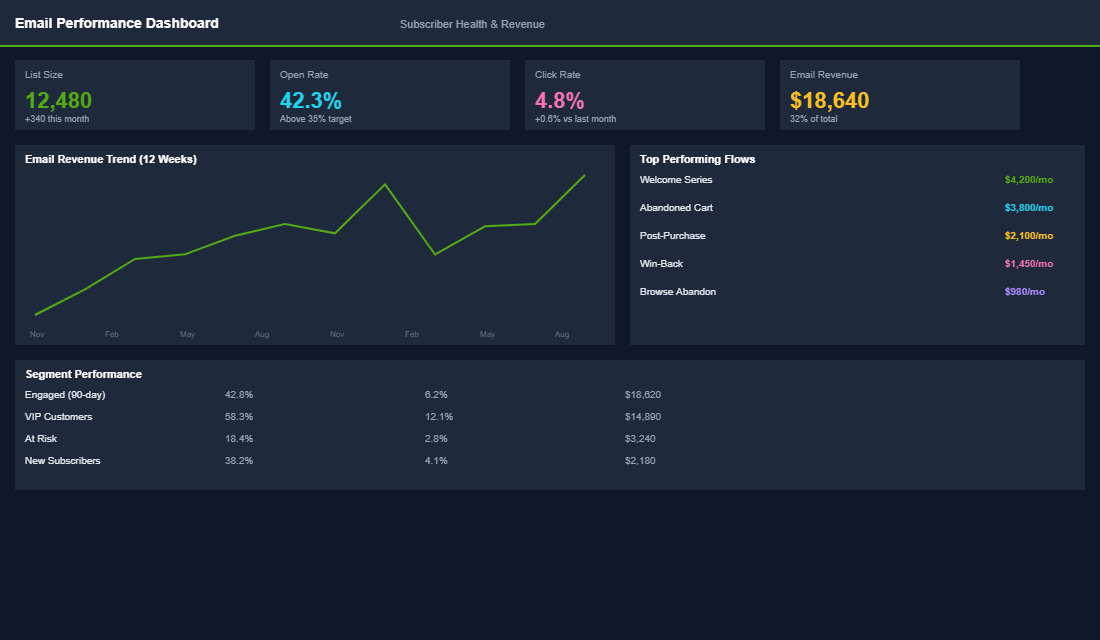
This is the most important post-purchase flow because it sets the tone for the entire customer relationship. It runs immediately after purchase and includes 2-3 emails over the first week.
Email 1: Thank you and what to expect (immediately after purchase). This is not your standard Shopify order confirmation – it is a branded, personal email that makes the customer feel great about their purchase. Thank them genuinely, tell them what happens next (processing time, shipping, delivery estimate), and include a short note from the founder or team. If you have a first-time buyer, welcome them to the brand. If they are a repeat customer, acknowledge their loyalty. This email should feel like it was written by a human, not generated by a system.
Email 2: Product education and tips (3-5 days after purchase, timed to arrive around delivery). Now that the customer has their product (or is about to), give them value. For skincare: how to use the product in their routine, application tips, ingredient explanations. For apparel: styling ideas, care instructions, outfit pairings. For food products: recipes, serving suggestions, storage tips. This email reduces buyer’s remorse, decreases returns, and positions your brand as a helpful resource rather than just a store.
Email 3: Brand story and community (7 days after purchase). Now that the customer has experienced your product, deepen the relationship by sharing your brand story, values, or mission. Invite them to follow you on social media, join your community, or read your blog content. This email is not selling anything – it is building emotional connection that drives long-term loyalty.
Flow 2: Review Request Sequence
Reviews are the single most valuable asset a post-purchase flow produces, and there is a whole system for collecting them at scale. The best time to ask is 7-14 days after delivery – when the customer has had enough time to use the product but the purchase is still fresh in their mind.
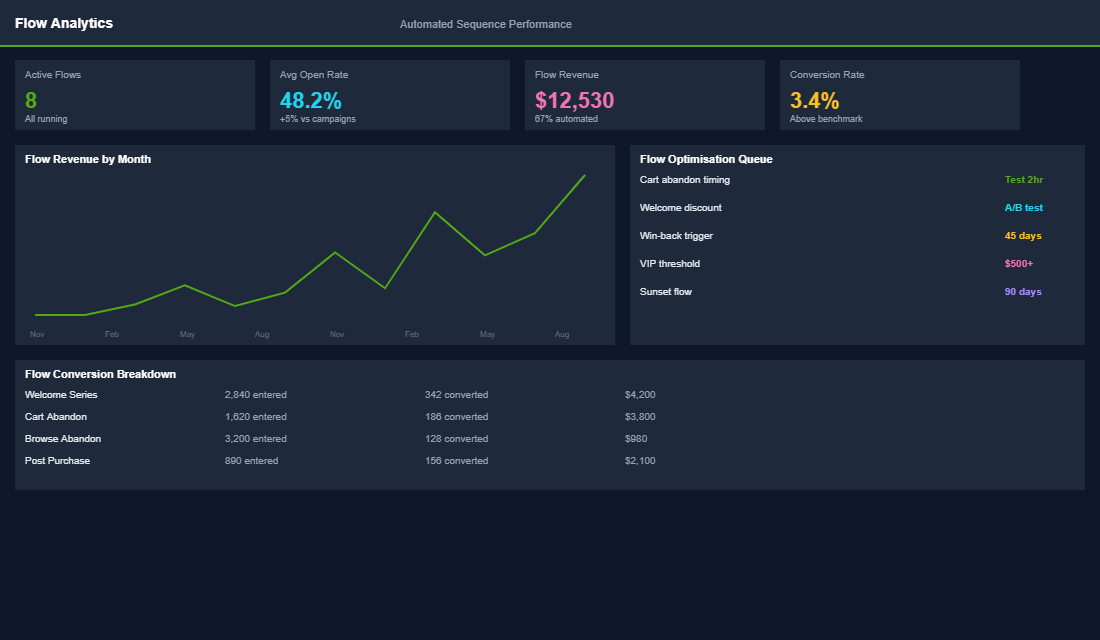
Email 1: Simple review request (10-14 days after purchase). Keep it short and direct: “How are you enjoying your [Product Name]? Your feedback helps other customers make confident decisions – and it only takes 60 seconds.” Include a direct link to the review form (Judge.me and Loox both generate unique review request links). Make leaving a review as frictionless as possible – one click to the form, pre-filled with the product name.
Email 2: Follow-up with incentive (7 days after first request, only if no review left). If the customer did not respond to the first request, send a follow-up with a small incentive: “Share your honest review and get 10% off your next order.” The incentive should not be conditional on a positive review – ask for honest feedback. This follow-up typically captures an additional 5-8% of customers who just needed a nudge.
Photo review bonus. Offer a slightly higher incentive for photo reviews: “Include a photo and get 15% off instead of 10%.” Photo reviews are 3-5x more persuasive than text-only reviews and dramatically improve product page conversion rates. Most customers are happy to snap a quick photo for an extra discount.
Flow 3: Cross-Sell and Replenishment Flow
This flow is where post-purchase emails directly drive revenue. The timing and content depend on your product type.
For consumable products (replenishment): If your product has a predictable usage cycle (30-day supply of supplements, 60-day supply of skincare), send a replenishment reminder 5-7 days before the customer is likely to run out. “Running low on your [Product]? Reorder now and never miss a day.” Include a one-click reorder link that pre-fills their cart. Replenishment flows convert at 5-10% – among the highest of any email type.
For non-consumable products (cross-sell): 14-21 days after purchase, recommend complementary products based on what they bought. “You loved the [Product] – customers who bought it also love these.” Use Klaviyo’s product recommendation engine to dynamically populate these emails with relevant items. Cross-sell flows typically generate $0.50-$2.00 per recipient in revenue.
Flow 4: Win-Back Flow for Non-Repeat Buyers
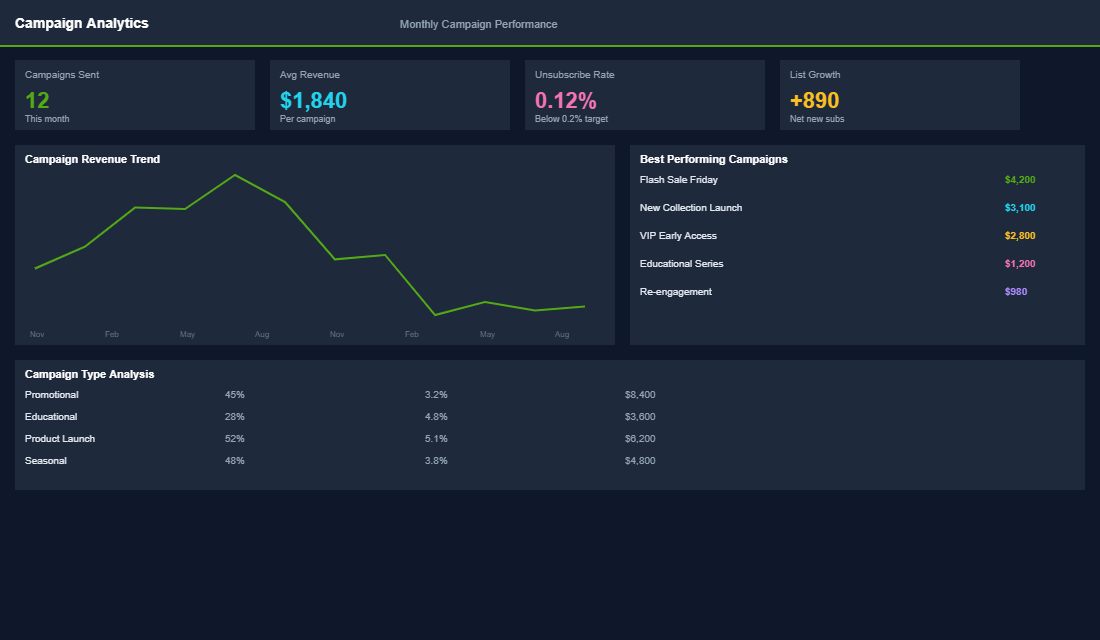
If a customer has not made a second purchase within 60-90 days, they are at risk of never buying again. A win-back flow targets these one-time buyers with a sequence designed to drive that critical second purchase.
Email 1 (60 days post-purchase): Value reminder. Remind them why they bought from you and what is new. “It has been a while since your last order – here is what you have been missing.” Feature new products, best sellers, and any improvements you have made since their purchase.
Email 2 (75 days): Social proof push. Share recent customer reviews, UGC, or press mentions. Show them that other customers keep coming back. “Join 4,000+ customers who have made [Brand] part of their routine.”
Email 3 (90 days): Incentive offer. A targeted discount to drive the second purchase: “We want you back – here is 15% off your next order, valid for 7 days.” The discount is justified because a second-time buyer is 9x more likely to become a long-term customer than a one-time buyer, and this flow is the email half of a broader win-back system. That 15% discount is an investment in lifetime value.
Flow 5: VIP Recognition Flow
- Trigger: Customer reaches a spend threshold (e.g., $500 total or 5th order). Celebrate their loyalty with a dedicated email acknowledging their VIP status. “You are officially part of our VIP family – thank you for being one of our most valued customers.”
- Include exclusive VIP benefits: Early access to new products, exclusive discount codes, free shipping for life, birthday gifts, or invitations to VIP-only events. These benefits should feel genuinely special, not just a repackaged standard offer.
- Make it personal. Use their first name, reference their favourite products (based on purchase history), and if possible, include a personal note from the founder. VIP recognition emails have some of the highest engagement rates of any email type because customers feel genuinely appreciated.
Flow Timing: The 90-Day Post-Purchase Calendar
Running all five flows at once is where most stores come unstuck. Each flow makes sense on its own, then a customer buys on a Tuesday and gets a thank-you email, a product education email, a review request and a cross-sell inside twelve days. The flows are fine. The calendar is not.
Map the whole 90 days on one page before you switch anything live. Day 0 is the thank you. Day 3 to 5 is education, timed to land when the parcel does. Day 7 is the brand story. Day 10 to 14 is the review request. Day 14 to 21 is the cross-sell or replenishment nudge. Day 60, 75 and 90 belong to the win-back sequence. Nothing else gets to occupy those slots.
Australian delivery times should shift your review timing. Australia Post standard parcels run 2 to 5 business days metro and 5 to 9 days to regional and WA addresses. If your review request fires on a fixed 10-day timer, a decent slice of your regional customers get asked to review a product they have owned for 48 hours. Trigger the review flow off the fulfilment or delivery event in Klaviyo rather than the order event, and add 7 days on top. Stores that make this one change typically lift review submission rates by 20 to 30% because they stop asking too early.
Set suppression rules so flows never collide. In Klaviyo, add a flow filter that skips anyone who has received another flow email in the last 48 hours, and exclude anyone with an open support ticket or an active return. Turn on smart sending. Then exclude active flow recipients from your campaign list entirely, so a Thursday promo blast does not land on top of a day-3 education email. One Aussie skincare brand we work with cut post-purchase unsubscribes from 0.6% to 0.18% by doing nothing more than adding suppression rules and spacing the calendar out.
The other timing decision worth making deliberately: first-time buyers and repeat buyers should not run the same calendar. A fourth-time customer does not need the brand story email, and asking them to review the same product again wastes a send. Split the entry on order count. Repeat buyers skip straight to education, replenishment and the loyalty and VIP track.
The Five Numbers That Tell You a Flow Is Working
Open rate is the number everyone quotes and the one that matters least. Post-purchase emails open at 60 to 70% almost regardless of how good they are, because people want to know where their parcel is. Judge these flows on revenue and retention instead. Five numbers, checked monthly, tell you everything.
- Revenue per recipient (RPR). Total flow revenue divided by people who entered it. A healthy cross-sell or replenishment flow sits at $0.50 to $2.00 per recipient. Under $0.30 and your product recommendations are wrong, not your copy.
- Placed order rate. Replenishment flows should convert 5 to 10%. Cross-sell flows 2 to 4%. Win-back flows 3 to 6% across the full three-email sequence. Anything sitting under half the benchmark is a targeting problem.
- Review submission rate. 5 to 12% of recipients for a two-email sequence with an incentive. Under 4% usually means you are asking before delivery or the review link takes more than one click.
- Unsubscribe rate per flow. Keep it under 0.2%. Post-purchase unsubscribes are expensive because you are losing a buyer, not a browser. A spike almost always traces back to send frequency, not content.
- Share of total email revenue. Flows should carry 45 to 60% of your Klaviyo revenue, with post-purchase flows specifically at 15 to 25%. If campaigns are doing 80% of the work, your automation is underbuilt.
Pull these into a single monthly view rather than checking them ad hoc. Klaviyo’s flow performance report gives you four of the five directly; the share-of-revenue split sits under Analytics, Campaigns vs Flows. Ten minutes a month is enough. The point is to catch a flow that quietly broke after a theme update or a product rename, which happens more often than most founders expect.
One caution on the win-back discount. If your day-90 email trains customers to wait for 15% off, you will see repeat rate climb and customer lifetime value stay flat, because you have simply moved margin around. Track second-order margin, not just second-order count. If margin per repeat customer is falling while repeat rate rises, drop the discount to 10% and lead with new products instead.
The Compound Effect of Post-Purchase Flows
Each of these five flows works well independently. Together, they create a system that nurtures every customer from first purchase to loyal advocate. The thank-you sequence builds goodwill. The review flow generates social proof. The cross-sell flow drives revenue. The win-back flow recovers at-risk customers. And the VIP flow rewards your best customers. Running all five, most Shopify stores see post-purchase email revenue increase by 40-60% within the first 90 days of implementation.
Inside eCommerce Circle we help hundreds of Aussie Shopify founders build and tune these exact flows in Klaviyo, then hold them to the five numbers above. If your post-purchase communication stops at a shipping confirmation, let’s talk.