You already know the feeling. It is 9:47 on a Tuesday night, the kids are asleep, and you are still copying tracking numbers into reply emails one at a time. The store did $180k last month. On paper you are winning. In reality you are the person packing the parcels, answering the “where is my order” messages, uploading the new product photos, chasing the supplier, and approving the ad copy. You are not running the business. You are the business.
What’s in This Article
This is the ceiling almost every Aussie founder hits somewhere between $40k and $500k a month. It does not feel like a strategy problem. It feels like a time problem. And the tempting fix is to work harder: earlier starts, later nights, weekends buried in the inbox. In Australia, small business owners are already bucking the national trend, with a sizeable share still clocking 60 and 70 hour weeks while everyone else’s hours fall.
Here is what most founders get wrong. They treat their first hire as a cost to delay until the money is “safe”, when the truth is the opposite. The reason revenue has plateaued is that every hour you spend on $25-an-hour admin is an hour you did not spend on the $2,000-an-hour work only you can do: offer, brand, positioning, buying, partnerships. Research on entrepreneurs found roughly 36% of the working week disappears into small administrative tasks, and more than three in ten owners lose between a quarter and half of every week to it. That is not a time problem. That is an output problem, and it has a name.
The Real Problem Is Not Time, It Is That You Are the Single Point of Failure
Inside the More Orders Operating System, this is the People engine, and it is the one most $1m founders quietly neglect. People is not “hiring staff”. It is team capability: the systems, roles, and relationships that decide whether the business can run beyond your personal capacity. When People is weak, you remain the central point of failure. Growth is capped by one person’s stamina, and every attempt to delegate creates more anxiety than freedom.
The diagnostic we run with members is brutally simple. If you went completely offline for two weeks tomorrow, no email, no Slack, no “quick checks”, what would break? For most founders at this stage the honest answer is “almost everything”, and that answer tells you exactly where your business is fragile. A store that collapses the moment you step away is not an asset. It is a job you cannot quit.
The founders who break through do not just add hands. They build a machine that runs without them in the loop for every decision. That is what this playbook is: the five-part system we use to take a founder from “I am the business” to a business that produces orders whether you are at your desk or on a beach in Byron. Get it right and you buy back 13 to 15 hours a week, the average that owners reclaim once they delegate properly, and often far more.
Part 1: Run the Two-Week Test and Audit Where Your Hours Actually Go
You cannot delegate what you have not measured. Before you write a single job ad, you need a clear picture of where your week disappears, because founders are terrible at guessing this. Most assume the big time sinks are strategic. They are almost never strategic.
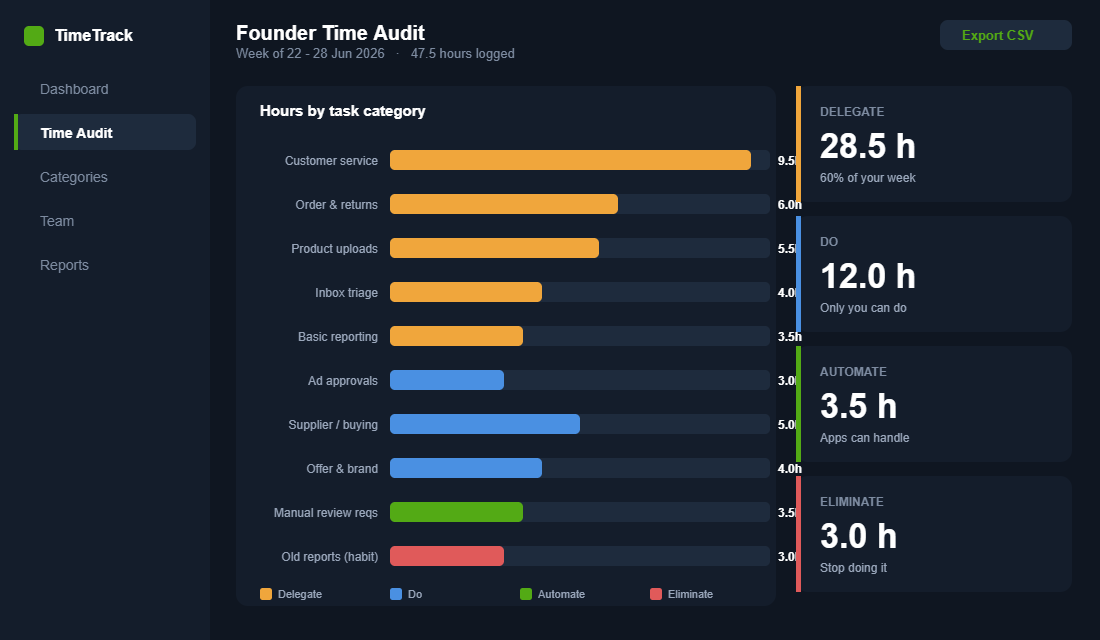
For one full week, log every task in 30-minute blocks. Do not tidy it up or make it look impressive. If you spent 40 minutes re-sizing images for a collection page, write it down. At the end of the week, run every line item through four columns:
- Eliminate. Work that does not need doing at all. You will be surprised how much reporting and “checking” is pure habit.
- Automate. Repetitive tasks a Shopify Flow, a Klaviyo automation, or an app can handle without a human. Order tags, review requests, low-stock alerts.
- Delegate. Tasks that need a human but not you. This is usually 60 to 70% of a founder’s week: customer service, order issues, listing uploads, basic reporting, invoice chasing.
- Do. The handful of things only you can do. Offer, brand voice, buying decisions, key relationships, the P&L.
The “Delegate” column is your first job description, written in your own handwriting. It is also your business case. If 22 hours a week is sitting in that column, and a capable ecommerce VA costs you a fraction of what those hours are worth in strategic output, the maths stops being a debate. Owners who delegate well report their operations running roughly 35% more efficiently, and they are measurably less likely to be drowning in poor work-life balance than the founders who insist on doing it all.
Part 2: Delegate Outcomes, Not Tasks
This is the single mindset shift that separates founders who scale from founders who just hire and stay exhausted. Most first-time delegators hand over tasks: “reply to this email”, “upload these five products”, “send me the numbers”. The founder stays in the loop as the brain, and the hire is just a pair of remote hands. You have not removed yourself from the bottleneck. You have added a person to it.
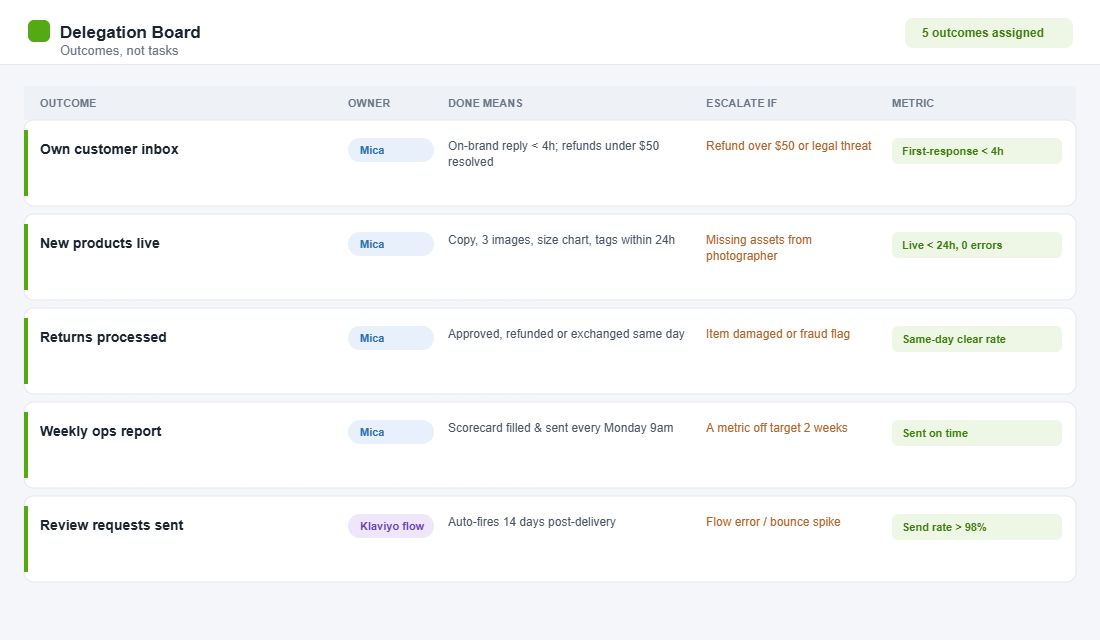
Delegating an outcome is different. Instead of “reply to this refund email”, the outcome is “own our inbox so that every customer gets a helpful, on-brand reply within four hours, and refunds under $50 are resolved without asking me”. Instead of “upload these products”, the outcome is “every new product is live with correct copy, three images, size chart, and tags within 24 hours of the photos landing in the shared drive”.
Outcomes come with three things attached: a definition of “done”, a boundary for when to escalate to you, and a metric you can check without hovering. Get those three right and the work becomes genuinely off your plate. This is the difference the More Orders framework draws between a business that has employees and a business that has operational independence. You are no longer delegating chores. You are delegating responsibility, with guardrails.
A practical way to write these: use the format “So that”. “Own product uploads so that new stock is selling within a day of arriving.” The “so that” forces you to name the business result, which is what you actually care about, not the keystrokes.
Part 3: Build Your SOP Library Before You Hire, Not After
Here is where 70% of first hires quietly fail. The founder brings someone on, spends three weeks answering the same questions on repeat, decides “it is faster if I just do it myself”, and lets the person go. The problem was never the hire. It was that the knowledge lived entirely inside the founder’s head, so every task became a live tutorial.
Documented standard operating procedures fix this, and the numbers are not subtle. A McKinsey analysis found organisations with well-documented SOPs can lift productivity by up to 25%. Teams that build real SOP libraries report 30 to 50% faster onboarding for new hires and a 40 to 60% drop in preventable errors. You cannot grow from one person to five on shadowing and memory. Documented process is the thing that lets a new hire become useful in days instead of months.
The good news: you do not need a polished operations manual. You need Loom and 10 minutes per task. Here is the exact method we give members, and it is the fastest way to turn what is in your head into something a hire can follow.
- Step 1: Install Loom and clean your screen. Add the free Loom Chrome extension. Close any tabs with private data, banking, or customer lists you do not want recorded.
- Step 2: Record yourself doing the task once, out loud. The next time you process a return or upload a product, hit record and narrate every click. “I am opening the orders tab, filtering by unfulfilled, then…” This takes 5 to 10 minutes, the time it takes to do the task anyway.
- Step 3: Grab the transcript. Loom generates a text transcript of your narration with one click. Copy it.
- Step 4: Turn it into a written SOP. Paste the transcript into Claude or ChatGPT with the prompt: “Turn this transcript into a numbered standard operating procedure with a checklist and a note on when to escalate.” You get a clean, step-by-step document in under a minute.
- Step 5: Store it where the hire lives. Drop the Loom link and the written SOP into a shared Notion page or Google Doc, organised by task. This becomes your onboarding library.
Record your top 10 recurring tasks this way and you have built a training system in an afternoon. Better still, once your hire is in, have them create the next SOP from your Loom video. They learn the task deeply while doing it, and your library grows without you writing a word.
Part 4: Make the Right First Hire (and Where to Actually Find Them)
For almost every Shopify store between $40k and $500k a month, the right first hire is a general ecommerce virtual assistant, not a specialist and not a senior operator. You are not hiring for expertise yet. You are hiring to reclaim the 20-plus hours a week sitting in your “Delegate” column so you can go and do the growth work. A good ecommerce VA can own customer service, order and returns handling, product listing, basic reporting, and inbox triage from day one.
On cost, be realistic and be fair. Offshore ecommerce VAs, most commonly from the Philippines, typically run between AUD $10 and $20 an hour depending on experience and platform, with global marketplace medians sitting around the low teens in US dollars. A reliable full-time VA is well within reach of a store doing six figures a month, and the return is measured in the founder hours it frees, not just the wage it costs. Where to look:
- OnlineJobs.ph for direct hires from the Philippines. You post a job, review applicants, and manage the relationship yourself. Lowest cost, more of your time to recruit and onboard.
- Managed VA agencies if you want the vetting, cover, and replacement handled for you at a higher hourly rate. Good if the two-week test scares you.
- Local Aussie contractors via referral for work that genuinely needs same-timezone availability or native-English customer voice, usually a later, more senior hire.
Hire for judgement and communication over resume polish. A short paid trial task, something real from your SOP library, tells you more in two hours than any interview. Have them process three test returns or draft five customer replies, then look at how they handle the edge case you deliberately left in. That is the signal.
One more thing the More Orders People engine insists on: your own compensation counts here too. Total people costs, including a real, regular salary for you, should be a planned percentage of revenue, not whatever is left over. If you have not run those numbers lately, our EOFY Profit Reset walks through exactly how people costs should sit inside a healthy P&L.
Part 5: Manage by Metrics, Not by Hovering
The final failure mode is the founder who hires help and then micro-manages it into uselessness, checking every reply, redoing every upload, and quietly proving to themselves that “no one can do it like me”. If you delegated an outcome in Part 2, you already have the tool to avoid this: the metric.
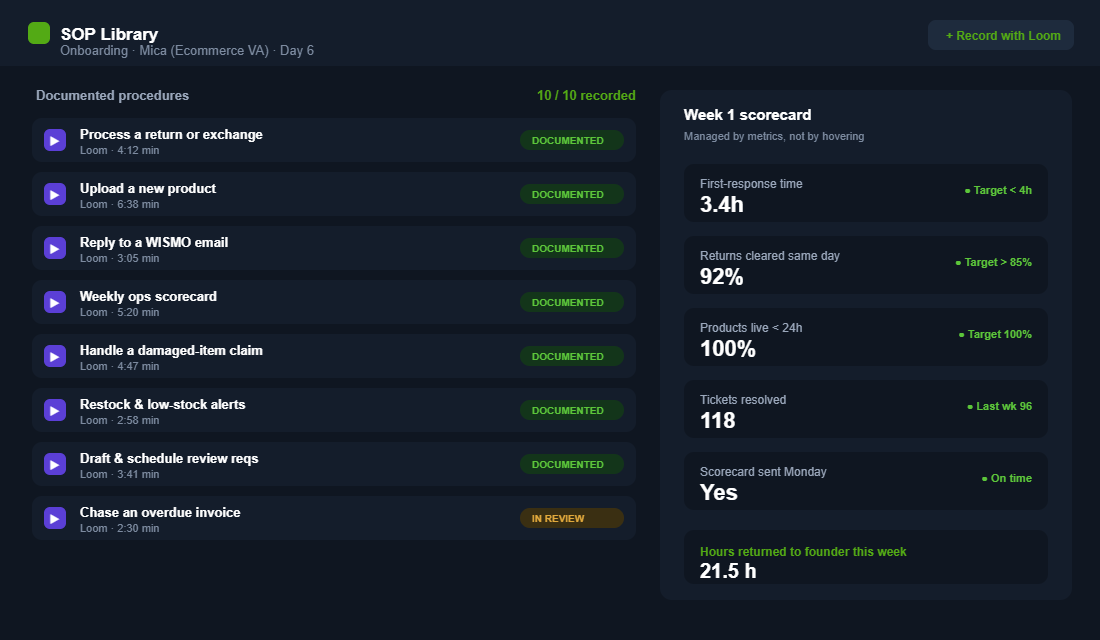
Quality control without hovering means you check the result, not the keystrokes. For a VA who owns customer service, you are not reading every email. You are watching first-response time, resolution time, and CSAT. For a VA who owns product uploads, you are checking that new stock is live within 24 hours with no errors on the page, not standing over the process. Set a weekly rhythm:
- A shared scorecard. Three to five numbers per role that define “good”, reviewed every Monday. Response time, orders shipped on time, tickets resolved, listings live.
- A weekly 30-minute check-in. Not a status report you could read yourself. A conversation about what is stuck, what needs a decision, and what the next SOP should cover.
- A clear escalation line. Everyone knows the exact threshold at which something comes to you, and trusts that below it, they decide.
This is the same discipline you would apply to an agency partner: you want measurable value, not activity and reports. Whether it is a VA handling your shipping and fulfilment queries or your post-purchase emails, the question is always the same: is the outcome reliably happening without me? If yes, leave it alone. If no, the fix is almost always a sharper SOP or a clearer metric, not you taking the task back.
The Compound Effect: How Five Parts Become Operational Independence
Look at how these pieces stack. The two-week audit tells you what to hand over. Delegating outcomes instead of tasks means the work actually leaves your plate. The SOP library means a hire is productive in days, not months. The right VA covers 20-plus hours of your week. And managing by metrics means you keep that time back permanently instead of drifting back into the weeds.
Individually, each part saves a few hours. Together they change what the business is. You stop being the single point of failure and start being the founder again: the one working on offer, brand, buying, and partnerships, the $2,000-an-hour work that actually moves revenue. The store keeps taking orders when you are asleep, sick, or away, because the People engine, not your personal stamina, is now carrying the load.
That is the real prize. Not “a VA”. Operational independence: a business that can run, and grow, without you approving every decision. It is also the thing that makes the business sellable one day, because you are selling an asset, not your own calendar.
Your First Hire Delegation Checklist
Work through this in order. Do not skip to hiring before the audit and SOPs are done, because that is exactly where most founders come unstuck.
- 1. Time audit. Log one week in 30-minute blocks. Sort every line into Eliminate, Automate, Delegate, Do.
- 2. Write the outcomes. Turn your “Delegate” column into 3 to 5 outcome statements using the “so that” format, each with a done-definition, an escalation boundary, and a metric.
- 3. Record 10 SOPs. Loom your top 10 recurring tasks, transcript to AI, store the written versions in one shared library.
- 4. Post the role. Hire a general ecommerce VA. Use a real paid trial task from your SOP library before you commit.
- 5. Onboard against the library. Week one is SOPs and shadowing. Week two, they start creating the next SOPs from your Looms.
- 6. Set the scorecard. 3 to 5 metrics per role, a weekly 30-minute check-in, a clear escalation line.
- 7. Run the two-week test again in 90 days. If less breaks when you step away, your People engine is getting stronger. If nothing changed, tighten the SOPs and metrics.
Save this, run it once properly, and you will feel the difference inside a month. The goal is not a smaller to-do list. It is a business that no longer needs you in the machine to keep the orders coming.
Inside eCommerce Circle, building the People engine and escaping the founder bottleneck is one of the core pillars we work on with every member. If you want a second opinion on where your business would break if you stepped away, let’s talk.