Most Aussie Shopify founders treat shipping as a line item to survive, not a lever to pull. It sits in Settings, someone picked “free over $100” eighteen months ago, and nobody has touched it since. Meanwhile it is quietly deciding whether half your add-to-carts ever turn into orders.
What’s in This Article
Here is the uncomfortable number. The average cart abandonment rate hit 70.19% in 2025, and when the Baymard Institute asked people why they bailed, the single biggest reason was extra costs like shipping, tax and fees being too high. Around 47% of shoppers have walked away from a full cart for exactly that reason. That is not a checkout problem. That is a shipping strategy problem wearing a checkout costume.
Now flip it. Australians spent a record $69 billion online in 2025, up 12% year on year, and 85% of shoppers say a reliable delivery experience will be the most important factor in whether they trust an online retailer over the next five years. Delivery is no longer the boring bit after the sale. For a growing slice of your customers, it is the sale.
This playbook gives you the five levers that turn shipping from a cost you silently absorb into conversion you capture and profit you keep. None of them require you to ship faster than Amazon. They require you to be deliberate where most of your competitors are asleep.
Why Shipping Decides Both Your Conversion and Your Margin
Shipping is the only part of your store that hits two lines of your profit and loss at once. It suppresses conversion at the checkout, and it eats gross profit after the order is placed. Most founders only ever look at one of those lines, usually the wrong one.
On the conversion side, freight is the number one reason carts die. On the profit side, an under-priced delivery promise can turn a healthy 60% gross margin order into a break-even one the moment it ships to regional WA. When you optimise only for conversion (free shipping on everything) you bleed profit. When you optimise only for cost (charge real freight on everything) you bleed conversion. The job is to engineer both at the same time.
The data backs the dual nature. In the Australia Post 2025 eCommerce Report, 56% of shoppers rate free shipping as their top delivery preference, but 69% say they want a range of delivery options at checkout, including out-of-home collection like Parcel Lockers. Shoppers do not just want cheap. They want choice and certainty. That gap is where smart operators win, and it is what your free shipping threshold alone cannot solve.
Lever 1: Price the Freight, Do Not Quietly Eat It
The default Shopify setup is a blunt instrument: one flat rate, or free over a number someone guessed. Both leak money. The fix is to treat freight as a pricing decision with three tools you blend by zone and order value.
- Free over a threshold. Your headline offer, set deliberately above your average order value so it lifts AOV instead of subsidising orders people would place anyway.
- Flat rate. A simple, predictable charge for orders under the threshold. Predictability beats accuracy here. Shoppers forgive a known $9.95 far more than a surprise calculated fee.
- Real-time carrier rates. For heavy, bulky or remote-area orders where a flat rate would torch your economics, let the carrier price it live so regional WA does not get the same deal as Sydney metro.
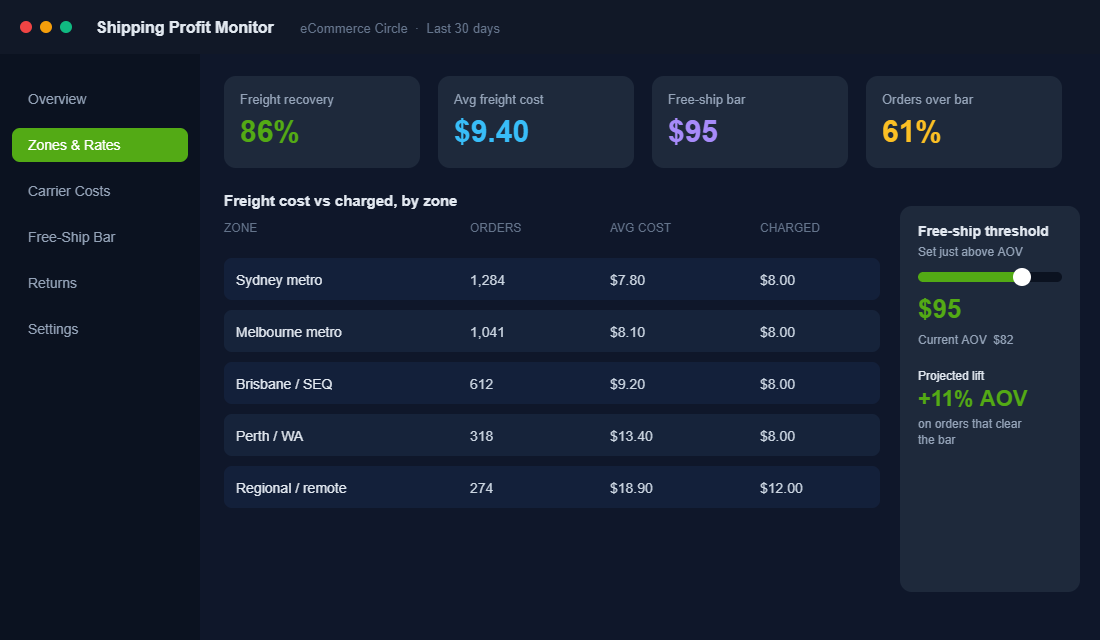
The highest-ROI move sits underneath all three: show the total landed cost early. Baymard found that surfacing shipping and tax on the product and cart pages, not at the final step, is one of the most effective abandonment fixes available. The cost itself rarely kills the sale. The surprise does. If your free-ship bar is $95, put “You are $13 away from free shipping” in the cart, not a silent shock at step three.
Set your threshold with a number, not a vibe. If your AOV is $82, a $95 bar nudges a meaningful share of orders up without pricing out your core basket. The screenshot below is the view every founder should be able to pull: freight recovery by zone, so you can see exactly which lanes you are subsidising.
Lever 2: Put a Real Date on the Page, Not a Vague Range
“Ships in 2 to 5 business days” is the most expensive sentence on your product page. It asks the shopper to do maths, assume the worst, and trust nothing. Replace it with a specific date and the numbers move fast.
The evidence is hard to argue with. 75% of shoppers say an estimated delivery date on the product page or in the cart positively influences their decision to buy, and roughly 12% of abandonment happens simply because no delivery date is shown. When brands have swapped a speed range for an accurate date, the lifts are real: the menswear retailer Harry Rosen reported a 13% checkout conversion lift, the brand Maude saw a 12% conversion and 10% profit lift from a product-page delivery promise, and Shopify says eligible Shop Promise merchants have seen up to a 25% increase in conversion.
Here is the part most founders miss: the date does not need to be the fastest on the market. It needs to be one the shopper can trust. Baymard found that 40% of major checkouts still show shipping speeds instead of delivery dates, even though dates are what users actually care about. “Get it by Thursday 3 July, order within 3 hours” beats “express available” every single time, because it removes the one thing that stops a purchase: uncertainty.
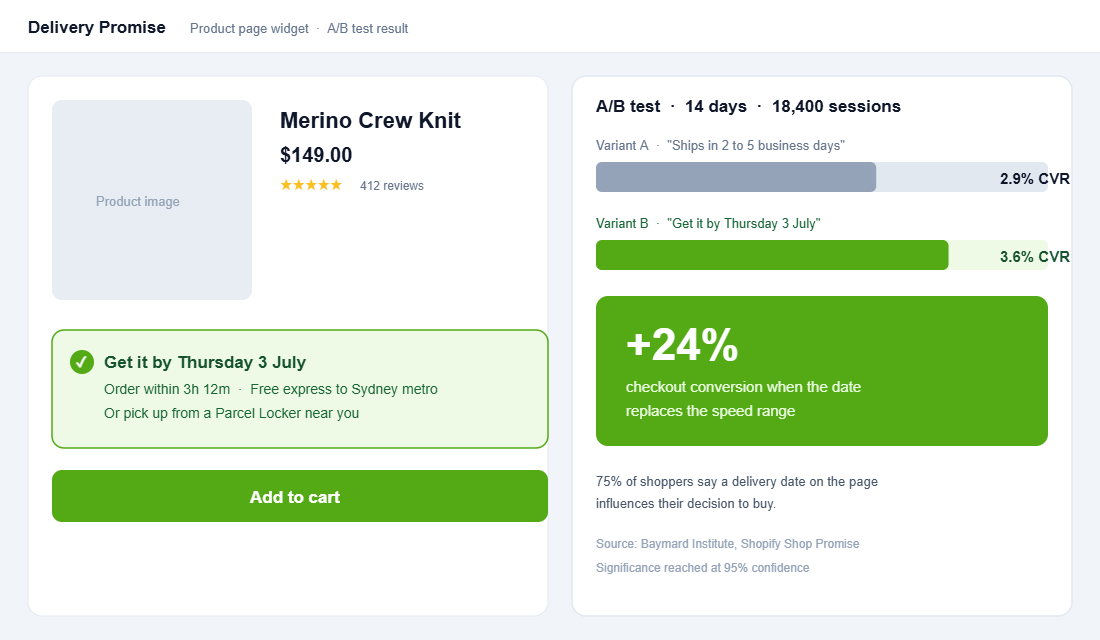
You can deliver this with a delivery-date app or your theme, then back it with carrier cut-off logic so the countdown is honest. An honest date you hit is worth ten optimistic ones you miss, because the miss shows up later as a “where is my order” ticket and a lost repeat customer.
Lever 3: Run a Carrier Mix, Not Carrier Loyalty
Most Aussie stores default to Australia Post for everything and never look again. Australia Post is excellent for a huge slice of the country, but “everything, everywhere” is how you overpay on the lanes where a courier is cheaper or faster. The operators winning on delivery run a mix and let rules decide.
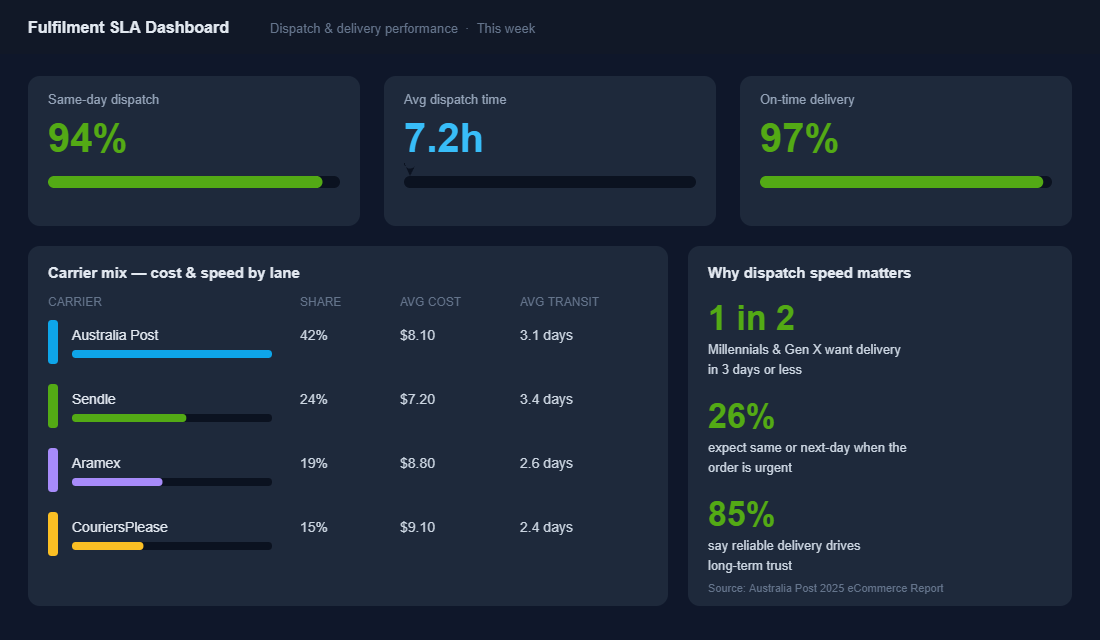
Build carrier assignment rules around three variables: zone, weight and order value. Australia Post for standard parcels to residential and regional addresses. A courier like Aramex or CouriersPlease for metro lanes where 2-day beats 3-day and the price is competitive. Sendle for lightweight, carbon-neutral parcels where cost is king. Then expose the choice. Remember, 69% of shoppers want a range of options, and offering Parcel Locker or pickup as one of them removes the “I am not home during the day” objection entirely.
The Iconic is the local benchmark for using speed as a weapon. It launched 3-hour delivery in Sydney back in 2011 and now offers same-day across Sydney, Melbourne, Adelaide and Brisbane, even trialling a 1-hour window. You do not need 1-hour delivery. You need to notice that one of Australia’s biggest online retailers treats delivery speed as a product feature, not a back-office cost, and to ask which of your lanes deserve a faster option at checkout.
Lever 4: Tighten the Dispatch SLA (and the Box)
A great delivery promise is worthless if the parcel sits in your back room for two days. The promise on the page and the dispatch on the floor have to be the same number. That means a published cut-off time (for example, order by 2pm AEST for same-day dispatch) and a pick-pack process that actually hits it.
Speed expectations are climbing. In the Australia Post 2025 data, one in two Millennial and Gen X shoppers now want delivery in 3 days or less, and 26% expect same or next-day when an order is urgent. You cannot meet a 3-day expectation if dispatch alone eats two of those days.
While you are tightening dispatch, audit the box. Carriers price on cubic (dimensional) weight, so an oversized carton filled with air is a cost leak that compounds on every order. Right-size your packaging, hold your same-day dispatch rate above 90%, and you protect both the customer promise and the unit economics behind it. Koala is the standout here: order a mattress or in-stock furniture item before 3pm on a weekday in the major metros and it arrives same day, often within 4 hours. That is dispatch discipline turned into a marketing headline.
Lever 5: Turn Returns Into a Second Sale
Shipping does not end at delivery. The return journey is the half of fulfilment most founders ignore, and it is where retention is won or lost. A clunky refund-only return tells a good customer to never risk a second order. A smooth, exchange-first return tells them you have their back.
- Lead with exchange, not refund. Default the flow to “swap the size or colour” before “give me my money back”. An exchange keeps the revenue and the customer.
- Offer store credit with a bonus. A little extra credit instead of cash turns a return into the next order and is well within consumer law when offered as a choice.
- Make the policy a sales asset. Koala pairs free metro return pickup with a 120-night trial, and that confidence is part of why people buy a mattress online at all.
Then close the loop with proactive tracking. The same delivery experience that wins the sale keeps winning after dispatch, so wire your order tracking page and post-purchase messages to do the reassuring for you. If you have not systemised the refund-to-exchange shift yet, the returns and exchanges playbook walks through the exact flow.
The Tool: Set Up Multi-Carrier Automation With Starshipit
You cannot run five levers by hand once you are past a few hundred orders a month. A shipping platform like Starshipit, built for the Australian and New Zealand market, is what makes the system run itself. Here is the setup that matters.
- Connect Shopify and your carriers. Link Starshipit to your store, then add accounts for Australia Post, Sendle, Aramex, DHL or whoever is in your mix. Orders flow in automatically.
- Build the assignment rules. Create rules by zone, weight, SKU and shipping method so each order auto-assigns to the right carrier. Tell it to pick the cheapest compliant option, or compare live rates, on every order.
- Automate the paperwork. Auto-generate shipping labels, packing slips, manifests and customs documents so pick-pack stops being a bottleneck and your same-day cut-off becomes realistic.
- Switch on branded tracking and delivery options. Push tracking notifications under your brand, surface estimated delivery dates, and offer multiple services and prices at checkout to satisfy that 69% who want a choice.
Starshipit will walk you through it step by step, and Shippit is a solid Australian-built alternative if you want carrier choice with a lighter setup. The platform is not the point. The point is that rules, not your time, decide the carrier on every order.
Peak Season Is Where Your Shipping Promise Breaks
Every shipping system looks fine in February. It is November that finds the cracks. Black Friday Cyber Monday and the lead-up to Christmas push order volume, carrier networks and your own pick-pack to their limits all at once, and the brands that lose are the ones who never adjusted their promises for it.
Three things go wrong in peak. Carrier cut-off dates move earlier than founders expect, so the “order by the 20th for Christmas” date you assume is often days sooner. Network congestion stretches transit times, which quietly turns your honest 3-day promise into a 6-day miss. And remote-area surcharges spike, so the regional orders you were already subsidising start costing real money.
The fix is to treat your peak shipping plan as a campaign, not an afterthought. Publish your last-dispatch-before-Christmas dates clearly on the site and in email. Pad your estimated delivery dates during the congested weeks so you keep the promise even when the network is slow. Lock in courier capacity for your metro lanes early. The same discipline that wins the $69 billion year-round sale season is what protects you when a quarter of your annual revenue lands in six weeks. Plan it once and your free shipping offer survives the rush instead of sinking your fourth-quarter profit.
The Compound Effect: Why the Five Levers Multiply
Run any one of these levers and you get a modest, isolated win. Run all five and they compound, because each one removes a leak the next one would have widened.
Pricing the freight protects margin on every order. Putting a real date on the page lifts conversion on the same traffic you already pay for, with brands seeing 12 to 25% gains. A smart carrier mix cuts your cost per parcel and adds the speed that justifies the date. A tight dispatch SLA means you actually keep the promise, so the date drives repeat orders instead of support tickets. And an exchange-first return turns the inevitable returns into second sales instead of refunds.
The maths stacks. A few percent more carts converting, on slightly higher average orders, shipped at a lower cost per parcel, with more of the returns retained as revenue. That is the difference between shipping being the thing that caps your growth and shipping being the thing that funds it.
The Australian Freight Benchmarks Worth Measuring Yourself Against
Most founders have no idea whether their shipping numbers are good or terrible, because nobody publishes them. Here are the marks worth holding yourself to on an Australian DTC store.
Freight as a percentage of revenue. Net freight cost — what you pay carriers minus what you collect from customers — should sit between 4 and 8 per cent of revenue for a typical parcel-sized product. Above 10 per cent and shipping is eating a whole margin point that belongs in your P&L. Below 3 per cent and you are probably over-charging customers and paying for it in cart abandonment instead.
Dispatch SLA. Same-day dispatch on orders placed before 12pm, next business day on everything else. Australian buyers have been trained by the majors, and the tolerance window is short. Every day you add between order and scan event measurably lifts “where is my order” tickets — most stores see WISMO enquiries roughly double when average dispatch slips past 48 hours.
Delivery reliability. Aim for 92 per cent or better of parcels arriving inside the window you promised on the product page. Not the window the carrier quotes you — the one you told the customer. Those are different numbers and the gap is where your reviews get written.
Metro versus regional split. Know it. If 30 per cent of your orders go outside the metro network and you are pricing on a metro average, regional orders are quietly subsidised by everyone else. Zone-based rates fix this without punishing your best-served customers.
Return rate by category. Apparel routinely runs 20 to 35 per cent. Homewares and hard goods sit closer to 3 to 8 per cent. If your return rate is well above your category norm, the problem is upstream — sizing information, photography, or expectation-setting on the product page — not the returns process itself.
The Returns Maths Founders Get Backwards
There is a reflex in Australian ecommerce that returns are pure cost, so the answer is to make them harder. That reflex costs money.
Work the numbers on a $120 apparel order. A return costs you roughly $12 in reverse freight, $6 in labour to inspect, repack and restock, and some proportion of items that cannot be resold at full price. Call it $22 all in, against $120 of revenue you now have to give back. Painful in isolation.
Now look at what happens to that customer. Buyers who have a clean return experience repurchase at materially higher rates than buyers who never returned anything, because the return is the moment they learn whether you are safe to buy from. A generous returns policy is not a cost centre. It is the cheapest confidence signal you can put on a product page, and it does its work before the order is placed, not after.
The lever that actually moves margin is conversion of refunds into exchanges and credit. Offer store credit at a 10 to 15 per cent bonus and a meaningful slice of refund requests become exchanges. Every one of those keeps the revenue and skips the reacquisition cost. Tools like Loop or Refundid handle the flow natively on Shopify, and an exchange-first portal typically converts 25 to 40 per cent of what would have been straight refunds.
Then close the loop on the data. Every return has a reason code. Pull them monthly, sort by SKU, and the top three reasons will tell you exactly which product pages are writing cheques your products cannot cash. Fixing a sizing chart on one SKU that drives 40 returns a month is worth more than any negotiation you will have with a carrier this year. If you want the full picture of what each order actually earns after freight and returns, run the numbers through a proper contribution margin calculation rather than trusting gross margin.
Your 5-Lever Shipping and Fulfilment Checklist
Run this audit on your own store this week. If you cannot tick a line, that is your next job.
- Lever 1 — Rates: Free-ship bar set above AOV, flat rate for under, real-time rates for heavy and remote orders, and landed cost shown on the cart, not sprung at checkout.
- Lever 2 — Dates: A specific estimated delivery date on the product page and cart (“Get it by Thursday”), not a 2 to 5 day range.
- Lever 3 — Carriers: At least two carriers assigned by rules, with a Parcel Locker or pickup option offered at checkout.
- Lever 4 — Dispatch: A published cut-off time, same-day dispatch rate above 90%, and right-sized packaging to control cubic-weight cost.
- Lever 5 — Returns: An exchange-first, store-credit-friendly return flow, plus branded post-purchase tracking.
The Bottom Line
Shipping is not the cost of doing business. It is one of the few levers that moves conversion and profit in the same pull, and most of your competitors are leaving it untouched in Settings. Price it deliberately, put a real date on the page, run a carrier mix, hit your dispatch promise, and turn returns into the next sale. Do that and delivery stops being the thing customers tolerate and starts being a reason they come back.
Inside eCommerce Circle, shipping and fulfilment economics is one of the core pillars we work on with every member, because it is where so much hidden profit lives. If you want a second opinion on yours, let’s talk.