It is 11pm. The kids are asleep, and you are on the lounge room floor surrounded by satchels, packing tape, and a stack of orders that has to be at the post office before the 4pm cut-off tomorrow. You built the brand to be free, and somehow you have become the highest-paid pick-and-pack worker in the country.
What’s in This Article
Here is the uncomfortable truth most Aussie founders hit somewhere between $40k and $150k a month: the thing that got you here, doing fulfilment yourself, is now the thing capping your growth. Every hour you spend packing is an hour you are not buying media, talking to customers, or building product. When founders tell us they have no time to grow, we can usually trace 25 to 30% of their week straight back to the packing bench.
Outsourcing to a third-party logistics partner (a 3PL) is how you buy that time back. Done well, it also makes you faster and cheaper than you could ever be on your own. Done badly, it torches your customer experience and your margin at the same time. This is the five-part system we use with members to hand off fulfilment without handing off the thing customers actually judge you on: the parcel that turns up at their door.
Part 1: Know the Exact Moment You Are Ready
Move too early and you are paying a 3PL margin on volume that does not justify it. Move too late and you are personally bottlenecking the whole business. The trick is knowing your real trigger points, and there are three of them.
Watch for these signals:
- Volume. Cost parity, where a 3PL costs about the same as doing it yourself once you count your own time, usually lands between 100 and 300 orders a month. Around 500 orders a month is the point most 3PLs treat as a real partnership with proper pricing, and 1,000 to 10,000 orders a month is the sweet spot for the best rates.
- The 50-a-day wall. Once you are consistently shipping more than 50 orders a day, manual packing stops scaling. You are hiring casuals, renting space, and still falling behind on the busy days.
- The time signal. When you or your team are spending more than 25 to 30% of the week on fulfilment, the cost is no longer the postage. It is the growth you are not creating because your hands are full of tape.
The volume number alone does not decide it. A founder shipping 200 heavy or fragile orders a month may need a 3PL sooner than one shipping 600 lightweight satchels. If fulfilment is eating your calendar and you are the reason the business cannot grow, you are ready, and this is the same founder-bottleneck problem we tackle in the Shopify Delegation Playbook.
There is a hidden ceiling here that catches people out. When you fulfil in-house, every sales spike creates a fulfilment crisis. A good campaign or a viral moment should be the best week of your year, but for a self-fulfilling founder it means a backlog, late dispatches, and a wave of complaints right when you should be celebrating. If you have ever felt a flicker of dread when sales suddenly jump, that is the ceiling talking. A 3PL removes it, because their whole job is absorbing volume you cannot.
Part 2: Build Your True Fulfilment Cost Model First
You cannot judge a 3PL quote until you know what fulfilment actually costs you today. Most founders wildly underrate their own cost because they never price their own labour. Do the maths properly before you take a single sales call.
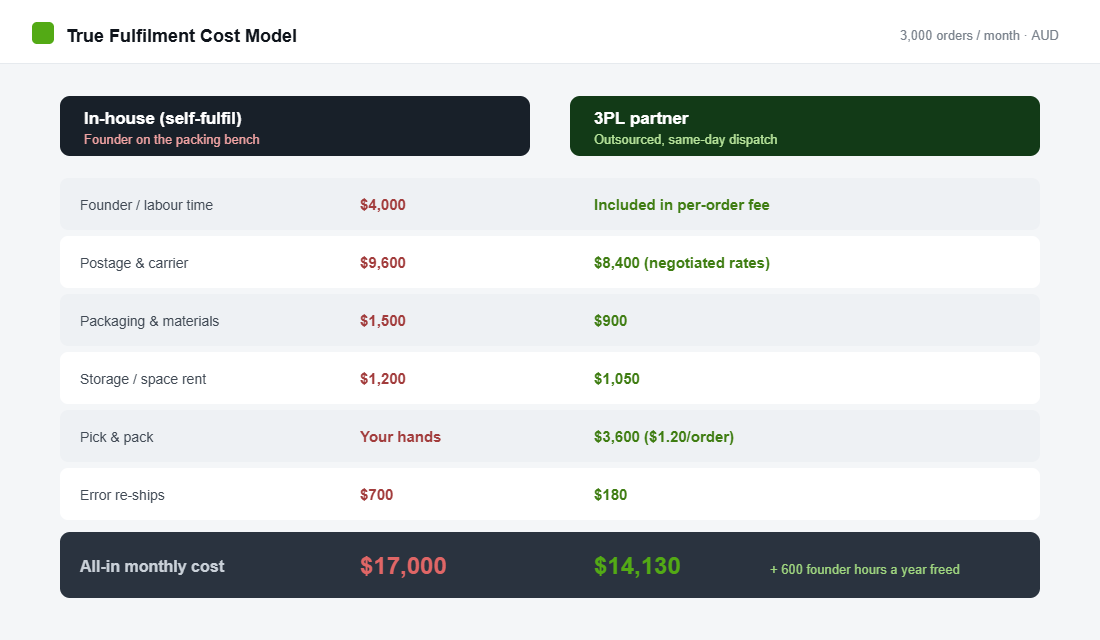
Start by pricing your own time honestly. If your hour is worth $100 to the business when spent on marketing or product, then two hours a day on the packing bench is $200 a day, or roughly $4,000 a month in opportunity cost before you count a cent of postage, packaging, or storage. Add the rent on the space your stock is eating, the casual wages during peak, and the cost of the orders you get wrong when you are tired. That full number, not just the postage line, is what you compare a 3PL quote against.
A 3PL quote is built from a handful of line items, and you need to model each one:
- Pick and pack: roughly $2.50 to $5.00 per order for standard DTC, depending on how many items and how much care each order needs.
- Storage: around $7 to $15 per pallet per month, and watch for long-term storage fees. In a 2025 survey of 600-plus warehouses, 48.6% now charge them, up from 23% the year before.
- Receiving: $25 to $50 per pallet to book your stock in.
- Returns: $3 to $10 per return processed, on top of the postage.
Remember that it is not all or nothing. Plenty of Aussie brands run a hybrid model, sending fast-moving core lines to the 3PL while keeping fragile, high-value, or limited-run products in-house where a personal touch matters. You can also start with a single warehouse and add a second location later once your order map justifies splitting stock across states. The goal is not to outsource everything on day one, it is to take the repetitive, high-volume work off your plate first and keep control of the pieces that genuinely need it.
All in, standard DTC fulfilment runs about $4 to $6 per order once you are past 3,000 orders a month. A healthy business spends 10 to 15% of gross sales on logistics, and the sharpest operations get that down to 8 to 10%. If your blended cost per order sits above that band, either your product is bulky or your 3PL is not the right fit. This cost model plugs straight into your unit economics, which is exactly the per-order profit picture we build in the Shopify Landed Cost Playbook.
Part 3: Choose the Right 3PL (Not Just the Cheapest)
The cheapest quote almost always costs you the most. Budget 3PLs running $1.50 to $2.00 pick-and-pack rates typically hit 97 to 98% pick accuracy. That sounds fine until you do the maths: at 98% accuracy on 3,000 orders a month, that is 60 wrong parcels every single month, each one a refund, a re-ship, and an angry customer.
Mid-tier providers at $2.50 to $3.50 hit 99% or better, and premium partners at $3.50 to $5.00 reach 99.5% and up. That extra dollar per order is not a cost, it is insurance against churn. Weigh accuracy against price, do not chase price alone.
It also pays to understand the software layer sitting between your store and the carriers. Many Australian 3PLs run on shipping platforms like Starshipit or Shippit, which pick the best carrier per order across Australia Post, Aramex, and the couriers, and push tracking back to the customer automatically. Ask which platform a 3PL uses and whether you get visibility into it, because that system is what turns a warehouse into a fast, trackable dispatch operation rather than a black box.
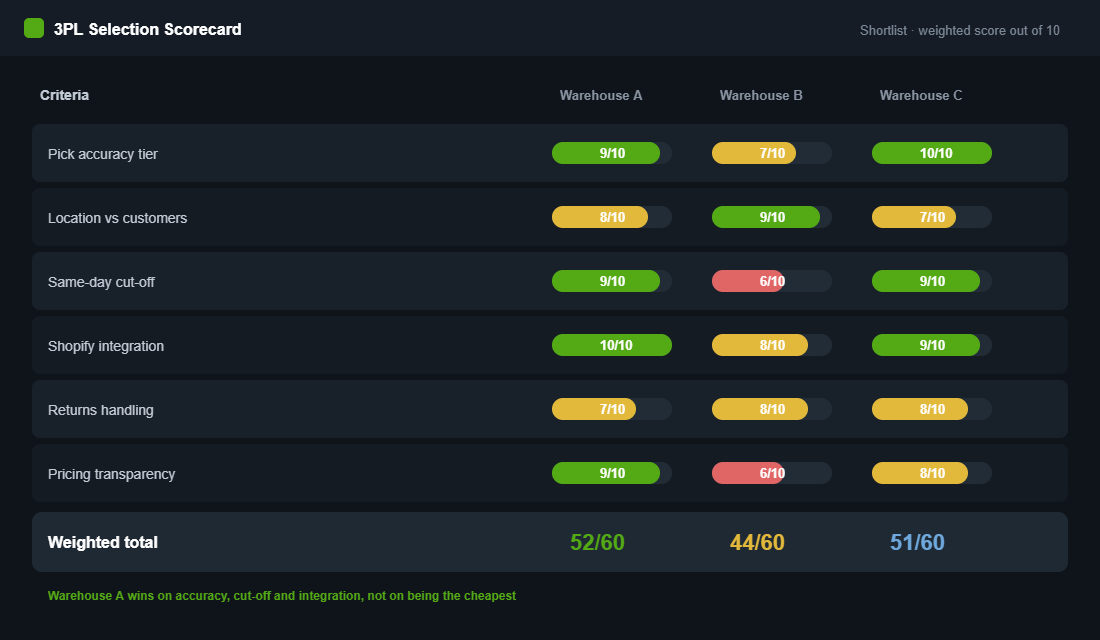
When you shortlist Australian 3PLs, score each one on the things that actually protect your brand:
- Location versus your customers. If most of your orders go to the east coast, a warehouse in Sydney, Melbourne, or Brisbane cuts a full zone off your transit times. Ask where their carrier volume is strongest.
- Same-day dispatch cut-off. A pro 3PL dispatches same day on orders in before cut-off. Founders packing once or twice a week are already 3 to 5 days behind before the parcel even moves.
- Shopify integration. Orders should flow to the 3PL automatically and tracking should flow back to the customer without you touching a spreadsheet. Confirm it is a real integration, not a nightly CSV.
- Returns handling. Ask exactly how they process, inspect, and restock returns, and what it costs. This is where hidden fees hide.
- Transparent pricing. Get every fee in writing: pick, pack, storage, receiving, returns, and any account or minimum monthly charge.
On the sales call, ask the questions that reveal how they run when things go wrong, not just when they go right. What happens if a carrier loses a parcel? How do they handle a stock discrepancy at receiving? What is their process during a sale when your volume triples overnight? Vague answers are a red flag. A good 3PL has a clear, boring, repeatable answer to every one of these, because they have lived through them with other brands.
This matters more in Australia than almost anywhere, because our distances are brutal. About 26% of Aussie shoppers expect same or next-day delivery when they need something urgently, and half of Gen Z and Millennial shoppers want their parcel in three days or less. The right 3PL, positioned near your customers, is how a small brand competes with the marketplaces on speed.
Part 4: Onboard Without Breaking the Customer Experience
The migration is where brands get burned. Stock goes missing in transit, orders stall during the handover, and customers feel it. Run the switch as a deliberate project, not a weekend job. Here is the sequence we use.
- Send a clean SKU list and sample orders. Give the 3PL your full catalogue with dimensions, weights, and barcodes, plus a few example orders so they can quote accurately and set up picking.
- Connect Shopify and test end to end. Install their app or integration, push a handful of test orders, and confirm the order flows in and the tracking flows back to the customer automatically.
- Split your inventory during changeover. Do not ship every unit at once. Send enough stock to cover a few weeks, keep a buffer yourself, and run both in parallel until the 3PL proves it can dispatch on time.
- Set and document the cut-off. Agree the daily dispatch cut-off and publish it at checkout. A visible same-day dispatch promise measurably reduces cart abandonment, since slow or uncertain delivery is a top-three reason Aussies bail at checkout.
- Watch the first 100 orders like a hawk. Track dispatch time, accuracy, and any damage on the first real orders. Fix issues while volume is low, not during your next sale.
Keep your customers informed through the changeover, at least internally in how you handle enquiries. You do not need to announce “we changed warehouses”, but your support replies should reflect the new dispatch reality, and your order-status emails should carry the correct tracking. A migration the customer never notices is a migration done right. The only version they should ever feel is the good one: parcels arriving faster than before.
Budget two to four weeks for a clean migration. The temptation is to flick the switch overnight to save on double-handling. Resist it. A parallel run that costs you a little extra for a fortnight is far cheaper than a wave of “where is my order” tickets and one-star reviews.
Part 5: Manage the Relationship With Real KPIs
Handing off fulfilment does not mean handing off accountability. A 3PL is a partner you manage, and the ones who drift are the ones nobody is holding to a number. Put four metrics on a simple monthly scorecard and review them together.
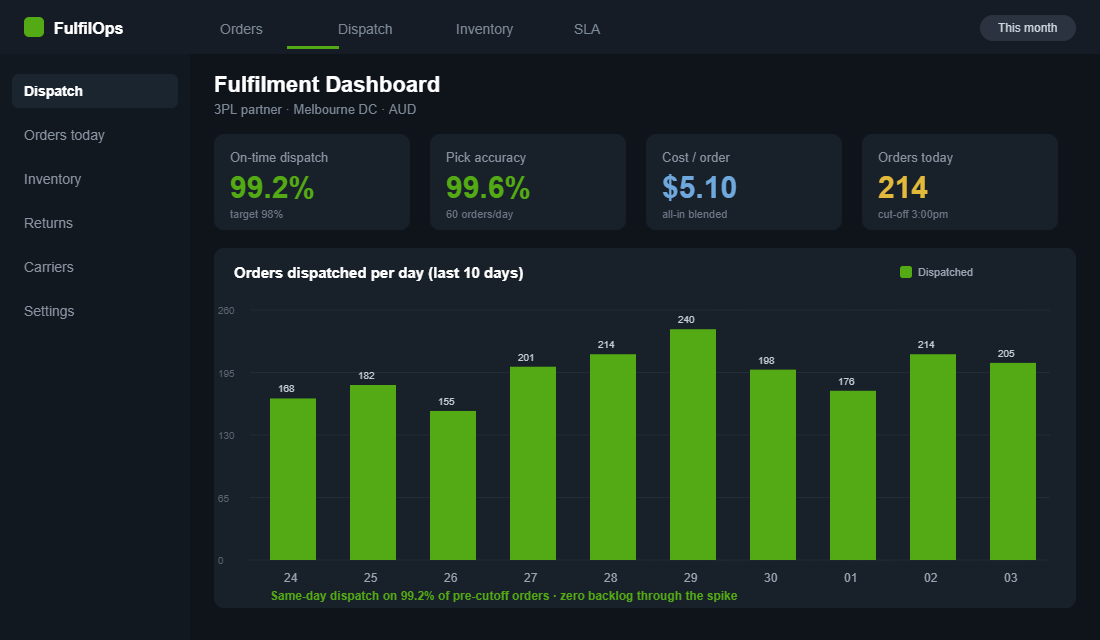
- On-time dispatch rate. The percentage of orders that leave by the agreed cut-off. Anything below 98% needs a conversation.
- Pick accuracy. Wrong items and wrong quantities per thousand orders. Hold them to the tier you are paying for.
- Cost per order. Your blended all-in fulfilment cost, tracked monthly. If it creeps, find out which line item moved.
- Damage and returns rate. Parcels arriving damaged points straight at packing quality and materials, and it is fixable once you can see it.
Beyond the monthly scorecard, plan your peak season with them well in advance. Give your 3PL a forecast before BFCM and your biggest sale periods so they can staff and stock accordingly. The brands that get let down at peak are almost always the ones who never warned their partner it was coming. Treat the relationship like a partnership with shared targets, and review it properly each quarter, not just when something breaks.
The upside of getting this right is real money, not just saved hours. Brands that move to a well-run 3PL typically break even on the switch within two to three months and see roughly a 25% improvement in fulfilment margin by month six, as they trade your unpriced midnight labour for negotiated carrier rates and proper systems. That is the difference between logistics as a tax and logistics as an advantage, the same lens we bring to the customer-facing side in the Shopify Shipping and Fulfilment Playbook.
The Compound Effect: Time, Speed, and Margin Together
Each part is useful alone. Together they change the shape of the business. You know when to move, so you switch at the right time. You model your true cost, so you negotiate from strength. You choose on accuracy, so you protect the customer. You onboard carefully, so nobody feels the handover. And you manage with KPIs, so the partner stays sharp.
Run the numbers on a founder shipping 3,000 orders a month. If fulfilment is eating 25% of a 50-hour week, that is roughly 12 to 13 hours a week, over 600 hours a year, spent on the packing bench. Hand that off and reinvest even half of it into acquisition and product, and you have effectively added a part-time growth hire without adding payroll. Meanwhile your dispatch goes from twice weekly to same day, your accuracy climbs, and your cost per order drops as you scale into better rates.
That is the compounding. Same orders, but faster delivery lifts conversion and reviews, freed-up founder time fuels growth, and better rates protect margin. In a market where Australians spent $82.6 billion online in 2025, up 14% year on year, the brands that win are the ones treating fulfilment as a growth lever, not a chore to survive.
When the Relationship Goes Wrong: Exit Planning and the Second Warehouse
Every founder signs a 3PL contract assuming it will work. Roughly one in three Australian DTC brands changes 3PL within their first two years, usually after a peak season exposes a capacity problem nobody stress-tested. Plan the exit while you are still friendly, because you will not have the leverage or the calm to plan it later.
Negotiate the exit terms before you sign
Four clauses decide how painful a divorce is. Push for a 30 to 60 day termination notice rather than the 90 to 180 many contracts default to. Cap the pick-and-pack exit fee per unit in writing, or you will be quoted $2 to $4 a unit to release your own stock. Insist your data is exportable — SKU-level inventory, order history, serial and batch records — in a standard format. And get a written commitment that stock is released within 10 business days of a settled account. Founders who skip these routinely pay $8,000 to $25,000 to leave.
Know the four signals it is time to go
Watch for a same-day dispatch rate that stays under 95% for two consecutive months. Watch for pick accuracy below 99.5%, because at 99% you are shipping one wrong order in every hundred and paying for it twice. Watch for a stock variance above 1% at cycle count. And watch how they behave in a crisis — a 3PL that goes quiet during a peak-week failure will do it again.
Run the transition in parallel, never as a switch
The safe move is a four to six week dual-running period. Send 20% of volume to the new provider in week one, 50% by week three, 100% by week five, and keep the old site live until the new one has cleared a full week at target. It costs you a few thousand dollars in duplicated minimums. A hard cutover that fails during a promotion costs far more than that in refunds and reviews.
The second-warehouse question
Most Aussie brands should stay single-node longer than they think. A second warehouse only pays once you are shipping roughly 1,500 to 2,000 orders a month and a meaningful share is crossing the country. Below that, split inventory creates stockouts in one node while the other sits deep, and you carry two sets of minimums for a delivery gain of a day. Above it, an east-coast and west-coast split can cut average transit from four days to two and lift conversion measurably — the mechanics of turning that speed into sales are covered in the delivery promise playbook.
Handing off fulfilment is a delegation decision, not an abdication. Keep owning the numbers, the customer experience and the exit path, and a 3PL becomes the leverage it is supposed to be — the wider view sits in the shipping and fulfilment playbook.
Your 3PL Transition Checklist
Work through this in order. Do not skip Part 2.
- Diagnose: confirm your volume, your 50-a-day wall, and the share of your week going to fulfilment.
- Cost it: build your true per-order fulfilment cost, including your own labour.
- Shortlist: score three Aussie 3PLs on accuracy, location, integration, returns, and transparent pricing.
- Trial: send a SKU list, connect Shopify, and run test orders end to end.
- Migrate: split inventory, run in parallel, and publish your dispatch cut-off at checkout.
- Manage: track on-time dispatch, pick accuracy, cost per order, and damage every month.
Inside eCommerce Circle, getting founders off the packing bench is one of the first moves we make, because it frees the time everything else depends on. If you want a second opinion on whether you are ready for a 3PL and how to choose one, let’s talk.