Have a look at the people you paid last month. The VA in Manila who works your hours. The media buyer who touches your ad account twice a week. The bloke who picks and packs three days a week out of your unit in Braeside. The photographer who shoots your drops.
What’s in This Article
How many of them sent you an invoice with an ABN on it? For most Aussie Shopify stores between 40k and 500k a month, the honest answer is nearly all of them.
Here is the problem. An ABN is a tax registration number. It is not a classification. It has never decided whether someone is a contractor or an employee, and since August 2024 it matters even less than it used to. The Fair Work Ombudsman and the ATO announced a joint crackdown on sham contracting in March 2026, and the maximum penalty for a single contravention now sits at 99,000 dollars for a business with fewer than 15 employees. Per contravention. Each misclassified worker is its own breach.
Most founders I speak with have never run the check. Not because they are dodgy, but because nobody told them there were four separate tests, and that you can pass one and fail the other three at the same time.
The ABN Is Not the Answer, and It Never Was
There were 1.1 million independent contractors in Australia in August 2025, about 7.6 per cent of everyone employed, according to the ABS. A big slice of them are genuine. Specialists with their own gear, their own clients, their own risk.
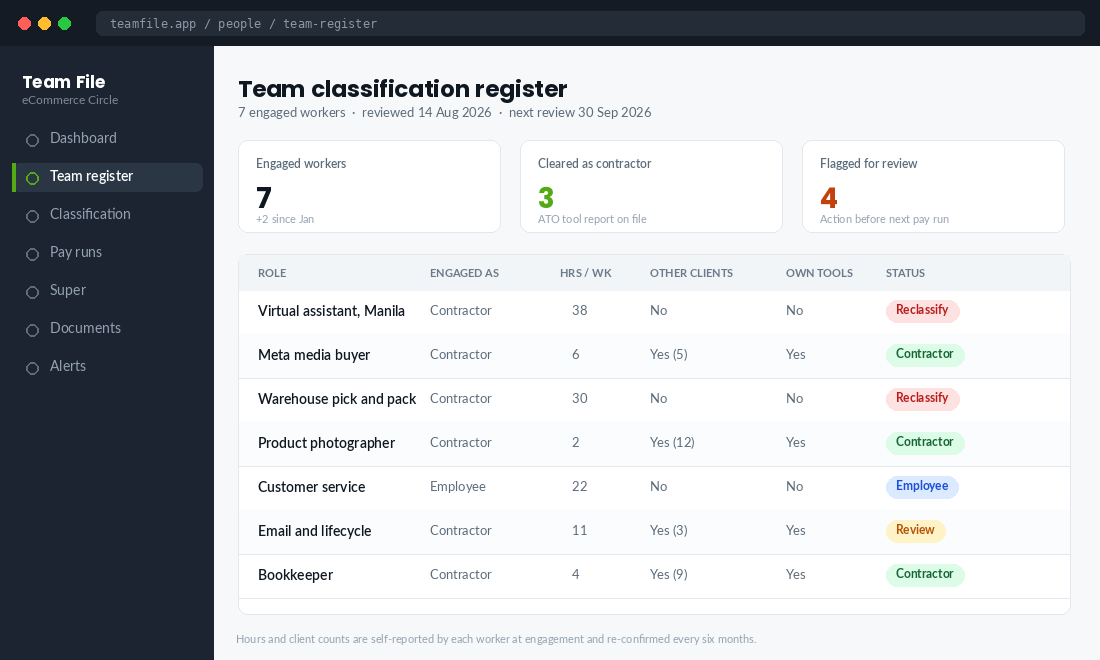
The trouble starts when a contractor stops behaving like one. The VA you hired at 10 hours a week is now doing 38. She uses your Shopify login, your Slack, your Klaviyo seat. She works the hours you set. She has no other clients. You are the only invoice she raises each month.
Nothing about that arrangement was decided on the day you signed a contractor agreement. It drifted there over eighteen months, one extra task at a time. And drift is exactly what the regulators look for.
The ATO now sees more of this than founders realise. Through taxable payments annual reporting in 2024 to 2025, it had visibility of almost 185,000 businesses paying more than 1.4 million contractors, totalling over 507 billion dollars. That data is matched against tax returns, ABN records, super reporting and Single Touch Payroll. One of the patterns it explicitly hunts for is contractors who work almost exclusively for one business.
On top of the data, the ATO receives close to 1,000 community tip-offs every week. They come from workers, from customers, and from competitors.
Why 2024 Changed the Ground Under Your Contracts
If you had this conversation with your accountant in 2022 and walked away comfortable, your comfort is out of date.
In February 2022 the High Court decided two cases on the same day, CFMMEU v Personnel Contracting and ZG Operations v Jamsek. Both pushed the law towards the written contract. If you had a properly drafted contractor agreement, the terms of that agreement largely decided the question. Plenty of businesses papered up their arrangements on the strength of those decisions and moved on.
Then the Closing Loopholes reforms inserted section 15AA into the Fair Work Act, effective 26 August 2024. It asks a different question. Not what the contract says, but the real substance, practical reality and true nature of the whole working relationship, including how the contract is actually performed day to day.
Worth knowing about those two High Court cases. In Personnel Contracting, a 22 year old labourer engaged and paid as an independent contractor was held to be an employee. In Jamsek, two truck drivers had been employees since the late 1970s, then in 1985 were offered the chance to become contractors on a take it or leave it basis. Sound familiar? That second pattern is the one small ecommerce businesses repeat constantly.
There is a narrow escape hatch. Contractors earning above 175,000 dollars a year can opt out of the section 15AA interpretation and keep their contractor status. For a store paying a VA 30 dollars an hour or a warehouse hand 35, that hatch is not available.
One more change matters. The old defence of “I didn’t know” is gone. Under the sham contracting provisions the question is now whether your belief that the person was a contractor was reasonable. Never having looked is not reasonable.
You Are Not Graded on One Test. You Are Graded on Four.
This is the part that catches out even good accountants, so read it twice.
Section 15AA only decides the meaning of employee and employer for the Fair Work Act. It does not decide your super obligation. It does not decide payroll tax. It does not decide workers compensation. Those are three separate regimes with three separate tests, and a worker can land differently in each one.
- Fair Work Act. Whole of relationship test under section 15AA. Decides award coverage, minimum rates, leave, notice, unfair dismissal rights.
- Superannuation guarantee. Separate test under the Superannuation Guarantee (Administration) Act 1992. A worker engaged principally for their labour is entitled to super even when they are correctly classified as a contractor. This is the one almost everyone misses.
- Payroll tax. The relevant contract provisions, broadly harmonised across the states, deem contractor payments to be wages unless you fit a specific exemption. One common exemption is where services are provided on no more than 90 days in a financial year. The burden of proving the exemption sits with you, per contractor, per year, on evidence.
- Workers compensation. State based deemed worker rules. In NSW, a policy is compulsory once you pay more than 7,500 dollars a year to workers and deemed workers.
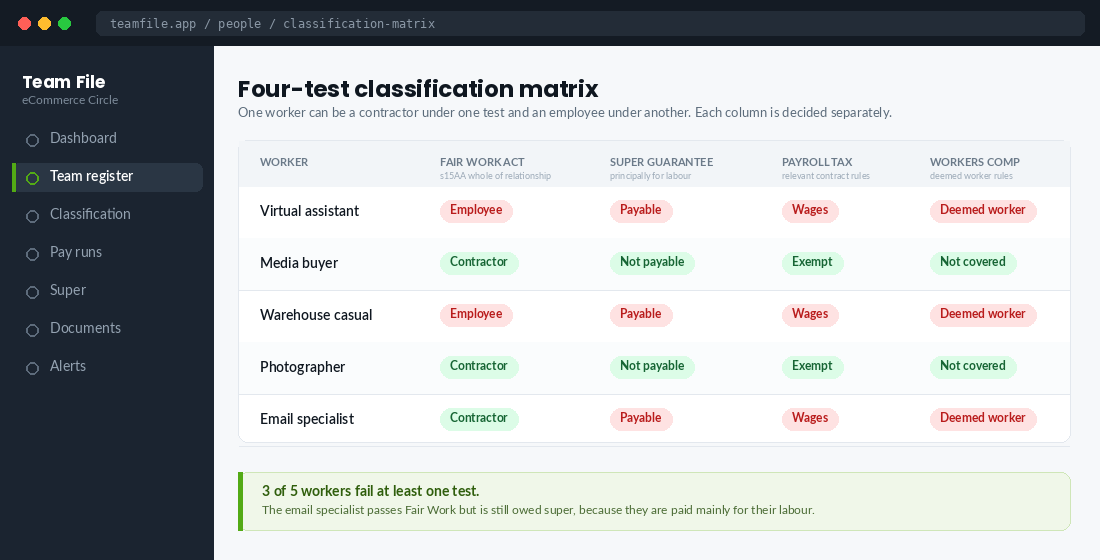
Look at the email specialist in that matrix. Genuine contractor. Three other clients, own laptop, own software, sets her own hours. She passes the Fair Work test comfortably. She is still owed super, because you are paying her mainly for her labour rather than for a result delivered by a business with substance behind it.
If you have been paying a freelance copywriter or designer for two years without a cent of super, that is the sentence to sit with.
The Seven-Signal Check to Run on Every Person You Pay
Here is the check. Run it on every person who sent you an invoice in the last quarter. Score each signal as C for contractor or E for employee. This takes about four minutes per person.
- Control over how the work is done. Do you direct the method and the hours, or do you specify an outcome and let them get on with it? Setting someone’s start time is an E.
- Ability to delegate or subcontract. Can they send someone else to do the job, at their own cost, without your permission? A genuine contractor can. If your VA cannot hand her Monday tasks to her cousin, that is an E.
- Basis of payment. Paid for time worked, or paid for a result, a milestone, or a quoted price? Hourly for ongoing work is an E signal.
- Tools and equipment. Who supplies the laptop, the software seats, the pallet jack, the camera? If everything they touch is yours, that is an E.
- Commercial risk. Do they carry the cost of fixing their own defects? Do they carry insurance? Someone who gets paid the same whether the job is good or bad is an E.
- Goodwill and other clients. Do they market themselves, hold other clients, and build a business that has value beyond you? Working exclusively for one business is the single loudest signal on the ATO’s list.
- Integration. Do they appear on your org chart, sit in your team meetings, use a company email address, and get introduced as part of the team? That is an E, and no clause in a contract undoes it.
Three or more E signals and you should not be settling this on your own judgement. That is the point to get advice, not the point to hope.
None of this is legal advice. It is the check I run with founders before they get the right people involved, so that the conversation with a workplace lawyer or your accountant takes twenty minutes instead of two hours.
Run the ATO Decision Tool Properly, and Keep the Report
The ATO publishes a free employee or contractor decision tool. Most founders have never opened it. It is the single highest value thirty minutes in this whole article, because the report it produces is evidence that your belief was reasonable.
How to use it properly:
- Do one worker at a time. Not one for “my VAs”. The tool assesses a specific working arrangement, and two VAs on different terms can land differently.
- Answer on reality, not on the contract. If the agreement says she can subcontract but you would never allow it, answer no. Answering aspirationally produces a report that protects nobody.
- Have the facts in front of you first. Actual hours over the last three months, who supplies equipment, how many other clients they hold, and how you pay them. Guessing here defeats the purpose.
- Save the report as a PDF the day you run it. The tool does not store your answers and you stay anonymous, so if you do not download it, it is gone. Name it with the worker and the date.
- File it with the engagement. One folder per person, holding the agreement, the decision tool report, their ABN lookup, and any insurance certificates.
- Re-run it every six months, and any time the role changes. Classification drifts. A tool report from 2024 says nothing about a role that doubled in hours since.
For workers compensation, most states publish their own status tool. In NSW, SIRA has a worker or contractor status tool that runs on the deemed worker rules rather than the tax rules. Run both. They can disagree, and that disagreement is exactly the point.
If you are running payroll for more than two or three people, this belongs in a system rather than a spreadsheet. An Australian HR and payroll platform such as Employment Hero will hold the contract, the classification note and the review date against each person, and prompt you when a review is due.
The Five Roles Aussie Shopify Stores Get Wrong Most Often
After running this with a lot of Aussie stores, the same five roles come up again and again.
- The full time offshore VA. Highest risk in the whole list. Set hours, your systems, no other clients, no ability to delegate. Being overseas changes the practical enforcement picture, not the principle. If you are still sorting out how this role should work, our Shopify VA playbook covers the scope and management side.
- The warehouse casual on an ABN. Works your shifts, uses your equipment, cannot send a substitute. This is close to a textbook employee, and it carries workers compensation exposure that founders rarely think about until someone is injured.
- The customer service person who “just helps out”. Ten hours a week, growing quietly, on your helpdesk, following your macros. Almost always an employee by the time anyone looks.
- The in-house-but-not-quite media buyer. The genuine ones hold five or six clients and run their own tooling. The risky version has one client, sits in your Monday meeting, and has not pitched anyone new in a year.
- The founder’s family member. No contract, irregular payments, sometimes no super. The relationship makes it feel informal. The law does not care that it is your brother-in-law.
Two of these are usually genuine contractors. The photographer who shoots four brands, and the bookkeeper with a client list. Leave those alone. This exercise is not about converting everyone to payroll. It is about knowing which is which.
What Payday Super Changed on 1 July
The timing on this matters, because the rules tightened six weeks ago.
The super guarantee rate reached 12 per cent on 1 July 2025, the final scheduled increase. Then from 1 July 2026, payday super started. Super now has to be paid at the same time as wages, and the contribution has to reach the employee’s fund within seven business days of payday. A new employee’s first contribution gets 20 business days.
Quarterly super was a forgiving system. You could misclassify someone for a full quarter before anything looked odd. Payday super removes that buffer. Every pay run is now a checkpoint, and gaps show up in ATO data within days rather than months.
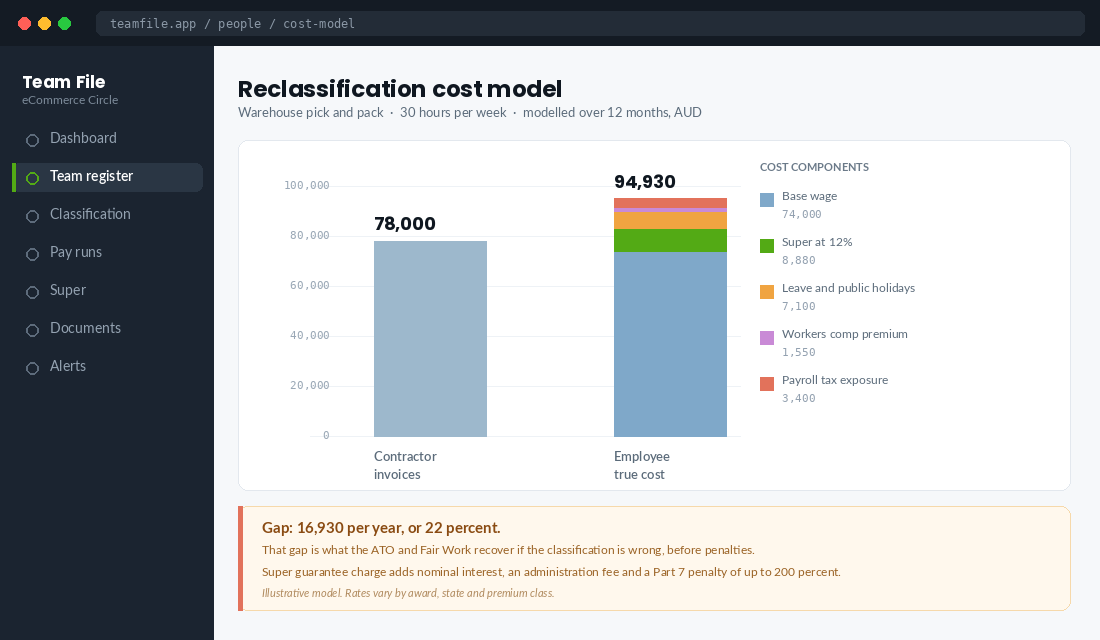
Understand what recovery actually looks like, because it is not simply the unpaid super. The super guarantee charge is deliberately more expensive than paying correctly in the first place. It bundles the shortfall, nominal interest and an administration fee, and it is not tax deductible. On top of that sits a Part 7 penalty of up to 200 per cent of the charge.
Add PAYG withholding penalties, back-paid leave, and payroll tax on amounts you never counted as wages. A single misclassified warehouse role over three years turns into a number that hurts a business doing 200k a month.
How to Fix a Misclassification Without Blowing Up the Relationship
Most founders reading this have just realised they have at least one problem. Here is the sequence that works.
- Do not do anything dramatic this week. Do not terminate the arrangement and re-engage the person on different paper to tidy it up. That specific move is what the FWO pursued in the case where it secured nearly 200,000 dollars in penalties against a Sydney health and wellness research company, which had terminated or threatened to terminate three workers so it could re-engage them as contractors doing substantially the same work. Going the other direction carelessly creates its own problems.
- Get the facts down first. For each flagged person, write out actual hours, the payment basis, who owns the tools, and how long it has run. You need this before you talk to anyone.
- Take advice on the exposure, not just the fix. Your accountant handles the super and PAYG position. A workplace lawyer handles the Fair Work position and any award coverage. Ask specifically about voluntary disclosure to the ATO, because coming forward generally lands better than being found.
- Model the true cost before you talk to the person. Base rate, super at 12 per cent, leave and public holidays, workers compensation premium, payroll tax if you are over your state threshold. Our ecommerce pay playbook walks through structuring the number so the conversion is not a pay cut in disguise.
- Have the conversation as an upgrade, because it is one. Most people gain from this. Super, leave, sick days, workers compensation cover. Lead with what they get, be straight that you got the setup wrong, and give them the new figure in writing.
- Fix the intake so it does not happen again. Every new person gets the seven-signal check and a decision tool report before their first invoice is paid. Ours sits alongside the paid trial test, so classification is settled at the same moment you decide someone is worth keeping.
A Clean Team File Compounds, Quietly
None of this makes you money next week. It is worth doing anyway, and here is the honest case for it.
The first thing you get is an accurate cost base. Founders who classify loosely almost always understate what their team really costs, which means their contribution numbers are wrong, which means every hiring and pricing decision downstream is built on a soft figure. Getting this right sharpens your P and L more than most founders expect.
The second thing is retention. People who receive super and leave and proper cover behave like people with a stake in the business. The best VA you ever had probably left because someone offered her the security you never did.
The third is the one nobody thinks about until it is urgent. If you ever sell this business, or take on an investor, or apply for meaningful finance, someone will open the team file. Unquantified employment liabilities do not just reduce the price. They stall deals while lawyers argue about indemnities, and they hand the buyer a reason to retrade you late in the process.
An afternoon with a spreadsheet, seven signals and the ATO tool. That is the whole job for most stores. Block it out for a Friday, work through everyone who invoiced you last quarter, and you will finish the day knowing exactly where you stand.
The founders who get caught out are rarely the ones cutting corners. They are the ones who set something up sensibly in 2023 and never looked at it again while the roles quietly changed shape around them.
Inside eCommerce Circle, getting your team structure right is one of the core pillars we work on with every member, because it sits underneath your margins, your hiring plan and eventually your exit. If you want a second opinion on yours, let’s talk.
This article is general information for Australian ecommerce operators and is not legal, tax or financial advice. Worker classification turns on the specific facts of each arrangement. Speak to a workplace lawyer and your registered tax agent before acting.