Returns are the silent tax on every Shopify brand. You celebrate the sale, the cash lands in your account, and then two weeks later a chunk of it quietly reverses out. Most founders track revenue obsessively and returns barely at all, which is exactly backwards, because returns are where a healthy-looking top line turns into a thin bottom one.
What’s in This Article
The scale is bigger than most realise. Online retail returns average around 24.5% of orders, more than double the 8.7% you see in physical stores. In apparel it routinely runs 25%, and some fashion segments climb past 40%. To put a number on the whole picture, US retailers processed $849.9 billion in returns in 2025 alone.
And the damage is not just the refunded order value. Return shipping runs $8 to $12 per item, processing and inspection add another $5 to $8, and one study found that handling a single return can eat up to 65% of the item’s original price once you account for labour and unsellable stock. A return is not a neutral event. It is a sale that cost you money to win and now costs you money to lose.
The brands that win do not try to stop returns, because you cannot. They engineer the returns experience so more of that reversed revenue stays in the business and the customer comes back anyway. This is the 5-part system we use with founders inside eCommerce Circle to do exactly that.
Part 1: Know Your True Return Cost (You Cannot Fix What You Do Not Tag)
The first problem is that most founders have no idea what returns are actually costing them. They know the refund figure in Shopify, but that is the smallest part of the bill. Until you can see the real cost, returns stay invisible and unmanaged.
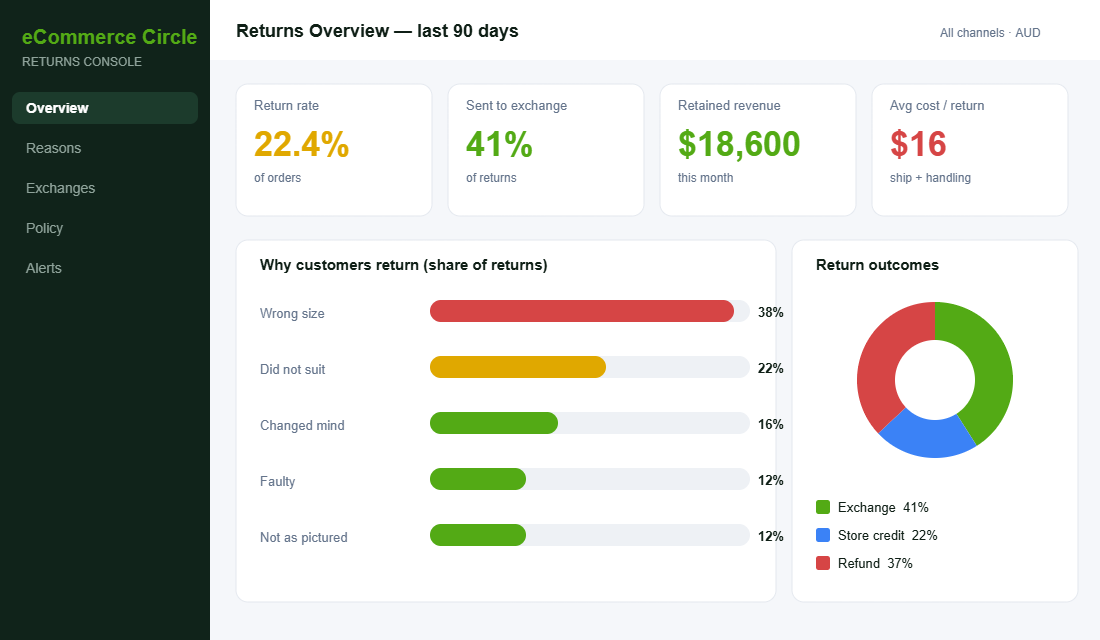
Start by promoting return rate to a first-class metric that sits right next to conversion rate and average order value on your dashboard. Then calculate your true cost per return: outbound postage you already paid, return postage if you cover it, warehouse labour to inspect and restock, and the write-off on anything that comes back unsellable. For a lot of Aussie brands shipping across the country, that lands around $15 to $20 a return, which quietly destroys the margin on a $60 order.
The single highest-leverage habit is tagging every return with a reason code. Without reasons, you are guessing. With them, you can see that (for example) one product line drives a third of your returns and fix the actual cause instead of just eating refunds forever.
Segment the data by SKU and category, because returns are never evenly spread. A handful of products almost always generate the bulk of the problem. Concentrate there. Cutting the return rate on your worst offender by even a few points frees up more profit than most ad optimisations you will run this quarter, and it costs you nothing in media spend.
Part 2: Attack the Number One Reason Before Anything Else
When you tag your returns, one reason will almost always tower over the rest: wrong size or poor fit. Across apparel and footwear, size and fit issues drive the majority of returns, and in our console example above they account for 38% on their own. If you only fix one thing this year, fix this.
The good news is that size returns are the most preventable kind, because they come from a gap between what the customer expected and what arrived. Close that gap on the product page and the return never happens. The tools are simple and cheap:
- Real garment measurements. Publish actual dimensions per size, not just a generic S/M/L chart lifted from your supplier.
- A fit quiz or size recommender. A few questions about height, weight, and usual size turns a guess into a confident choice.
- Model reference notes. State the model’s height and the size they are wearing on every product image.
- Fit feedback in reviews. Let customers flag whether an item runs small, large, or true to size, so the next buyer self-corrects.
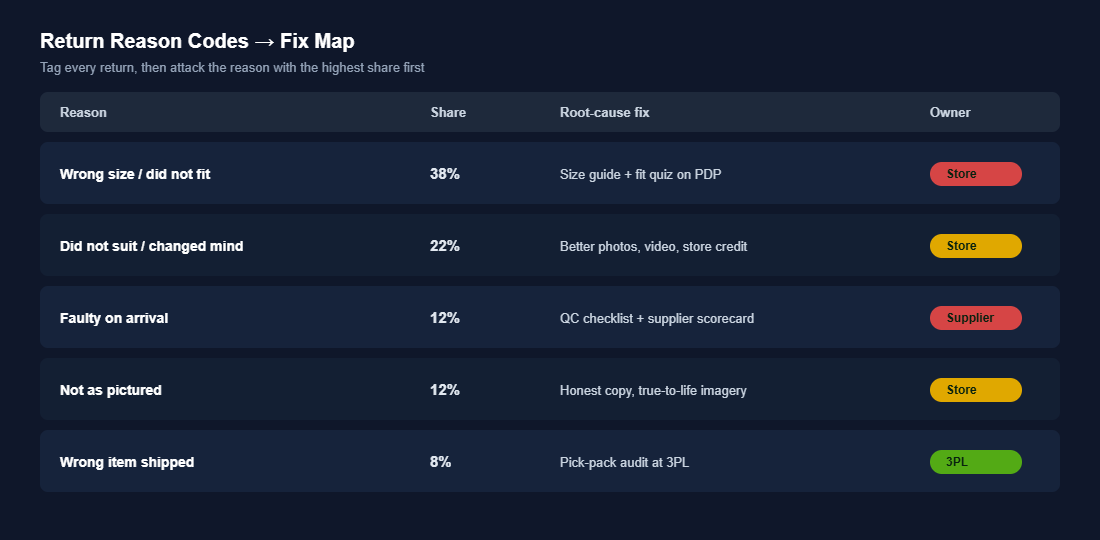
The point of the reason map above is accountability. A fault on arrival is a supplier and quality-control problem, not a copy problem. A wrong item shipped is a pick-and-pack issue at your 3PL. When you route each reason to the person who can actually fix it, returns stop being a vague cost and become a list of solvable jobs. We go deep on the sizing side of this in the Shopify Size and Fit Playbook.
Part 3: Turn Refunds Into Exchanges and Store Credit
Here is where most brands leak the most money, and it is entirely fixable. When a return is inevitable, the default outcome should not be a refund to the customer’s card. A refund sends the revenue out the door for good. An exchange or store credit keeps it inside the business and keeps the customer, too.
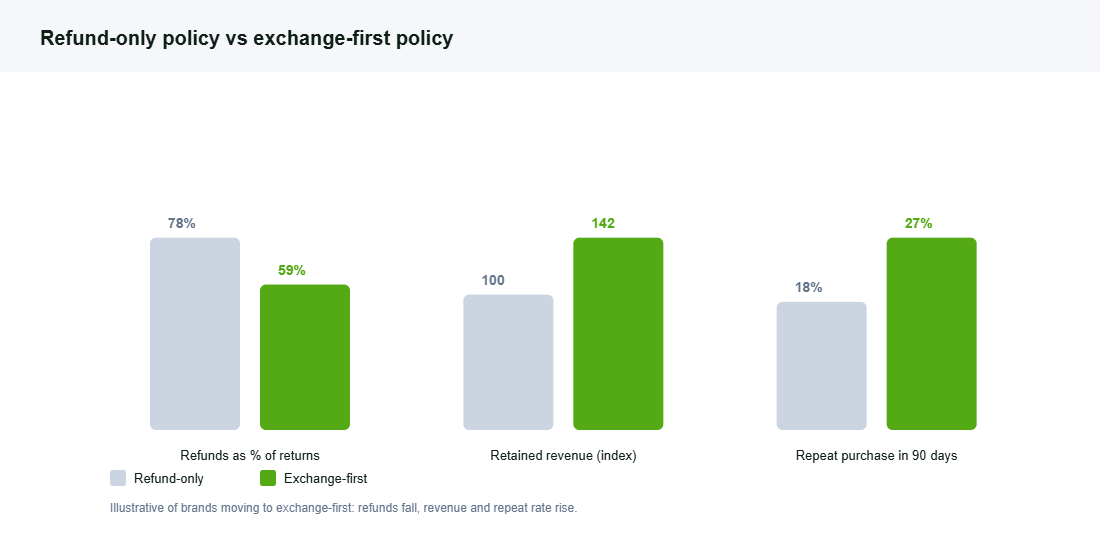
The data on this is striking. Brands that move to an exchange-first flow cut their refund rates by around 28%, and instant-exchange options have been shown to produce 34% fewer refunds. Loop Returns, one of the leading Shopify returns platforms, has helped more than 4,000 brands including Allbirds and Brooklinen retain over $843 million in revenue that would otherwise have been refunded away.
You build this with the flow, not with a stingy policy. The winning pattern looks like this:
- Lead with the exchange. When a customer starts a return, show the size swap or alternate product first, and make it one tap.
- Offer instant exchanges. Ship the replacement before the original comes back, so the customer never feels out of pocket.
- Sweeten store credit. Add a small bonus (say 10% extra) when they take credit instead of a refund. It is cheaper than losing the sale.
- Let them shop the whole store. A “shop now” option during the return turns a return into a fresh order, often at a higher value.
On the tooling, Loop Returns, AfterShip Returns, and Return Prime all install on Shopify and run this playbook out of the box. Setup is straightforward: connect the app to your store, set your return window and eligible-item rules, switch the default outcome from refund to exchange or credit, and turn on bonus credit. Most brands have it live inside a day and see the refund share of returns start falling within the first month.
Once the flow is live, track one number above all others: the share of returns you keep as revenue, whether that is an exchange, store credit, or a fresh order placed during the return. Watch it weekly. Moving that figure from, say, 45% to 60% of returns retained is worth more to your bottom line than a comparable lift in new-customer conversion, because there is no acquisition cost attached to revenue you simply refused to hand back.
Part 4: Make the Return a Retention Moment, Not an Exit
A return is one of the most emotionally charged moments in the whole customer relationship. Something did not work out, and the customer is watching to see how you handle it. Get it right and you often earn more loyalty than a smooth first purchase ever would. Get it wrong and you lose them for good, refund or not.
The mechanics that build trust are all about removing friction and uncertainty. Give customers a branded self-service returns portal so they never have to email you and wait. Communicate proactively at every step: return received, refund or credit issued, replacement on its way. Process refunds and credits fast, because a customer staring at a “pending” balance for ten days is a customer writing a one-star review.
This is where the Protection pillar meets the Patrons pillar. An easy return experience is a direct driver of repeat purchase, and repeat buyers are where the real profit lives, since you have already paid to acquire them once. In our comparison earlier, moving to an exchange-first, low-friction flow lifted the 90-day repeat-purchase rate from 18% to 27%. That is the returns process quietly doing the work of a retention campaign. If you want to see how that flows through to long-term value, pair this with the Shopify Customer Lifetime Value Playbook.
Part 5: Protect Your Margin From Return Fraud and Policy Abuse
Generosity is a strategy, not a religion. The same easy returns that delight honest customers are an open door for a small group who will abuse them, and that group is expensive. In 2024, US retailers lost more than $103 billion to return fraud and serial returners, which accounted for around 15% of total retail losses.
The abuse takes a few familiar shapes. Wardrobing is buying an item, wearing it once, and returning it. Empty-box and switch fraud is returning the wrong item or nothing at all. Serial returners order five variants intending to keep one and send the rest back on your postage every single time. None of this is your fault, but all of it is your cost if you ignore it.
The fix is smart policy design, not a mean one. A few guardrails protect the margin without punishing good customers:
- Clear windows and conditions. A defined return window and “unworn, tags attached” rules give you firm ground to stand on.
- Sensible final-sale categories. Clearance, intimates, and heavily personalised items can be excluded up front, stated plainly at checkout.
- Flag repeat abusers. Most returns apps can surface customers whose return rate is wildly out of line, so you can adjust their options quietly.
- Consider return postage rules. Covering return postage for exchanges but not for change-of-mind refunds nudges behaviour in the right direction without feeling harsh.
The goal is balance. A policy so tight it scares off honest buyers costs you far more in lost sales than fraud ever will, since a clear, fair returns policy is itself a conversion driver at checkout. Protect the edges, stay generous in the middle.
Why Returns Are a Profit, Retention, and Acquisition Lever at Once
The reason returns deserve a proper system, not a policy page you wrote once and forgot, is that fixing them pays you in three directions at the same time, and each one feeds the next.
First, profit. Every return you prevent at the source (by fixing sizing, copy, or quality) protects margin you already earned. Second, retained revenue. Every refund you convert into an exchange or store credit keeps money in the business that would otherwise have vanished. Third, retention and acquisition. A returns experience that feels fair and effortless turns a shaky moment into loyalty, drives that 90-day repeat rate up, and becomes a genuine reason to buy in the first place, because confident shoppers convert better when they know a return will not be a nightmare.
Stack those together and the effect compounds fast. Reducing your gross return rate, keeping more of the returns you do get as revenue, and delighting people on the way through is a flywheel that lifts contribution profit without spending a dollar more on ads. It also links straight back to your logistics, which is why we treat returns as the reverse side of the Shopify Shipping and Fulfilment Playbook, not a separate afterthought.
Put rough numbers on it. A brand doing $200,000 a month with a 22% return rate is watching around $44,000 of orders come back every month. Shave three points off that return rate through better sizing, then keep half of the remaining returns as exchanges instead of refunds, and you protect and retain tens of thousands of dollars a month that used to leak straight out. None of that required a single extra visitor to the site.
Write a Returns Policy That Converts Instead of Scaring People Off
Before any of the mechanics above ever get used, your returns policy is doing quiet work on the sale itself. A large share of online shoppers read the returns policy before they buy, not after, and a clear, fair one measurably lifts conversion. It is one of the few pages that earns money on the way in and saves money on the way out.
Most policies do the opposite because they are written like a legal shield. Walls of fine print, hedged language, and a tone that assumes every customer is a thief. That reads as risk to a first-time buyer weighing up whether to trust you with their card. The fix is to write it like a confident brand, not a nervous one.
A returns policy that converts covers the essentials in plain English and puts them where people actually look:
- The window, stated simply. “30 days to return or exchange” beats a paragraph of conditions.
- What is free and what is not. Be upfront that exchanges are free and change-of-mind refunds carry return postage, so there are no nasty surprises.
- Exchange framed as the easy default. Lead with the swap, not the refund, so the customer expects it before they even start.
- Findability. Link it from the product page, the cart, and the footer. A policy nobody can find cannot reassure anybody.
There is also a hard rule specific to selling in Australia. Under Australian Consumer Law, you must offer a repair, replacement, or refund when an item has a major fault, and that obligation stands no matter what your store policy says. Your written policy governs change-of-mind returns, which are a courtesy you design. It does not override a customer’s legal rights on faulty goods, so keep the two clearly separate in your own head and in your copy. Treating a genuine fault as a change-of-mind return is the fastest way to earn a chargeback and a bad review at the same time.
Get the tone right and the policy stops being a defensive document and starts being a sales asset. Confident, specific, and generous in the middle, with the guardrails from Part 5 quietly holding the edges.
Your Takeaway: The Returns Scorecard
Run your store against this checklist this week. Every line you cannot tick is money sitting on the table.
- Measured. Return rate, true cost per return, and reason codes are tracked as first-class metrics, segmented by product and category.
- Prevented. Your biggest return reason (usually size and fit) is being attacked at the source with real measurements, a fit tool, and honest imagery.
- Retained. Your default return outcome is an exchange or bonus store credit, not a refund to card, powered by a proper returns app.
- Delighted. Customers use a branded self-service portal, get proactive updates, and receive fast refunds or credits.
- Protected. Clear windows, sensible final-sale rules, and abuser flags guard your margin without scaring off honest buyers.
Inside eCommerce Circle, returns are one of the Protection pillars we work through with every member, because it is the rare fix that guards your margin, keeps your revenue, and builds loyalty in a single move. If you want a fresh set of eyes on where your store is leaking money through returns, let’s talk.