You obsess over the ad, the hero shot, the checkout. Then a third of your orders come back, most of them because the size was wrong. That is the quiet tax almost every Aussie fashion brand pays, and most founders treat it as a cost of doing business instead of a problem they can actually fix.
What’s in This Article
Here is the number that should stop you. The Iconic, the most visited fashion site in the country, runs a return rate around 30%, and that is considered the industry average. The Australian Circular Fashion Association reports that roughly 30% of all online purchases get returned, and a further 30% of those returns cannot even be resold because of damage, timing or processing cost. Size and fit sit right at the centre of it.
Across the research, fit and sizing is the single biggest reason clothing comes back. Australian data pins it at about 45% of returns, and McKinsey has put it as high as 70% for some categories. So if returns are eating your margin, more than half the fix lives in one place: how you handle size and fit on your Shopify store. This is the playbook we run with fashion members inside eCommerce Circle, in six parts.
Part 1: Diagnose before you spend a cent on an app
Most founders jump straight to installing a size chart app. Wrong first move. You cannot fix what you have not measured, and the returns you get already tell you exactly where the problem is. Before you touch the product page, pull your return reasons for the last 90 days and sort them.
You are looking for the split between “too small”, “too large”, and “did not suit or fit”. If “too small” dominates, your garments likely run small and your chart is optimistic. If returns are spread evenly, the problem is confidence, not accuracy. Shoppers cannot tell what they are buying, so they bracket instead: 63% of Australian online shoppers now order multiple sizes of the same item, keep one, and send the rest back.
That bracketing habit is expensive. Processing a single return costs anywhere from 20% to 65% of the item value once you count return shipping, inspection, repackaging and the write-offs. Refundid found businesses paid up to 30% more on return shipping in 2024 than the year before.
This is why ASOS Australia added an $8.99 return fee in 2023. Punishing customers is one lever. Removing the doubt that causes the return is the better one.

Set a baseline you can actually track. Note your current return rate, the share driven by size and fit, and your product page conversion rate before you change anything. Without that baseline you will never know if the work paid off, and “it feels better” is not a metric you can take to your P&L.
Part 2: Rebuild the size chart so it is trustworthy
A generic S/M/L chart copied from your supplier is worse than useless. It teaches shoppers not to trust you the first time it is wrong. A trustworthy chart does two jobs at once: it tells the shopper the garment measurements and helps them map those to their own body.
Get the fundamentals right first:
- Measure the garment, not just the body. Give flat measurements (chest, waist, length) in centimetres so a shopper can compare against an item they already own and love.
- Use real Australian sizing. AU 8 to 16 is not the same as US or EU sizing. If you sell internationally, show a conversion, but lead with AU.
- Segment charts by fit type. A relaxed tee and a fitted dress should never share one chart. Assign charts by collection so the right one shows on the right product.
- Add a “how to measure” visual. A short diagram showing where to measure the bust, waist and hip removes the guesswork that causes half-size errors.
This is also a conversion play, not only a returns play. Websites that add a proper size finder see roughly a 10% average lift in conversion, because certainty is what turns a hesitant add-to-cart into a completed order. The chart is not admin. It is a sales asset that happens to also cut returns.
Part 3: Add a fit recommender that does the thinking for them
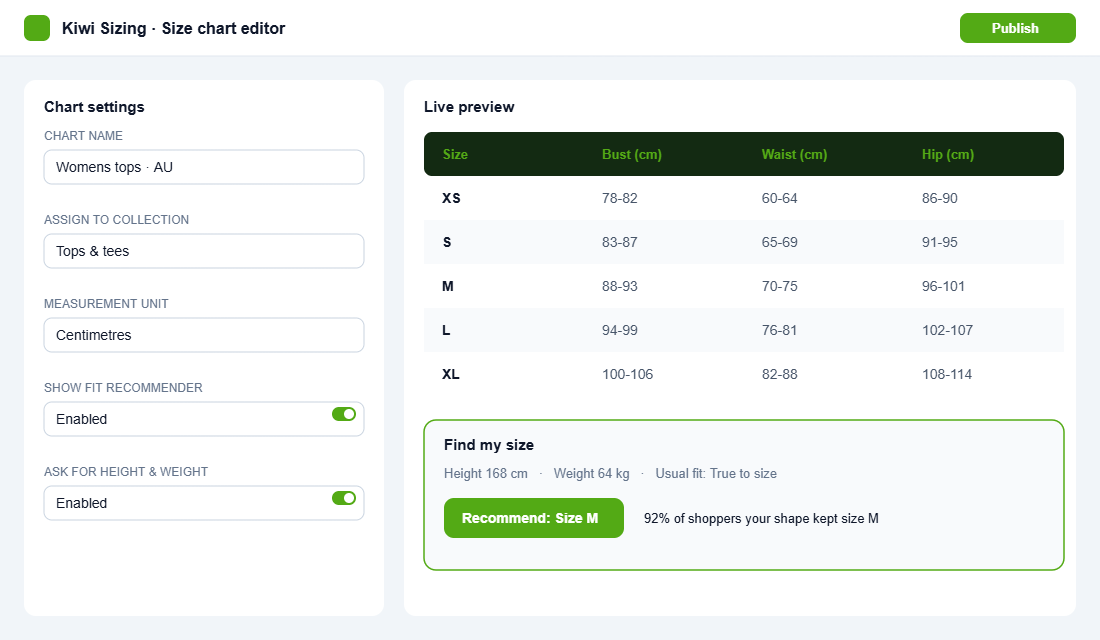
A static table still asks the shopper to do maths. A fit recommender does the maths for them. The shopper enters a couple of details, height, weight, usual fit, maybe a brand they already wear, and the tool returns a single confident answer: “You are a size M.” That shift from a table to a recommendation is where the biggest return reductions come from.
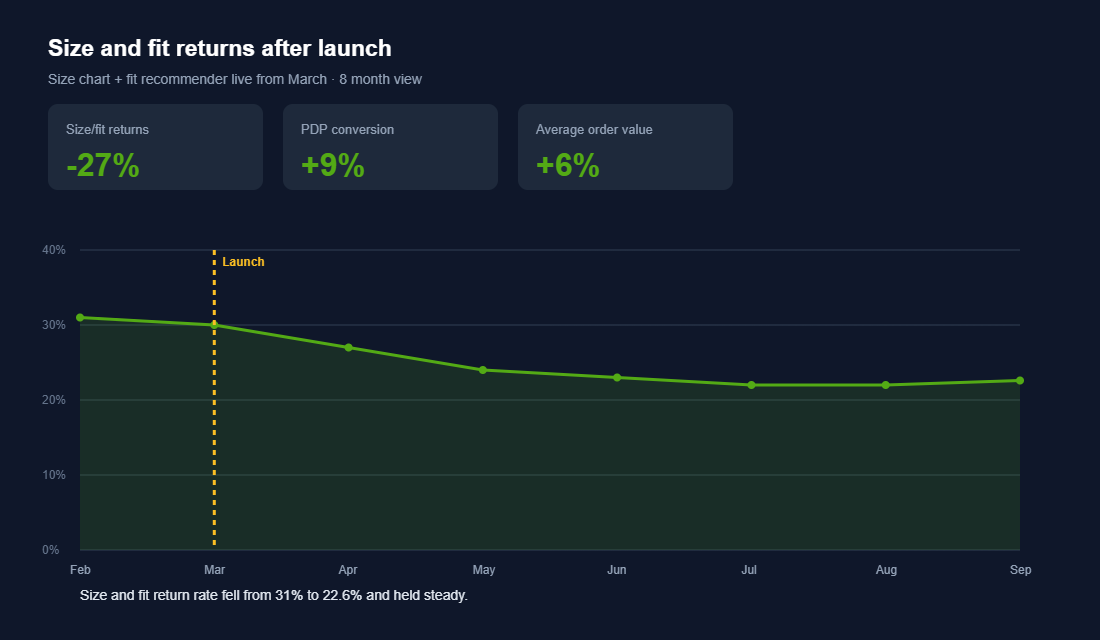
The results are not marginal. Virtusize has cut size-related returns by about 27% year on year for brands like Under Armour and Asics. True Fit has reduced fit-related returns from bracketing by 24% for multi-brand retailers, and up to 50% for single-brand stores. On top of that, brands using AI sizing tools report average order values rising around 15%, because a confident shopper buys the full outfit instead of testing one piece.
You do not need enterprise budget to start. For most Aussie Shopify stores, an app-based recommender covers 90% of the value at a fraction of the cost. Kiwi Sizing is the one we point members to most often, and it has a genuinely useful free tier.
How to set up Kiwi Sizing on Shopify
- Install from the Shopify App Store. Kiwi is a one-click install used by more than 16,000 brands. The free plan covers full styling and automatic unit conversion, and the premium plan is only $6.99 a month for unlimited charts.
- Import your charts fast. Kiwi can pull size charts from an image, a product description or a CSV, so you are not rebuilding tables by hand.
- Assign charts by collection. Map each chart to the right collection so tops, bottoms and dresses each show their own guidance automatically.
- Turn on the recommender. Enable the machine-learning size recommender and choose the inputs (height, weight, usual fit). Keep it to three questions maximum so you do not add friction.
- Place the trigger on the product page. Add a clear “Find my size” link right next to the size selector, then test it live on mobile and desktop before you call it done.
Part 4: Write copy that sets fit expectations up front
The best fit tools in the world will not save a product page that stays silent on fit. Every apparel PDP should answer three fit questions before the shopper has to ask: does it run small, true or large; what is the model wearing; and what is the fabric like. Silence on any of these is an invitation to bracket.
Bake fit language directly into the description and the imagery:
- State the fit verdict plainly. “Runs true to size” or “Size up if you are between sizes” removes the single most common hesitation.
- Show model specs. “Our model is 175cm and wears a size S” gives a real reference point that a chart never can.
- Describe the fabric behaviour. Note stretch, structure and whether it softens after washing. Fabric is half of perceived fit.
- Surface fit reviews. Let customers tag reviews with “fits small”, “true”, or “fits large” so real buyers do the reassuring for you.
This is core product page work, and it compounds with everything else you do on the PDP. If you have not tightened the rest of that page, our Shopify product page playbook covers the full conversion architecture that fit language plugs into.
Part 5: Mine your returns data to kill repeat offenders
A size system is not “set and forget”. Once your chart and recommender are live, your returns data becomes a feedback loop. A small number of products almost always drive an outsized share of size returns, and those are the ones costing you the most.
Every month, pull the products with the highest size-and-fit return rate and act on the pattern:
- If one style is returned “too small” constantly, your chart for that item is wrong. Re-measure the actual garment and correct it.
- If a supplier batch shifts, fit can drift between production runs. Spot it in the data before customers do.
- If a product is returned across all reasons, the issue is quality or expectation, not sizing. That is a merchandising decision, not a chart fix.
When you get this loop running, the trend line moves and stays moved. The pattern we see with members mirrors the wider data: size and fit returns falling by a quarter or more within a couple of months, then holding steady because the guidance keeps improving.
When a return does happen, the experience still matters. A smooth, fair returns flow protects the lifetime value you worked to earn, and our Shopify returns and exchanges playbook shows how to turn that moment into a second sale rather than a lost customer.
Part 6: Make the whole thing work on a phone
Here is where most size systems quietly fail. More than 70% of Aussie fashion traffic is on mobile, yet the size chart is often a tiny link that opens a pop-up you cannot read, or a table that spills off the screen. If the fit experience is broken on a phone, you have solved nothing for the majority of your buyers.
Hold your store to a mobile standard:
- The size trigger is thumb-reachable. “Find my size” sits right beside the size selector, not buried at the bottom of the description.
- Charts scroll cleanly. Tables should be readable and swipeable, never pinch-to-zoom.
- The recommender is a few taps. Big tap targets, minimal typing, an instant answer.
- Nothing blocks the add-to-cart. The fit widget helps the decision, it never covers the buy button.
Fit is a mobile conversion lever as much as a returns lever. If you want the full mobile picture, our Shopify mobile conversion playbook covers the rest of the phone experience that sits around it.
The compound effect
Look at these six parts on their own and each is a modest improvement. Stack them and they become a system that changes your economics. A trustworthy chart builds the confidence a recommender converts.
Clear fit copy sets the expectation the data then validates. The returns loop keeps the whole thing sharpening itself, and a solid mobile experience makes sure the majority of your traffic actually benefits.
Run the numbers on a store doing $100k a month with a 30% return rate where half of returns are size-driven. Cut those size returns by 27% and you are keeping roughly $4,000 a month in orders that used to bounce, before you count the processing costs you avoid and the conversion lift on the way in. That is not a nice-to-have. That is a margin project hiding inside your product page.
The brands that win at this do not treat sizing as customer service. They treat it as conversion architecture. The size chart, the recommender and the fit copy are all part of how a shopper decides, and if you are still building better fit reasoning into buyers, our Shopify product quiz playbook is a natural next step for guided selling.
Three sizing mistakes that quietly cost you orders
When we audit a fashion store’s fit experience, the same three mistakes show up again and again. None of them look urgent, which is exactly why they never get fixed and keep bleeding margin month after month.
Mistake 1: One chart for the whole catalogue
A single size chart applied to everything guarantees it will be wrong for most products. Your oversized knit and your bodycon dress do not fit the same body the same way. When the chart contradicts what the shopper actually receives, you have not just lost that order to a return, you have taught them to bracket every future order to protect themselves. Segment charts by fit type and the guidance starts telling the truth.
Mistake 2: Hiding fit information below the fold
If a shopper has to scroll past six paragraphs of brand story to find whether a jacket runs small, most will not bother. They will guess, or they will order two sizes. Fit information belongs where the size decision happens, right at the size selector. Doubt at the point of decision is the single biggest driver of the bracketing habit that now affects 63% of online shoppers.
Mistake 3: Treating returns as a cost, not a signal
Every size return is free product research telling you exactly which item, which size and which body type has a problem. Brands that file returns under “cost of doing business” throw that signal away. Brands that read it monthly fix the specific products driving the damage and watch the trend line fall. With processing costs running 20% to 65% of item value, ignoring that signal is one of the most expensive habits in ecommerce.
What a fixed store actually feels like
When the six parts are in place, the shopper experience changes in a way you can feel. Someone lands on a dress from a Meta ad, sees “runs true to size, our model is 168cm in a size S”, taps “Find my size”, answers three quick questions, and gets a confident “you are a size M”. No second-guessing, no ordering two sizes to be safe. They buy one, it fits, and they keep it.
Multiply that across every order and the maths is hard to ignore. You convert more of the traffic you already pay for, because certainty closes the sale. You hold more of the revenue you book, because fewer orders come back.
And the returns that do happen are genuine preference, not fit failures you could have prevented. That is the difference between a store that tolerates a 30% return rate and one that has decided not to pay that tax any longer.
The Six Numbers That Tell You Your Sizing Is Working
Everything in this playbook can be measured, and it should be. Without numbers, you will not know whether the fit recommender paid for itself or whether your new size charts actually cut returns. Track these six every month in one simple sheet:
- Size-related return rate. Returns tagged “too big”, “too small” or “didn’t fit”, divided by total orders. For Aussie apparel stores this commonly sits between 10% and 20% of orders before any fixes. Aim to cut it by a quarter within six months.
- Share of returns that are fit-related. If fit is still more than half of all returns after you have fixed your charts, the problem is usually a specific product, not the whole range.
- Exchange-to-refund ratio. An exchange keeps the revenue. A refund loses it. Offering instant exchanges first typically pushes this ratio from roughly 1 in 5 towards 1 in 3. Our Shopify returns playbook covers how to set that up.
- Size-guide or recommender engagement. The share of PDP visitors who open the guide or use “Find my size”. Healthy numbers are often 10-25% on apparel. Much lower usually means the trigger is hard to find on mobile.
- Conversion rate of engaged shoppers. Compare conversion for people who used the size tool against people who did not. Engaged shoppers commonly convert at 1.5-3x the rate of those who did not. If yours do not, the recommendation is not building confidence.
- Multi-size orders. Orders with the same product in two or more sizes are “bracketing”. Track the share each month. Falling bracketing is one of the clearest signs shoppers now trust your sizing.
Most of these come straight from Shopify reports and your returns app, such as Loop, AfterShip Returns or Rich Returns. The recommender numbers come from your sizing app and GA4 events. It takes about 30 minutes a month once the sheet is built.
Two tips make the numbers far more useful. First, review them by product, not just store-wide. One badly cut pair of jeans can hide inside a healthy average. Second, feed what you learn back into the page. If fit-tagged reviews keep saying “runs small”, say so above the size selector. Our reviews playbook shows how to collect fit feedback at scale, and the PDP conversion playbook covers where that information should sit on the page.
Your size and fit checklist
Run this before you call your fit experience done:
- Pulled 90 days of returns and split size reasons into too small, too large, and did not suit
- Recorded a baseline return rate, size-and-fit share, and PDP conversion rate
- Rebuilt charts with garment measurements in centimetres, led by AU sizing
- Assigned a separate chart to each collection or fit type
- Added a “how to measure” diagram
- Installed a fit recommender and limited it to three questions
- Placed a clear “Find my size” trigger beside the size selector
- Added fit verdict, model specs and fabric behaviour to every apparel PDP
- Enabled fit-tagged reviews
- Set a monthly review of the highest size-return products
- Tested the full experience on a real phone
Inside eCommerce Circle, size and fit is one of the core pillars we work on with every fashion member, because it sits on the exact line where conversion and margin meet. If you want a second opinion on yours, let’s talk.