Somewhere in your footer, behind a link nobody clicks, sits one of the most underused growth assets on your Shopify store: your warranty. Most Aussie founders treat it as legal fine print. A thing the lawyer said to include. A page written once and never read again, least of all by customers.
What’s in This Article
The brands getting it right treat the warranty as a sales tool, a data engine and a retention system rolled into one. And the numbers back them: 60% of consumers say they prefer to be offered warranty coverage at checkout, warranty-related emails pull open rates of 60 to 75% against under 10% for promotional sends, and extended protection plans run gross margins of 50 to 70% while your products likely run 15 to 20%.
This playbook is the 5-part system for putting your guarantee to work: make it a selling point, build a registration engine, decide on extended coverage, turn claims into loyalty moments and feed the data back into product quality. All of it with Australian Consumer Law squarely in view, because in this country your warranty sits on top of guarantees the law already gives every customer.
First, the ACL Reality Check Every Aussie Founder Needs
Before you write a single word of warranty copy, understand this: the Australian Consumer Law gives your customers automatic consumer guarantees on everything you sell. Goods must be of acceptable quality, fit for purpose and match their description. Those rights exist whether you offer a warranty or not, and no policy you write can exclude them.
That has two practical consequences. One, a “no refunds” sign or a 30-day limit on faulty goods is not just bad service, it can be misleading conduct that attracts ACCC attention. Two, if you publish a “warranty against defects” document, the ACL requires specific mandatory wording in it, including the text that begins “Our goods come with guarantees that cannot be excluded under the Australian Consumer Law”. Get your template checked once by a lawyer and reuse it everywhere.
Here is the strategic point most founders miss: because the ACL floor exists for everyone, a warranty that simply restates the law adds nothing. Your warranty only becomes a competitive weapon when it goes visibly beyond the minimum, in length, in simplicity or in generosity. That is what the rest of this playbook builds.
Part 1: Move the Warranty From the Footer to the Product Page
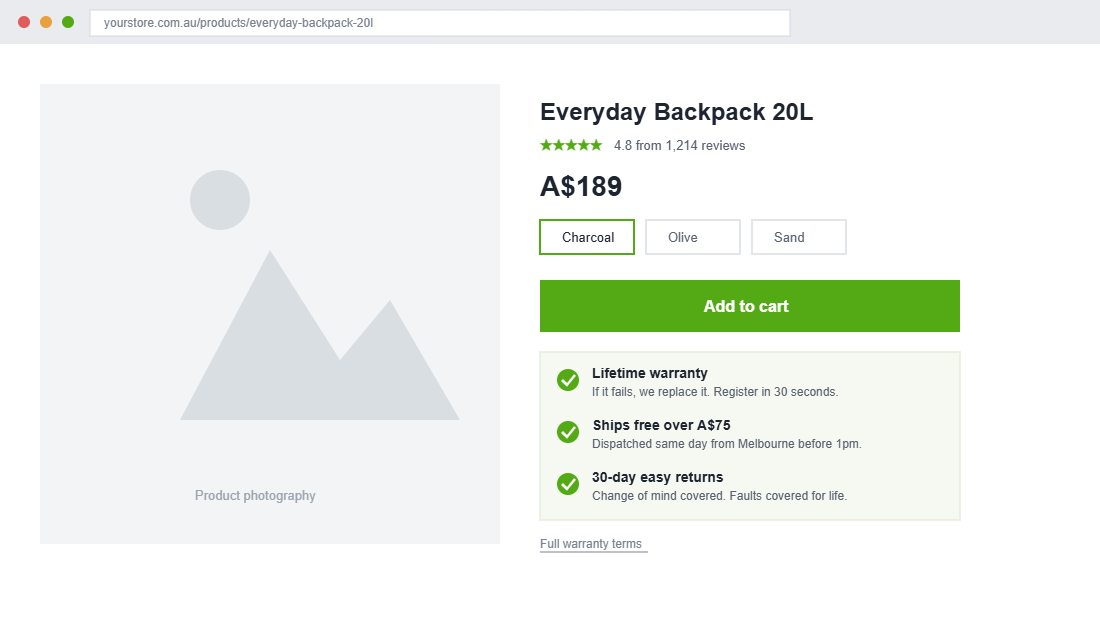
A warranty nobody sees converts nobody. The first move is placement: your guarantee belongs on the product page, above the fold or immediately under the add-to-cart button, written in one plain sentence.
Look at the Aussie brands that do this well. July prints its lifetime warranty on luggage right into the buying experience, and it reads as confidence, not legalese. Bellroy backs its wallets and bags with a 3-year warranty and says so on every product page. Crumpler built decades of brand equity on a famously generous lifetime warranty for manufacturing faults. In every case the warranty is doing sales work: it answers the quiet question “what if this falls apart?” at the exact moment the customer is deciding.
- Write it in one sentence. “Every order is covered by our 2-year warranty. If it fails, we replace it.” If your warranty needs a paragraph to explain, it needs a rewrite, not a longer page.
- Put a trust block under add-to-cart. Warranty, shipping time and returns, three lines with icons. This is prime real estate for anxiety-killers, not for a wall of badges.
- Match the warranty to the product’s fear. Apparel fears fading and seams. Electronics fear dead units. Furniture fears wobble. Name the fear your customer actually has and cover it explicitly.
- Keep the detail page one click away. The full terms live on a dedicated page with the ACL mandatory text, claim steps and timeframes. Plain English headings, no scanned PDF.
Risk reversal is one of the oldest levers in commerce because it works. If your product quality genuinely holds up, the customers your warranty converts will outnumber the claims it costs you by an uncomfortable margin. Uncomfortable, that is, for the competitor who kept theirs in the footer.
Part 2: Build the Registration Engine (This Is a Data Play)
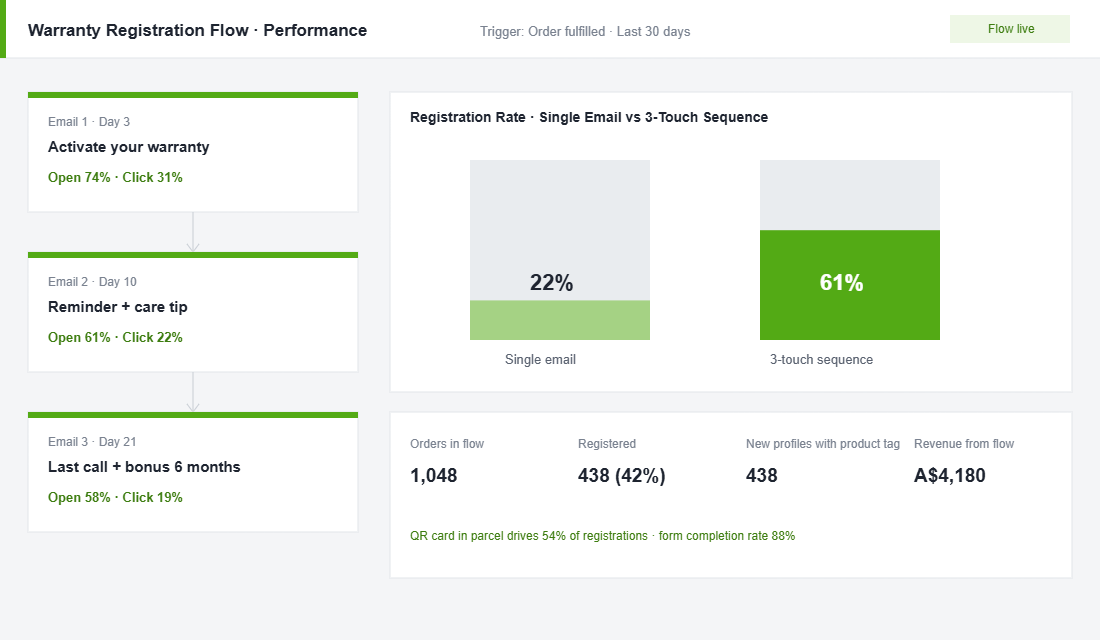
Here is the part almost every DTC brand skips. Warranty registration is not admin, it is first-party data capture wearing a sensible outfit. Across all product categories the average registration rate sits around 38%, and 44% of customers who never register say it is simply because the process felt inconvenient. That is not a demand problem. That is a friction problem you can fix in an afternoon.
Why bother? Because a registered customer is a known customer. If you sell through wholesale, marketplaces or retail as well as your own store, registration is often the only way to learn who actually owns your product. And registered customers opt in at the exact moment they are happiest with you, which is why warranty and product emails open at 60 to 75%.
The tool for the job is Klaviyo, which most Shopify stores already run. Here is the setup, start to finish:
- Create a “Warranty Registration” sign-up form in Klaviyo (Forms, then Create Form, then choose a dedicated landing page or embedded form). Ask for name, email, order number and product. Four fields, nothing more.
- Add a QR code card to every parcel. One card, one job: “Activate your warranty in 30 seconds.” Point the QR at the form. A physical prompt at the unboxing moment beats any email you will ever send.
- Build a 3-touch registration flow. Trigger on order fulfilment: day 3 (“activate your warranty”), day 10 (reminder plus a care tip), day 21 (last call). The data here is stark: a single follow-up email gets registration rates around 22%, while a 3-touch sequence lifts it to roughly 61%.
- Tag the profile on submission (for example warranty-registered plus the product handle) so every future flow can segment on ownership.
- Trigger a post-registration flow that delivers the warranty confirmation, care instructions and one cross-sell suggestion. Useful first, promotional second.
Sweeten the deal and registration rates climb further: an extra 6 months of coverage, a care guide, or entry into a monthly draw all outperform a bare “register now”. The reward does not need to cost much. It needs to make the 30 seconds feel worth it.
Part 3: The Extended Warranty Decision (Margin Most Founders Never Collect)
Extended or paid protection is the sharpest end of the warranty opportunity, and it is not for every store. The benchmarks first: online attach rates average 5 to 6% across categories, electronics run 15 to 30%, and around 55% of consumers say yes to extended coverage on electronics and appliances when asked. The US extended warranty market alone is worth about US$53 billion and growing at 9.2% a year. Somebody is collecting that margin. Usually it is not the brand.
Extended coverage suits products where failure is plausible and replacement is painful: electronics, appliances, eyewear, prams, e-bikes, furniture. It is a poor fit for low-ticket consumables, where the offer reads as a money grab and adds checkout friction for nothing.
- If it fits, test it as a checkout add-on. Apps like Extend, Corso and Mulberry run the underwriting and claims so you are not carrying the liability yourself. Evaluate whether they support Australian merchants and AUD before committing, this space moves quickly.
- Price against the anxiety, not the product cost. Protection on a $450 pram sells at $39 far more easily than protection on a $45 kettle sells at $6.
- Keep the ACL boundary clean. A paid plan must offer value beyond the consumer guarantees the customer already has by law, and your copy must never imply their free rights depend on buying it. This is exactly the territory regulators have pinged retailers for in the past.
- Watch two numbers monthly: attach rate (aim past the 5 to 6% average) and claim ratio. A healthy program funds itself and then some, at 50 to 70% gross margin on every plan sold.
If paid protection is not right for your catalogue, the free-but-generous route still wins: a visibly longer warranty than your competitors, offered to registered customers, converts trust into orders without a checkout upsell in sight.
Put the Promise Everywhere the Doubt Lives
Once the warranty is worth talking about, talk about it everywhere a customer hesitates. The product page is only the first venue.
- In your ads. “Lifetime warranty” in a Meta headline is a differentiator competitors cannot copy overnight, because it has to be true first.
- In your review replies. Every public response to a quality complaint should mention the claim was covered under warranty. Future shoppers read those threads more carefully than your homepage.
- On the packaging. The unboxing moment is peak goodwill. A card that says “covered for life, register in 30 seconds” does double duty: reassurance and registration.
- In the cart and checkout. One line of microcopy near the payment button (“every order covered by our 2-year warranty”) lands at the exact moment doubt peaks. Stores that test this rarely remove it.
The pattern is simple: find the moments where the customer silently asks “what if it breaks?” and answer before they finish the thought. That is what separates a warranty that sells from a warranty that sits.
Part 4: Treat Every Claim as a Retention Moment
A warranty claim is a strange gift. The product failed, which is bad. But the customer chose to contact you instead of silently binning the product and the relationship, which is very good. What happens in the next 48 hours decides whether you keep them for life or lose them loudly.
The claim experience most stores deliver is an interrogation: receipts, photos from four angles, a week of silence, then a grudging replacement. Flip it. The customer is not a suspect, they are a repeat purchase standing in front of you holding a broken thing.
- Set a claim SLA and publish it. “Claims answered within one business day, resolved within five.” Then hit it. Slow claims are how warranties turn from asset to liability.
- Replace first, investigate second under a sensible dollar threshold. For a $40 item, the postage-plus-interrogation routine costs more than the replacement and torches goodwill for sport.
- Ask for the story, not the paperwork. A photo and two sentences tell you 90% of what you need. Registered customers (Part 2) should never be asked for proof of purchase you already hold.
- Close the loop with a check-in. A one-line email a week after the replacement lands (“how is the new one holding up?”) is the cheapest loyalty program ever built. Then let your win-back flows stay warm for the next purchase.
There is a defensive payoff too. A customer with a clear, fast claim path does not open a chargeback, and warranty terms you honour quickly are evidence in your favour when a dispute does land. If chargebacks are already biting, our Chargeback Defence Playbook covers that whole fight.
Part 5: Feed Warranty Data Back Into the Product
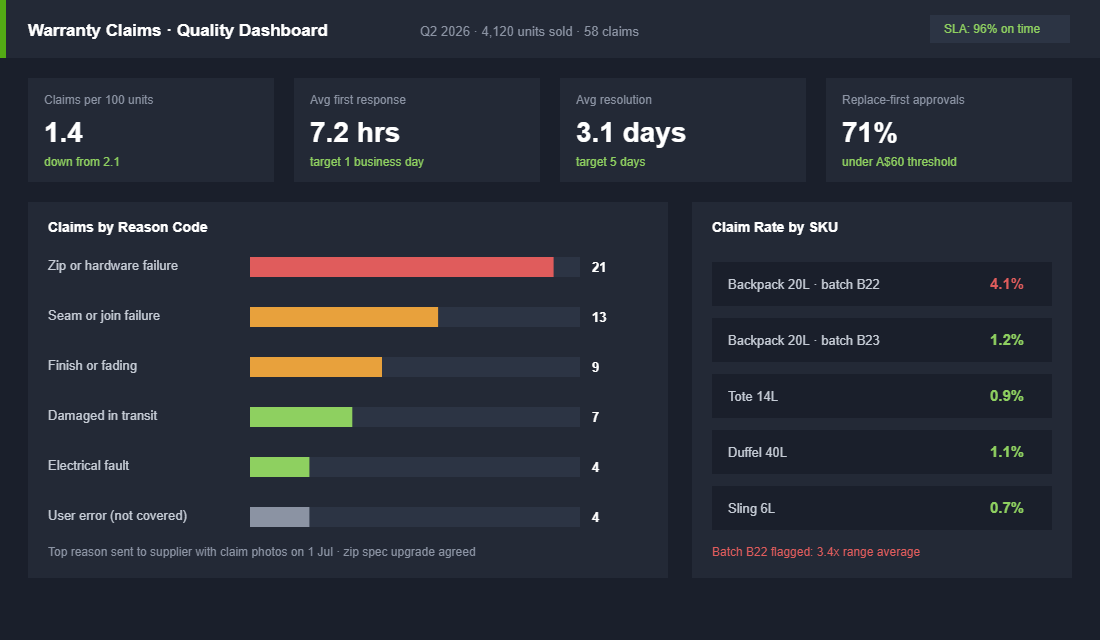
Every claim is a defect report a customer wrote for free. Most brands process the replacement and delete the insight. The operators who compound tag every claim with a reason code and read the totals monthly.
- Keep the taxonomy short: seam or join failure, electrical fault, zip or hardware, finish or fading, damaged in transit, user error. Six codes cover most catalogues.
- Track claims per 100 units sold, by SKU and by batch. A SKU claiming at 4% when the range claims at 1% is a supplier conversation this month, not a mystery forever.
- Send the top reason code upstream. Photos from claims are exactly the evidence that wins a rework or credit negotiation with your manufacturer.
- Price the fix against the claim rate. If a 60-cent zip upgrade halves a 3% claim rate, that is not a cost, that is one of the best margin decisions you will make all year.
This loop is also how a longer warranty becomes affordable. Claim rates fall as the product improves, which funds a bolder guarantee, which converts more shoppers, which generates more data. Measure the flow-through on repeat purchase with our LTV Playbook and the case for quality writes itself.
The Four Warranty Mistakes That Cost Aussie Stores Real Money
- Restating the ACL and calling it a warranty. “12-month warranty” on goods the law already protects for a reasonable period is not generosity, and savvy customers know it. Go beyond the floor or say nothing.
- Writing terms that fight the law. Blanket “no refunds”, “change of mind only within 7 days, faulty goods excluded” or warranties “void” for third-party repairs are ACCC bait. The mandatory ACL text exists precisely because stores kept getting this wrong.
- Hiding the claim form. If lodging a claim takes more clicks than placing an order, customers skip the claim and go straight to a chargeback or a one-star review. Both cost more than the claim did.
- Treating registration data as a trophy. Collecting emails you never use is worse than not collecting them. The value is in the flows: care content, anniversary offers, replacement-cycle reminders timed to the product’s real lifespan.
The Compound Effect: What a Working Warranty System Is Worth
Run the numbers on a store doing 1,000 orders a month at a $90 average order value.
- Registration engine (Part 2): a 3-touch flow converting around 40% of orders gives you 400 new known customers a month, reading emails at 60 to 75% open rates. That list quietly becomes one of your best-performing channels.
- Conversion lift (Part 1): a visible guarantee on the product page only needs to move conversion a fraction of a percent to add dozens of orders a month. Risk reversal earns its keep silently.
- Extended coverage (Part 3): if it fits your catalogue, a 6% attach on a $25 plan is $1,500 a month, most of it margin.
- Claims and data loop (Parts 4 and 5): faster claims stop chargebacks and bad reviews at the source, while reason codes cut the defect rate itself, so the whole system gets cheaper to run every quarter.
Each part works alone. Together they turn a legal necessity into a flywheel: trust converts, registration captures, claims retain, data improves the product, and the improved product lets you promise even more.
The Warranty Copy That Converts (And the Words That Kill Trust)
You can have a genuinely generous warranty and still get no conversion lift from it, because the words you chose made it sound like a trap. Warranty copy is a trust exercise, and trust is destroyed by hedging.
Read your current warranty line out loud. If it needs a second sentence to explain the first, it is not working. The version that lifts add-to-cart is short, specific, and states the remedy before the conditions.
- Say the remedy first. “Breaks in 3 years, we replace it” beats “3 year limited warranty subject to terms”. The customer is buying certainty, not a policy number.
- Use a real number, not a category. “Lifetime” reads as marketing. “10 years” reads as a commitment somebody had to sign off on.
- Kill the word “limited” from the product page. It belongs in the terms document where it is legally useful. On the PDP it does nothing except plant doubt at the exact moment you were building confidence.
- Name who pays return postage. This is the unspoken question behind every warranty. If you cover it, say so in the same sentence. If you do not, say that too. Ambiguity here is worse than a “customer pays” policy stated plainly.
- Avoid “at our discretion” on the product page. It is standard legal language and it reads as “we will find a reason to say no”. Keep it in the full terms, not the promise.
- Give it a name. “The 5 Year Promise” or “The No Dud Guarantee” turns a policy into a brand asset that your customers can repeat to a friend. Unnamed warranties do not get talked about.
One caution specific to the Australian market. Anything you write must sit alongside your consumer guarantees, never appear to replace them. Wording that implies a customer’s only remedy is your voluntary warranty is a compliance risk, not just a copy problem. Get the promise line and the terms page reviewed together, and read the Australian Consumer Law requirements before you publish anything that sounds absolute.
Test it properly rather than arguing about it internally. Run the new promise line as a single-variable split test on your highest-traffic product page, hold it for two weeks or until you have a few thousand sessions per variant, and measure add-to-cart rate rather than revenue. Warranty copy moves the decision to add, and revenue is too noisy a metric to read it cleanly at typical Australian store volumes.
How to Price an Extended Warranty Without Guessing
Most founders price extended protection by copying whatever the competitor charges, then wonder why it either never sells or quietly loses money. There are only four numbers you need, and you already have three of them.
- Your real claim rate. Claims per 100 units sold, measured over a full product lifecycle rather than the last quarter. Pull it from your helpdesk tags. Most physical goods sit somewhere between 1 and 5%, and the founders who guess almost always guess high.
- Your replacement cost. Landed COGS plus outbound freight plus the labour to process the claim. Not RRP. Using RRP here is why extended warranties get priced at three times what they need to be.
- The uplift in claim rate over the extended period. Failures cluster. Year three of a product’s life usually carries a higher claim rate than year one, so apply a multiplier rather than assuming the base rate holds flat.
- Your target loss ratio. How much of the premium you are willing to pay out in claims. A loss ratio of 30 to 40% is a sensible starting point for a self-funded program and leaves room for the claims you did not model.
The arithmetic is straightforward. Expected claim cost per unit equals claim rate times replacement cost times the period multiplier. Divide that by your target loss ratio and you have your price floor. On a $200 item with a 3% claim rate, an $80 replacement cost, a 2x multiplier for the extended period and a 35% target loss ratio, the maths lands you around $14. Most stores would have charged $39 and killed attach rate for no reason.
Where to put the offer
Attach rates vary hugely by placement. In-cart as a line item generally outperforms a product page radio button, and both outperform a post-purchase upsell for warranty specifically, because the anxiety you are selling against is highest while the customer is still deciding. Shopify Functions or an app like Rebuy or Zipify can run it as a cart add-on without a theme rebuild.
Review the program every six months against actual claims, not modelled ones. If your loss ratio comes in under 15%, you are overcharging and suppressing attach. If it climbs past 60%, either the price is too low or you have a product quality issue that the warranty is masking. Either way the number tells you something the sales report will not, and it belongs on the same monthly review as your returns reduction metrics.
The Warranty One-Pager (Steal This)
One page, seven boxes. Fill it in this week and you have a warranty system instead of a footer link:
- The promise: one plain sentence, visible on every product page. Length and remedy stated, no asterisks doing heavy lifting.
- The legal layer: full terms on one page, ACL mandatory wording included, checked once by a lawyer.
- The registration hook: QR card in every parcel plus a 3-touch Klaviyo flow. Target: 40%-plus of orders registered.
- The extended decision: offer paid protection only if the product fear justifies it. Target attach: above the 5 to 6% average.
- The claim SLA: answered in one business day, resolved in five. Published where customers can see it.
- The replace-first threshold: a dollar figure under which claims are approved on a photo and two sentences. Write it down so your team stops asking.
- The monthly review: claims per 100 units by SKU, top reason code, one fix sent upstream to the supplier.
Inside eCommerce Circle, Protection is one of the ten P’s we work through with every member, and the warranty system is one of the fastest wins in it. If you want a second opinion on yours, let’s talk.