Here is a sentence that should make every Aussie Shopify founder put their coffee down. In 2025 the ACCC quietly swept more than 2,000 Australian online retailers, reading their returns pages line by line, looking for stores that mislead shoppers about their rights. Plenty got a warning letter. The ones who ignored it are the ones who end up in a media release.
What’s in This Article
Most founders think their returns policy is a customer-service document. It is actually a legal document. And the most common version, the one with a tidy line like “no refunds on sale items” or “returns accepted within 30 days only”, is very often illegal under the Australian Consumer Law. Not aggressive. Not risky. Flatly against the law.
The stakes just doubled. From 28 March 2026 the maximum penalty for a company breaching the ACL jumped from $50 million to $100 million per breach, and for an individual from $500,000 to $2.5 million. You will almost certainly never see a fine that size on a DTC store. But Mazda copped $11.5 million and Fitbit $11 million for exactly the thing your returns page might be doing right now: telling customers their rights are smaller than the law says they are. This is the playbook we use with members to make a Shopify store ACL-compliant without turning it into a refund free-for-all.
First, a quick reality check (this is general info, not legal advice)
Everything below is general information to help you ask better questions, not legal advice for your specific business. When you are ready to lock your policy down, confirm the wording with a lawyer or check it against the ACCC’s own guidance at accc.gov.au. With that said, the rules are far less mysterious than most founders assume. You can get 90% of the way to compliant in an afternoon.
Part 1: Learn What the ACL Actually Guarantees (Most Founders Get This Backwards)
The single biggest mistake is treating “returns” as one thing. Under Australian law there are two completely separate worlds, and you must keep them apart in your head before you touch a single line of policy.
World one: consumer guarantees. Every product you sell in Australia comes with automatic guarantees that you cannot remove, water down, or contract out of. The big ones are that goods must be of acceptable quality, fit for any purpose you described, match their description, and match any sample or demo. These apply on top of, and separate from, any manufacturer warranty. When a product fails one of these guarantees, the customer has rights, full stop.
World two: change of mind. If a customer simply does not like the colour, ordered the wrong size, or saw it cheaper elsewhere, the law gives them nothing. A change-of-mind return is a goodwill gesture you choose to offer. You are completely free to say “no change-of-mind returns on sale items” because that is your policy, not their right.
The trouble starts when founders write one blunt rule that accidentally strips away world-one rights while trying to manage world two. “No refunds after 30 days” sounds reasonable until a $400 jacket falls apart at day 45. Under the ACL a fault that appears in a “reasonable time” still triggers a remedy, and there is no fixed 30-day cut-off. Acceptable quality is judged on price, durability, and what a reasonable buyer would expect, not on your calendar.
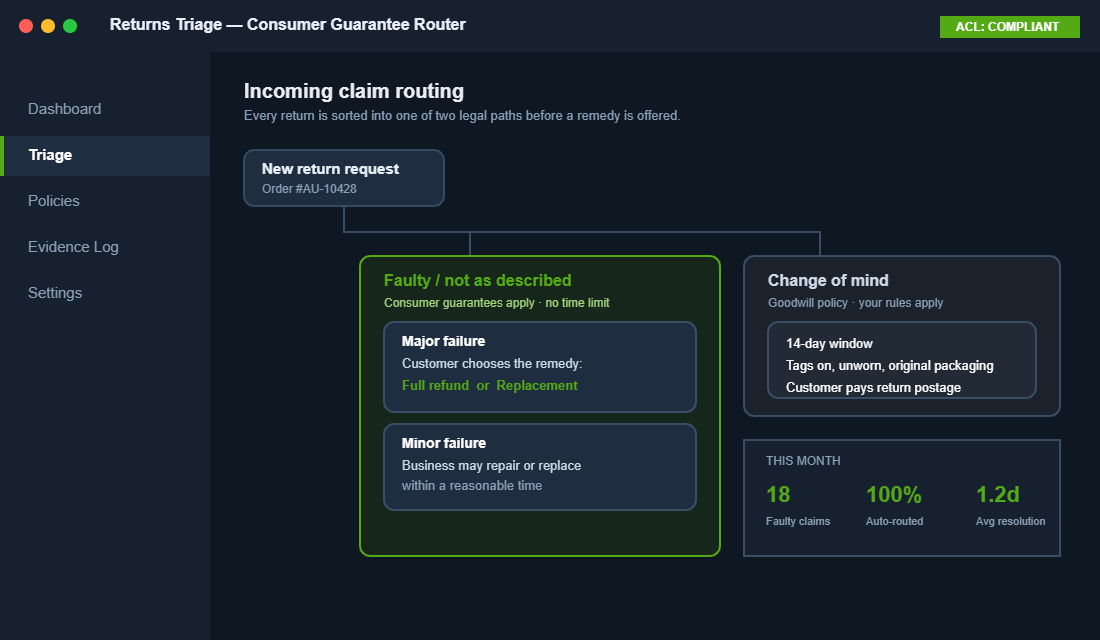
One more distinction that decides who is in control. For a major failure (the kind a reasonable person would not have bought if they had known, or something unsafe or wildly different from description), the customer chooses the remedy: a refund or a replacement. For a minor failure that can be fixed, you get to choose, and you can repair within a reasonable time. Knowing which is which is what stops you handing out refunds you did not owe, and stops you denying ones you did.
Part 2: Rewrite Your Returns Page So It Never Denies a Guarantee
Open your current returns or refund policy right now. Read it as if you were an ACCC officer doing a sweep. You are looking for any sentence that could make a shopper believe their rights are smaller than the law allows. That is the exact test the regulator used across those 2,000 stores.
The fix is structural, not cosmetic. Split your policy into two clearly labelled sections so a customer (and a regulator) can see you understand the difference:
- Faulty or not as described. State plainly that customers are covered by the consumer guarantees under the Australian Consumer Law, that these rights have no expiry, and that you will repair, replace, or refund in line with whether the failure is major or minor. Never attach a hard time limit to this section.
- Change of mind. This is where your conditions live. Set your window (14, 30, 60 days), your condition requirements (tags on, unworn, original packaging), who pays return shipping, and any exclusions like final-sale items. This section can be as strict as you like.
Two phrasing rules carry most of the weight. First, never use the words “no refunds” as a blanket statement anywhere. Display a “no refunds” line and you are breaking the law even if you would have honoured a faulty claim in practice, because the statement itself misleads. Second, do not present the manufacturer’s warranty as the customer’s only option. Fitbit’s $11 million penalty came partly from telling buyers they had no replacement right once the two-year warranty expired. Your guarantees sit above the warranty, not under it.
If you sell anything over about $100, this is not optional housekeeping. Acceptable quality expectations scale with price, so a higher-ticket catalogue carries more exposure, not less.
Part 3: Run the Site-Wide “No Refunds” Sweep
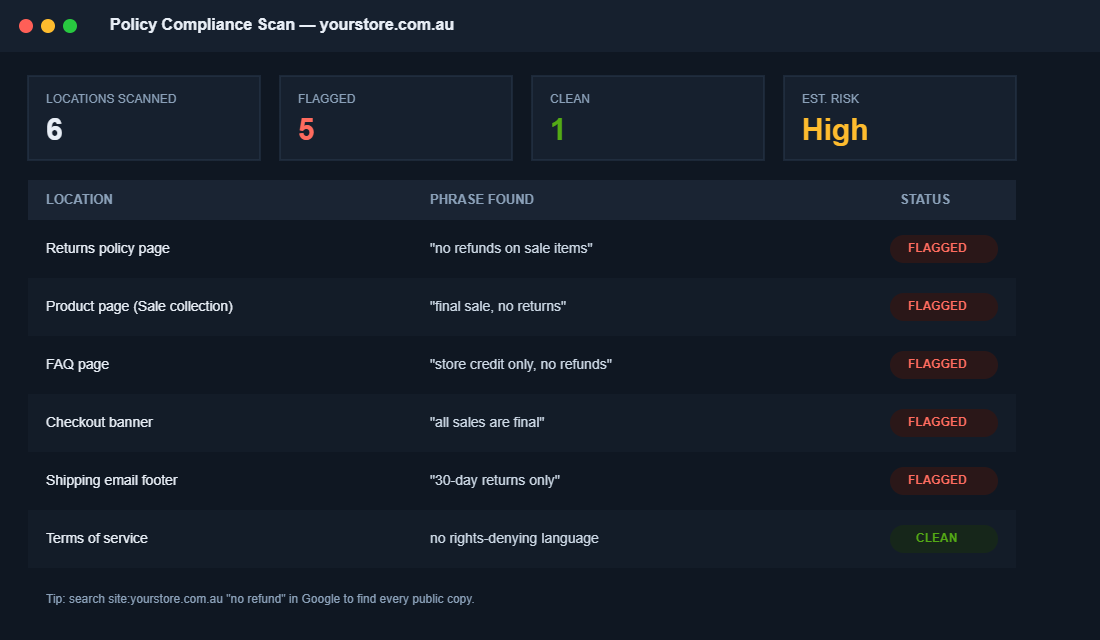
Here is the part almost everyone misses. You can have a perfect returns page and still be non-compliant, because the misleading language is hiding in nine other places on your Shopify store. The ACCC does not only read your policy page. It reads everything a shopper sees.
Hunt down and rewrite every instance of rights-denying language in these spots:
- Product pages. Especially “final sale, no returns” badges on discounted lines and anything in a size or care tab.
- The cart and checkout. Sale banners and checkout notices that say “all sales final”.
- Your FAQ page. Old answers like “we don’t offer refunds, only store credit” are a classic trap.
- Email and SMS macros. The canned support reply your VA pastes when someone asks about a refund. This is where staff accidentally state the wrong rule fastest.
- Order confirmation and shipping emails. Footer text often carries an outdated returns line.
- Terms of service. The boilerplate you imported when you launched.
A fast way to catch them: use your browser to search your own domain in Google with site:yourstore.com.au “no refund” and site:yourstore.com.au “final sale”. Then open Shopify admin, go to Settings, Policies, and confirm the returns policy there matches your rewritten version, because that linked policy is what shows in the footer and at checkout. Members are often shocked at how many copies of the same dangerous sentence exist once they go looking.
Know Your Category’s Return Reality Before You Build the System
How hard you need to engineer this depends on what you sell, because return volume is wildly uneven across categories. Online returns run about three times higher than in-store, roughly 30% of online orders versus under 9% in physical retail, and the category spread is huge.
- Apparel and footwear: 20 to 40%. The highest-return category, mostly sizing and fit. A large share of these are change-of-mind, so your policy split and your sizing content carry the load. Fewer are true faults, but the volume means even a small fault rate is a lot of claims.
- Electronics: 8 to 15%. Lower volume but higher value and a higher proportion of genuine faults, which is exactly the category where consumer guarantee disputes turn expensive. This is the Fitbit zone.
- Beauty and consumables: 4 to 12%. Lowest return rate, but acceptable-quality and safety guarantees still apply, and hygiene exclusions for change of mind need careful wording so they never read as denying a faulty-product remedy.
The lesson is to match effort to exposure. Apparel founders should obsess over the change-of-mind workflow and sizing accuracy. Electronics founders should obsess over the faulty path and their evidence log, because that is where a single mishandled claim becomes a pattern. Either way, you need a system, not a vibe.
Part 4: Build a Returns Workflow That Routes Faulty Away From Change of Mind
Compliant words are step one. The real protection is an operational system that handles the two worlds differently every single time, without relying on a tired support agent to remember the law at 4pm on a Friday. With online return rates sitting around 19 to 20% of orders (and apparel pushing 20 to 40%), this volume is too high to handle by gut feel.
A dedicated returns app does the routing for you. AfterShip Returns is a solid, widely used option on Shopify, and Rich Returns and Loop work the same way. Here is how to set one up so it protects you:
- Install and connect. Add AfterShip Returns from the Shopify App Store and connect it to your store so it can read order data and push return labels.
- Create two return reasons groups. Build one path for “Faulty or not as described” and a separate path for “Change of mind”. This single split is the most important configuration you will make.
- Set rules per path. On the change-of-mind path, enforce your window and condition rules and make the customer pay return postage. On the faulty path, remove the time limit, waive return shipping, and flag the request for human review rather than auto-approval.
- Auto-generate the portal. Turn on the branded self-service returns page so customers lodge requests themselves, which cuts the WISMO-style support load dramatically.
- Map remedies to outcomes. For faulty major failures, offer refund or replacement as the customer’s choice. For minor faults, offer repair or replacement first. Bake the ACL logic into the workflow so it happens by default.
Done well, this also kills a different problem: return abuse. When your faulty path requires a photo and a short description, the chancers who claim “faulty” to dodge return postage on a change-of-mind item get filtered out. We go deep on that in the Shopify return abuse defence playbook, and it pairs perfectly with this compliance work.
Part 5: Train the Team and Keep the Evidence
Your policy is only as compliant as the last message your support team sent. The Mazda case is the cautionary tale: nine customers, recurring serious faults, and staff who kept offering only a repair or a partial refund when the customers were entitled to choose a full refund or replacement. That pattern of representation cost $11.5 million plus compensation. It was not one rogue email. It was a script.
So build the right script. Give your team three pieces of plain language they can paste with confidence:
- The acknowledgement. “Because this item is faulty, you’re covered by the consumer guarantees under Australian Consumer Law, separate from any warranty.”
- The major-failure offer. “As this is a major fault, you can choose a full refund or a replacement. Which would you prefer?”
- The minor-failure offer. “We can repair or replace this for you at no cost. Here’s how that works.”
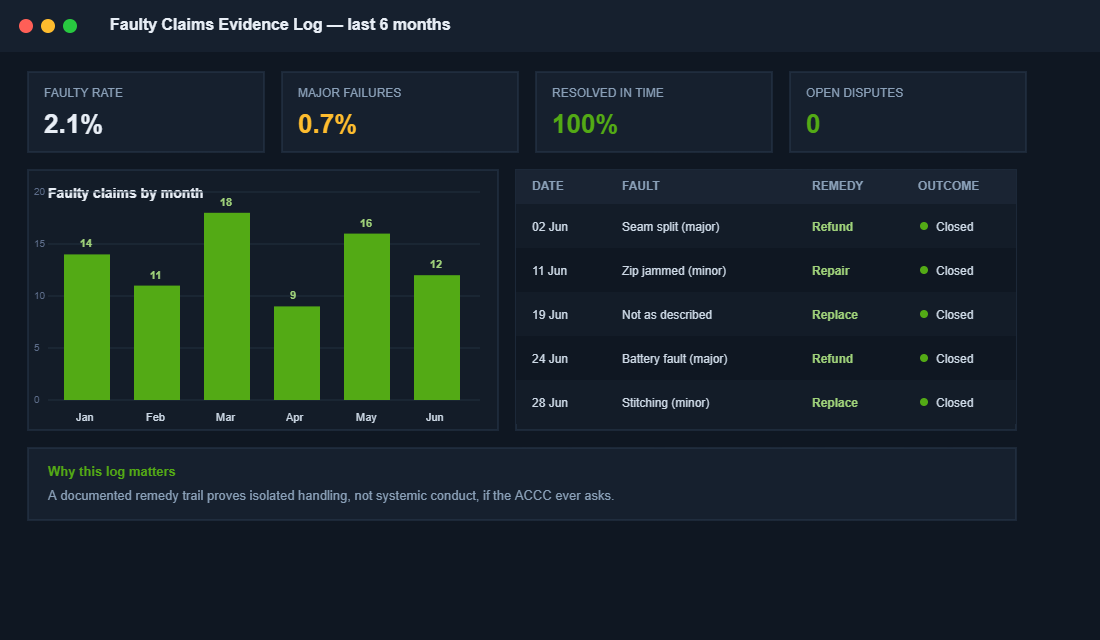
Then keep records. For every faulty claim, log the date, the fault, the remedy offered, and the outcome. Two reasons. First, if the ACCC ever asks, a clean log is the difference between “isolated mistake” and “systemic conduct”, and that distinction drives penalty size. Second, the data tells you which products keep failing, which is a quality problem worth fixing at the source. This kind of operational rigour is the same discipline behind our chargeback defence playbook, where documented evidence is what wins disputes.
The Three Myths That Make Founders Over-Refund
Compliance scares founders into giving away money they never owed. The fear comes from three myths. Kill them and you protect both your customers’ rights and your own margin.
- Myth one: you must accept change-of-mind returns. You do not. The law forces nothing for “I changed my mind”. A generous change-of-mind policy can lift conversion, but that is a marketing decision you control, not a legal duty. Plenty of profitable Aussie brands run a strict 14-day, tags-on change-of-mind window and are fully compliant.
- Myth two: you must refund the instant someone claims fault. You do not. You are entitled to a reasonable opportunity to assess the claim. Asking for a photo, a description, or the item back before issuing a remedy is normal and lawful. What you cannot do is use that process as a stalling tactic to deny a genuine guarantee.
- Myth three: you are on the hook forever. You are not. The guarantee lasts a “reasonable time” tied to the product’s price and expected durability. A $30 phone case and a $2,000 sofa carry very different expectations. Reasonable is not infinite, and it is not 30 days either. It is judged on the product.
The founders who lose money are the ones who, terrified of an ACCC letter, refund everything on demand. The compliant move is sharper: honour every genuine guarantee fully and fast, and hold the line confidently on everything the law does not require. That balance is the whole game.
The Compound Effect: Compliance Is a Conversion Asset
Founders treat consumer law as a tax: annoying, defensive, pure downside. That framing costs you money. Watch what happens when the five parts work as one system.
A clear two-part policy removes purchase anxiety, especially on higher-ticket items where Australians hesitate. A clean returns portal turns a scary “what if it’s faulty” moment into a two-minute self-service flow, so support volume drops and your team spends time on revenue instead of refunds. The faulty-versus-change-of-mind split simultaneously honours real rights and blocks abuse, which protects margin. And the evidence log feeds your product team the failure data that quietly lifts quality over time.
Each piece is useful alone. Together they convert a legal obligation into trust, and trust is what makes a first-time buyer in a $82.6 billion Australian online market choose you over the cheaper option. The stores that win the next decade are not the ones with the strictest no-refund line. They are the ones confident enough to tell customers their real rights, because they have built the system to handle them.
Your ACL Compliance Checklist
Run this top to bottom this week. If you cannot tick every box, you have found your weekend project.
- Two worlds defined. Your policy clearly separates “faulty or not as described” from “change of mind”.
- No time limit on faults. The faulty section has no 30-day or warranty cut-off on consumer guarantee rights.
- No blanket “no refunds”. The exact phrase appears nowhere on your site, including sale badges.
- Warranty is not the only path. You never present a manufacturer warranty as the customer’s sole remedy.
- Major vs minor logic. Customer chooses refund or replacement on major failures; you can repair on minor ones.
- Site-wide sweep done. Product pages, FAQ, checkout, emails, and terms all checked and cleaned.
- Returns app routing. Separate faulty and change-of-mind paths configured with different rules.
- Team script ready. Support has paste-ready language for acknowledgement, major, and minor failures.
- Evidence log live. Every faulty claim records date, fault, remedy, and outcome.
- Reviewed for your business. Final wording confirmed against ACCC guidance or with a lawyer.
Inside eCommerce Circle, protecting your store legally and financially is one of the core pillars we work on with every member, because a single misworded policy can undo a year of growth. If you want a second opinion on yours, let’s talk.