You can run a store doing four hundred thousand a quarter, hold healthy margins, and still get blindsided by a BAS bill you cannot pay. Not because the business is broken. Because the tax architecture underneath it was set up once, in a hurry, by someone who was mostly guessing.
What’s in This Article
Here is what that looks like in practice. GST collected on Australian orders sits in the same bank account as everything else, so it reads as revenue. International orders that should be GST-free get taxed anyway, or worse, do not get taxed and cannot be evidenced as exports. Shopify payouts land net of fees, so the numbers in the dashboard never tie to the numbers in Xero. Come lodgement day, the guesswork compounds.
The ATO is not guessing. The net GST gap in Australia was estimated at 7.9 billion dollars in 2022 to 2023, up from 4.4 billion the year prior, and small business carries more than half of it. That is not a story about fraud. It is mostly a story about setup errors that nobody caught. This playbook walks through the six layers of tax architecture that keep an Aussie Shopify store clean, so the cash you think you have is the cash you actually have.
Quick note before we start: I run stores and coach founders, I am not your accountant. Everything below is operational setup you should walk through with your bookkeeper or tax agent before you change a setting.
Layer 1: Know Which Rules Actually Apply to You
Most tax mistakes are downstream of a fuzzy answer to one question: what kind of seller am I, and to whom? Nail that first and the rest of the settings become obvious.
The Australian registration threshold is 75,000 dollars in GST turnover, and it has not moved since GST was introduced on 1 July 2000. Once you hit it, or once you reasonably expect to hit it, you have 21 days to register. Registration is effective from the date you crossed the line, not the date you got around to applying.
Two details that catch Shopify operators out. First, the threshold is measured on turnover, not profit. Gross sales before ad spend, before cost of goods, before anything. Second, GST-free sales still count toward turnover. If half your revenue goes to overseas customers, those export sales are GST-free but they are still connected with Australia, and they still count toward the 75,000.
So the brand shipping 50,000 to Aussie customers and 50,000 overseas has crossed the threshold. Plenty of founders in that position think they have not.
What to write down before you touch Shopify
- Registration status and date. Registered from when, on what ABN, under what entity name.
- Reporting cycle. Quarterly for most stores. Note that from 1 April 2025 the ATO began moving businesses with poor lodgement or payment histories onto monthly GST reporting for at least twelve months.
- Accounting basis. Cash or accruals. This determines when GST is recognised, and it changes your BAS numbers materially.
- Where you are registered overseas. UK VAT, EU OSS, NZ GST, US state nexus. Each one you trip triggers its own obligations.
That last point matters more every year. Bondi Sands went from a Melbourne startup in 2012 to being sold in 95 countries, including over 7,700 Walgreens stores in the US. Who Gives A Crap, founded in Melbourne in 2012, built a US operation and landed in Whole Foods Market in April 2024. Neither of those brands got there without their tax registrations keeping pace with their shipping map. Growth that outruns your tax setup is a liability, not a win.
Layer 2: Configure Shopify So the Price on the Page Matches the Tax You Owe
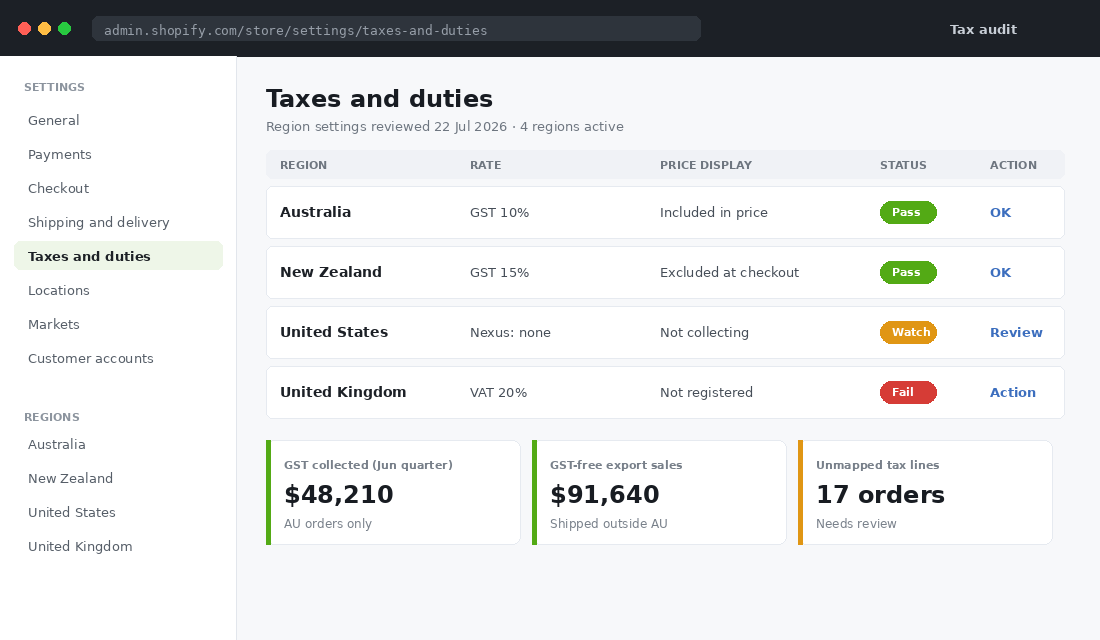
Australian shoppers expect a GST-inclusive price. That is not a preference, it is a legal display requirement, and it also happens to be a conversion issue. A price that jumps 10 per cent at checkout is one of the cleanest ways to lose an otherwise ready buyer.
The correct Shopify configuration for an Australian store is straightforward once you have seen it done properly.
- Go to Settings, then Taxes and duties, and select Australia.
- Set the country tax rate to 10 per cent.
- In the regions section beneath, leave each state and territory at 0 per cent and choose “added to 10% federal tax” from the dropdown. Setting a state rate here is the classic double-taxation error.
- Turn on all prices include tax so the displayed price is the price paid.
- Under tax overrides, create a collection for anything that is GST-free or input taxed and set that collection to 0 per cent. Most stores do not need this. If you sell basic food, certain medical items, or specific education products, you do.
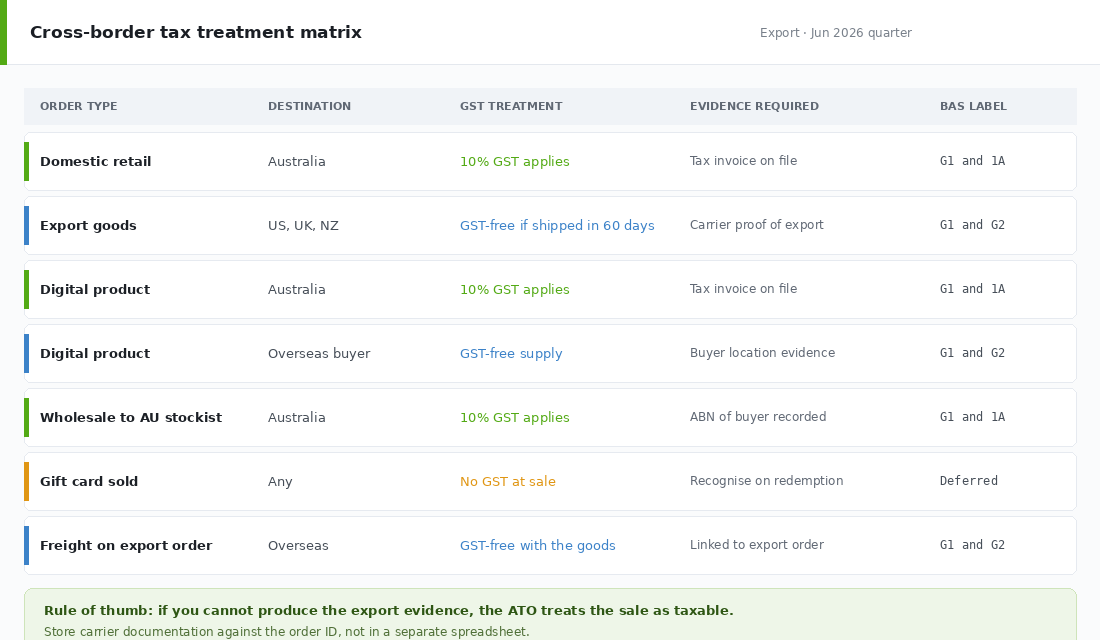
- Confirm whether shipping is taxable for you. In Australia, freight on a taxable sale generally carries GST. Freight attached to an export order generally follows the goods and is GST-free.
Then run the test that almost nobody runs. Place a real order to an Australian address and a real order to an overseas address, and read both tax lines. Not the theory, the actual order. I have lost count of the stores where the settings looked right and the orders told a different story.
If you have never placed a test order to an overseas address and read the tax line on the confirmation, you do not know what your store is doing. You know what you configured.
Layer 3: Separate Exports From Domestic Sales at the Order Level
This is where the real money hides. Exported goods are GST-free, but only if you can prove the export happened, and only if it happened inside the window.
The rule is specific. Goods are GST-free exports if they leave Australia within 60 days of the earlier of two events: you receive any payment for the goods, or you issue an invoice for them. Where payment is by instalments, the clock starts on the final instalment. Miss the window and the treatment can change on you.
The documentation standard is where most stores fall down. The ATO wants evidence the goods physically left Australia. A verbal arrangement with your 3PL is not evidence. If you deliver to a freight forwarder or consolidator inside Australia, you can still claim GST-free status, but only where it is clearly documented that the goods were then exported.
Build the evidence into the order, not into a spreadsheet
The operational fix is boring and it works. Store the export evidence against the order record, so evidence and transaction never drift apart.
- Tag every order by tax treatment automatically. Use Shopify Flow to apply a gst-free-export tag when the shipping country is not Australia, and a gst-domestic tag when it is.
- Push tracking back onto the order. Your fulfilment integration should write the carrier and consignment number to the order, not just email it to the customer.
- Run a monthly exception report. Every order tagged as an export with no tracking number is a claim you cannot defend. Chase it in the month it happens, not eighteen months later when someone asks.
- Watch the 60-day clock on pre-orders and backorders. Taking payment in March for stock that ships in June is exactly the pattern that breaks the export concession.
Digital products follow the same logic with different evidence. A digital sale to an Australian consumer carries GST. A digital sale to an overseas buyer is generally GST-free, but you need evidence of where the buyer actually is, which means capturing and retaining location data at the point of sale rather than inferring it later.
Layer 4: Handle Imports and Duties Without Taxing Yourself Twice
Two thresholds govern goods coming into Australia, and mixing them up creates both compliance risk and margin leakage.
Since 1 July 2018, GST applies to low value imported goods of 1,000 dollars or less sold to Australian consumers by overseas suppliers, marketplaces and re-deliverers with Australian GST turnover of 75,000 or more. That GST is collected at the point of sale. For consignments above 1,000 dollars, GST, customs duty and clearance charges are collected at the border from the importer instead.
If you are an Aussie brand importing your own stock, the GST you pay at the border is generally claimable as an input tax credit. If you are dropshipping from an overseas supplier into Australian customers, the rules can land differently depending on who is treated as the supplier. That is a conversation for your accountant, not a setting you should guess at.
Getting duty collection right on outbound international orders
Shopify made this considerably easier. As of 5 February 2025, the duties and import taxes calculator became available on all Shopify plans, not just Advanced and Plus. As of 29 September 2025, DDU orders also capture sales tax for registered destinations.
You choose one of two models per destination, and you cannot offer both in the same country.
- DDP (delivered duty paid). Duties and import taxes are calculated and charged at checkout. The customer pays up front, the parcel clears without a surprise. Higher cart total, dramatically fewer refused deliveries.
- DAP or DDU (delivered at place). The carrier bills the customer on arrival. Lower cart total, and a meaningful share of those parcels come back to you because the buyer refuses the bill.
For considered purchases over about 150 dollars, DDP usually wins on total contribution once you price in refused deliveries and return freight. Before you switch it on, you need HS codes and country of origin on every product. Shopify flags the gaps for you. Fill them before you enable collection, not after. If you are working through this alongside a wider international push, our Shopify Markets playbook covers the market structure decisions that sit above this.
Layer 5: Treat GST as a Liability, Not as Revenue
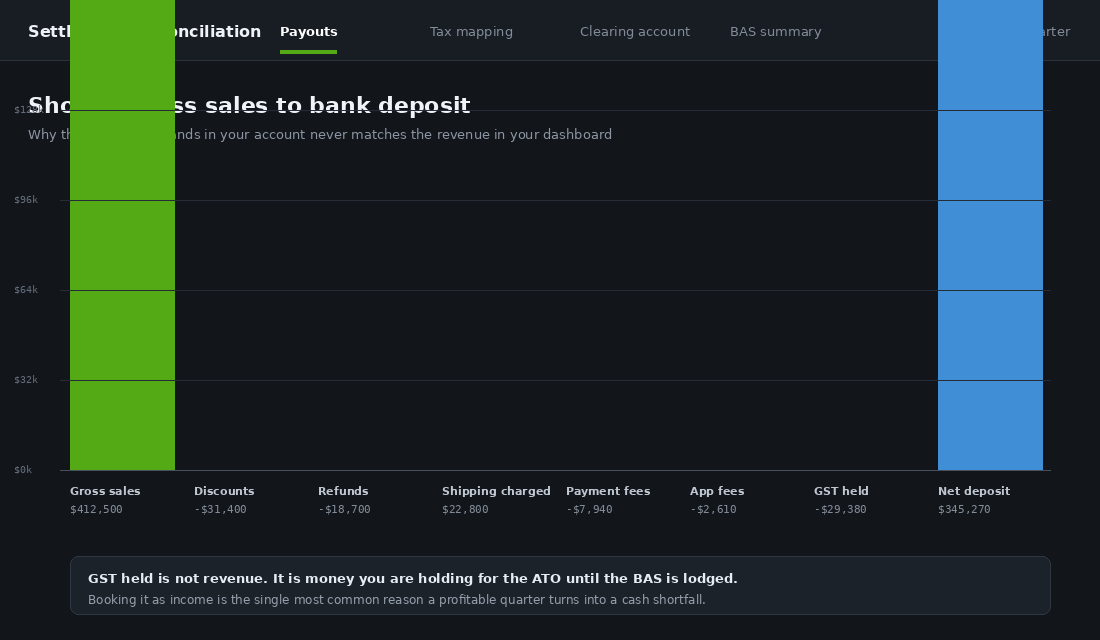
This is the single behaviour that separates operators who sleep well at BAS time from operators who scramble. The GST you collect was never yours. You are holding it for the ATO.
On a quarter with 412,500 dollars in gross sales, roughly 29,000 of that can be GST held on domestic orders. If that sits in the trading account alongside everything else, it reads as available cash. You spend it on inventory or ad spend in month two, and in month four you owe it.
The mechanic that fixes it
- Open a separate tax account. A basic high interest business savings account is fine. It only needs to be one click away from your main account and psychologically hard to raid.
- Sweep weekly, not quarterly. Set a recurring transfer of your estimated GST liability every Monday. Weekly amounts are painless. Quarterly amounts are terrifying.
- Sweep on the net position. You are remitting GST collected minus input tax credits on your purchases. Sweeping the gross collected over-reserves and starves your working capital.
- Add PAYG instalments to the same account. If you are on instalments, they land on the same BAS. Reserve them together or you will solve one problem and keep the other.
The founders who do this describe the same shift: the BAS stops being an event. It becomes a transfer from one account you own to another. That is also the point at which your contribution margin numbers start telling you the truth, because you are no longer counting money you owe as money you made.
Layer 6: Reconcile Shopify Payouts to Your BAS With a Clearing Account
Your Shopify dashboard shows gross sales. Your bank shows a net deposit, several days later, with fees already taken out and multiple orders bundled together. Those two numbers will never match, and trying to force them to match by hand is how bookkeepers lose weekends.
The fix is a clearing account. Sales, discounts, refunds, shipping, fees and tax all post to the clearing account in full. When Shopify deposits a payout, the deposit clears the balance. What is left in the account at any moment is simply what Shopify owes you but has not paid yet.
Setting up A2X for Shopify and Xero
A2X is the tool most Australian ecommerce accountants standardise on for this. It breaks Shopify activity into settlements and posts an entry that ties exactly to the deposit in your bank feed. Most stores can connect it in under an hour.
- Install A2X from the Shopify App Store and connect it to your Xero or QuickBooks file.
- Set your Shopify clearing account in the chart of accounts, plus a separate account for payment processing fees.
- Map each Shopify transaction type to a ledger account: product sales, shipping income, discounts, refunds, gift cards, tips.
- Map your tax rates. Domestic sales to GST on income. Export sales to GST-free income. Fees to their correct treatment. This step is the one people rush, and it is the step that determines whether your BAS is right.
- Import a few historical settlements first and reconcile them against deposits you already know are correct. Fix the mapping there, before you go live.
- Turn on auto-posting, then check the clearing account balance monthly. A balance that keeps growing means something is not being cleared and the mapping needs another look.
Once this is running, your BAS is largely a report rather than a research project. Pair it with a disciplined month end close and you get numbers you can act on inside the first week of the month, not the third.
The Five GST Mistakes That Trigger an ATO Please-Explain
Six layers sounds thorough, but most BAS blowups we see come from a handful of small, repeatable mistakes. Check your last quarter against these five before your accountant does.
- Charging GST on export shipping. If the order is a GST-free export, the freight on that order is GST-free too. Plenty of stores set a blanket 10% on all shipping and quietly over-remit. A store doing $30k a quarter in export freight hands the ATO $2,700 it never owed.
- Taxing gift cards at sale. GST applies when the card is redeemed, not when it is purchased. Booking it at sale inflates this quarter’s liability and understates the next one, and the mismatch compounds every BFCM.
- Missing input credits on your own tool stack. Shopify, most apps, and your agencies charge GST on fees to Australian merchants, and every dollar of it is an input tax credit. On $5k AUD a month of platform, app and transaction fees, that is roughly $1,350 a year left on the table. A2X or a clean Xero mapping picks these up automatically.
- Adjusting refunds in the wrong period. A December sale refunded in January is a January adjustment. Netting it against December understates one BAS and overstates the other, which is exactly the pattern that draws a review.
- Treating marketplace sales like direct sales. Sell through Amazon AU or eBay AU and the marketplace is sometimes the entity collecting GST on the transaction. Double-reporting those sales means paying tax twice on the same order.
The fix is rhythm, not heroics. Block 90 minutes in the week after each quarter closes: 30 minutes reconciling payouts through A2X into Xero, 30 minutes running the five checks above, 30 minutes reviewing the draft BAS with your accountant. Members who hold that rhythm tell us BAS surprises simply stop happening.
And once exports become a real slice of revenue, the GST-free layer turns into a pricing lever. Our guide to Shopify Markets for international selling covers how to price overseas orders so that margin lands with you instead of disappearing into badly set tax rules.
Why These Six Layers Compound
Individually each layer looks like admin. Together they change how the business runs.
Layer 1 tells you which rules apply. Layer 2 makes the store enforce them automatically on every order. Layer 3 turns export treatment from an assertion into documented evidence. Layer 4 stops you paying tax twice on stock and stops surprise duty bills killing your international conversion rate. Layer 5 means the cash is there when the bill arrives. Layer 6 means the numbers are trustworthy without a fortnight of reconstruction.
The compounding shows up in three ways. Your real margin becomes visible, because GST is stripped out of the revenue line and duty is priced into international orders properly. Your cash forecast becomes reliable, because the largest lumpy outflow in the calendar is already funded. And your optionality goes up, because clean tax records are the first thing an investor, a lender or an acquirer asks for. Nobody funds a business whose numbers need explaining.
The ATO is also getting harder to surprise. Live data feeds from banks, payment platforms and marketplaces are now matched against BAS disclosures to find under-reported turnover. The era of the estimate that nobody checks is over.
The Quarterly Tax Architecture Checklist
Print this. Run it in the first week after each quarter closes. It takes about twenty minutes once the setup is done.
Settings
- Australian country rate is 10 per cent, state rates are 0 per cent set to added to federal.
- All prices include tax is switched on.
- Tax overrides still map to the right collections after this quarter’s product changes.
- Every active shipping destination has a deliberate tax setting, not a default one.
Orders
- Every export-tagged order has a tracking number and carrier evidence attached.
- No export order sat longer than 60 days between payment and despatch.
- Pre-orders and backorders reviewed against the 60 day rule.
- Digital sales have buyer location evidence retained.
International
- HS codes and country of origin present on all active products.
- DDP or DAP setting reviewed per destination against refused delivery data.
- Overseas registration thresholds checked against trailing twelve month sales per country.
Money
- Tax account balance covers the estimated net GST plus PAYG for the quarter.
- Weekly sweep amount updated for the current run rate.
- Clearing account balance is roughly one payout cycle, not growing.
- Unmapped or exception transactions cleared to zero before lodgement.
Four categories, sixteen checks. Any item you cannot tick is a specific instruction for the next fortnight, which is a far better outcome than a vague sense that the tax side probably needs looking at.
Where Most Stores Should Start
If you only do one thing this week, do Layer 5. Open the separate account, calculate your weekly sweep, set the recurring transfer. It takes fifteen minutes and it removes the failure mode that actually kills stores, which is not a tax error, it is a cash timing error.
Then work backwards. Test orders to check your settings. Export tagging and evidence. HS codes. Clearing account last, because that one is worth doing properly with your accountant in the room.
Inside eCommerce Circle, protecting the business you have built is one of the core pillars we work on with every member, because the fastest growth in the world does not matter if the foundations underneath it are guesswork. If you want a second opinion on yours, let’s talk.