Your 3PL just added a surcharge. Australia Post lifted its fuel surcharge from 4.8% to 12% in April. Container rates jumped 28.8% in two months. Wages are up 3.2% year on year. And your prices? Still exactly where they were in 2024.
What’s in This Article
Most Aussie founders respond to rising costs by quietly absorbing them. They tell themselves they are protecting customers, but what they are actually doing is donating their margin to their freight company. Every quarter they wait, the gap between what it costs to fulfil an order and what they charge for it gets wider.
The brands that scale do the opposite. They treat price as a lever to be managed, not a setting to be feared. McKinsey’s pricing research found that a 1% improvement in price, with volume held steady, lifts operating profit by around 8% for the average large company. No ad campaign, no new product, no extra headcount gets you that. This playbook walks through the 5-part system we use with eCommerce Circle members to raise prices deliberately, communicate them properly, and come out the other side with more profit and customers still on side.
Part 1: The Maths That Makes Price Your Biggest Lever
Before touching a single price tag, you need to understand why this lever is so powerful. Say you sell a product for $80 with a landed cost of $32, $12 in fulfilment and payment fees, and $16 in marketing cost per order. Your contribution per order is $20.
Now raise the price 5% to $84. Nothing else changes. Contribution jumps from $20 to $24 per order. That is a 20% increase in profit contribution from a 5% price move. The maths works because the entire increase falls straight to the bottom line: your supplier, your 3PL, and Meta do not take a cut of it.
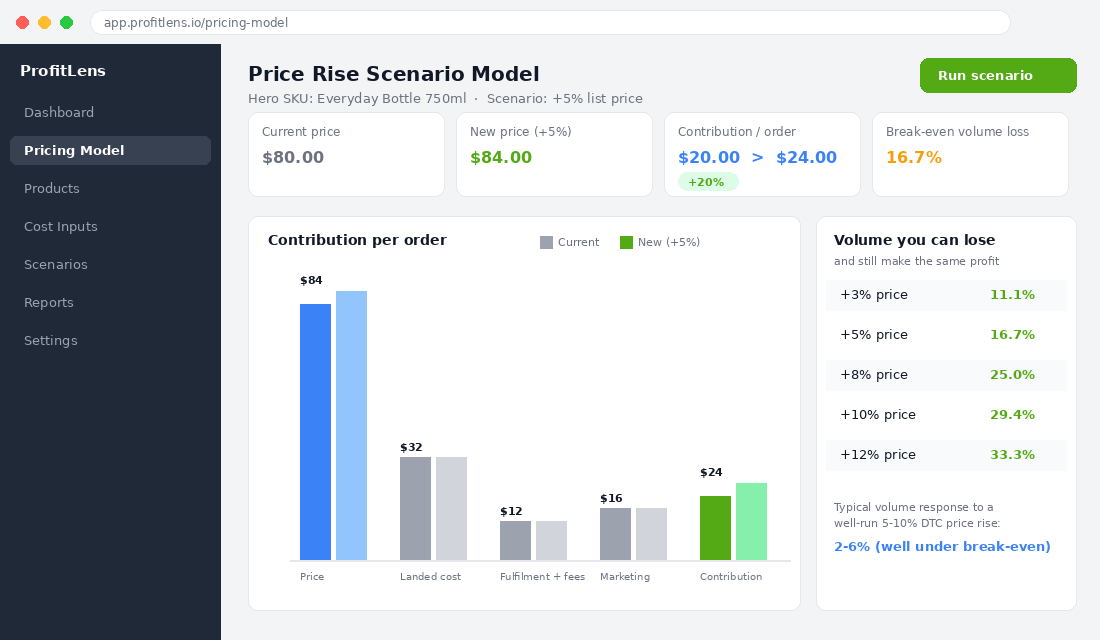
The same maths tells you how much volume you can afford to lose. In the example above, you could lose roughly 1 in 6 orders and still make the same total profit. Run this calculation for your own store before you do anything else:
- Contribution per order today. Price minus landed cost, fulfilment, payment fees, and marketing cost per order.
- Contribution per order after the rise. Same formula with the new price.
- Break-even volume loss. Old contribution divided by new contribution. If the result is 0.83, you can lose 17% of orders before the rise costs you anything.
The reason this exercise matters more in 2026 than it did two years ago is that the cost side is not slowing down. Deloitte Access Economics has flagged pressure that could add another 2.1% to the Australian retail cost base on top of the inflation already in the system, and port booking and handling fees have climbed 10 to 40% since early 2025. Holding your 2024 prices against 2026 costs is not a neutral decision. It is a decision to shrink your own margin every single month.
Almost every founder who runs this exercise is shocked by how much room they have. In practice, well-executed DTC price rises of 5 to 10% rarely move volume anywhere near the break-even line. Yotpo’s DTC Index found 87% of online merchants raised prices in 2025 to offset cost pressure. Your competitors have already moved. If your landed costs are a mystery, start with our landed cost playbook first, because you cannot price with confidence on numbers you do not trust.
Part 2: Decide Where to Raise (Not Everything, Not Evenly)
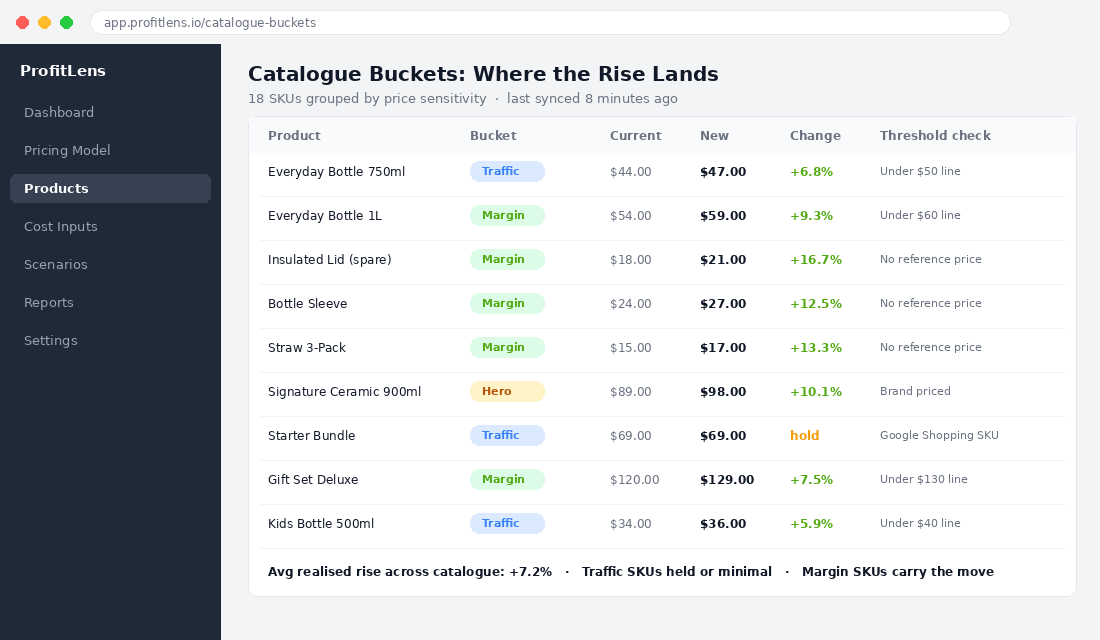
The lazy version of a price rise is 10% across the board. The smart version treats your catalogue like a portfolio, because your customers do not price-check every SKU equally.
Split your products into three buckets:
- Traffic products. The items people compare and Google. Your entry-level product, your best seller, anything that appears in Google Shopping against direct competitors. Raise these last and least.
- Margin products. Variants, larger sizes, accessories, add-ons, and anything unique to you. Customers have no reference price. These can move 8 to 15% with almost no volume response.
- Hero products. Your signature item. Price it on brand strength, not cost-plus. RM Williams has lifted the price of its Craftsman boot again and again over the past decade, and demand has held, because the product carries the brand’s whole story. Your hero product earns pricing power the same way.
Then check your thresholds. Price sensitivity is not linear: it clusters at round numbers. Moving from $44 to $48 is usually invisible. Moving from $48 to $52 crosses the $50 line and gets noticed. If a rise pushes you just over a threshold, either stop just under it or push far enough past it that you are pricing into the next tier with intent.
One more place to look before you touch the price tag: your discount ladder. If you run 20% off every month, trimming to 15% off every six weeks is a real price rise that never appears on a product page. For many stores, realised price (what customers actually pay after discounts) is 12 to 18% below list price. Tightening that gap is the quietest rise available to you.
Part 3: Test Before You Commit
You do not have to guess what a price rise will do. On Shopify, you can test it properly with Intelligems, the price testing app built for exactly this job. It splits your traffic, shows different visitors different prices, and calculates profit per visitor for each variant, factoring in your COGS, discounts, and shipping.
Setting it up takes an afternoon:
- Install Intelligems from the Shopify App Store. Plans start at US$49 a month and it holds a 4.7 out of 5 rating from merchants. Connect your store and load your COGS so the profit maths is real, not revenue-only.
- Pick 3 to 5 margin-bucket SKUs. Do not start with your hero or your traffic products. Test where the risk is lowest.
- Create a two-variant test. Control at current price, variant at plus 8 to 10%. Resist testing three or four price points at once unless you have serious traffic: splitting under 1,000 weekly sessions per variant leaves you waiting months for an answer.
- Run for at least two weeks or 100 orders per variant. Judge on profit per visitor, not conversion rate. A variant that converts 6% worse but earns 11% more contribution is a winner.
- Roll the winner out to the matching bucket. Then move to the next bucket and repeat.
If your traffic is too small to test properly (under roughly 15,000 sessions a month), skip the tooling and use the phased rollout instead: raise prices for new customers first, watch conversion for two weeks, then extend to the whole store. New visitors have no memory of your old prices, so they give you a clean read with zero goodwill risk.
Part 4: Announce It Like a Founder, Not a Finance Department
Here is the part most founders get wrong. The research on this is blunt: companies that frame a price rise well retain up to 95% of their customers through it. The rise itself is rarely the problem. The corporate-speak email that starts with “due to increased operational costs” is the problem.
Your existing customers deserve two things: notice, and a reason that respects their intelligence. The playbook that works looks like this:
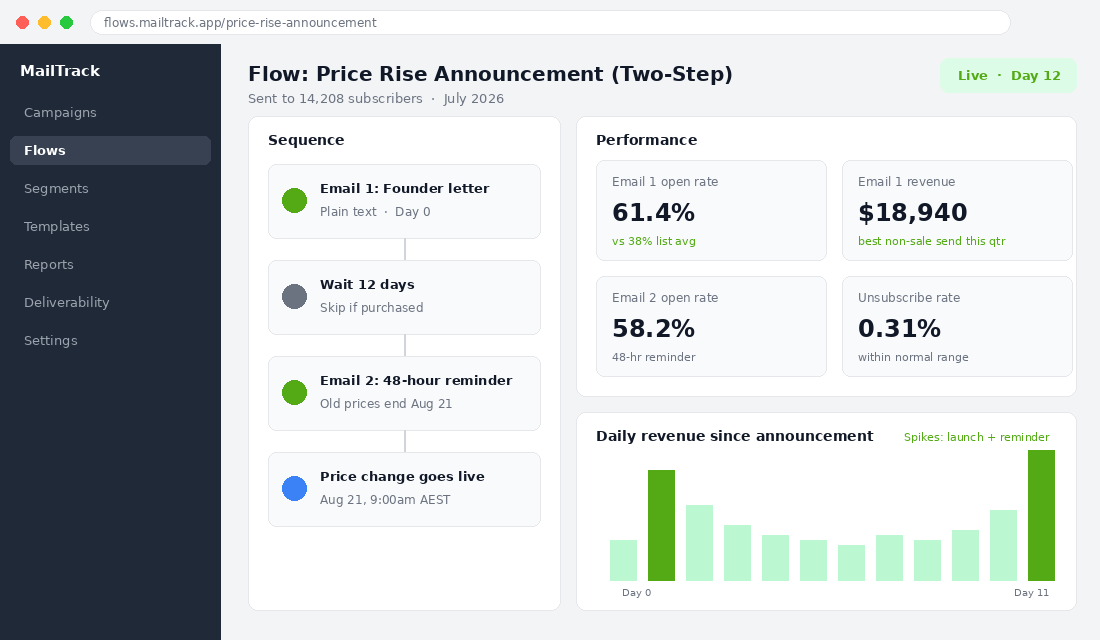
- Send a plain-text email from you, the founder. No campaign template, no hero banner. Your name, your words, 150 to 250 words total. Say what is changing, when, and why in one honest sentence. “Freight into Australia is up nearly 30% since February and we have held prices as long as we could” beats any euphemism.
- Give 2 to 4 weeks notice with a real deadline. “Current prices hold until August 21” turns the announcement into your best-performing campaign of the quarter. Jewellery brand Kimai runs this as a two-step sequence: the announcement, then a final reminder 48 hours before the change. Existing customers stocking up at old prices is not lost revenue, it is a loyalty dividend.
- Anchor the rise to something customers get. If the rise funds better packaging, faster shipping, or local support, say so specifically. If it simply keeps the business healthy, say that. Aussie customers respect straight talk and punish spin.
- Brief your support inbox first. Write the three-line response to “why did prices go up?” before the email goes out, so every reply is calm and consistent.
Here is a template you can adapt in ten minutes. It has done the rounds with eCommerce Circle members in skincare, apparel, and homewares, and the pattern holds across all of them:
Subject: A change to our prices from August 21
Hi [first name],
I wanted you to hear this from me, not from a checkout page. From August 21, most of our prices will rise by around 6 to 8%. Freight into Australia has jumped nearly 30% since February and our costs have followed. We have held our prices for as long as we could, and this change keeps us making [product] the way you expect it made.
Until August 21, everything stays at current prices. If you have been meaning to stock up, this is the moment.
Thanks for backing a small Australian business. It means more than you know.
[Founder name]
Notice what the template does not do. It does not apologise. It does not bury the change in paragraph four. It does not promise the rise is temporary. Apologising frames the new price as a wrong you are committing, and customers take their cue from your framing. State the change, give the honest reason, hand them a genuine chance to buy at the old price, and move on.
Timing matters too. Send the announcement on a Tuesday or Wednesday morning, keep the final-48-hours reminder short, and do not run any other campaign in the same window. The announcement is the campaign. Stores running this two-step pattern typically see their strongest non-sale revenue week of the quarter, funded entirely by customers who were already planning to buy eventually.
One group needs special handling: your subscribers and repeat buyers. Grandfather them for one extra cycle, or pair the rise with a loyalty perk. Acquiring a new customer costs 5 to 25 times more than keeping an existing one, so protecting your best customers through the transition is not generosity, it is arithmetic. Your customer lifetime value playbook shows you how to work out exactly what those top customers are worth before you decide how generous to be.
Part 5: Hold the Line After the Rise
The fortnight after a price rise is where discipline pays. Watch four numbers daily for the first two weeks, then weekly:
- Conversion rate on changed SKUs. A dip of 5 to 10% in week one is normal and usually recovers as the anchoring memory fades.
- Contribution per order. This is the number the whole exercise exists to move. It should step up immediately.
- Total contribution per day. The tie-breaker. If per-order contribution is up more than volume is down, you are winning even while conversion looks worse.
- Repeat purchase rate at 30 and 60 days. The long-term check that existing customers stayed with you.
Read those numbers by segment, not just in aggregate. New visitors and returning customers respond to a rise very differently. New visitors never saw the old price, so any conversion drop in that segment points to a threshold or offer problem, not a goodwill problem. Returning customers carry the old price in their heads, so a temporary dip there is anchoring, and it fades. If your analytics setup cannot split those two groups cleanly, fix that before the rise, because the blended number will tell you a muddled story and tempt you into the wrong response.
The biggest post-rise mistake is panicking at the week-one dip and launching a 20% off sale. Do that and you have taught your entire list that price rises are fake and waiting beats buying. Aesop built one of Australia’s great premium brands on the opposite lesson: it simply never discounts, so customers never learn to wait. You do not need Aesop’s positioning to borrow the principle. Whatever your new price is, defend it for at least 60 days before you run any promotion that touches those SKUs.
If volume genuinely does not recover, do not roll the price back. Fix the value side instead: stronger product page proof, bundling, better photography. A price rise that exposes a weak offer has done you a favour by showing you where the real problem is. Our bundle playbook is the natural next move, because bundles let you protect the new price point while lifting perceived value at the same time.
How the Five Parts Compound
Run in sequence, this system feeds itself. The maths in Part 1 tells you how much room you have, so you stop pricing from fear. The portfolio split in Part 2 concentrates the rise where customers are least sensitive, so the maths holds in practice. Testing in Part 3 replaces opinion with profit-per-visitor data, so the rollout is a decision rather than a gamble. The founder-led announcement in Part 4 converts the change into a revenue spike and a trust deposit instead of a churn event. And the discipline in Part 5 makes the new price real, which resets the baseline for the next rise.
That last point is the one to sit with. Brands that manage price well do not do it once. They build a small, boring, twice-a-year pricing review into their calendar, nudging 3 to 5% where the data allows, and they never again find themselves 20% behind their costs begging customers to accept a giant catch-up rise. Small, regular, well-communicated moves are how you keep margin without ever writing the dreaded “due to rising costs” email again.
The Price Rise Checklist
Steal this and run it in a single working session before your next rise:
- Know your numbers. Contribution per order today, after the rise, and your break-even volume loss.
- Bucket the catalogue. Traffic, margin, and hero products, with a different treatment for each.
- Check thresholds. Stay under round-number lines or price boldly past them, never just over.
- Trim the discount ladder first. Realised price is the quietest rise you can make.
- Test or phase. Intelligems on margin SKUs if you have traffic, new-customers-first if you do not.
- Write the founder email. Plain text, honest reason, real deadline, 2 to 4 weeks notice.
- Protect your best customers. Grandfather subscribers one cycle, brief support before launch.
- Watch four metrics for 14 days. Conversion, contribution per order, total contribution, repeat rate.
- Defend the price for 60 days. No discounts on changed SKUs, no rollbacks, fix value instead.
A price move is really a margin move, so model it on the number that matters rather than on revenue. If you have not worked yours out per product yet, start with contribution margin and put the increase through that.
Inside eCommerce Circle, pricing is one of the core Profit levers we work on with every member, and it is usually the fastest one to move. If you want a second opinion on where your catalogue has room, let’s talk.