Ask most Shopify founders how the business is going and they will quote you two numbers: yesterday’s sales and the bank balance. Ask them what their contribution margin was last month, or how much of the cash sitting in that account actually belongs to the ATO, and the conversation goes quiet.
What’s in This Article
That silence is expensive. A joint CommBank and UNSW study found close to 80% of Australian small businesses felt significant cash flow pressure in the past year, and ASIC benchmarks show poor cash flow or financial management is cited in roughly 47% of SME insolvencies. Most of those founders were not lazy. They just ran their business off a bank balance instead of a set of clean books.
The fix is not hiring a CFO or spending your weekends in spreadsheets. It is a month-end close: a short, repeatable routine that turns your messy Shopify data into a profit and loss statement you can actually trust. Done properly, it takes under 2 hours a month. This playbook gives you the exact 5-step system, the tool stack, and the 7-point checklist we use with eCommerce Circle members.
Why Your Bank Balance Is Lying to You
Your bank balance is a single number that mixes at least four different stories. Some of that cash is real profit. Some is GST you have collected on behalf of the ATO and never owned. Some is money you will need for the next inventory order. And some is gift card balances or unshipped orders that are still liabilities, not earnings.
Running decisions off that blended number is how founders end up spending the ATO’s money on stock, then scrambling when the BAS lands. One in six Aussie small businesses now lose more than $2,500 a month to late payments alone, and the ones who feel it worst are the ones who find out at BAS time rather than at month end.
A monthly close separates those stories. Revenue becomes revenue, GST becomes a set-aside, inventory becomes a plan, and profit becomes a number you can defend. If you have read our guide to the 7 financial metrics every Shopify store owner should track, the close is the routine that keeps every one of those metrics honest.
The Real Reason Shopify Books Get Messy: The Payout Problem
Here is the trap almost every founder falls into. Shopify does not deposit your sales into your bank account. It deposits payouts, and a payout is a compressed bundle: gross sales, minus processing fees, minus refunds, sometimes spanning two different weeks of orders.
So when a $4,812 payout hits your bank feed and you code it straight to “Sales”, you have just understated your revenue, hidden your merchant fees, and buried your refunds. Do that for a year and your accountant is reverse-engineering your entire business at tax time, usually at their hourly rate.
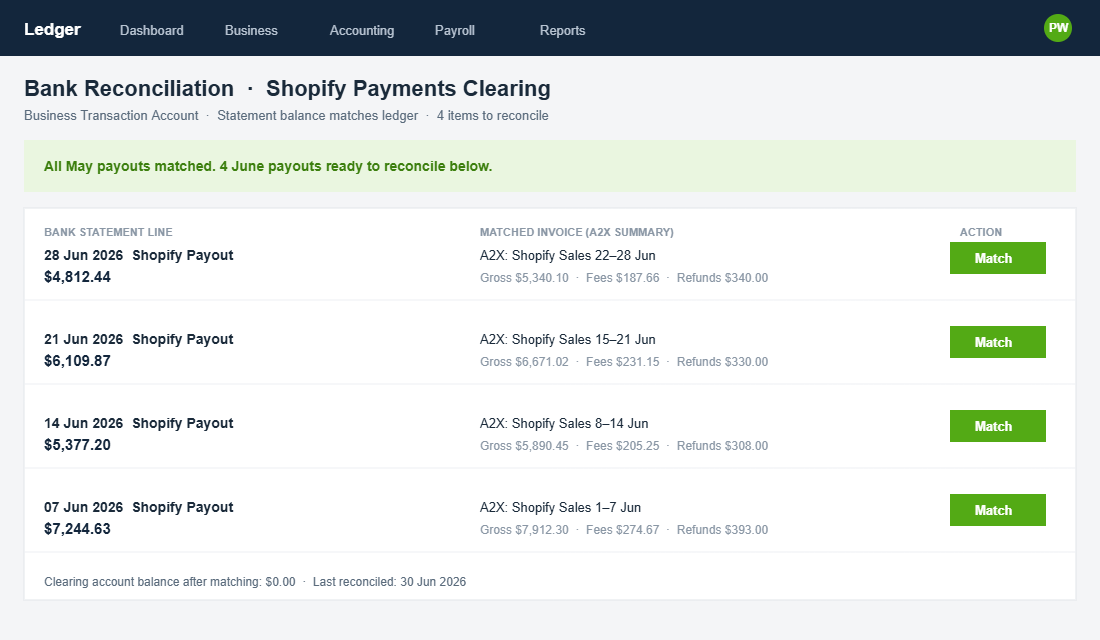
The professional fix is a clearing account. Sales get recorded at their true gross value in a “Shopify Payments Clearing” account, and payouts simply move cash from that clearing account to your bank. When the clearing account returns to zero after each payout, you know every dollar has been explained. That one structural change is the difference between books you trust and books you apologise for.
Step 1: Build the Two-Tool Stack That Does the Heavy Lifting
You need exactly two tools: Xero as your ledger and A2X as the translator between Shopify and Xero. Founders doing manual bookkeeping burn 5 to 10 hours a week on it. With this stack, members typically get to 1 to 3 hours a week, and the close itself drops under 2 hours a month.
A2X watches every Shopify payout, then posts a summary invoice into Xero that splits the payout into gross sales, discounts, refunds, merchant fees, gift cards and GST. The invoice matches the bank deposit to the cent, so reconciliation becomes one click per payout. Here is the setup, which most stores finish in under an hour:
- Connect the pipes. Install A2X from the Shopify App Store, connect your store, then authorise your Xero organisation. A2X pulls in your recent payout history automatically.
- Create the clearing accounts. In Xero, add a “Shopify Payments Clearing” account, plus separate clearing accounts for PayPal and Afterpay if you use them. Every gateway settles on its own schedule, so each needs its own holding pen.
- Map the money. In A2X, map gross sales to Sales Revenue, fees to Merchant Fees, refunds to a Refunds contra-revenue account, and gift card sales to a Gift Card Liability account. This 20-minute mapping session is where your P&L gets its accuracy.
- Check the GST settings. Confirm A2X is applying GST on Australian sales and treating export orders as GST-free. Then send one payout across and reconcile it in Xero as a test.
From that point on, the robots do the data entry. Your job shrinks to reviewing and deciding, which is exactly where a founder’s hours should go. Founders already spend around 36% of their working week on admin. This step claws a chunk of it back.
Step 2: Set Up a Chart of Accounts That Reads Like a Scoreboard
Xero’s default chart of accounts was built for generic small businesses, not DTC brands. If your P&L lumps freight, merchant fees and ad spend into “General Expenses”, it cannot tell you the one thing that matters: how much of each sale you actually keep.
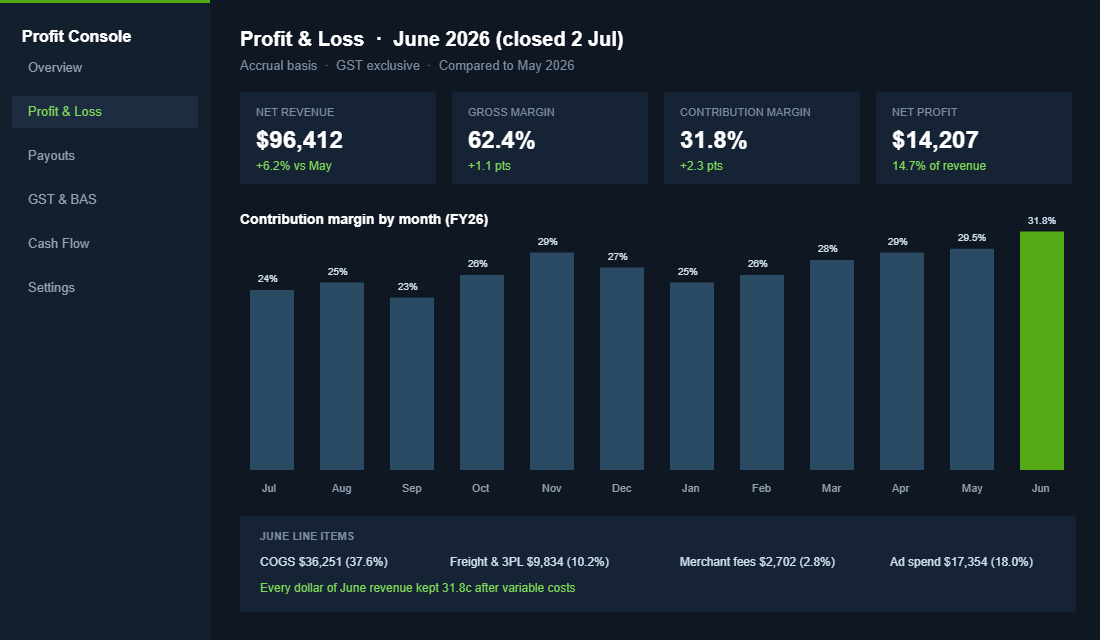
Restructure your P&L into three tiers. Revenue at the top: gross sales, minus discounts, minus refunds, giving net revenue. Variable costs next: COGS, freight and 3PL, merchant fees, and ad spend. What is left is your contribution margin, the number we unpack fully in the Shopify contribution margin playbook. Below that sit your fixed costs: apps, software, rent, wages, insurance.
Structured this way, your P&L answers operator questions in ten seconds. Is my margin trending up or down? Did that shipping rate change actually help? Can I afford another hire from fixed costs? A healthy DTC contribution margin usually sits between 25% and 35% of net revenue. If you cannot see yours on one page, your chart of accounts is hiding it.
Step 3: The 20-Minute Friday Rhythm That Makes Month End Painless
The founders who dread month end are the ones who arrive at it with five weeks of unreconciled transactions. The ones who breeze through it do a 20-minute tidy-up every Friday. Same work, radically different experience.
The Friday routine has three moves. First, open the Xero bank feed and match every A2X payout invoice that landed during the week. One click each. Second, categorise the non-Shopify lines: ad platform charges, app subscriptions, freight invoices, supplier payments. Set up bank rules for the recurring ones and Xero will pre-code them for you. Third, glance at the clearing accounts. If they are drifting away from zero, something is wrong and you have caught it within days instead of months.
That is it. No spreadsheets, no shoebox of receipts. Snap supplier invoices into Hubdoc or Xero’s file inbox as they arrive and attach them to transactions when you code them. Twenty minutes a week buys you a month end with no archaeology.
Step 4: Run the 7-Point Month-End Close Checklist
The close itself happens in the first three business days of the new month. Block 90 minutes, put your phone in another room, and work the same checklist every single time. Save this list somewhere you will actually see it:
- 1. Reconcile every payout. All Shopify payouts for the month matched to their A2X invoices in the bank feed. No exceptions, no “I’ll fix it later”.
- 2. Zero the clearing accounts. Shopify Payments, PayPal and Afterpay clearing accounts should all land on zero, or on the exact value of in-transit payouts.
- 3. Clear the bank feed. Every remaining line categorised. Anything you cannot identify goes to a “Sort Me” account you empty before signing off, not a dumping ground you never revisit.
- 4. Roll the gift card liability. Gift cards sold increase the liability, redemptions decrease it. The balance should match Shopify’s gift card report.
- 5. Post inventory and COGS. Take your closing stock value from Shopify or your inventory app and post the COGS journal so margin reflects what you actually sold, not what you happened to buy that month.
- 6. Check your GST set-aside. Look at the GST owing on your Xero dashboard and confirm that cash is parked in a separate savings account.
- 7. Review the P&L against last month. Write down the three biggest variances and one sentence on why each moved. This is the step that turns bookkeeping into strategy.
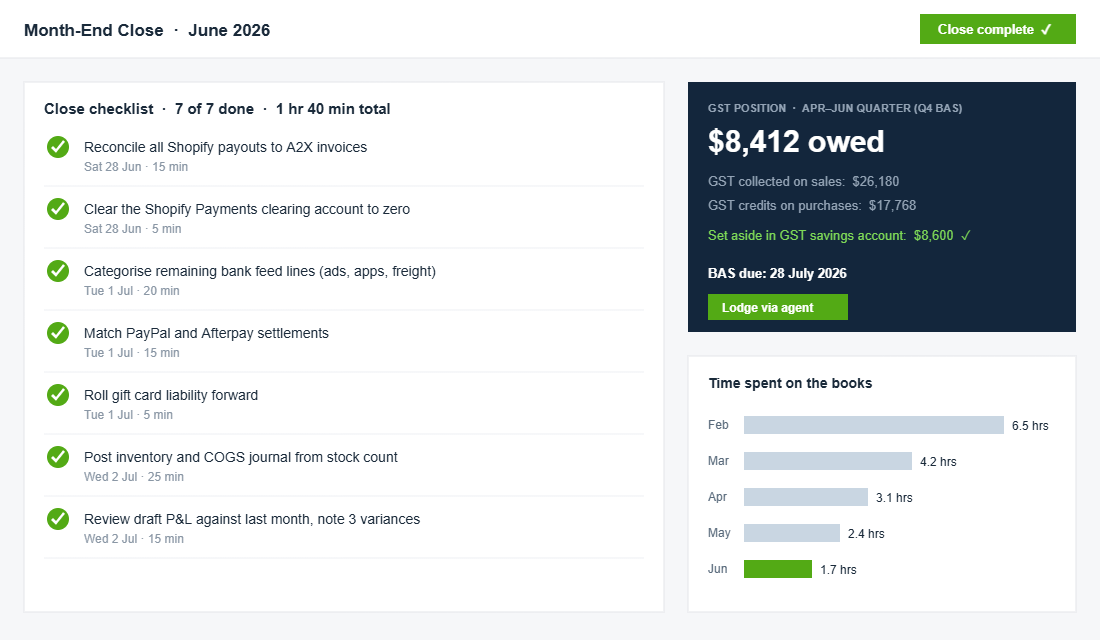
The first close usually takes three hours because you are cleaning up history. By the third month, founders consistently report 90 minutes or less. The checklist does not just produce clean books, it produces them on a schedule, which is what makes every downstream decision faster.
Step 5: Read Your P&L Like an Operator, Not an Accountant
Clean books are worthless if you never interrogate them. Once the close is done, sit with the P&L for fifteen minutes and answer five questions in writing.
- Did contribution margin move, and why? A two-point drop might be a freight increase, a discount-heavy campaign, or a product mix shift. Name the cause while the month is fresh.
- What did a customer cost me versus what did they bring? Divide ad spend by new customers, compare it to first-order contribution. If acquisition ate the margin, growth was rented, not earned.
- Which line item grew faster than revenue? Apps, freight and fees all creep. Anything growing faster than sales for two straight months gets audited.
- How many weeks of cash do I have? Average weekly outgoings divided into available cash, after the GST set-aside. Under six weeks means the next inventory order needs a rethink.
- What one number will I try to move next month? Pick a single target, write it down, and check it at the next close. That loop is the entire discipline of profitable growth.
CPA Australia estimates more than 60% of startups that fail within three years go down because of poor financial control. Nobody inside those businesses was reviewing five questions a month. The bar is genuinely that low, which means the edge is genuinely that cheap.
GST and BAS Without the Last-Minute Panic
For Australian stores, the close has one extra job: keeping you square with the ATO. The rules are simple enough. Once your turnover hits $75,000 you must register for GST within 21 days, charge 10% on Australian sales, and lodge a BAS, usually quarterly. Export orders are GST-free but still count toward your turnover.
The mechanics stop being scary when the bookkeeping is right. Because A2X splits GST correctly on every payout and Xero tracks GST on every expense, your BAS becomes a report you review rather than a project you dread. The habit that removes the fear entirely: every month at close, transfer the GST owing into a separate savings account. When the BAS lands on 28 July for the June quarter, the money is already sitting there.
We cover registrations, deductions and the traps in detail in our Australian ecommerce tax guide. The short version: the ATO does not care that you were busy scaling, and a clean monthly close is the cheapest tax insurance you will ever buy.
The Multi-Gateway Trap: PayPal, Afterpay and the Reconciliation Gaps That Hide Real Money
Most Aussie stores do not run on Shopify Payments alone. Add PayPal and Afterpay and you now have three settlement engines, each with its own fee structure, payout timing and reporting quirks. This is where otherwise tidy books quietly fall apart.
PayPal holds a balance, which means money can sit inside PayPal for weeks before it ever touches your bank. If you only record the bank transfer, you are recognising revenue late and missing fees entirely. Afterpay settles net of its merchant fee, which typically runs meaningfully higher than standard card processing, so coding the deposit as pure sales quietly inflates revenue and hides one of your biggest variable costs.
The treatment is the same medicine as Step 1: one clearing account per gateway, and a summary posting that splits gross sales from fees before the cash lands. A2X handles multiple gateways from the same Shopify store, so the setup cost is one extra mapping session, not a new system. At close, each clearing account either zeroes out or equals the in-transit settlements you can point to. If a clearing account drifts for two months straight, that is not an accounting quirk. That is money leaking, and now you can see exactly which pipe it is leaking from.
One more habit worth stealing: at every close, calculate total payment fees across all gateways as a percentage of net revenue. For most DTC stores it lands between 2% and 4%. If yours is above that, the mix has shifted toward your expensive gateways and it might be time to reorder your checkout options or renegotiate.
When to Hand It Off: The DIY-to-Bookkeeper Decision
Should you be doing any of this yourself? Early on, yes. Running your own close for at least six months teaches you how the machine works, and founders who have done it are dramatically better at managing bookkeepers later because they know what “done” looks like.
The handoff point is usually somewhere between $50k and $100k a month in revenue, or the moment the Friday rhythm keeps losing to firefighting three weeks in a row. A good ecommerce bookkeeper in Australia typically costs $300 to $800 a month for a store this size. Measure that against the 5 to 10 hours a week manual bookkeeping consumes and the maths rarely argues back.
- What you hand off: the weekly reconciliation, the coding, the GST mechanics and the checklist execution.
- What you never hand off: Step 5. The five operator questions are the founder’s job. The moment you stop reading your own P&L, you have outsourced your judgement, not your admin.
- How to brief them: send this playbook. A bookkeeper who pushes back on clearing accounts or A2X summaries is telling you they do not specialise in ecommerce. Keep interviewing.
Whoever runs the process, the deadline stays the same: books closed and P&L reviewed by day three of the new month. Speed matters, because a variance you catch on 3 July is a fix you make in July. The same variance discovered at BAS time in late October is a quarter of margin you never get back.
The Compound Effect: What Clean Books Actually Buy You
Each step in this system looks small on its own. Together they change how the business runs. The clearing account makes every payout explainable. The chart of accounts turns the P&L into a scoreboard. The Friday rhythm keeps the work microscopic. The checklist makes the close automatic. The five questions turn the numbers into next month’s plan.
Now stack the payoffs. Pricing decisions get made from real margins instead of vibes. Inventory orders get sized against actual weeks of cash. Ad budgets get judged on contribution, not ROAS screenshots. And when you eventually want funding, a line of credit, or an exit, you hand over two years of clean monthly financials while your competitors hand over a shoebox. The founder who closes their books every month is not doing more admin than the founder who does not. They are doing dramatically less, just on a schedule, and they are the only one of the two who actually knows what their business is worth.
Start this week: install A2X, create the clearing account, and put a 90-minute close block in your calendar for the first Tuesday of August. Three months from now the whole routine will feel as normal as checking yesterday’s sales.
The 6 Reconciliation Gaps That Break Most First Closes (and the Fix for Each)
Your first three closes will surface the same handful of problems. Knowing them in advance turns a four-hour frustration into a 20-minute checklist.
Gap 1: the payout timing straddle. Shopify Payments pays out on a 2 to 3 business day lag, so the last few days of every month sit in transit. A2X handles this with the clearing account, but only if you never manually reconcile a payout against sales. Gap 2: refunds netted against new sales. A $2,000 payout can hide $600 of refunds. If your P&L shows net sales only, your refund rate (which should be under 5 to 8% for most categories) is invisible. Make sure A2X posts refunds to their own line.
Gap 3: gift card liability. Gift card sales are not revenue until redeemed. Post them to a liability account or your December will look 5 to 10% better than it was. Gap 4: Afterpay and PayPal fees booked late. These gateways settle on different cycles and their fees (4 to 6% for BNPL) often land in the following month. Accrue them. Gap 5: inventory purchases expensed on payment. A $30,000 stock order paid in March is not a March cost. It is COGS across the months you sell it. Gap 6: the Shopify bill itself. Apps, themes and transaction fees sit on one invoice in USD. Book it at the month’s average rate and stop the FX noise from hitting your margin line.
For the full walkthrough of the Shopify-to-Xero matching process, use the Shopify Xero reconciliation guide.
From Close to Cash: Turning Your P&L Into an 8-Week Cash Forecast
A clean P&L tells you what happened. It does not tell you whether you can afford the next stock order. The close is only half the job until it feeds a forward view.
Once the month is closed, spend 15 minutes rolling three numbers forward: expected payouts (last month’s daily average sales times 0.97 for refunds and fees), committed outflows (supplier deposits, BAS, payroll, ad spend at your current daily rate), and the opening bank balance. Lay them across eight weekly columns in a Google Sheet. Most founders find their first genuine cash dip sits three to five weeks out, right where a stock deposit and a BAS payment collide.
Imagine a $150K/month Aussie apparel brand. Closed books show 42% contribution margin and $18K net profit. The forecast shows a $35K supplier deposit in week 4 and a $22K BAS in week 5 against $48K in the bank. Profitable on paper, tight on cash. Seeing that a month early is the difference between negotiating 30-day terms calmly and scrambling for a line of credit at 14% interest. The full method is in the 8-week rolling cash forecast.
The 5 Numbers to Read First When the Close Is Done
You do not need a 40-line P&L review every month. Five numbers, checked in order, tell you whether the business moved in the right direction.
Gross margin after landed cost, which should hold within 2 points month to month. A drop usually means a supplier price rise or freight surcharge you have not repriced for. Contribution margin after ad spend and fulfilment, the number that tells you whether growth is worth having. Under 20% and you are buying revenue, not building a business. Marketing efficiency ratio (total revenue divided by total ad spend). Most healthy Aussie DTC brands sit between 4 and 7. Refund rate, watched as a trend. A move from 4% to 7% is a product or sizing problem, not a finance one. Operating expenses as a percentage of revenue. If revenue grew 15% and opex grew 25%, you are scaling costs faster than sales.
Put the five in a single row of your monthly scorecard alongside the same five from last month and the same month last year. Ten minutes with that row, every month, is worth more than any dashboard app you can install. Make GST a sixth line if you are near the $75K threshold or growing fast; the Shopify GST playbook covers what to watch.
Inside eCommerce Circle, profit clarity is one of the core pillars we work on with every member, and the month-end close is where it starts. If you want a second opinion on your numbers, let’s talk.