For a decade the DTC playbook was simple: interrupt someone on Meta, drag them to your Shopify store, and hope they convert before the distraction wins. That model still works, but it is getting expensive and the click-through is leaking value at every step. TikTok Shop tears the middle out of it. Discovery, decision and checkout happen in the same fifteen seconds, inside one app, without the customer ever tapping a link to your site.
What’s in This Article
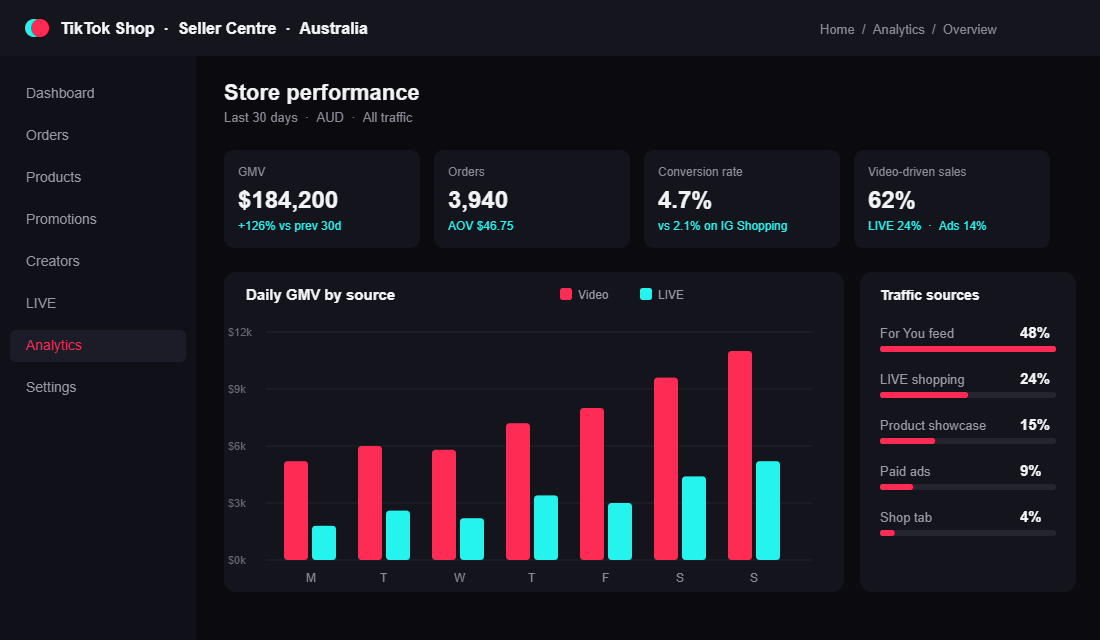
The numbers are not a fad. TikTok Shop did roughly US$66 billion in global sales in 2025, close to double the US$33.2 billion it managed in 2024, and it is forecast to clear US$112 billion in 2026. There are around 15 million sellers on it worldwide. In the United States it already accounts for 18.2% of all social commerce. This is not an experiment any more. It is a channel.
Here is what most Aussie founders are getting wrong. TikTok Shop went live in Australia in early 2025, and the brands treating it as “just another place to run ads” are missing the point entirely. TikTok Shop is a native sales channel that plugs straight into Shopify. Run it right and a video that would have earned you a like now earns you an order. This playbook is the five-part system for setting it up, feeding it, and turning Australian scroll time into real revenue.
What TikTok Shop actually is, and why it is different from TikTok ads
Start by separating two things founders constantly blur together. TikTok ads are how you buy reach and send people somewhere. TikTok Shop is where the transaction happens natively, inside the app, with your catalogue, checkout and orders living on TikTok itself. You can absolutely feed one into the other, but they are different machines. If your focus is paid acquisition, that sits in our Shopify TikTok Ads Playbook. This piece is about the shop.
A TikTok Shop shows up in three places: tagged products inside organic videos in the For You feed, a product showcase tab on your profile, and LIVE shopping where viewers tap to buy while you demo. The magic is that none of these require the customer to leave. No landing page, no cart bounce, no “3 second load time” tax. That collapsed path is exactly why conversion behaves so differently here.
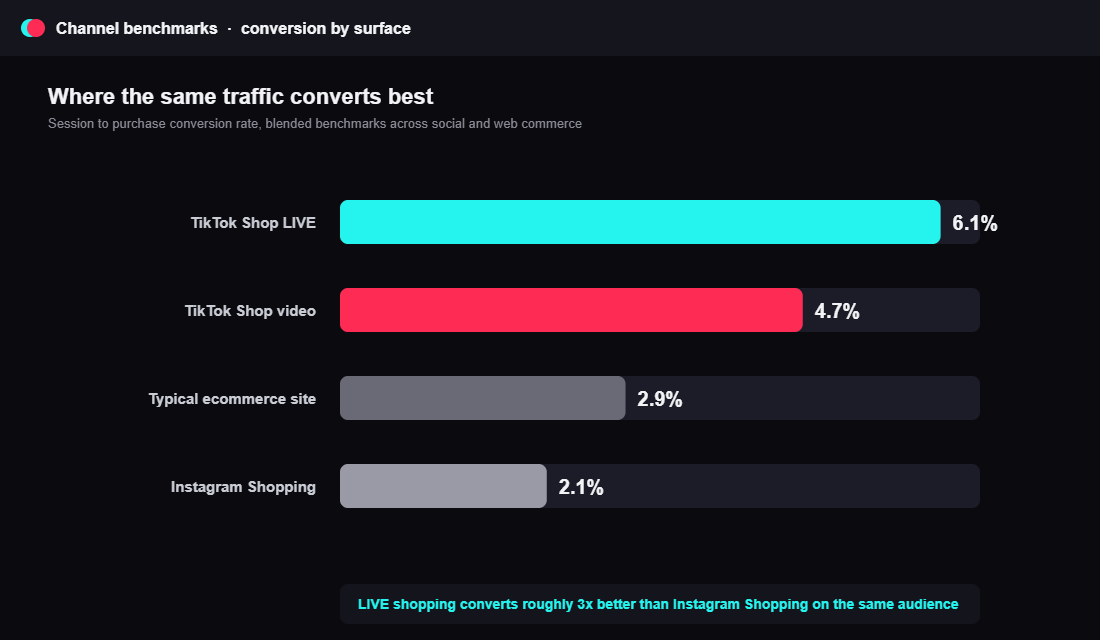
And it does behave differently. TikTok Shop video content converts at around 4.7% session to purchase, more than double Instagram Shopping at 2.1%. LIVE shopping pushes that to roughly 6.1%. For an Australian store used to a 2 to 3% site conversion rate, those are figures worth taking seriously.
Australian shoppers took to it quickly. TikTok already has deep daily reach here across the under-35 audience, and the same behaviour that made Aussie beauty, fashion and wellness brands go viral now has a checkout attached to it. The shift is subtle but important: you are no longer sending someone off to buy later, you are catching them at the exact moment of intent while the video is still playing.
Part 1: Connect it to Shopify properly before you post a thing
The fastest way to make TikTok Shop a nightmare is to run it as a separate island: a second catalogue, a second stock count, orders you copy across by hand. Do that and you will oversell, mis-ship and burn the goodwill a viral video just bought you. The whole point of the Shopify integration is that you manage one source of truth and TikTok mirrors it.
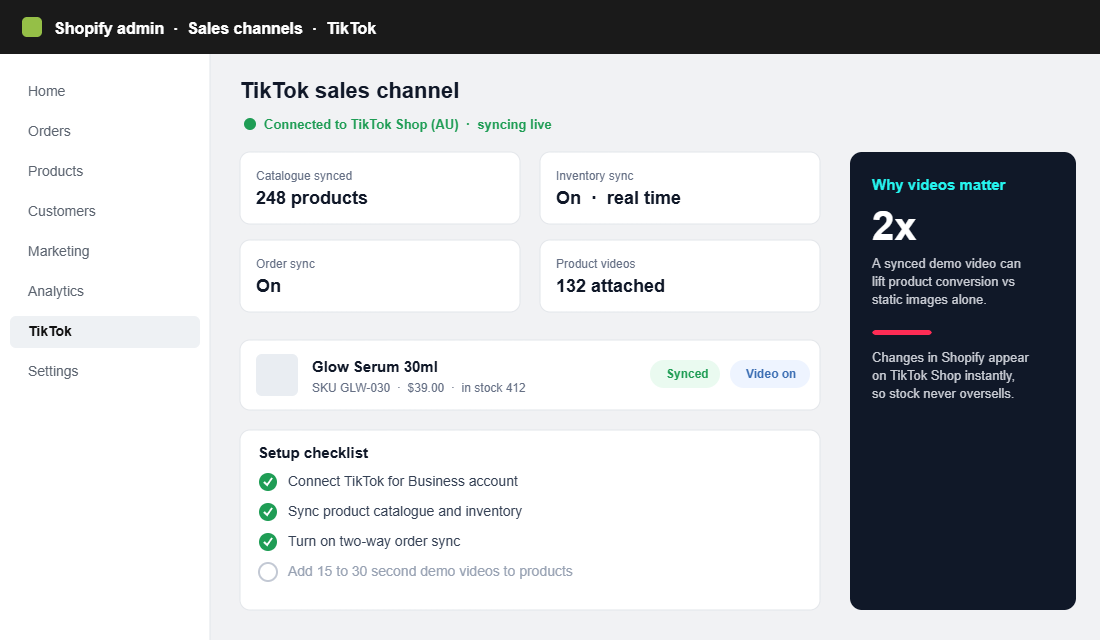
Install the TikTok sales channel from the Shopify App Store, then connect a TikTok for Business account. Once linked, your catalogue, inventory, fulfilment and orders sync both ways. Change a price or a stock level in Shopify and it appears on TikTok Shop within moments, so a product that sells out in a livestream stops selling everywhere at once.
- Install the channel. Add TikTok from the Shopify App Store and log in with a TikTok for Business account.
- Sync the catalogue. Push products, inventory and pricing so both platforms read from Shopify.
- Turn on two-way order sync. Orders placed on TikTok flow into Shopify for fulfilment and reporting.
- Attach demo videos. A 15 to 30 second product video synced from Shopify can roughly double conversion versus static images alone.
Get this foundation right and everything after it is just content and creators. Get it wrong and no amount of views will save you from the operational mess.
Part 2: Win the feed with content that sells, not content that just performs
The content that goes viral and the content that sells are not always the same thing, and TikTok Shop punishes founders who confuse them. A skit that pulls a million views but never shows the product in use will earn you followers and no orders. The winning format is closer to a demonstration than an advert: someone genuinely using the product, talking to camera, with the buy button tagged the entire way through.
Lead with the hook in the first second, show the transformation or result fast, and make the product the hero rather than the punchline. This is the same customer-content engine that powers organic growth elsewhere, and the raw material is usually your own customers. Our Shopify UGC Playbook covers how to source and brief that content at volume so you are never staring at an empty content calendar.
- Hook in the first second. The scroll is ruthless. Earn the next three seconds immediately.
- Show, do not tell. Product in hand, in use, with a clear before and after where you can.
- Tag every video. An untagged viral video is a wasted sale. The product link must be live in frame.
- Post volume. This is a probability game. Brands that post daily give the algorithm more shots at a winner.
Part 3: Build a creator affiliate engine, the real growth lever
You will never out-post the entire creator economy on your own, and you do not need to. TikTok Shop has a native affiliate program baked in: creators browse a marketplace of products, request samples, and post videos that carry your buy link. When their video drives a sale, they earn a commission you set. It is performance marketing where you only pay on results.
Commissions are set by the seller, not TikTok, and for most physical products they land somewhere between 5% and 15%. That is the price of an army of creators making content you did not have to brief, shoot or fund up front. The brands that scale on TikTok Shop are rarely the ones posting the most themselves. They are the ones who have recruited a hundred creators to do it for them.
The mechanics here rhyme with traditional affiliate marketing, just faster and more visual. If you want the structure for recruiting, tiering and paying partners, the Shopify Affiliate Marketing Playbook maps it out. On TikTok the same logic applies: make samples easy to get, set a fair commission, and reward your top few creators disproportionately.
- Open your product to the affiliate marketplace so creators can find and request it.
- Set a commission that clears. Too low and no creator bothers. 10 to 12% is a common sweet spot for physical goods.
- Send samples generously. The cost of a sample is trivial against one video that pops.
- Double down on winners. When a creator converts, give them exclusive codes, early drops and higher rates.
Think of your creators as a distributed content team you pay only when they sell. A single brand account might manage a handful of posts a week. A network of fifty active creators can put out that many in a day, each one reaching a different corner of the Australian For You feed you would never buy your way into.
Part 4: Use LIVE shopping to compress the buying decision
LIVE shopping is where TikTok Shop stops feeling like social media and starts feeling like a home shopping channel that actually converts. You go live, demo products in real time, answer questions in the comments, and viewers buy without leaving the stream. That live, time-bound, slightly urgent format is why LIVE converts at around 6.1%, the highest of any surface on the platform.
The UK beauty brand Made By Mitchell became the poster child for this, stacking record-breaking LIVE sales by treating streams as scheduled events rather than random appearances. Australian brands that already win on TikTok through viral content, the Bondi Sands and MCoBeauty types, are perfectly placed to capture that same demand natively instead of watching it leak to a link in bio.
Treat LIVE as a repeatable format, not a one-off. Pick a regular slot, promote it in your feed for days beforehand, line up a handful of hero products, and build in genuine reasons to buy now: limited stock, live-only bundles, a question-and-answer segment. If you want the full structure for streams, our Shopify Live Shopping Playbook goes deep on run sheets and offers.
Part 5: Price and merchandise for impulse, then protect your margin
TikTok Shop is an impulse machine, and impulse has a price ceiling. Average order values here run low by design, roughly US$35 to US$59 in the American market, well under the US$100 you might see on Meta. Sub-$100 products simply convert better to a scrolling, discovery-driven buyer. The 18 to 24 group alone now averages 9.1 TikTok Shop purchases a month at around a $74 basket.
That reality should shape what you put forward. Lead with your hero product, an entry price point, or a curated bundle that feels like a no-brainer at a scroll-friendly price. Save the premium, considered-purchase items for channels where people arrive ready to research. Pushing a $300 product into a feed built for impulse is a fast way to great views and no orders.
Then do the margin maths before you scale. Between creator commissions of 10 to 15%, platform fees, the cost of generous sampling and low AOV, TikTok Shop can look busy and still lose money if you are not careful. Know your contribution margin per order, set commissions you can actually afford, and lean on bundles and post-purchase offers to lift basket size. Volume is only a win when each unit is profitable.
One Australian detail worth nailing early: make sure your TikTok Shop pricing is GST-inclusive and your fulfilment settings reflect real domestic shipping times. Nothing kills a promising channel faster than a customer who felt surprised at checkout or waited a fortnight for a parcel a video implied was on hand. Clean, honest pricing and fast local dispatch are quiet conversion levers of their own.
Three mistakes that stall a TikTok Shop launch
Most stores that “tried TikTok Shop and it did nothing” tripped over the same three things. None of them are about the channel being wrong for Australia. All of them are self-inflicted and fixable in an afternoon.
The first is treating it like a billboard. Founders repost their polished ad creative, watch it die in the feed, and conclude the audience does not buy. TikTok rewards content that feels native and human, filmed on a phone, talking to camera, showing the thing actually working. Studio-perfect brand films are the fastest way to get scrolled past. If it looks like an advert, it performs like one.
The second is going quiet after one video. The algorithm is a probability engine, and one post is one lottery ticket. Brands that win are posting daily and briefing creators weekly, giving the system dozens of shots at a breakout. Consistency beats brilliance here, because a single winner can carry a month of orders and you cannot predict which upload it will be.
The third is ignoring the operations until it hurts. A video pops overnight, orders flood in, and a store that never synced inventory oversells stock it does not have or ships three days late. That turns a once-in-a-quarter viral moment into a wave of refunds and one-star reviews. The founders who capitalise are the ones who built the Shopify plumbing before the spike, not during it.
- Native over polished. Phone-shot demos beat studio ads on this platform, every time.
- Volume over perfection. Post daily and brief creators weekly so the algorithm has winners to find.
- Operations before virality. Sync stock and orders first so a spike becomes revenue, not refunds.
Sidestep those three and you are already ahead of most Australian stores dabbling on the platform. The channel is young enough here that discipline on the basics is a genuine edge.
How the five parts compound
On their own, each part is a tactic. Together they form a flywheel. Solid Shopify plumbing means you can handle a spike without overselling. Great feed content gives the algorithm winners to push. A creator affiliate army multiplies that content far beyond what you could post yourself. LIVE shopping converts the warmed-up demand at the highest rate on the platform. Impulse-friendly pricing makes the whole thing profitable at volume.
Now watch it stack. A creator posts a tagged demo that pops in the For You feed. That video sends viewers to your LIVE, where scarcity closes them at 6% plus. Orders flow into Shopify automatically, inventory stays honest, and the buyers you just won become the next wave of user content. Each part feeds the next, and none of it depends on dragging a customer to a slow landing page.
The brands still treating TikTok as a top-of-funnel awareness toy are leaving the checkout on the table. The ones treating TikTok Shop as a native channel are compounding content, creators and conversion inside the app where the attention already lives.
Your TikTok Shop launch checklist
Work through these in order. Most Aussie stores can be live within a week.
- 1. Install the TikTok sales channel in Shopify and connect a TikTok for Business account.
- 2. Sync catalogue, inventory and orders both ways so Shopify stays the single source of truth.
- 3. Attach demo videos to your hero products in Shopify before you launch.
- 4. Choose 3 to 5 impulse-friendly heroes under $100 to lead with, plus one bundle.
- 5. Set affiliate commissions at a rate you can afford, around 10 to 12% for physical goods.
- 6. Open products to the creator marketplace and start sending samples to relevant creators.
- 7. Post daily in a demonstration-led format, hook first, product as hero, always tagged.
- 8. Schedule a weekly LIVE with promoted timing, hero products and live-only offers.
- 9. Reward top creators with exclusive codes, early access and higher rates.
- 10. Track contribution margin per order so volume actually turns into profit.
Inside eCommerce Circle, building new sales channels like TikTok Shop without breaking the ones you already have is one of the core pillars we work on with every member. If you want a second opinion on your channel mix, let’s talk.