Every October, an office manager in Melbourne opens a spreadsheet with 180 names in it and a budget of roughly $250 a head. She has to choose, brand, wrap and ship the lot before the second week of December. She does not want a discovery call. She wants one page that tells her what it costs, how fast it ships, whether you can put a logo on it, and who to email.
What’s in This Article
Most Aussie DTC brands have nothing for her. No corporate page, no tiers, no minimum order quantity, no lead time. So she buys generic hampers from a gifting reseller who marks up someone else’s product, and your brand never enters the conversation.
That is a $45,000 order you did not lose on price. You lost it on paperwork. And it is happening while the rest of the market is fighting over the same retail shopper: Roy Morgan and the Australian Retailers Association forecast $72.4 billion in pre-Christmas retail spending across the six weeks into Christmas, with 15.9 million Australians (68% of adults) buying gifts. Corporate buyers sit outside that scrum entirely. They order early, they order in volume, they rarely ask for a discount code, and they come back the same week every year.
This is the five-part system for turning your existing product range into a corporate gifting channel. No new SKUs. No wholesale team. Just a page, a price ladder, and a Shopify configuration most founders do not realise they already have.
Part 1: Sell to the Buyer, Not the Recipient
Here is the mistake that kills most corporate gifting attempts before they start. Founders write the corporate page like a product page. Beautiful lifestyle imagery, emotive copy about how the recipient will feel, a story about the founder’s grandmother.
The person reading it is not the recipient. She is an executive assistant, an office manager, an HR or People and Culture coordinator, or an account director. She has been handed this job on top of her actual job. She is judged on one thing: whether 180 gifts land on 180 desks, on brand, on budget, on time.
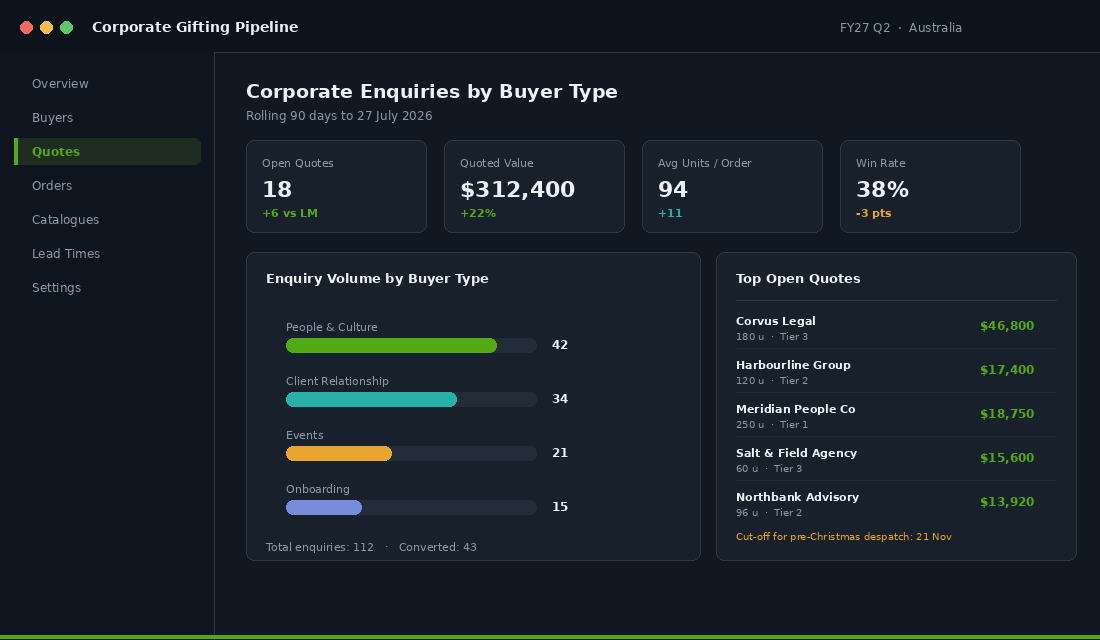
Everything on your corporate page should answer her anxiety, not the recipient’s delight. There are four buyer types worth mapping, and each one buys for a different reason:
- The People and Culture buyer. Buys staff gifts, onboarding kits and milestone rewards. Cares about the per-head budget, the FBT threshold, and whether remote staff can be shipped individually. Buys in November and again in June.
- The client relationship buyer. Account directors at agencies, accounting firms, law firms and real estate groups. Buys 30 to 120 gifts for clients. Cares about looking generous and looking different from last year. Willing to pay a premium for something not sold in Myer.
- The events buyer. Conference organisers, marketing managers running a roadshow. Buys 200 to 2,000 units at a low unit price. Cares about lead time and logo placement above all else.
- The onboarding buyer. Fast-growing companies sending welcome kits to new starters. Small volumes, but recurring monthly, which makes it the most valuable of the four over a year.
Pick two. Do not try to serve all four in year one. If your average order value sits above $120 and your product photographs well on a desk, go after the client relationship buyer and the onboarding buyer. If your unit economics work at scale and you can brand cheaply, go after events and People and Culture.
Part 2: Build the Corporate Gifting Page That Closes Without You
Bellroy, the Fitzroy-based accessories brand, runs one of the cleanest corporate gifting operations in Australia. Their corporate page states the minimum order quantity, shows the customisation options (debossed leather, stitched fabric), quotes production at 10 to 14 business days, and takes bulk orders that range from 50 embroidered wallets to 350 branded backpacks. No pricing guesswork, no “contact us for a quote” black hole.
Frank Green, another Melbourne brand, runs a dedicated co-branding and corporate gifts page for the same reason. Both brands understood the same thing: the corporate buyer will not chase you. If the page does not answer her questions in ninety seconds, she opens a new tab.
Your corporate gifting page needs seven blocks, in this order:
- A headline that names the buyer. “Corporate gifting for teams of 20 to 500” beats “Gifts they will love”. She needs to know in two seconds that you serve her volume.
- Three price tiers with real numbers. Not “from $X”. Actual per-unit pricing at 25, 100 and 250 units. Hiding price is the single biggest reason corporate enquiries go cold.
- Minimum order quantity, stated plainly. If your MOQ is 25 units, say so above the fold. You will lose the tyre-kickers and keep the real buyers.
- Lead times by option. Unbranded: 3 business days. Branded packaging: 10 business days. Custom engraving: 15 business days. Put a cut-off date on the page in September (“order by 21 November for pre-Christmas delivery”).
- Branding and personalisation options with photos. Logo on the box, a swing tag, a printed card with a custom message. Show them, do not describe them. Our product personalisation playbook covers the fulfilment side of this in detail.
- Split shipping, spelled out. Can you ship 180 individual addresses for remote staff? This is now the most common corporate requirement in Australia and most brands cannot do it. If you can, it is a genuine reason to win the order.
- One form, six fields. Name, company, email, unit quantity, delivery date, branding required yes or no. Nothing else. Every extra field cuts completion.
Add a downloadable one-page PDF gift guide with your tiers and lead times. The buyer almost never has final sign-off. She forwards a PDF to her manager. If your information only lives on a web page, it dies in her inbox.
Part 3: Price Your Tiers Around the ATO Minor Benefits Line
This is the most valuable thing on this page and almost nobody in Australian DTC uses it.
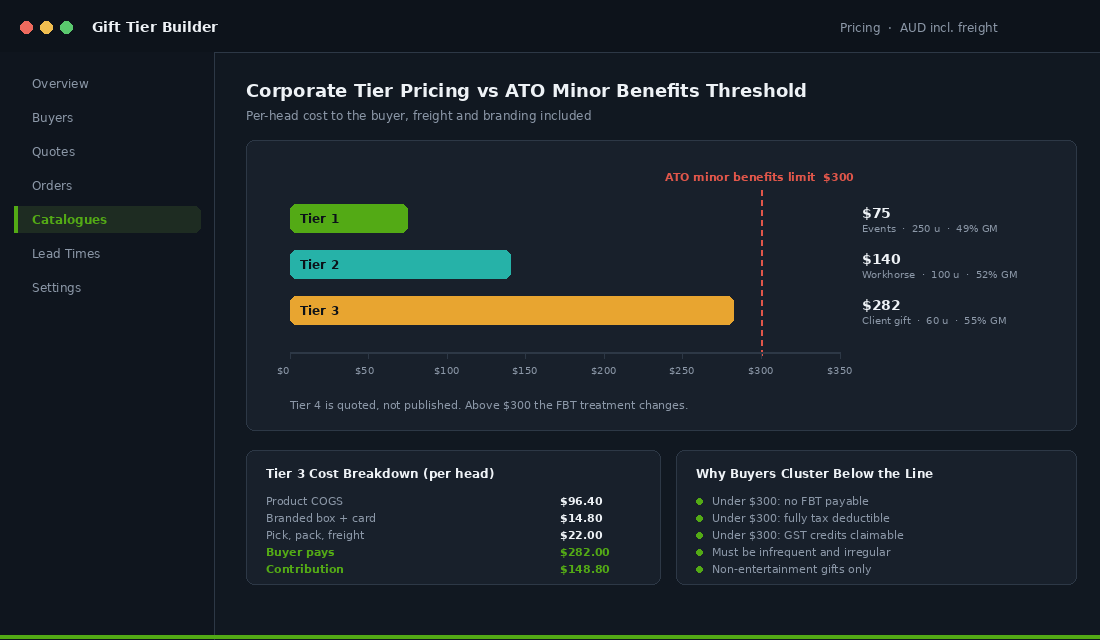
Under the ATO minor benefits exemption, a gift to an employee is exempt from fringe benefits tax where the notional taxable value is less than $300 and the benefit is infrequent and irregular. Non-entertainment gifts under that threshold (hampers, skincare, a bottle of wine, flowers, gift cards) are also fully tax deductible, with GST credits claimable. Cross $300 and the employer pays FBT on the whole thing, and the economics of the gift change completely.
So the corporate buyer is not shopping in a smooth price range. She has a wall at $300 per head, and she wants to get as close to it as possible without touching it. That is why generic hampers cluster at $89, $149 and $249. It is not taste. It is tax.
Build your ladder to match. A four-tier structure that works for most Aussie brands:
- Tier 1, around $65 to $85. The events and mass-staff tier. Single hero product, branded swing tag, no custom box. Aim for 45 to 55% gross margin at 250 units.
- Tier 2, around $120 to $160. The workhorse. Two products, branded outer box, printed card. This tier should carry most of your volume.
- Tier 3, around $220 to $260. The client gift. Three products, premium packaging, personalised message card. Sits deliberately under the $300 line with room for the buyer to add freight without breaching it.
- Tier 4, quoted. Anything above $300 per head is a different conversation, usually executive or VIP client gifting, and the FBT question is the buyer’s problem. Do not publish a price. Take the call.
Two margin rules. First, quote your tiers including freight and branding, because that is how the buyer budgets. A $260 gift plus $22 freight reads as $282 to her finance team, and if you quoted $282 you would still be inside the line. Second, never discount below your DTC price on the strength of volume alone. Corporate orders should carry better contribution margin than retail, not worse, because there is no ad spend attached to them. If you are unclear on your true per-order profit, fix that before you quote anything.
One more caution: the exemption applies to non-entertainment gifts. Tickets, event experiences and restaurant vouchers are treated differently. Tell the buyer to confirm treatment with their accountant, and put that line in your PDF. It signals you know the terrain, which is exactly what she wants from a supplier.
Part 4: Wire Shopify to Actually Take the Order
The reason most brands run corporate gifting through email and a spreadsheet is that they think proper B2B tooling means Shopify Plus. That stopped being true. As of the Spring 2026 release, Shopify put company profiles, B2B catalogues and volume pricing on the Basic, Grow and Advanced plans, not just Plus.
On a standard paid plan you now get company accounts, up to three active pricing catalogues, net payment terms (Net 30, 60 and 90), purchase order numbers at checkout, quick order lists, reorder from history, and draft orders with invoice-from-draft. Plus is still required for unlimited catalogues, partial payments and deposits, and direct catalogue assignment at the location level. For a brand doing 30 corporate orders a year, you do not need any of that.
Here is the setup, in order, and it takes about two hours:
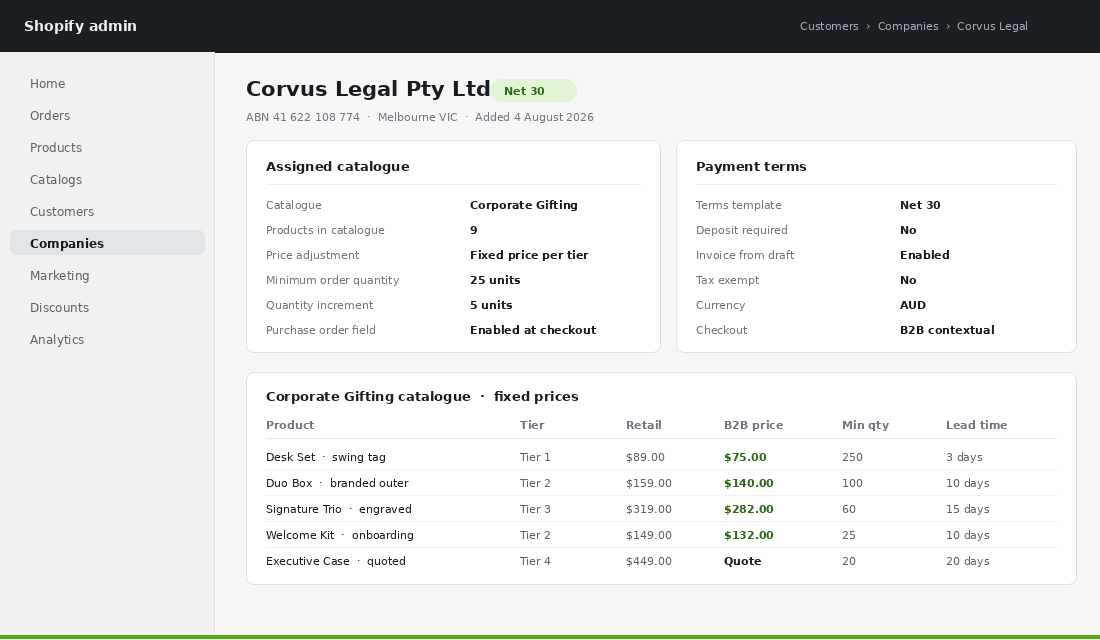
- Create your gifting catalogue. In Shopify admin, go to Products, then Catalogs, and create a catalogue named “Corporate Gifting”. Add only your tier products. Set fixed prices per tier rather than percentage discounts so your margin is locked.
- Set quantity rules. On each tier product, set a minimum order quantity matching your published MOQ and an increment (for example, minimum 25, increments of 5). This kills the retail shopper who tries to buy one at corporate pricing.
- Create the company record. Under Customers, choose Companies, then add the business, the buyer as a contact, and the billing location. Assign the Corporate Gifting catalogue to that company.
- Turn on net terms and PO numbers. Set Net 30 as your default for companies with an ABN. Enable the purchase order field at checkout. Corporate procurement will not pay by credit card at $40,000, and an invoice option is frequently the deciding factor.
- Build the draft order template. For quoted work, use draft orders with custom line items for branding and setup fees, then send the invoice directly from Shopify. Who Gives A Crap runs a similar model on its wholesale portal, offering invoice payment above a set order value rather than forcing card payment.
- Automate the handoff. Use Shopify Flow to tag any order over your MOQ with “corporate”, notify your fulfilment channel, and trigger a task to confirm the branding artwork within 24 hours.
If you already run a wholesale channel, this bolts straight onto it. Our B2B wholesale playbook covers the catalogue and terms architecture in more depth. And if you want a zero-risk entry point, corporate branded gift cards are the fastest version of this channel to launch, which we break down in the gift card playbook.
Part 5: Run the 12-Week Corporate Gifting Calendar
Corporate gifting is not a campaign you run in December. By December the budget is spent and the gifts are already on desks. The buying window opens in September and effectively closes in the first week of November.
Working backwards from a 21 November despatch cut-off, here is the calendar:
- Weeks 1 to 2 (late July, early August). Build the page, the tiers and the PDF. Lock your branding supplier and confirm their December capacity in writing. Order sample kits.
- Weeks 3 to 4 (mid August). Photograph the tiers as gift sets, not as loose products. Set up the Shopify catalogue, quantity rules and company records. Test a live draft order end to end.
- Weeks 5 to 6 (late August, early September). Mine your own customer list first. Search your Shopify customers for email domains that are not gmail, hotmail or outlook. Those are people who bought your product with a work email. They are the warmest corporate leads you will ever have and they cost nothing.
- Weeks 7 to 8 (mid September). Send the corporate gift guide to that list, plus a segment of your top 10% of customers by spend. One email, one PDF, one clear cut-off date. Follow up with anyone who opens twice.
- Weeks 9 to 10 (early October). Outbound. LinkedIn search for office managers, executive assistants and People and Culture coordinators within 20km of your warehouse. Local is a real advantage: it means they can see samples this week.
- Weeks 11 to 12 (late October, early November). Close, confirm artwork, take deposits and lock production. Publish a hard cut-off and hold it. Buyers respect a supplier who says no on 22 November far more than one who over-promises and ships on 19 December.
The email-domain mine in weeks 5 and 6 is the highest-return hour in the entire calendar. A brand doing 8,000 orders a year will typically surface 200 to 400 work-domain customers. Even a 3% conversion at tier 2 pricing on 60 units is roughly $25,000 in revenue from a list you already own.
Why the Corporate Channel Compounds
Retail customers churn. Corporate buyers renew. That difference is what makes this channel worth the two hours of setup.
The research on structured gifting programmes is consistent: client retention improves by up to 43% where gifting is embedded in the relationship model, and 52% of companies report increased sales after launching a corporate gifting programme. That is the benefit your buyer is chasing, and it is why she will come back next year rather than re-run a procurement process she hated. Australia’s corporate gifting market is compounding at roughly 11.8% a year, faster than most developed markets.
Stack the five parts and the mechanics work like this. Part 1 tells you which two buyers to chase, so your page speaks one language instead of four. Part 2 gives that buyer everything she needs to forward to her manager without emailing you. Part 3 puts your tiers where her budget wall actually sits, which removes price as an objection. Part 4 means she can raise a PO, pay on Net 30 and reorder next year in four clicks. Part 5 puts all of it in front of her in September, when the money is still unallocated.
The compounding shows up in year two. A corporate account that ordered 120 units last November does not need to be re-acquired. She has a saved company profile, a catalogue, a price she has already justified internally, and a supplier who delivered. Your customer acquisition cost on that order is one email. Meanwhile that same 120 units, sold at retail, would have cost you somewhere between $4,000 and $9,000 in ad spend to move.
There is a second-order effect worth naming. Those 120 recipients are 120 people who now own your product and did not pay for it. A meaningful slice of them become retail customers in the first quarter of the following year. Corporate gifting is the only channel that pays you to run product sampling at scale.
Your Corporate Gifting Readiness Checklist
Print this. If you cannot tick all twelve by the end of August, you will not be ready for the September buying window.
- Two target buyer types chosen and written down
- Corporate gifting page live with a URL you can send in an email
- Minimum order quantity published above the fold
- Three published price tiers with real per-unit numbers
- Top tier priced deliberately under the ATO minor benefits threshold, freight included
- Lead times published for unbranded, branded and custom options
- Hard pre-Christmas despatch cut-off date set and displayed
- Split shipping to individual addresses confirmed as possible or clearly ruled out
- One-page PDF gift guide downloadable from the page
- Shopify B2B catalogue, quantity rules and company record configured and tested
- Net 30 terms and purchase order field enabled at checkout
- Work-email-domain segment exported from your customer list
Twelve boxes. Most of them are an afternoon’s work. The gap between brands that land corporate orders and brands that do not is almost never product quality. It is whether an office manager with 180 names and a deadline could find your page, understand your pricing, and forward it to her manager before she got pulled into her next meeting.
Inside eCommerce Circle, building a second revenue channel that does not depend on ad spend is one of the core pillars we work on with every member. If you want a second opinion on whether corporate gifting fits your range, let’s talk.