In December 2025 the Federal Court ordered Australian retailer City Beach to pay a $14 million penalty for selling products containing button batteries that did not meet Australia’s mandatory safety and information standards. It was the first time the ACCC had gone to court for a penalty over those standards instead of quietly issuing an infringement notice.
What’s in This Article
Before that came the notices. Davie Clothing, the company behind The Oodie, paid $150,000. Hungry Jack’s paid $150,000. Tesla paid $155,000. The ACCC has also taken Amazon AU to the Federal Court over button batteries in children’s unicorn backpacks.
Here is the part most Aussie founders miss. Not one of those businesses made the product. They imported it or they listed it, and that was enough.
If your stock comes out of a factory in Shenzhen, Ho Chi Minh City or Ahmedabad, section 7 of the Australian Consumer Law treats you as the manufacturer whenever that overseas maker has no place of business in Australia. Your Shopify store is not a shopfront for someone else’s goods. Legally, they are your goods, with your name on the compliance obligation.
The good news is that this is a solvable problem, and it is solvable cheaply if you do it in the right order. Below is the six-check system to run on every new product before a purchase order is released. It takes about 90 minutes per SKU the first time and roughly 20 minutes once your team has the habit.
Why the Importer Is the One Who Pays
Under the ACL, a “manufacturer” includes the importer of goods where the actual manufacturer does not have an Australian place of business. Both the overseas factory and you can be concurrently liable, and a customer does not have to choose which one to chase. They will chase the one they can reach, which is you.
That liability cannot be contracted away. A clause in your supplier agreement saying the factory carries responsibility for safety is useful for recovering money from them later. It does nothing for your position with the regulator or the customer.
There is a second reason this is landing on DTC brands now rather than on big retail. Large retailers have compliance teams, and they have had them for decades. The growth in Australian ecommerce has put thousands of small brands into the importer seat with no equivalent function, which is exactly the gap the regulator has said it intends to close. Being small is not a defence, and being an online-only business is not a defence either.
The numbers around this are worth sitting with:
- Around 650 consumer product recalls are notified to the ACCC each year, and only about half of the affected products ever come back.
- 1,247 product safety market actions were recorded across Australia in 2025, down 3.2% on the 1,288 in 2024, but the second half of 2025 rose 10.3% on the first half.
- Maximum penalties for a company under the ACL are now the greater of $50 million, three times the benefit obtained, or 30% of adjusted turnover during the breach period.
- Unsafe products sold through online marketplaces and hazards to children sit at the top of the ACCC’s stated product safety priorities heading into 2026.
A recall does not just cost you the stock. It costs the freight, the destruction, the customer service hours, the paid media you already spent driving traffic to that product page, and a public listing on the recalls register that sits in Google results for years. Two weeks of paperwork in August is a very cheap trade.
Check 1: Classify the Product Before the Deposit Leaves Your Account
Most compliance disasters start the same way. The sample looked great, the price worked, the deposit went out, and nobody asked whether the thing was legal to sell here. By the time anyone checks, you have 3,000 units on a boat.
The fix is a 15 minute search before money moves. Go to productsafety.gov.au and run the product through two lists: mandatory standards, and banned products. Australia has mandatory standards covering a long list of everyday categories, including bicycle helmets, cots, prams and strollers, toys for children under three, aquatic toys, children’s nightwear, sunglasses and elastic luggage straps.
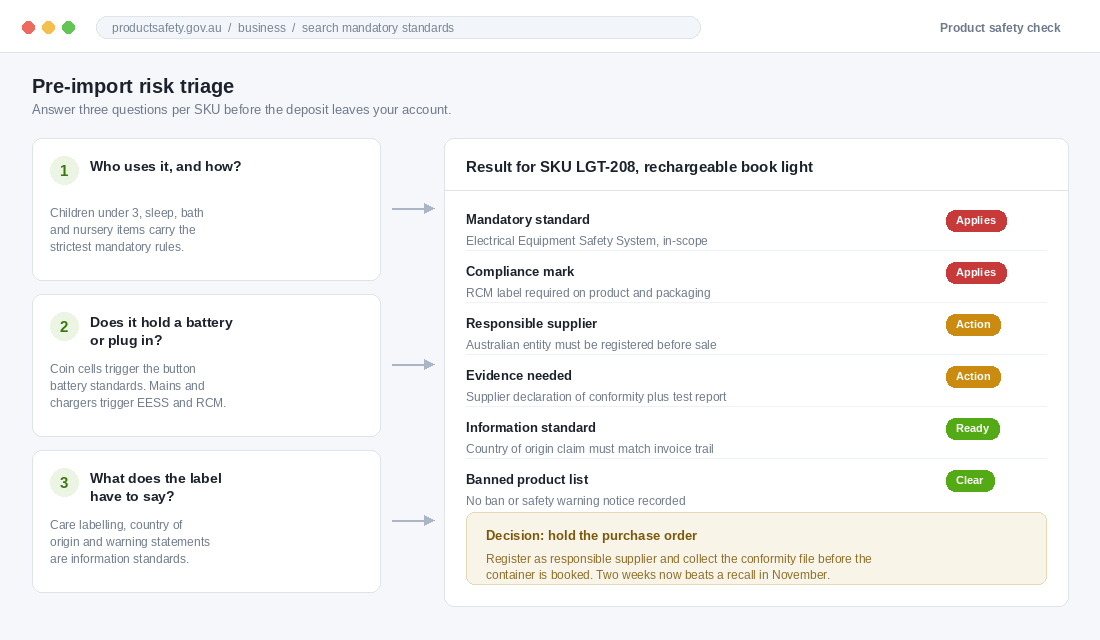
Ask three questions and write the answers on the product brief:
- Who uses it and how? Anything intended for or attractive to children under three, anything used in sleep, bath or nursery settings, and anything worn on the body carries the strictest rules.
- Does it hold a battery or plug in? Coin cells and mains power each trigger a separate regime, covered in checks 2 and 3.
- What is the product legally required to say? Care labelling, country of origin and warning statements are information standards, and breaching them is a breach in its own right even when the product is perfectly safe.
Pay attention to the phrase “attractive to children” as well, because it catches products that were never designed for kids. A scented candle with a glitter finish, a novelty drink bottle, a soft homewares item shaped like an animal: if a three year old would put it in their mouth, the toy rules can apply regardless of who you built it for. Sell it to adults, test it for children.
If the answer to any of these is “not sure”, that is not a green light to proceed and confirm later. That is your cue to hold the deposit. A supplier who cannot answer basic questions about which standard their product meets is telling you something useful about how they run their factory. Our product sourcing playbook covers how to vet that supplier properly before you get this far.
Check 2: Hunt for the Coin Cell in Everything
Australia’s button and coin battery standards have been mandatory since 22 June 2022, and they are the single most common way an ordinary DTC brand walks into a penalty. They cover secure battery compartments, child resistant packaging, warning labels and compliance testing.
The trap is that founders think of this as a toy problem. It is not. Coin cells hide in musical greeting cards, LED decorations, flameless candles, key finders, remote controls, novelty gifts, kitchen scales, thermometers, light up shoes and reading lights. The Oodie is a clothing brand and still landed a six figure infringement notice.
Run this on every SKU that has any electronic function at all, no matter how small:
- Ask the supplier to open it. Request photos of the battery compartment showing the fastener. A compartment held closed by a screw or a tool operated latch is the baseline expectation, not a nice extra.
- Request the compliance test report against the relevant Australian standard, with the report dated and naming the exact model you are buying, not a similar model from the same factory.
- Check the packaging artwork for the required warnings before the print run, not after. Child resistant packaging for spare batteries is part of the rule.
- Test the sample yourself. Try to open the compartment with your fingers and a butter knife. If you can get in, so can a toddler.
The cost of getting this right is a few hundred dollars in testing and one extra week in the production schedule. The cost of getting it wrong now sits in the public record at $14 million.
Check 3: Anything That Plugs In Needs a Registered Australian Supplier
If your product runs off mains power, ships with a charger, or contains a wireless radio, you are in Electrical Equipment Safety System and ACMA territory. The mark that signals compliance is the RCM, the Regulatory Compliance Mark, and it is not a sticker you can simply ask the factory to print.
Using the RCM requires an Australian based manufacturer, importer or supplier to act as the responsible supplier. If your factory has no Australian entity, that responsible supplier is you. The steps look like this:
- Determine the risk level of the equipment. Medium and high risk items carry registration obligations on the national database, and the classification drives everything that follows.
- Register your business as a responsible supplier on the EESS national database and obtain your supplier number. Do this while the sample is still being approved, because it is not instant.
- Collect the test evidence from a recognised laboratory covering the Australian standard for that equipment type.
- Complete a Supplier Declaration of Conformity and keep it on file. This is the document that connects your business to the claim the RCM makes.
- Apply the RCM to the product and packaging and confirm placement on the artwork proof before mass production.
One more thing that catches founders out at this stage. If you change factories for the same product, the evidence does not travel with the design. A new production site means new test reports and, in most cases, a new declaration. Treat a factory change like a new product, because from a compliance standpoint that is exactly what it is.
Founders selling homewares, beauty devices, outdoor gear and pet products get caught here constantly, because a rechargeable anything drags you into this regime. Build the registration once and it carries across your whole electrical range.
Check 4: The Label Is Part of the Product
Information standards are the quiet killer, because the product is genuinely safe and the breach is still real. Clothing and textiles need care labelling. Cosmetics need ingredient labelling. Country of origin claims have to hold up against your actual invoice and production trail.
Origin claims are worth extra care for Aussie brands, because the marketing pull toward “Australian Made” is strong and the tests behind it are specific. If the goods are manufactured offshore and only finished or packed here, the honest claim is a different claim, and the ACCC has a long history of pursuing brands that stretch it.
The same discipline applies to any performance claim you print. Waterproof ratings, thread counts, SPF numbers, weight limits and food-safe claims are all statements you have to be able to back with evidence. A claim you cannot substantiate on the packaging is a misleading conduct problem sitting quietly on every unit you own.
Three practical habits stop label problems dead:
- Approve artwork as a separate gate. Sign off the physical label, swing tag and carton print in writing, before the factory prints anything.
- Match your website to your label. Your product page copy, your ads and your packaging all have to tell the same origin and composition story. Regulators read the product page.
- Photograph the approved label and store the image with the SKU. When a customer or a regulator queries it in 18 months, you want the proof in one click.
Check 5: Build the Evidence Pack Before the Container Sails
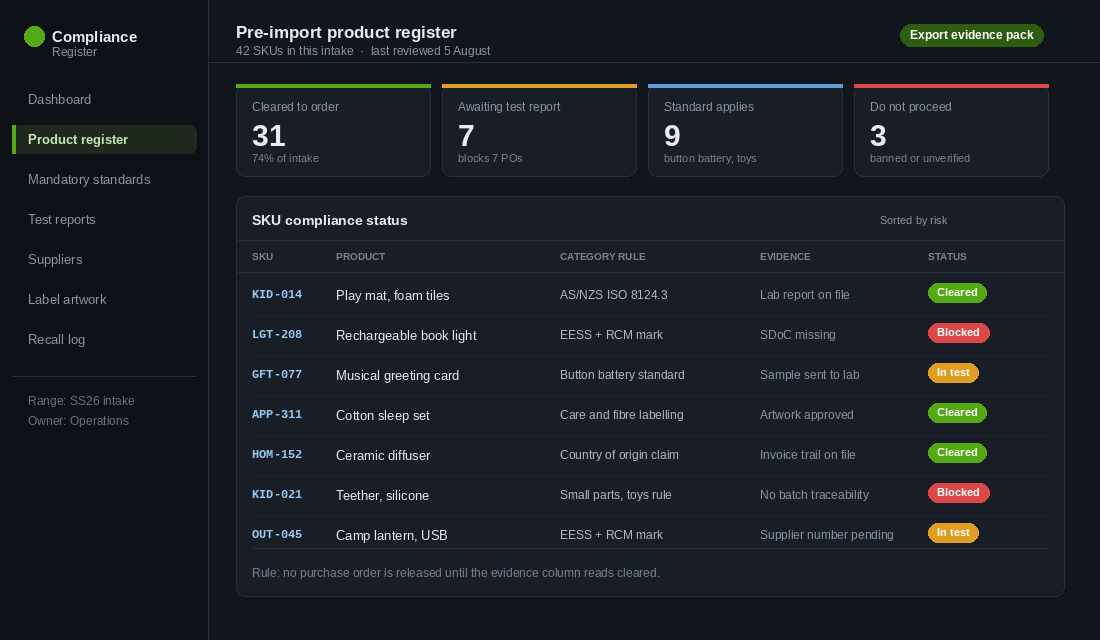
Compliance is not a feeling. It is a folder. If you cannot produce documents on demand, you are non-compliant in practice even when the product itself is fine.
Every SKU that touches a mandatory or information standard needs the same pack:
- Test report from a recognised laboratory, naming the exact model and dated.
- Supplier Declaration of Conformity where an RCM or similar mark is applied.
- Signed supplier declaration confirming the goods shipped match the tested sample, issued per production run.
- Batch or lot coding so you can isolate one production run instead of recalling three years of stock.
- Approved artwork proofs for labels, tags and cartons.
- Golden sample photographs from your pre-shipment inspection.
Batch coding deserves special attention. Brands that can trace a defect to a single run recall hundreds of units. Brands that cannot recall everything they have ever sold. Our quality control playbook covers golden samples and AQL inspections in detail, and the product recall playbook walks through the clock you are on once something goes wrong.
Check 6: Store the Compliance File Where Your Team Actually Works
Most brands that do the work still fail this step. The test reports live in the founder’s inbox or a shared drive nobody opens, and when a customer service rep needs the answer at 4pm on a Friday, they guess.
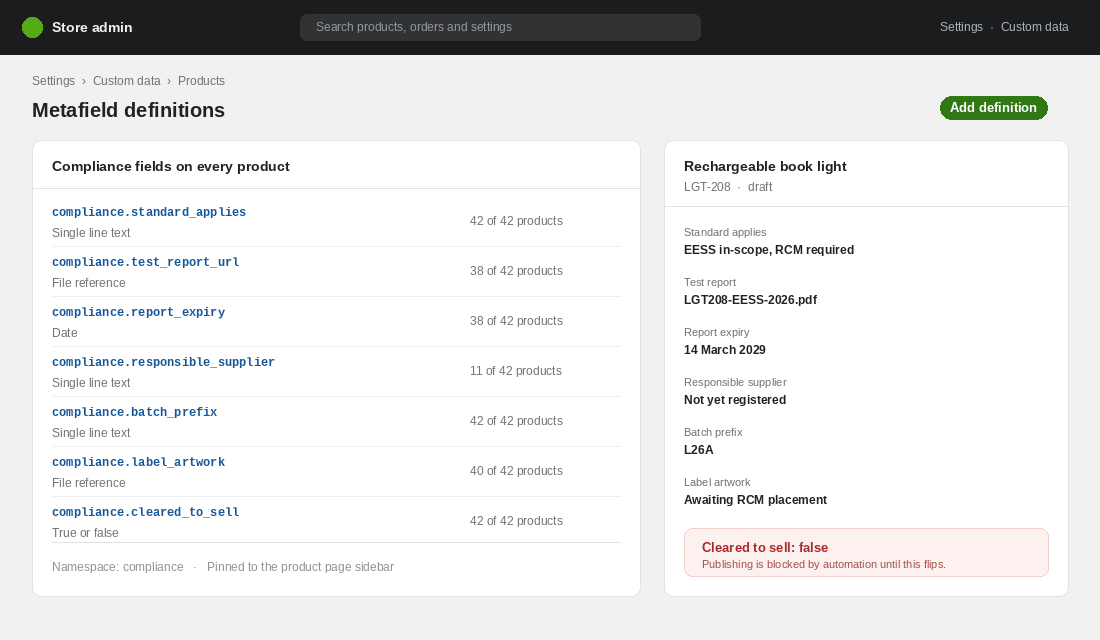
Put the file next to the product. Shopify metafields do this for free and take about 20 minutes to set up.
- In Shopify admin, go to Settings, then Custom data, then Products, and click Add definition.
- Create the namespace compliance and add these fields: standard_applies (single line text), test_report_url (file), report_expiry (date), responsible_supplier (single line text), batch_prefix (single line text), label_artwork (file) and cleared_to_sell (true or false).
- Pin the definitions so they appear in the product page sidebar and your team sees them without hunting.
- Use the bulk editor to backfill your existing catalogue. Sort by newest supplier first, because that is where your unknowns live.
- Build one Shopify Flow automation: when a product is about to be published and cleared_to_sell is false, keep it unpublished, add the tag compliance-hold and send an internal alert.
That last step is the one that changes behaviour. A rule your team has to remember will fail. A rule the platform enforces will not.
What Six Checks Actually Buy You
Run this system for two intakes and it stops feeling like paperwork, because the return shows up in places you were not expecting.
Your supplier negotiations get sharper. Factories that are used to being asked for conformity documents behave differently from factories that are not. Asking on day one tells them what kind of buyer you are, and it filters out the ones you should never have shortlisted.
Your marketplace expansion gets faster. Amazon, eBay and the big retail buyers all ask for compliance documentation before they onboard a product. Brands with the folder ready move in weeks. Brands without it spend three months chasing a factory that has changed account managers twice.
Your response time in a crisis collapses. A defect in one batch becomes a targeted recall of one batch, handled in days, instead of a scramble through three years of orders.
Your business becomes easier to sell. Every acquirer runs product compliance in due diligence. Missing conformity files on your top selling SKUs turn into price adjustments and escrow holdbacks. A clean register turns into a faster deal.
None of this shows up on your Shopify dashboard. It shows up as the recall you never had, and it compounds every time you add a supplier.
What Actually Happens When the ACCC Contacts You
Founders imagine this as a court summons. It almost never starts that way. It starts as an email or a phone call from a state fair trading office or the ACCC asking for information about a specific product — usually because a consumer complained, a competitor reported you, or your product was picked up in a market surveillance sweep.
What they ask for first is almost always the same short list: the supplier’s details, the test report, the packaging artwork, and your sales volume for that SKU. If you built the evidence pack in Check 5, this is a 20-minute reply and the matter usually ends there. If you did not, you are now emailing a factory in another timezone asking for a certificate that may not exist, while the clock runs.
That gap is what turns a routine enquiry into a problem. The regulator’s view of your business is shaped almost entirely by how fast and how completely you answer that first request. Cooperation and a documented compliance process are explicitly relevant to how these matters are handled, and to what penalty a court considers appropriate if it ever gets that far.
Practical rules for that moment. Answer within two business days even if the answer is partial, and say when the rest is coming. Do not guess at technical details — a wrong statement about a test standard is worse than “I am confirming that with the supplier.” Do not keep selling the product while you work it out; pause the SKU in Shopify, because continuing to supply after being put on notice is the fact pattern that escalates things. And loop in a lawyer who does consumer product work before you send anything substantive if the enquiry mentions a mandatory standard or an injury.
Keep a single named person accountable for the response. Compliance enquiries that get bounced between a founder, a warehouse manager and a customer service inbox are the ones that go badly, because nobody owns the timeline.
The Marketplace Layer: Where Compliance Gets Enforced Before the Regulator Ever Calls
Here is what has changed for Aussie brands in the last two years. Increasingly the first entity to enforce product compliance against you is not the ACCC — it is the platform you sell on.
If you sell anywhere beyond your own Shopify store, each channel runs its own compliance gate, and each one can pull your listing without warning:
- Amazon AU will request test reports and safety documentation for whole categories, often with a short window to respond before the listing is suppressed. Restricted categories require pre-approval documentation before you can list at all.
- eBay and Catch action listings reactively on complaints and recall notices, which means a single customer report can take a SKU down.
- TikTok Shop and Meta Shops apply their own prohibited and restricted product policies, which are stricter than Australian law in several categories — particularly anything therapeutic, cosmetic, or making a health claim.
- Your payment providers matter too. Processors have prohibited-product lists, and a compliance issue that triggers a review can put a hold on settlements — a very expensive week that has nothing to do with the product itself.
The practical implication is that the evidence pack from Check 5 is not just regulator insurance. It is your marketplace reinstatement kit. Brands that can produce a test report, a supplier declaration and compliant artwork inside 48 hours typically get listings restored in days. Brands that cannot often lose the SKU for the season, and on a marketplace that also damages your ranking and review history on that listing permanently.
Budget for it accordingly. Third-party testing for a simple consumer product generally runs a few hundred to a few thousand dollars per SKU depending on the standard. Set against a container of stock you cannot legally sell, or a marketplace listing that disappears in Q4, it is one of the cheapest forms of insurance in the business.
Build the Compliance Calendar, Not Just the File
The six checks are a pre-import gate. They are not a one-time exercise, because the standards move and your product does not stay frozen.
Put four recurring items in whatever your team actually uses — ClickUp, Asana, Notion, a shared calendar, it does not matter which:
- Quarterly: check the ACCC Product Safety Australia site for new or amended mandatory standards and recall notices in your categories. This takes fifteen minutes and it is the recurring compliance task that pays for itself the most often.
- Every reorder: re-confirm the supplier has not changed materials, components or the factory. A battery compartment that was screw-secured in run one and clip-secured in run three is a different compliance position on the same SKU.
- Annually: review test report expiry dates and supplier declarations. Some certifications lapse.
- On every new marketplace launch: run that channel’s category requirements before the first listing goes live, not after it gets suppressed.
The founders who never have a compliance crisis are rarely the ones who know the most about standards. They are the ones who made this a recurring calendar item instead of a thing they think about when a container is already on the water. Same discipline as your quality control process — the value is entirely in the repetition.
None of this is legal advice, and product compliance is genuinely specialised. If you are importing anything with a battery, a heating element, a therapeutic claim or a child user, get a compliance consultant across it before the deposit leaves your account. A few hours of their time is cheaper than every alternative.
The Pre-Import Compliance Checklist
Copy this into your product brief template and make it a required field before any deposit is approved.
- Searched productsafety.gov.au for a mandatory standard covering this category. Result recorded.
- Searched the banned products list. Result recorded.
- Confirmed whether the product contains a button or coin battery, and requested compartment photos.
- Confirmed whether the product is mains powered, ships with a charger, or contains a radio.
- Registered as responsible supplier and obtained a supplier number, where electrical rules apply.
- Requested test reports naming the exact model, with dates and laboratory details.
- Approved label, swing tag and carton artwork in writing, including any required warnings.
- Verified the country of origin claim against the invoice and production trail.
- Confirmed the batch or lot code format so any production run can be isolated.
- Loaded every document into the product record and set cleared_to_sell before publishing.
Ten lines. Most SKUs clear it in under half an hour, and the ones that do not are exactly the ones you needed to catch.
One caveat worth stating plainly. This is general information, not legal advice. Where a product sits close to a line, or falls into a regulated area like therapeutic goods, cosmetics or food, get a compliance specialist or a lawyer to look at it before you commit to a production run. The advice costs a fraction of the stock.
Product compliance is not the exciting part of building a brand. It is the part that decides whether the exciting parts survive contact with a regulator. If you want to understand the rest of your obligations once the product is live and selling, our consumer law playbook covers guarantees, refunds and the policy wording that goes with them.
Inside eCommerce Circle, Protection is one of the ten pillars we work on with every member, and product compliance is where most brands find they have been carrying a risk they never priced. If you want a second opinion on yours, let’s talk.