Most Aussie Shopify founders read the words “new consumer law” and quietly file it under next year’s problem. This one deserves a different reaction, because the behaviour it outlaws is sitting in your theme right now.
What’s in This Article
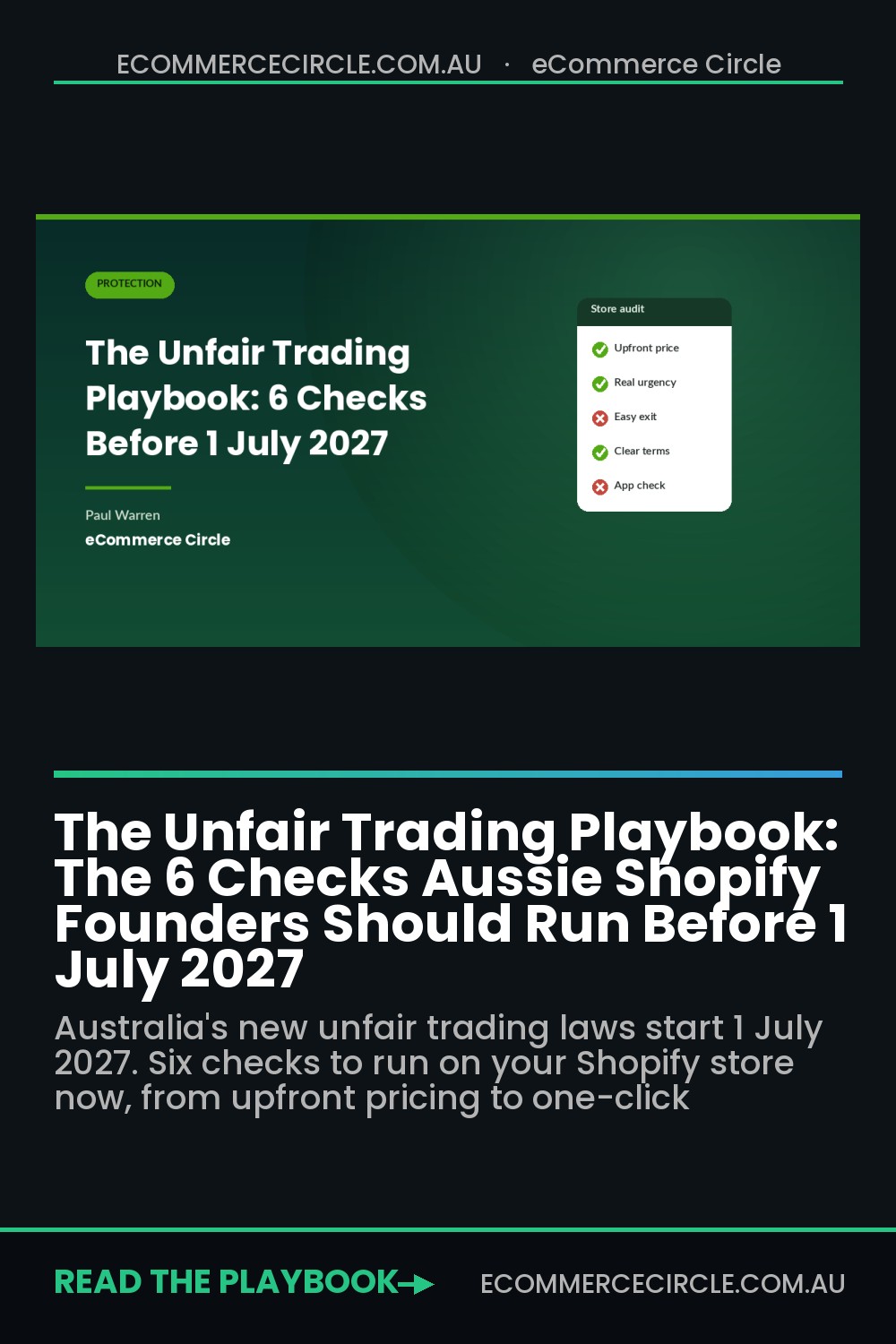
On 1 July 2027 the Competition and Consumer Amendment (Unfair Trading Practices) Act 2026 switches on a brand new prohibition inside the Australian Consumer Law. It bans conduct that manipulates a shopper, or unreasonably distorts the environment they make a buying decision in, where that conduct causes them detriment. DLA Piper puts the exposure at north of $100 million for a company and $2.5 million for an individual per contravention. That is not a parking fine.
Here is the part that should get your attention. The practices being targeted are not exotic. They are default settings on a lot of Australian Shopify stores. A delivery fee that only appears once someone reaches checkout. A countdown timer that resets when you hit refresh. A subscription that takes one click to start and an email to the support inbox to stop. Baymard Institute has the average cart abandonment rate at 70.22%, and unexpected extra costs are the single biggest reason people walk. The law is about to make the most expensive version of that behaviour illegal as well as unprofitable.
You have roughly eleven months of runway. Almost every fix below is a theme edit, an app setting or a page of copy, not a legal project. Run these six checks now and you will be finished long before the ACCC starts asking questions.
What the Act Actually Targets (And What It Leaves Alone)
The new prohibition has two limbs and a consequence test. Conduct breaches it if it manipulates the consumer, or unreasonably distorts the environment in which they decide, and it causes or is likely to cause detriment. Detriment is not limited to money lost. The explanatory memorandum specifically includes wasted time and inconvenience.
The manipulation limb is aimed at exploiting predictable behavioural biases, for example high pressure tactics that manufacture false urgency. Worth noting, the draft version required conduct to be unreasonably manipulative. That word was dropped before the Act passed. Conduct only has to be manipulative now, which is a materially lower bar than the one most retailers were preparing for.
The distortion limb covers two things: pushing someone into a transaction they would not otherwise have made, and obstructing someone from acting on a decision they have already made, such as seeking a refund or cancelling. Presenting an “overwhelmingly complex” environment, or burying key information in excessive and confusing detail, is called out by name.
Three sensible limits are worth knowing. The prohibition does not currently apply to contracts with small businesses or franchisees, though Treasury consultation on extending it closed in July 2026. It does not apply where the customer is a body corporate buying for a business. And it does not apply to financial services or financial products. If you sell wholesale through a separate B2B channel, that side of your operation sits outside this regime for now.
Normal marketing is still legal. The explanatory memorandum is explicit that legitimate, reasonable and generally accepted promotion is not the target. You can still run a sale, still write persuasive copy, still show that stock is low. What you cannot do is make it untrue, unclear or hard to escape.
Check 1: The Price You Advertise Has to Survive the Whole Journey
This is the check that will cost most stores the most work, and it is the one with the clearest rules.
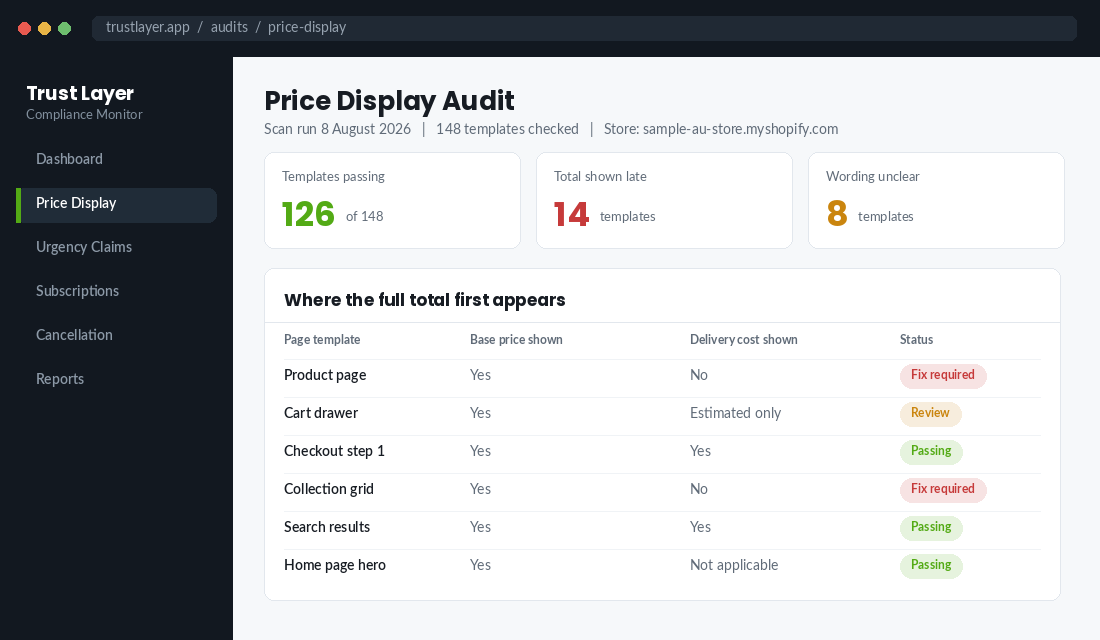
The Act adds a disclosure obligation that bites whenever you display a base price and a transaction-based charge applies. A transaction-based charge is an amount that is not payable for the goods themselves. A delivery fee is the obvious example for ecommerce. Where one applies, you have to disclose four things: the amount of the charge, or the method for working it out if it cannot be calculated yet; that it applies per transaction; whether it is or may be payable; and whether the displayed price already includes it.
The presentation standard matters as much as the content. That information has to appear while the base price is displayed, in a legible, prominent and unambiguous way, and in close proximity to the price. A link to a shipping policy three clicks away will not satisfy any of those three tests.
Some charges are carved out. Optional extras the buyer chooses, payment surcharges within the meaning of the Competition and Consumer Act, taxes and levies imposed on the supplier, and charges prescribed by regulation are all excluded. Your delivery fee, your handling fee and your “order processing” fee are not.
If you want a preview of what enforcement looks like, look at Webjet. In July 2025 the Federal Court ordered Webjet to pay $9 million in penalties after an ACCC case. Between 2018 and 2023 it advertised airfares that excluded compulsory “servicing” and “price guarantee” fees running from $34.90 to $54.90 per booking. The investigation started because one consumer complained that a fare advertised “from $18” ended up costing almost three times that once the fees appeared. That case was run under the existing misleading conduct provisions, before the new regime even exists.
What to do this month:
- Put a delivery line under every price. On the product page, directly beneath the price, state the position plainly. “Delivery from $9.95 per order, free over $99” beats “shipping calculated at checkout” on both compliance and conversion.
- Fix the collection grid too. The obligation attaches to displaying a base price, and your collection template displays hundreds of them. A single line in the collection header covering the delivery position handles it.
- Kill the word “estimated” if the number is knowable. If you have flat-rate domestic delivery, say the number.
- Move any handling or processing fee into the product price. If a fee applies to every order without exception, it is not a fee, it is your price. Rolling it in removes the disclosure obligation entirely and removes the biggest abandonment trigger at the same time.
- Screenshot the total at four points: product page, cart drawer, checkout step one, and the order confirmation. If the number changes between any two of them without the customer choosing something, you have work to do.
Check 2: Your Urgency Has to Be True
Scarcity is not banned. Fake scarcity is.
The explanatory memorandum uses a scarcity indicator as its worked example of how the same widget can sit on either side of the line. Showing genuine remaining stock levels is legitimate. The identical display becomes a contravention when it is used to pressure a shopper and manufacture a false sense of urgency, and the memorandum notes the risk rises when it is stacked with other pressure tactics.
That “stacked” point is the one Aussie stores keep getting wrong. One honest low-stock badge is fine. A low-stock badge, plus a countdown timer, plus a “14 people are viewing this”, plus a cart reservation clock, plus an exit popup offering a better price, all on the same page, is exactly the environment the distortion limb was written for.
The Consumer Policy Research Centre surveyed 2,000 Australians for its Duped by Design report and found 83% had experienced at least one negative consequence from manipulative online design. One in five spent more than they intended. Nearly one in three had stopped using a website or app because of it. That last number is the commercial argument. Pressure tactics do not just create legal risk, they burn the customers who notice.
Run this test on every urgency element on your store. Ask one question: if a customer took a screenshot and came back in 48 hours, would the claim still hold up?
- Stock counters must read live inventory. If the badge says “only 3 left” because someone hardcoded a threshold of 3, remove it or wire it to the real quantity.
- Timers must end. A sale that “ends tonight” and is still running on Thursday is the clearest possible evidence of manufactured urgency. Set a real end time and let the price actually go back up.
- Social proof widgets must reflect real events. “Sarah from Geelong just bought this” is fine if Sarah exists. Randomised name generators are not defensible.
- Cart reservation clocks need to reserve something. If the stock is not actually held, the clock is theatre.
- Cap yourself at one urgency element per page. This is the single easiest way to stay on the right side of the stacking problem.
We covered how to build scarcity that is both honest and effective in The Shopify Urgency and Scarcity Playbook. Everything in there still works under the new rules, because it was built on real constraints rather than invented ones.
Check 3: A Subscription Has to Be as Easy to Leave as It Was to Join
The subscription provisions are the most prescriptive part of the Act, and they catch more Shopify stores than founders expect.
A “subscription contract” covers four shapes. An indefinite recurring supply, like a monthly membership. A fixed term that automatically continues unless someone stops it. An initial free period that flips to paid, such as a 30-day trial. And an initial discount period that steps up to a higher rate, for example $25 for month one then $50 ongoing. If you run a subscribe-and-save box, a replenishment programme, or a paid membership tier, you are in scope.
Before someone can agree, you have to disclose that it is a subscription contract, the payment liabilities they will incur, the contract period, how it renews or continues, any notice period, and how to end it. For written contracts that information must be legible, prominent, unambiguous and in close proximity to where the person agrees. In practice, that means it belongs next to the subscribe button, not in a terms page linked from the footer.
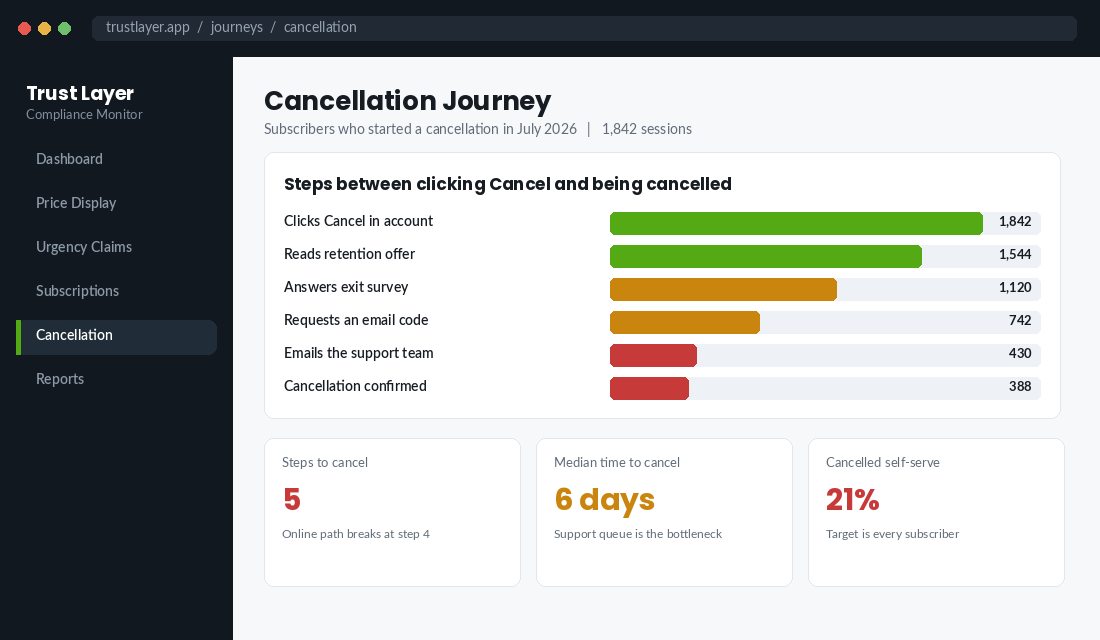
The exit requirements are the sharp end. You must provide a way to end the contract. Each cancellation method has to be easy to find, straightforward, and require only the steps reasonably necessary to cancel and protect the subscriber’s interests. Critically, if the customer signed up online, one of the ways out must also be online. The memorandum’s example is a gym that makes a member who has moved interstate attend a branch in person. The ecommerce equivalent is making someone email support and wait.
Do this in the next fortnight:
- Cancel your own subscription. Sign up as a customer, then cancel, and count the clicks and the elapsed time. If it takes more than three clicks from the customer account, it is too many.
- Allow exactly one save attempt. A single pause or discount offer is a reasonable step. A survey, then an offer, then a confirmation, then a code by email is a wall.
- Never route cancellation through a human. “Contact our team to cancel” is the practice the exit provisions were written to kill.
- Email before a trial converts. Send the reminder before the first paid charge, with the amount, the date and a one-click cancel link. This is also the cheapest way to prevent chargebacks.
- Put the terms at the point of decision. Directly under the subscribe option: the recurring amount, the frequency, when it renews, and how to stop it.
If subscriptions are a meaningful slice of your revenue, pair this check with The Shopify Subscription Playbook. Stores that make cancelling easy consistently report better lifetime value than stores that trap people, because a customer who leaves cleanly will come back.
Check 4: The Information That Changes the Decision Cannot Be Buried
The Act lists example dark patterns, and two of them are about disclosure rather than pressure: failing to disclose material information, and disclosing it in a complex, ineffective, unclear, unintelligible, ambiguous, untimely or overwhelming way.
Read that list again. “Untimely” and “overwhelming” are the words that matter for ecommerce. You can technically disclose everything and still contravene the prohibition if you disclose it in a way, or at a point, that makes it useless.
Material information for a Shopify store usually means one of six things: the real dispatch and delivery window, whether the item is a pre-order and when it ships, the returns window and who pays return postage, the warranty position, ongoing costs such as replacement filters or refill pods, and any sizing or compatibility constraint that determines whether the product works at all.
The practical standard is simple. If a fact would change whether a reasonable customer buys, it belongs on the product page above the fold or in the first accordion, written in a sentence a person can read in five seconds. Not a PDF. Not a policy page. Not the twelfth line of a shipping table.
- Pre-orders need a date, not a season. “Ships from 14 October” is disclosure. “Shipping soon” is not.
- State who pays return postage. This is the number one source of Australian post-purchase complaints and it takes one sentence to fix.
- Surface consumable costs. If the machine is $299 and the pods are $34 a month, say so on the page.
- Cut your product page disclaimers in half. Long disclaimer blocks are now a risk factor, not a shield. Excessive information that makes key facts hard to find is named in the memorandum.
- Check your claims separately. Environmental and health claims carry their own ACCC exposure, which we covered in The Shopify Green Claims Playbook.
Check 5: What Happens After the Sale Counts as Trading Too
This is the detail most summaries skip, and it is the one that reshapes how you should think about your support inbox.
The prohibition applies to conduct “in connection with” the supply or offer of supply. The explanatory memorandum states that phrase is deliberately drafted to capture conduct occurring after purchase, including conduct affecting a customer’s ability to access or use what they bought. The distortion limb explicitly covers obstructing a consumer from implementing a decision they have already made, and it names seeking a refund as the example.
Translated into Shopify terms: a returns process designed to be annoying enough that a percentage of people give up is now a legal risk, not just a reputational one. So is impeding someone’s ability to exercise a legal right, which is listed as a dark pattern in its own right. Your consumer guarantee obligations under the ACL do not shrink because your policy page says “final sale”.
- Give people a self-serve returns portal. If a customer has to email to start a return, you have built the same wall the exit provisions target for subscriptions.
- Drop artificial evidence requirements. Asking for a video of the unboxing, the original outer carton and a receipt number for an order you can look up is obstruction dressed as process.
- Publish the refund timeframe and hit it. “Refunds processed within 5 business days of receipt” is a promise you can keep and a defence you can point to.
- Separate policy from guarantees. Your change-of-mind policy is your choice. The consumer guarantees are not, and your team should be trained to tell the difference.
- Audit your macros. Read the first three replies your helpdesk sends on a faulty item. If any of them push back before offering a remedy, rewrite them.
The mechanics of a returns system that protects margin without frustrating people are in The Shopify Returns Playbook.
Check 6: Your App Stack Is Now Part of Your Compliance Surface
Here is the uncomfortable truth about a mature Shopify store. You did not write most of the interface your customers see. Apps did.
The urgency widget, the exit intent popup, the cart upsell, the shipping protection add-on that arrives pre-ticked, the post-purchase one-click offer, the subscription widget’s cancel flow. Each of those was configured by someone else, often with defaults tuned for short-term conversion lift in a different regulatory market. Under the new prohibition, they are your conduct.
Pre-ticked boxes deserve their own mention. Anything automatically added to a cart that the customer did not choose, whether that is shipping protection, carbon offset or an extended warranty, sits squarely in manipulation territory. It also generates a disproportionate share of chargebacks, which is a cost you are already paying.
- List every app that renders something on a product page, cart or checkout. Most stores find between eight and fifteen.
- Screenshot what each one actually shows. Do it on a phone, in an incognito window, as a first-time visitor. That is the journey the ACCC would look at.
- Untick everything. Any add-on must start unselected and be chosen deliberately.
- Check the defaults you never touched. Urgency apps often ship with randomised counters and evergreen timers turned on out of the box.
- Delete what you cannot justify. Every app you remove is one less thing to audit, one less script slowing the page, and one less monthly bill.
Why the Compliant Store Usually Outsells the Aggressive One
Run those six checks together and something becomes obvious. This is not a compliance project with a conversion cost. It is a conversion project with a compliance benefit.
Consider the numbers. Australians spent $82.6 billion online in 2025, up 14% year on year, with 9.8 million households shopping online and the average household buying from 16 brands a year, according to the Australia Post eCommerce Report 2026. Spend is rising while basket sizes fall, which is the signature of a value-seeking market. A value-seeking shopper compares more, checks totals harder, and abandons faster when a number moves.
Now stack that against Baymard’s finding that 48% of shoppers abandon when shipping, taxes or other charges push the total above what they expected. Showing the delivery cost on the product page does not just satisfy a disclosure obligation. It removes the biggest single abandonment trigger in ecommerce, and it does it before you spend money sending traffic to that page.
The same logic runs through the rest of it. Honest urgency keeps the 30% of Australians who abandon brands over manipulative design. Easy cancellation lifts reactivation, because subscribers who leave without a fight come back. Clear material information cuts the support tickets, the wrong-size returns and the disputes. Every one of those is margin.
The stores that will struggle in 2027 are the ones whose conversion rate depends on a customer not noticing something. If that describes a part of your funnel, the eleven months of runway is the gift, not the deadline.
The 60-Minute Readiness Audit You Can Run This Week
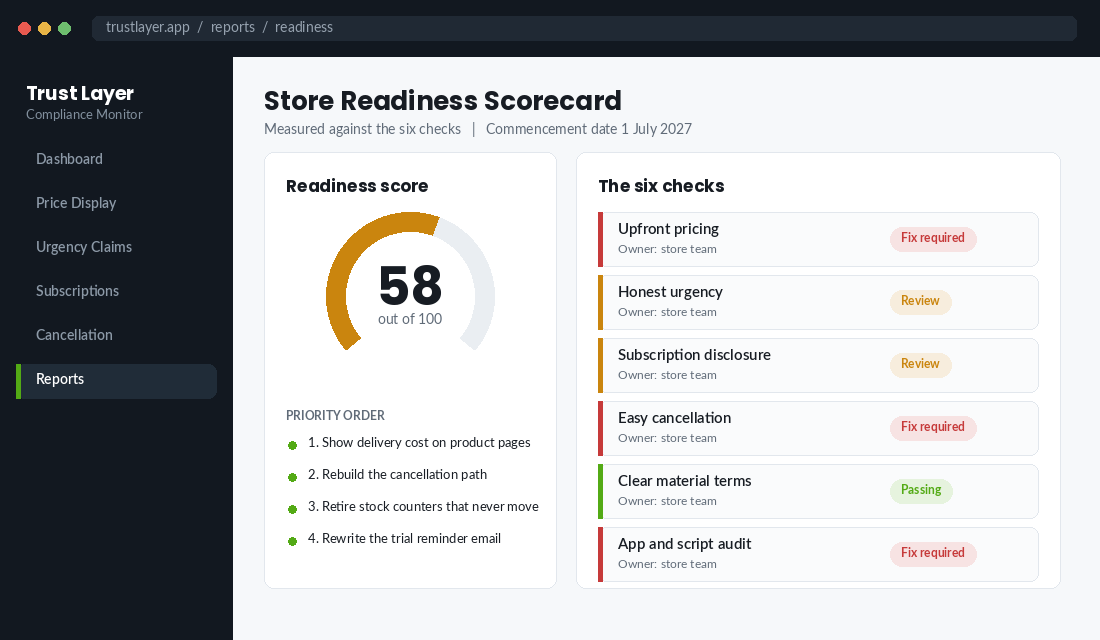
Block one hour. Open your store on a phone, in an incognito window, as a stranger. Work through the six checks in order and score each one out of ten. Anything under seven goes on the build list.
- Upfront pricing. Does the delivery cost, or the method of calculating it, appear next to the price on the product page and the collection page? Does the total ever move without the customer choosing something? Owner: developer. Effort: half a day.
- Honest urgency. Is every counter, timer and social proof widget driven by real data? Is there more than one urgency element on any page? Owner: store team. Effort: two hours.
- Subscription disclosure. Are the amount, frequency, renewal terms and cancellation method visible next to the subscribe button? Is a reminder sent before the first paid charge? Owner: retention lead. Effort: half a day.
- Easy cancellation. Can a customer cancel online in three clicks or fewer, without contacting a human? Owner: retention lead. Effort: one day.
- Material information. Are dispatch windows, pre-order dates, return costs, warranty terms and ongoing consumable costs on the page in plain language? Owner: merchandiser. Effort: ongoing.
- App and script audit. Have you listed every app rendering on product, cart and checkout, screenshotted what each shows, and unticked every pre-selected add-on? Owner: store team. Effort: half a day.
Most Aussie stores land somewhere in the fifties on the first pass. Fixing checks one, four and six usually gets you past eighty, and those three are the cheapest to do. Do them before peak season, because the version of your store that runs Black Friday is the version you will still be running in July 2027 if you do not act now.
One last thing worth saying plainly. Nothing here is legal advice, and if you run subscriptions at scale or a complex fee structure, get a lawyer to look at your specific setup well before 2027. What this article gives you is the operator’s version: the six places on a Shopify store where the new law will actually bite, and what to change first.
Where to Start
Pick check one and do it this week. Put the delivery position under your price on every template that shows a price. It is the highest risk item under the new disclosure rules, it is the most common reason Aussie shoppers abandon carts, and it is a theme edit rather than a project.
Then work down the list. Six checks, roughly three days of work spread over a quarter, and you are finished with a law that does not commence for another eleven months.
Inside eCommerce Circle, protecting the store is one of the core pillars we work on with every member, and this shift is exactly the kind of thing that quietly separates the brands that keep compounding from the ones that get caught out. If you want a second opinion on where your store sits, let’s talk.