Open your product pages right now and search for the word “eco-friendly”. If you sell skincare, apparel, food or anything that ships in a box, you will probably find it. Then find “sustainable”. Then “plastic free”. Then “carbon neutral”.
What’s in This Article
Now ask yourself a harder question. For each one of those phrases, could you put a document on the table tomorrow morning that proves it? Not a supplier’s marketing PDF. Actual evidence: a lab report, a bill of materials, a certification number, a calculation you can show your working on.
Most Aussie founders cannot. And that is not me being dramatic. When the ACCC ran an internet sweep of 247 businesses looking specifically at environmental and sustainability marketing, 57% were found to have made concerning claims. In cosmetics and personal care it was 73%. In textiles, garments and footwear it was 67%. Food and beverage came in at 65%. Those are the exact three categories most Australian DTC brands sit in.
Here is the part that changed the maths. From 28 March 2026, the maximum penalty for a corporation breaching the Australian Consumer Law lifted from 50 million dollars to 100 million dollars, or three times the benefit obtained, or 30% of adjusted turnover across the breach period, whichever is greatest. Greenwashing has been an ACCC enforcement priority every year since 2023 and it stayed on the list for 2026-27. This is no longer a big-brand problem you can watch from the sidelines.
Why the risk moved from theoretical to real
For years the standard founder response to green claims compliance was “we’re too small to matter”. That was never a great argument, and it is a worse one now.
Look at what the ACCC has actually done. In April 2025 the Federal Court ordered Clorox Australia to pay 8.25 million dollars over its GLAD to be GREEN “50% Ocean Plastic Recycled” kitchen tidy and garbage bags. The bags were made from roughly 50% recycled plastic, but the plastic was collected from communities in Indonesia with no formal waste management, some of it up to 50 kilometres from a shoreline. Not from the ocean. The product was arguably better for the environment than a virgin plastic bag. The claim was still misleading, because the words on the pack described something that did not happen.
That is the trap. You do not have to be lying to be in breach. You have to be overstating, or being vague enough that a reasonable customer fills in the gap with something better than the truth.
Since then the regulator has kept moving. It brought proceedings against Edgewell Personal Care over “reef friendly” claims on Hawaiian Tropic and Banana Boat sunscreens. It took action against Australian Gas Networks over advertising that household gas would become renewable “within a generation”. In June 2026 it commenced Federal Court proceedings against Grill’d, alleging its “Tree Day Tuesday” campaign overstated when customer purchases would actually trigger donations to tree-planting projects.
Read that Grill’d allegation again, because it is the one closest to home. It is not about materials science. It is about a promotional mechanic on a website not matching what happened operationally behind it. Every Shopify store running a “we plant a tree with every order” campaign should be reading that case carefully.
The commercial cost usually arrives before any regulator does. A competitor complaint, a screenshot on Reddit, a journalist with a slow news day. You end up pulling copy, reprinting packaging and explaining yourself to your best customers. That is a far more likely outcome than a court date, and it still hurts.
The six phrases that get Australian stores flagged
The ACCC published eight principles for making environmental claims in December 2023, and the through-line is simple. Claims must be truthful, substantiated, specific about what part of the product or business they apply to, and clear about any conditions attached.
Measured against that, these are the six phrases that do the most damage on Australian product pages:
- “Eco-friendly.” Friendly compared to what? It implies a whole-of-product benefit that almost nothing can support. Highest risk phrase on this list, and the most common.
- “Sustainable.” Same problem, broader. If it appears on your homepage with no explanation underneath, it is doing nothing for conversion and a lot for your risk profile.
- “Carbon neutral.” Only defensible if you can name the standard, the boundary (product? shipping? whole business?) and the offsets purchased.
- “Recyclable.” Recyclable where? Kerbside in most Australian councils, or only through a drop-off scheme that 4% of your customers will ever use?
- “Plastic free.” Usually untrue at the component level. The label adhesive, the pump, the tamper seal and the tape on the carton are all worth checking.
- “Natural” and “chemical free.” Everything is chemicals. This one draws complaints from customers who know their stuff, and it dents credibility fast.
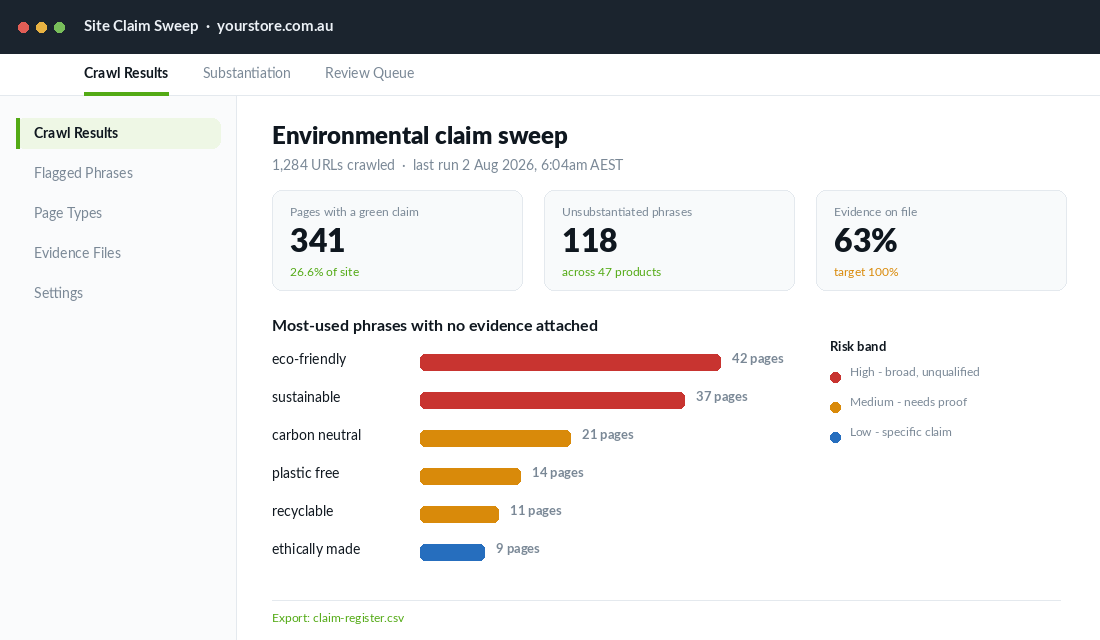
None of these phrases are banned. The issue is that on their own they are unqualified. Attach a specific, provable fact and the same claim becomes both safer and more persuasive. That is the whole game.
Step 1: Sweep your entire store, not just your product pages
You cannot fix claims you cannot see. And they are never only on product pages. They live in collection descriptions, the About page, shipping and returns copy, blog posts from three years ago, alt text, meta descriptions, FAQ answers and app-generated badges you forgot were installed.
The fastest way to find all of them is Screaming Frog SEO Spider. The free version crawls up to 500 URLs, which covers a lot of small catalogues. The paid licence is around 259 AUD a year and worth it if you have more than a few hundred products.
Set it up like this, it takes about ten minutes:
- Download and open Screaming Frog. Go to Configuration, then Custom, then Search.
- Add one filter per phrase. Set each to “Contains” and enter the term: eco-friendly, eco friendly, sustainable, sustainability, carbon neutral, carbon offset, plastic free, biodegradable, compostable, recyclable, recycled, natural, chemical free, ethically made, eco.
- Tick “Ignore case” on every filter so you catch “Eco-Friendly” and “ECO FRIENDLY” too.
- Paste your domain into the URL bar and hit Start.
- When the crawl finishes, open the Custom Search tab in the right-hand pane. Each filter shows a count and the exact URLs.
- Export every filter to CSV. Combine them into one sheet with two columns: URL and phrase found.
Two things the crawl will miss, so handle them manually. First, text rendered by apps after page load (review widgets, badge apps, some upsell modules). Check those in the app admin. Second, anything not on your website: your Meta and Google ad copy, your Klaviyo flows, your Amazon and eBay listings, and your physical packaging artwork. Claims made in an ad are held to exactly the same standard as claims made on your PDP.
Expect the number to surprise you. On a mid-sized Aussie store the first sweep typically turns up 200 to 400 instances across the site. That is not a crisis. It is a work queue.
Step 2: Build a claim substantiation register
This is the artefact that does the heavy lifting, and almost nobody has one. A claim substantiation register is a single sheet listing every environmental claim you make publicly, where it appears, what evidence backs it, who approved it and when it needs reviewing again.
Build it in Google Sheets with these seven columns:
- Claim as published. The exact wording, copied and pasted. Not a summary.
- Where it appears. Every location: PDP, collection page, packaging, Meta ads, welcome flow, wholesale deck.
- Evidence held. The specific document. “Supplier lab report, PET content, dated 14 Jan 2026” beats “supplier says so”.
- Evidence link. A URL to the file in Google Drive so nobody has to go hunting.
- Status. Approved, Pending evidence, or Rejected pending rewrite.
- Approved by and date. One named human. Accountability stops claims drifting.
- Next review date. Twelve months, or sooner if the supplier or formulation changes.
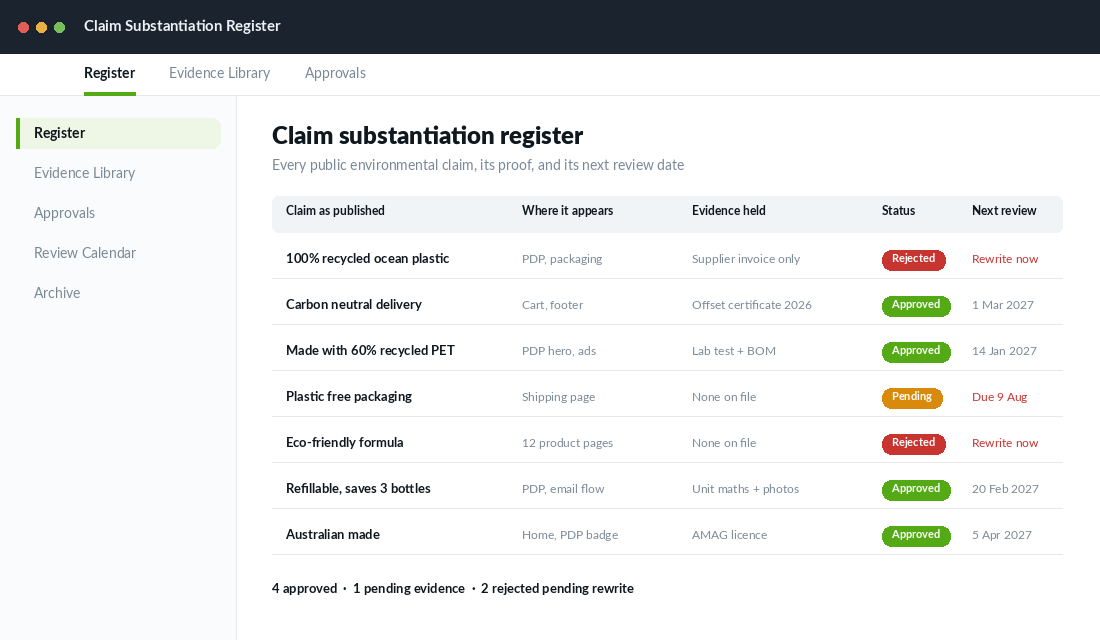
Work top-down by exposure. Claims on your three best sellers and your packaging get done first, because they reach the most people and cost the most to change later. A blog post from 2023 can wait a fortnight.
Chase the evidence properly. Email each supplier and ask for the specific document, not a reassurance. If a supplier cannot produce evidence for a claim they have been making to you, that tells you something useful about the supplier as well as the claim. This is the same discipline you would apply to a cost line, and it belongs in the same conversation as your broader Australian Consumer Law obligations around refunds, guarantees and product descriptions.
If you are on Shopify and want the register to live closer to the product data, build it as a metaobject with fields for claim, evidence type, evidence file and review date, then link it to the relevant products. That way the proof travels with the product instead of sitting in someone’s inbox.
Step 3: Rewrite vague claims into specific ones
Here is where founders panic and strip everything out. Do not do that. Deleting every green claim on your site costs you real conversion with the customers who care, and it is an overcorrection.
The move is to trade the broad word for the specific fact underneath it. Broad words are legally exposed and commercially weak, because shoppers have been trained to discount them. Specific facts are safer and they convert better.
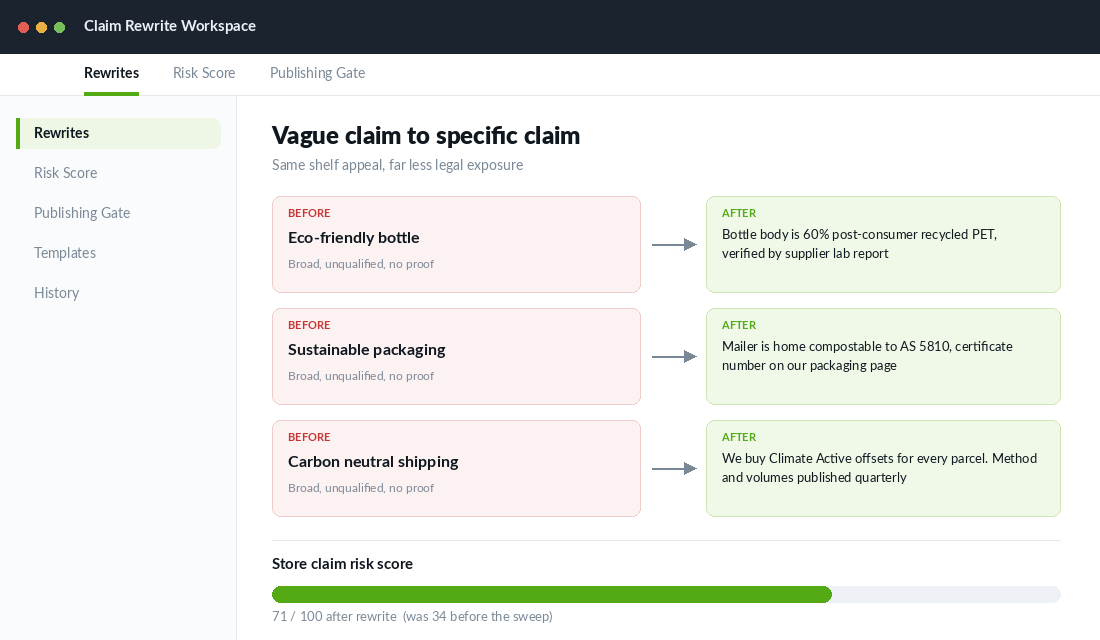
Three rewrites that work on almost any Australian store:
- “Eco-friendly bottle” becomes “Bottle body is 60% post-consumer recycled PET (cap and pump are not).” The bracket is the important bit. Naming what is excluded is exactly what the ACCC principles ask for, and customers read it as honesty rather than a caveat.
- “Sustainable packaging” becomes “Mailer is home compostable to AS 5810. Certificate number on our packaging page.” A standard and a verifiable reference beats an adjective every time.
- “Plastic free” becomes “No plastic in the box, the void fill or the tape. The product’s safety seal is still plastic while we test alternatives.” Admitting the gap makes the rest of the claim believable.
The rule of thumb: every green claim should carry a number, a standard, or a named component. If it carries none of those three, it is decoration and it is a liability. Apply the same discipline you would use anywhere else in your product page copy system, where specifics consistently outperform adjectives.
Two placement notes. Keep the qualifier next to the claim, in comparable size, not buried in a footer or an accordion three clicks down. And never put a broad green claim in a hero headline with the substantiation only appearing further down the page. The ACCC’s view is that the overall impression matters, and a big headline plus small print is exactly the pattern it flags.
Step 4: Fix your packaging and recyclability claims
Packaging is where the biggest gap usually sits, because the artwork was signed off years ago by someone who is no longer at the business, and it is expensive to change.
Three checks to run this week:
- Are you using the Australasian Recycling Label correctly? The ARL is administered by APCO and is the only recycling label most Australians can act on. If you are using a generic Mobius loop instead, you are asking a customer in Ipswich to guess. Getting ARL certified requires running your packaging through PREP, and once you have it, the claim is doing real work.
- Does “recyclable” mean kerbside? If your soft plastic pouch is only recyclable through a drop-off scheme, say so. Soft plastics collection in Australia has been unreliable since the REDcycle collapse, and a “recyclable” claim on a pouch that most councils will not accept is precisely the kind of overstatement that gets challenged.
- Are you conflating recycled and recyclable? “Made from recycled material” and “can be recycled” are different claims with different evidence requirements. Half the packaging I audit uses one word and means the other.
If you find a problem on printed stock, you do not have to pulp it. Work through the current run, correct the digital copy immediately (that is instant and free), and fix the artwork at the next reprint. Document that decision and the date in your register. A business that identifies an issue and has a dated remediation plan is in a materially different position to one that did nothing. While you are in there, it is worth revisiting the whole packaging and unboxing experience, because accurate claims and a good delivery moment tend to get built at the same time.
Step 5: Treat carbon neutral as the highest-risk claim you own
Offset-based claims attract more scrutiny than any other category, here and overseas, because the claim is entirely dependent on a chain of paperwork the customer cannot see.
If you are going to make one, four things need to be nailed down:
- Scope. Is it the product, the shipping leg, or the whole business? “Carbon neutral shipping” and “carbon neutral company” are wildly different promises. Say which one you mean, in the claim itself.
- Method. Name the standard you measured against and who verified it. Climate Active is the recognised Australian certification and it carries weight precisely because it is auditable.
- Reduction before offset. The ACCC principles expect you to show genuine effort to reduce emissions, not just buy your way out. If your only action is buying credits, be careful how you frame it.
- Offset quality. Know what you bought, the registry it sits on and the vintage. If a journalist can show your credits came from a project with integrity problems, the story writes itself.
If you cannot satisfy all four, the honest and safer version is a description of the action rather than a claim about the outcome. “We fund verified reforestation projects for every order through Climate Active certified partners” says what you actually do. “Carbon neutral” says something about the result that you may not be able to defend.
And if you run a “we plant a tree with every order” mechanic, go and check the operational truth right now. When does the donation actually get triggered? Monthly in a batch? Only above a threshold? Only on some products? The gap between the promise on the site and the process in the back office is exactly what the Grill’d proceedings turn on.
Step 6: Put a claim gate in your publishing process
Cleaning up 300 claims once is a project. Keeping the number at zero is a process. Without a gate, drift starts again the moment a new supplier deck lands or a freelance copywriter reaches for a nice adjective.
The gate has three parts and takes almost no time once it exists:
- A blocked-words list in your content brief and your PDP copy template. Anyone writing product copy, ad copy or email copy sees it before they start. The list is the six phrases above plus anything specific to your category.
- One approval step. Any new environmental claim goes to one named person with the evidence attached. No evidence, no publish. This is a two-minute check, not a committee.
- A quarterly re-sweep. Re-run the Screaming Frog crawl every quarter and diff it against the register. Anything new that is not in the register gets caught within 90 days.
Put the re-sweep in the calendar as a recurring task owned by whoever runs your site, and pin the register in the same folder as your brand guidelines. Systems that live where people already work are the ones that survive.
What this compounds into
Here is the part most founders miss while they are worrying about the regulator. This work makes you money.
PwC’s 2025 Voice of the Consumer survey found only 35% of Australian consumers are willing to pay a premium for environmentally friendly products, while 56% actively want to learn about what companies are doing. Sit with that gap for a second. Most people are interested and unwilling to pay, which is a polite way of saying they do not believe you. Meanwhile the same research shows Australians will pay more for products that are durable (67%), repairable (55%) and locally produced (52%). Those are all specific, checkable attributes. The vague ones are the ones nobody pays for.
That is the whole insight. Vague green claims have been so widely abused that they now carry close to zero persuasive weight while carrying real legal weight. Specific claims do the opposite. “60% post-consumer recycled PET, cap excluded” is believable in a way “eco-friendly” stopped being years ago.
So the six steps stack into something better than compliance. The sweep shows you where you are exposed. The register forces evidence to exist. The rewrites turn that evidence into copy that a sceptical shopper will actually accept. The packaging and offset work removes your two biggest liabilities. The gate stops it all sliding back.
What you end up with is a store where every environmental claim is provable, and a set of product pages that read like they were written by people who know their supply chain. That reads as competence, and competence converts.
Give it a weekend. Run the crawl on Saturday, build the register on Sunday, and work the queue over the next fortnight. It is one of the few jobs on your list that reduces risk and lifts conversion at the same time.
This article is general information for Australian ecommerce operators, not legal advice. If you make significant environmental claims or you have had a complaint, get advice from a lawyer who works in consumer law.
Inside eCommerce Circle, getting your claims and your product copy honest and specific is one of the core pillars we work on with every member. If you want a second opinion on yours, let’s talk.