For about a decade, selling overseas from an Australian Shopify store was almost suspiciously easy. You flicked on international shipping, quoted a flat rate, and the parcel slipped under a de minimis threshold somewhere on the other side of the world. Nobody paid duty. Nobody complained.
What’s in This Article
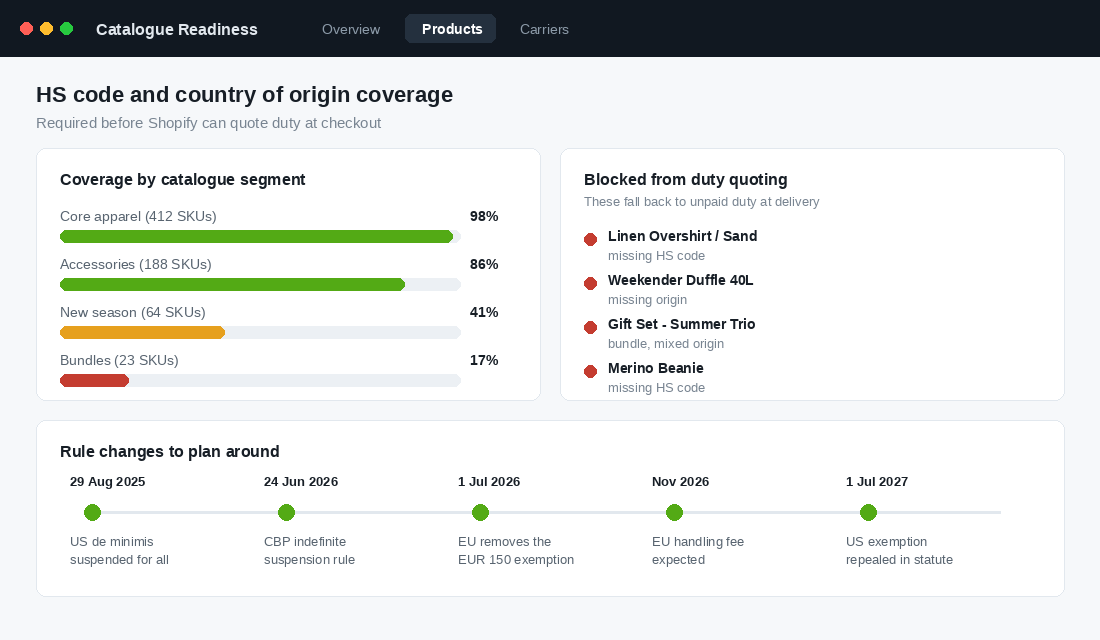
That model is gone. The United States suspended its 800 dollar de minimis exemption for all countries on 29 August 2025, and on 24 June 2026 US Customs and Border Protection issued interim final rules suspending it indefinitely, with a statutory repeal already legislated for 1 July 2027. The European Union removed its 150 euro duty exemption on 1 July 2026 and replaced it with a flat 3 euro charge per item category.
Here is why that matters more than most founders realise. Baymard puts the 2026 average cart abandonment rate at 70.22%, and 48% of abandoners say extra costs were too high or turned up too late. Duty is now an extra cost on almost every international order you send. If you do not decide where that cost sits, your carrier will decide for you, and it will decide at your customer’s front door.
What Actually Changed, and Why the Old Workaround Stopped Working
The old model relied on thresholds. Under a certain declared value, most destinations waved the parcel through without duty. Aussie brands built their entire international pricing on that gap, often without knowing it.
Three changes closed it:
- The United States. The 800 dollar exemption was suspended for all countries from 29 August 2025. CBP then published interim final rules on 24 June 2026 grounding the indefinite suspension in older trade law rather than an emergency order, and the exemption is legislated to disappear entirely on 1 July 2027 under the One Big Beautiful Bill Act.
- The European Union. From 1 July 2026 the 150 euro customs duty exemption is gone. A flat 3 euro duty applies per item category on business to consumer parcels, and it runs as a transitional measure until the EU Customs Data Hub arrives in 2028, when normal classification based rates take over. A separate EU wide handling fee is expected from November 2026.
- Everywhere else tightened too. The United Kingdom still applies VAT on consignments at or below 135 pounds at the point of sale. New Zealand collects GST on low value goods. Canada’s de minimis for postal shipments sits at just 20 dollars. Australia has been collecting GST on imports below 1,000 dollars since 2018, so the direction of travel has been obvious for years.
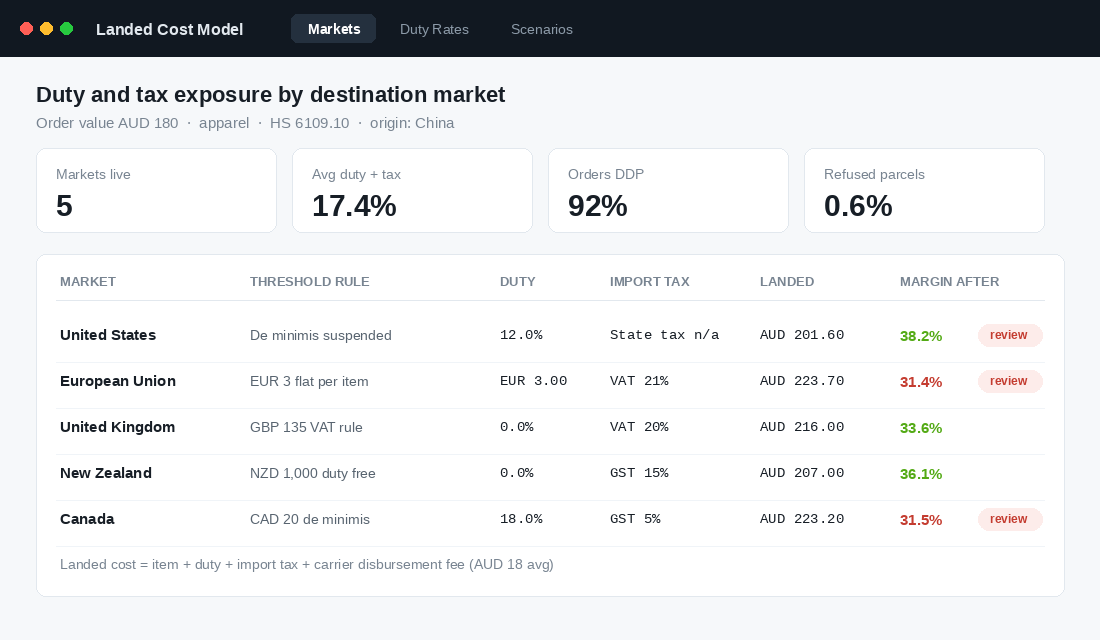
The practical effect is simple. A 180 dollar apparel order to the US or the EU now carries a real duty and tax line that did not exist two years ago. On a 35% gross margin, an unplanned 12% duty plus a carrier disbursement fee can take a healthy order and leave you with pocket change.
DDP or DAP: Pick One and Commit
There are only two honest ways to handle duty, and the damage comes from sitting between them.
DDP (delivered duty paid) means you quote and collect duty and import tax at checkout, ship on a DDP label, and the parcel arrives with nothing owing. DAP or DDU (delivered at place, duty unpaid) means the customer is billed by the carrier before delivery.
Most stores think they are running DAP with a warning in the shipping policy. What they are actually running is a surprise. The customer sees an email or SMS from DHL or FedEx demanding duty plus a brokerage or advancement fee, and that fee is often a flat charge that dwarfs the duty on a small parcel. Some refuse the parcel outright, which means you pay outbound freight, return freight and a refund, and you lose the customer.
Our position with members is straightforward. If a market makes up more than roughly 5% of your orders, go DDP. If it is a trickle, DAP is survivable, but only if the unpaid duty is stated in the cart and on the confirmation email, not buried in a policy page.
What DDP requires you to have in place
- A carrier account that supports DDP labels. Standard labels will still hand the bill to your customer even if you collected the money.
- HS codes and country of origin on every product and variant you ship internationally.
- A pricing model that absorbs or passes on the duty deliberately, not by accident.
- A refund path for duty when an order is returned.
Step 1: Fix the Data Layer Before You Touch Pricing
This is the step everyone skips, and it is the one that quietly breaks the other four. Shopify cannot quote duty at checkout for a product that has no HS code and no country of origin. Those products silently fall back to unpaid duty at delivery, which means you can be running DDP on 80% of your catalogue and DAP on the rest without knowing.
Work through it in this order:
- Export your catalogue. Pull Product, Variant, HS code and Country of origin into a sheet. Sort by blank HS code first.
- Classify by product family, not by SKU. Every merino beanie shares a code. Do the family once, apply it to every variant. A 400 SKU apparel catalogue is usually 15 to 25 real classifications.
- Get the origin right, not convenient. Country of origin is where the goods were manufactured or substantially transformed, not where your 3PL sits. Getting this wrong is a compliance problem, not a rounding error.
- Deal with bundles and kits separately. Mixed origin bundles are the most common blocker. Either classify the dominant component and document the reasoning, or exclude bundles from international markets until you have advice.
- Re-run the export monthly. New season products arrive without codes. Make it part of the product launch checklist, alongside images and copy.
If you have never audited your product data at this level, our landed cost playbook is the companion piece. It covers the inbound side of the same equation, and the two models need to share one source of truth for origin.
Step 2: Rebuild Your Landed Cost Model Per Market
A single international price list stopped working the moment duty rates diverged. Build the model per market and let the numbers tell you which markets are worth serving.
For each destination, calculate:
- Duty. Rate by HS code and origin, applied to the customs value. Apparel and footwear are the painful categories. Rates in the 10 to 20% band are common.
- Import tax. VAT or GST at the destination rate, usually calculated on the item value plus duty plus freight, so it compounds.
- Carrier disbursement or brokerage fee. Budget 15 to 25 dollars per parcel on DAP consignments. This is the fee that turns an 11 dollar duty bill into a refused parcel.
- Freight and packaging. Your real cost, not the rate you advertise.
- Payment and FX. Cross-border card rates and currency conversion sit 1 to 2% above your domestic blended rate.
Then compute margin after duty, per market, at your typical order value. Not average order value across the whole store. The order value that international customers actually buy at, which is usually higher than domestic because freight forces basket building.
The output is a decision, not a spreadsheet. Markets where margin after duty holds above your domestic floor stay open and get investment. Markets that fall below it either get a price increase, a higher free shipping threshold, or get switched off. Turning off a bad market is a legitimate answer and it is the one Aussie founders resist most.
Step 3: Switch On Duty Collection Inside Shopify
Shopify’s duties and import taxes feature is available across plans through the duty calculator, and it does the quoting work for you once the data layer is clean. The setup is not long, but the order matters.
- Settings, then Markets. Open the market you want to configure and find Duties and import taxes.
- Select the destination countries. Start with your top two by order volume. Do not switch on 40 markets in one sitting.
- Review the flagged products. Shopify lists every product missing an HS code or country of origin. That list is your work queue from Step 1.
- Decide who absorbs the fees. You can pass the full amount to the customer or absorb part of it in your pricing. Make the choice explicitly and record it.
- Switch your shipping labels to DDP. This is the step that gets missed. If you collect duty at checkout and then ship a standard label, your customer is charged twice. Confirm your carrier account supports DDP labels before you go live.
- Place a live test order. Buy from the destination country using a VPN or a colleague overseas, and follow it all the way to delivery. Check the duty line on the checkout, the commercial invoice on the label, and whether anything is requested at the door.
If your volumes are large enough that Shopify’s native quoting is not precise enough, Zonos and Avalara both offer deeper classification and landed cost APIs. Start native. Graduate when the variance between quoted and actual duty costs you more than the software does.
Step 4: Price So the Duty Does Not Break Conversion
Collecting duty at checkout adds a line item to a page where 48% of abandoners already say costs are too high. You need to design around that, not just switch it on and hope.
- Use market specific pricing. Shopify Markets lets you set price adjustments per market. Absorbing half the duty into a slightly higher list price beats showing the full amount as a separate charge at the last step.
- Show it early. Put estimated duty and tax in the cart drawer, not only at the payment step. Late surprises are what kill the order, more than the amount itself.
- Raise the international free shipping threshold. If your domestic threshold is 99 dollars, the international one probably needs to be 150 to 180 dollars to cover freight and duty. Our threshold playbook has the maths.
- Name it plainly. Use “Duties and import taxes (prepaid)” as the line label. The word prepaid is doing real work. It tells the customer nothing else is coming.
- Add one line of reassurance near the buy button. Something like: no charges on delivery, everything is paid at checkout. That single sentence recovers more than most redesigns.
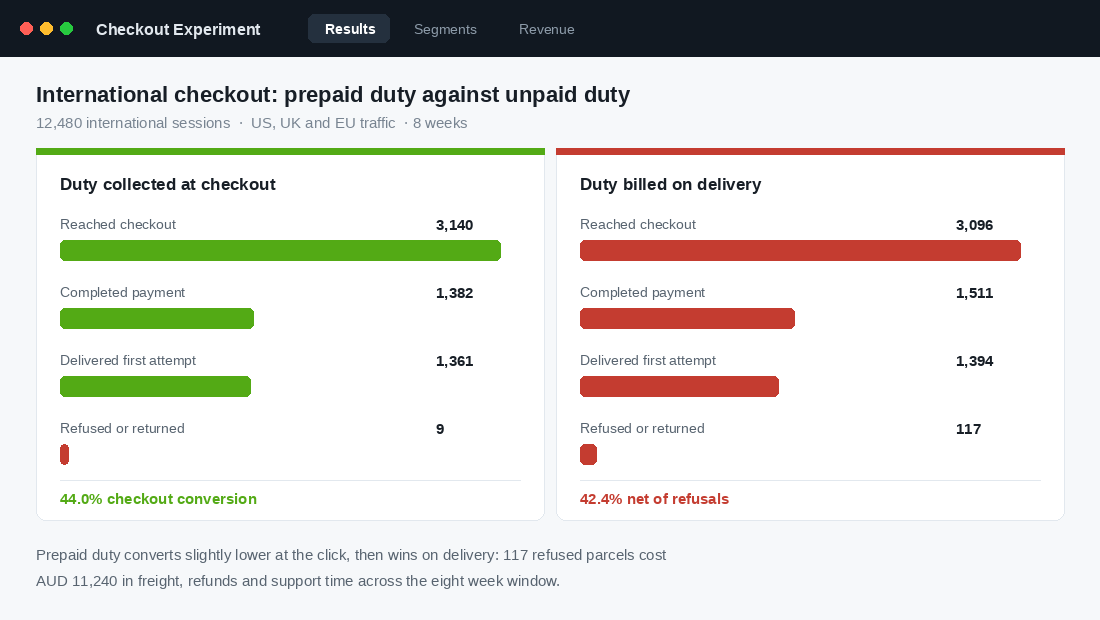
When you test this, do not judge it on checkout conversion alone. Prepaid duty usually converts a touch lower at the click and wins decisively on delivered orders, because refusals and re-deliveries disappear.
Step 5: Write the Refusal and Return Protocol Before You Need It
Cross-border returns are where the money quietly leaks. Duty already paid on a returned item is not automatically refunded to you, and the customer will expect the full amount back including the duty they paid at checkout.
Decide these five things in advance and write them into your policy page and your helpdesk macros:
- Do you refund prepaid duty on a return? Most brands do, and treat it as a cost of doing business. Say so plainly, because it is a conversion asset.
- Do you accept international returns at all, or offer store credit instead? Credit at 110% of value is often better for both sides than paying return freight from Los Angeles.
- Who pays return freight? Set it by reason code. Faulty is on you. Change of mind is on them.
- What happens to a refused parcel? Agree with your carrier whether it is destroyed, returned or abandoned, and what each costs, before it happens.
- Can you claim duty drawback? If you re-export or destroy returned goods at volume, ask your customs broker. It is administrative work, and above a certain scale it pays for itself.
Track refused and undelivered parcels as their own metric. Anything above 1% of international orders means your duty communication is failing somewhere upstream.
What the Aussie Brands Doing This Well Actually Do
The brands that have made overseas selling work from Australia tend to reach the same conclusion, and they reach it earlier than everyone else: past a certain volume, you stop shipping across the border on every order.
Showpo is the clearest local example. The Sydney fashion brand opened a Los Angeles warehouse for its official US launch back in 2017 and later brought fulfilment in house rather than shipping every American order from Australia. Once stock sits inside the destination market, the duty conversation happens once on a bulk import at commercial rates, not 4,000 times on individual parcels with a disbursement fee attached to each one.
July, the Melbourne luggage brand, runs the other side of the same strategy. It sells direct rather than through wholesale, which means it controls the retail price in each market. That control is what lets a brand quietly absorb a duty change into local pricing instead of bolting a new charge onto the checkout, which is exactly the move that protects conversion when rates shift.
Who Gives A Crap built international operations around local warehousing for the same reason. Bulky, low value goods are the worst possible candidates for parcel by parcel duty, because the fixed fees swamp the item value.
The trigger point is worth knowing. Setting up 3PL capability in the US typically runs somewhere between 25,000 and 80,000 US dollars once you count integration, stock and working capital. Below roughly 300 to 500 orders a month into one market, DDP parcel shipping is still the right answer. Above it, run the comparison properly, because the duty savings alone can carry the business case.
The Compound Effect: This Is a Protection Play, Not a Shipping Chore
Taken one at a time, these five steps look like admin. Together they change the economics of your international business.
Clean product data makes accurate quoting possible. Accurate quoting makes DDP viable. DDP removes the doorstep surprise, which removes refusals, which removes the freight and refund losses that make international look unprofitable in your reports. A per market landed cost model then tells you which markets deserve ad spend, so your market expansion decisions are made on margin after duty rather than on revenue.
There is a competitive angle too. Only about 6% of international shoppers currently buy from Australian stores, while Australians send 21% of their overseas spend to the US. The gap is not demand. It is friction, and duty surprises are a large part of it. Most of your Australian competitors will handle this badly for another year. The brands that quote duty cleanly at checkout in the next two quarters will look like the professional option in every market they enter.
Your Cross-Border Duty Readiness Checklist
Run this before your next international campaign. If you cannot tick every box, you are shipping risk, not orders.
- Every internationally shipped product has an HS code and a country of origin.
- Bundles and kits are either classified or excluded from international markets.
- Landed cost is modelled per market, including a 15 to 25 dollar disbursement fee assumption.
- Margin after duty is calculated for each market at your real international order value.
- Markets below your margin floor have been repriced, re-thresholded or switched off.
- Duty and import taxes are switched on in Shopify for your top markets.
- Your carrier account is configured for DDP labels and has been tested with a live order.
- The checkout shows a clearly labelled prepaid duty line, visible from the cart onward.
- The international free shipping threshold covers freight plus duty, not just freight.
- Your returns policy states whether prepaid duty is refunded.
- Refused and undelivered parcels are tracked as a monthly metric with a 1% ceiling.
- A calendar reminder exists for November 2026 (EU handling fee) and 1 July 2027 (US statutory repeal).
Work through it in one sitting with your ops person and a spreadsheet. Most stores find two or three broken items, and each one is worth more than a month of conversion tweaks. If checkout is where you want to keep improving after this, our checkout optimisation playbook is the natural next step.
Inside eCommerce Circle, protecting margin on international orders is one of the core pillars we work on with every member. If you want a second opinion on yours, let’s talk.