On 1 July 2026, Australia Post lifted Parcel Post prices by an average of 4.95% for retail customers and 4.25% for contract customers. If you sent 2,000 parcels last financial year, that increase quietly walked off with money you had already budgeted as profit. Most founders absorbed it, updated a spreadsheet, and moved on.
What’s in This Article
Here is the part almost nobody acts on. The Baymard Institute puts the average cart abandonment rate at 70.22%, and 48% of abandoning shoppers name extra costs like shipping, taxes and fees as the reason they left. Freight is simultaneously your biggest controllable cost line and your biggest conversion killer. Every year you pay more for the privilege of losing sales.
Meanwhile 72% of Australian shoppers placed a click and collect order in the last twelve months, and Australia Post data has click and collect sitting at 13.6% of online purchases. There is a slice of your customer base that would happily drive to you, pay nothing for postage, and hand you back the freight cost as margin. Most Shopify stores never offer it, or bury it so deep in checkout that nobody finds it.
This is the playbook for turning collection into a real channel instead of a checkbox nobody ticks.
Why a Collected Order Is Worth More Than a Shipped One
Run the numbers on a single order before you build anything. Take a typical 120 AUD order with a 55% gross margin. That is 66 AUD of gross profit. Now subtract what it actually costs to get the thing to the customer.
- Outbound freight. Metro parcel, 1kg satchel, roughly 11 to 14 AUD depending on your contract rate.
- Packaging. Satchel, void fill, thank you card. Call it 1.80 AUD.
- Pick and pack labour. Two to four minutes at a loaded warehouse rate. Around 2.20 AUD.
- Payment fees. Roughly 1.9% plus 30 cents on a Shopify Payments domestic card. About 2.58 AUD.
- Delivery failure and reship risk. Even at a 1.5% failure rate on a 14 AUD parcel, you are provisioning around 0.40 AUD per order.
That shipped order lands somewhere near 47 AUD of contribution. The same order collected from your warehouse keeps the freight, most of the packaging, and all of the failure risk. You are looking at a 12 to 15 AUD swing on a single transaction, before you count the fact that the customer is now standing in front of you.
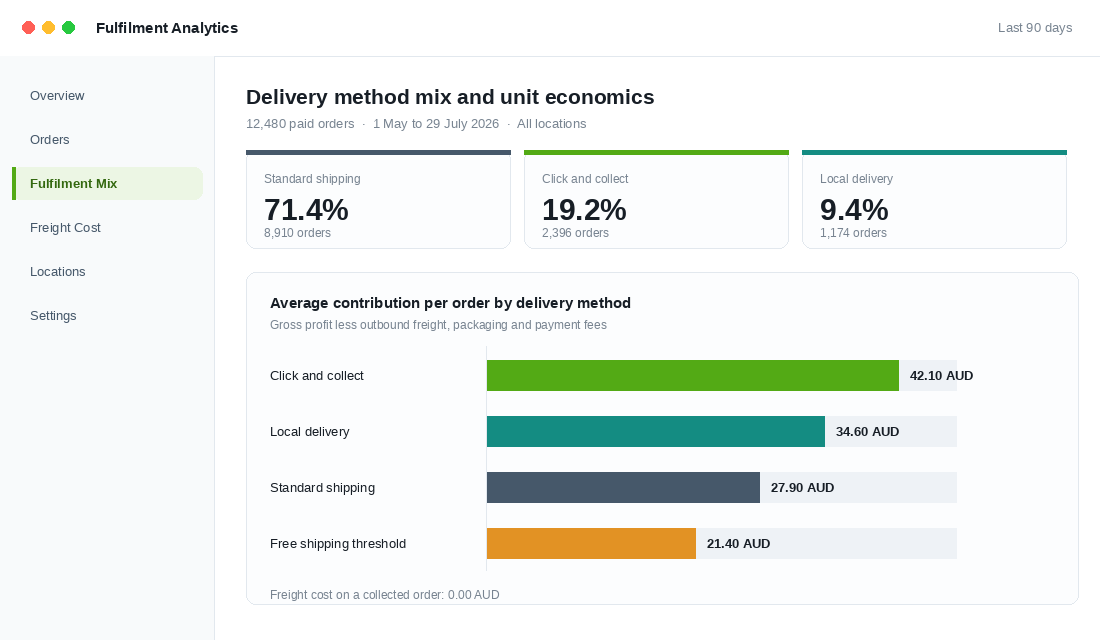
The mistake is treating this as a rounding error. If collection reaches 15% of your order volume and you do 1,200 orders a month, that is 180 orders a month keeping an extra 13 AUD each. Call it 2,340 AUD a month, or roughly 28,000 AUD a year, from a setting you configure once. That is a full time contractor funded by a checkout option.
If you have not built a proper per order cost model yet, do that first. Our contribution margin playbook walks through the exact line items, because you cannot optimise a fulfilment mix you have never costed.
The Three Collection Models (Pick the One That Fits Your Stock)
Click and collect is not one thing. There are three distinct models and they have very different operational costs. Choosing the wrong one is why most attempts quietly die after six weeks.
Model one: warehouse or showroom pickup. The customer collects from where your stock already lives. This is the highest margin option and the easiest to run, because there is no stock transfer and no second location to reconcile. It works even if you are online only, provided you have an address a human can safely visit during business hours. The constraint is geography. If your 3PL is in Truganina and your customers are in Bondi, this does nothing for them.
Model two: local delivery inside a radius. You are still cutting the carrier out, but you are running the van. This suits high value, fragile or perishable goods where a courier is expensive or risky. Florists, furniture, meal producers and pet food brands all run this well. The maths only works if you can batch six or more drops per run, otherwise your driver cost exceeds the postage you saved.
Model three: third party collection points. Parcel lockers and pickup shops. Australia Post now runs more than 5,000 out of home collection points nationally, including over 1,500 Parcel Lockers, and it grew that locker network by more than 60% year on year with usage up 20%. This is the model that scales beyond your postcode. The catch: Shopify’s native pickup points feature is only available to merchants in France, Italy, Spain and the UK, so Australian stores need a carrier integration or a dedicated app to surface locker addresses at checkout.
Most Aussie brands should start with model one, add model two if their product profile suits it, and treat model three as a phase two project. Do not try to launch all three in the same month.
Find Your Collect Number Before You Build Anything
Before you configure a single setting, work out how many of your existing customers could realistically collect. This takes twenty minutes in Shopify admin and it will tell you whether this is a 2% project or a 20% project.
- Export twelve months of orders. Shopify admin, Orders, Export, all orders, plain CSV. You want the shipping postcode column.
- Group orders by postcode. A pivot table on shipping postcode, counting order ID and summing total.
- Draw a 25km ring around your pickup address. Any free postcode radius tool will list the postcodes inside it. Do not eyeball this on a map.
- Sum the orders inside the ring. That is your addressable pool. In our experience with metro based Aussie brands, it usually lands between 18% and 34% of total orders.
- Apply a conservative take rate. Assume 25% to 40% of that addressable pool will choose collection once it is well merchandised. If your addressable pool is 24% and your take rate is 33%, your realistic ceiling is about 8% of all orders in year one.
If that number multiplied by your freight saving is under about 800 AUD a month, park it and go work on something else. If it is over 2,000 AUD a month, it deserves a fortnight of your attention. Being honest with this calculation is what separates a channel from a distraction.
Setting Up Local Pickup in Shopify Without Breaking Your Rates
Shopify handles local pickup natively and it is free. The configuration takes about fifteen minutes per location. Here is the exact path and the settings that matter.
- Confirm the location exists. Settings, Locations. The address must be the real collection address, not your registered business address. Customers will navigate to whatever you type here.
- Enable pickup. Settings, Shipping and delivery, Local pickup, then select the location and switch it on.
- Set an honest expected pickup time. Shopify offers preset windows. Pick the one you can hit on your worst day, not your best. “Usually ready in 24 hours” that you always beat is far better than “ready in 2 hours” that you miss twice a week.
- Write the pickup instructions field properly. This is the single most valuable box on the page and almost everyone leaves it blank. Include the parking situation, the door to use, the buzzer or reception process, the hours, and what ID or order number to bring. Two sentences of clarity here removes most of your support tickets.
- Check inventory is committed at that location. If the location is not stocked in Shopify’s inventory settings, pickup will silently disappear from checkout for those items.
- Test with a real order. Place a live order, mark it ready for collection, and read the notification email as a customer would. Then walk to your own door and see whether the instructions actually work.
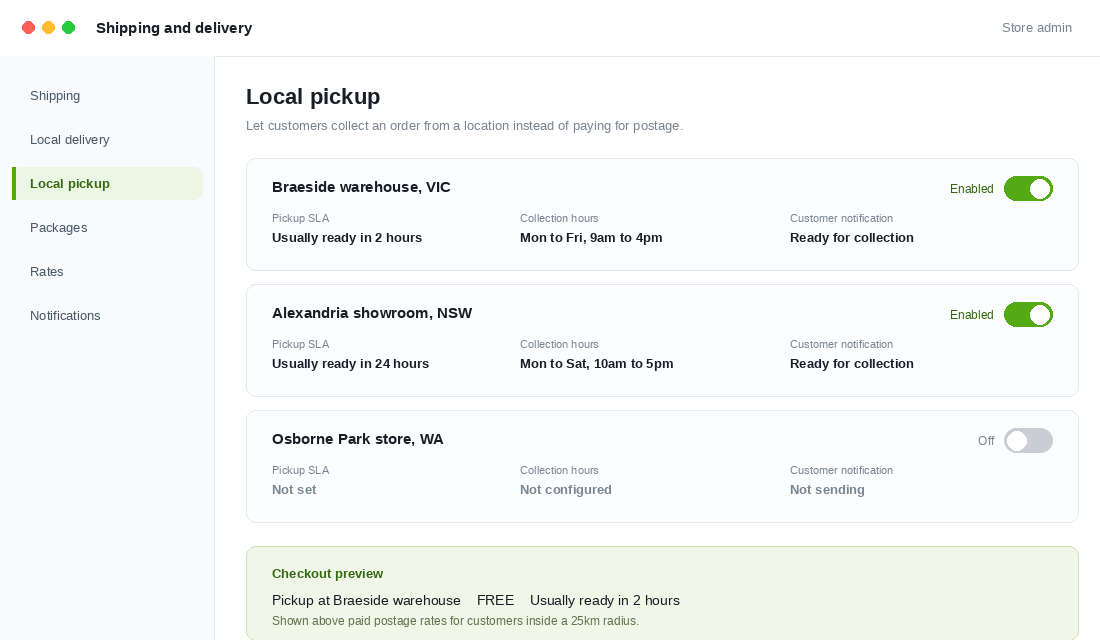
Native pickup has one real limitation: customers cannot choose a collection date or time slot. If you need scheduling, blackout dates, capacity caps per slot or a delivery calendar, you need an app. Zapiet Pickup and Delivery is the category standard, sits at 4.9 stars, and Australia has long been one of its largest markets. It has a free tier covering two locations and 250 orders a month, plus a fourteen day trial on paid plans, so you can prove the revenue before you commit to the subscription.
Add scheduling only when you have evidence you need it. A calendar you do not need is friction you have paid for.
Merchandise Collection Before Checkout, Not Inside It
This is where nearly every store loses the opportunity. They enable local pickup, it appears as a radio button on the shipping step, and adoption sits at 2%. The customer never knew it existed until after they had already decided whether the freight cost was worth it.
Remember that 48% of abandoners leave over extra costs. Those people bounce at the cart, before they ever reach the shipping step where your free pickup option is waiting. You have to move the message upstream.
- Product page, under the add to cart button. A single line: “Free collection from our Braeside warehouse, usually ready in 2 hours.” Use geolocation if you have it, otherwise show it to everyone.
- Cart drawer, above the checkout button. Place it directly beside your shipping estimate so the comparison is unavoidable.
- Announcement bar for metro traffic. Segment by geo and run it for your two biggest metro areas only. National traffic does not need to see it.
- Abandoned cart email, variant two. If the customer’s IP or saved address sits inside your radius, swap the standard discount offer for the collection reminder. You are giving away zero margin instead of ten percent.
- Delivery cut off periods. When Australia Post cut offs pass in December, collection becomes the only way to buy. Brands that have merchandised it all year capture that. Brands that scramble in week one of December do not.
Bunnings built the largest online retail operation in Australia partly on the back of exactly this behaviour, putting collection front and centre rather than treating it as a fallback. On the Shopify side, Australian florist Bower and Bloom rebuilt its pickup and delivery experience around scheduled collection windows because flowers are the definition of a product where a customer would rather come and get it than trust a carrier with it.
Your delivery messaging across the whole site needs to be consistent while you do this. Our delivery promise playbook covers how to keep those claims aligned so you are not promising two different things on two different pages.
Build the Back of House So “Ready in Two Hours” Is Actually True
Collection dies from operational sloppiness far more often than from lack of demand. A customer who drives twenty minutes and waits at an unattended roller door does not come back, and they tell people. Six rules keep it clean.
- Give pickup orders their own queue. Tag them automatically with Shopify Flow and pick them first every morning. They are your highest margin orders and they have a human waiting.
- Stage them alphabetically by surname. A dedicated shelf with A to F, G to M, N to S, T to Z. Whoever is at the door should find the parcel in under thirty seconds without opening a laptop.
- Only send “ready for collection” when it is physically on the shelf. Not when it is picked. Not when it is packed. On the shelf.
- Verify with the order number, not ID. Asking for photo identification for a 60 AUD candle order feels like an accusation. The order number from their email is enough.
- Set a seven day uncollected rule. Automated reminder at day two, second at day five, then either convert to a shipped order at your cost or refund. Uncollected stock sitting in a corner is inventory you cannot sell.
- Nominate a collection owner. One named person owns the shelf, the queue and the SLA. Shared responsibility means nobody checks the shelf at 4pm.
Target a median ready to collect time under two hours for orders placed before 2pm. Track it. If your median drifts past four hours, your promise is now a lie and adoption will fall faster than it climbed.
The Second Sale Happens at the Counter
Here is the number that turns collection from a cost saving into a growth channel. Research on Australian shoppers found 78% make additional purchases when collecting an order, with 24% doing it every time and 54% doing it occasionally.
That is a customer standing in front of your product, with their wallet out, who has already decided they trust you. No ad spend, no attribution debate, no creative fatigue. Most brands hand over a parcel and say thanks.
- Put something on the counter. Three to five high margin, low consideration items under 30 AUD. Consumables, accessories, refills, samples. Physical products the customer can hold while you find their parcel.
- Give the collection point a tiny Shopify POS terminal. The attach sale has to take under sixty seconds to complete or it will not happen.
- Script one line. “Do you need refills while you are here?” beats silence, and it beats a hard pitch. Everyone at the door uses the same line.
- Offer a collection only bonus. A free sample sachet with every pickup costs you 90 cents and creates a reason to choose collection again next time.
- Ask for the review at the door. A QR code on the counter converts far better than the review email sent three days later.
A 30% attach rate at an average 24 AUD add on across 180 collected orders a month is another 1,296 AUD of revenue at strong margin. That is not a rounding error either. If you are running any physical touchpoints, the omnichannel playbook covers how to wire POS and online inventory together properly.
The Click and Collect Scorecard
Five numbers, reviewed weekly. Anything more and you will stop looking at it by week three.
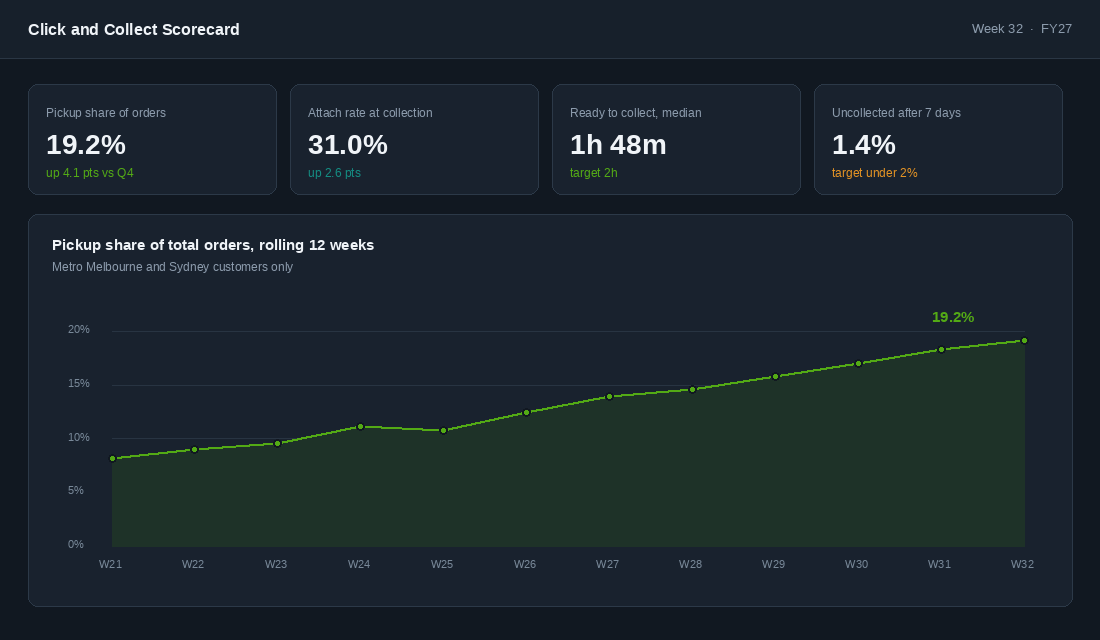
- Pickup share of total orders. Your headline adoption number. Set a twelve month target based on the addressable pool maths above.
- Pickup share of in radius orders. The truer measure. National traffic dilutes the headline number and hides real progress.
- Median ready to collect time. Your promise, measured. Under two hours for morning orders.
- Attach rate at collection. Percentage of collections that include a counter purchase. Aim for 25% and up.
- Uncollected after seven days. Your operational warning light. Under 2% is healthy. Above 5% means your notifications or your hours are wrong.
Review these on the same Monday cadence as the rest of your numbers. Collection is one of the few levers where a bad week is visible immediately and fixable inside a day.
How the Pieces Compound
Look at what happens when all six parts run together, because none of them is impressive on its own.
The maths tells you collection is worth 13 AUD an order, so you build it properly instead of half enabling it. Merchandising it on the product page moves adoption from 2% to somewhere near 15%, which means the freight saving is now real money instead of a curiosity. A reliable two hour SLA means those customers choose collection again next month rather than defaulting back to postage, so adoption holds instead of decaying.
The counter attach adds revenue at almost no cost, which improves the contribution on an order that was already your best one. Better contribution means your blended margin lifts, which means your acceptable customer acquisition cost lifts, which means you can outbid competitors for the same traffic. And because those customers now have a physical relationship with your brand, they churn less than customers who only ever met a satchel.
None of that shows up if you enable the toggle and walk away. All of it shows up if you treat collection as a channel with an owner, a target and a scorecard.
Your 14 Day Collection Rollout
Copy this into your project tool and work it in order. It is deliberately short because the whole point is that this is a fortnight of effort, not a quarter.
- Days 1 and 2. Export twelve months of orders. Calculate your addressable pool inside a 25km radius and your realistic take rate. Decide go or no go on the number, not the vibe.
- Days 3 and 4. Cost a shipped order and a collected order line by line. Write down the per order swing. This is the number you will defend the project with.
- Day 5. Configure local pickup in Shopify. Real address, honest SLA, properly written pickup instructions, inventory committed at the location.
- Day 6. Build the back of house. Staging shelf, alphabetical bays, Flow tag for pickup orders, named owner.
- Day 7. Place a live test order and collect it yourself. Fix everything that annoyed you.
- Days 8 to 10. Merchandise it. Product page line, cart drawer line, geo targeted announcement bar, abandoned cart variant for in radius customers.
- Day 11. Set up the counter. Five attach products, POS terminal, one scripted line, review QR code.
- Day 12. Build the scorecard. Five metrics, one view, Monday review slot in the calendar.
- Days 13 and 14. Write the uncollected order policy and automate the day two and day five reminders.
Do this in August and you will have three months of clean data and a proven operation before the December delivery cut offs arrive. That is the window where collection stops being a nice option and becomes the only way some customers can buy from you in time.
Postage is going to keep getting more expensive. The brands that handle it best are not the ones with the sharpest carrier contract. They are the ones who worked out which customers never needed a carrier in the first place.
Inside eCommerce Circle, fulfilment economics is one of the core pillars we work on with every member. If you want a second opinion on yours, let’s talk.