Here is a conversation I have with founders far more often than I’d like. A shipment lands, the cartons are opened, and a chunk of the stock is wrong. Wrong colour, loose seams, lids that don’t sit flush. The founder emails the factory. The factory says the goods “match the sample”. The founder asks for a credit. The factory says that’s not how it works. And the founder realises the only thing they ever signed was a pro forma invoice and a WeChat thread.
What’s in This Article
Most Aussie Shopify brands run their entire supply chain on goodwill and a purchase order. That works right up until the day it doesn’t, and that day usually arrives when you have the most money on the line: your biggest production run, right before peak season, with a deposit already paid.
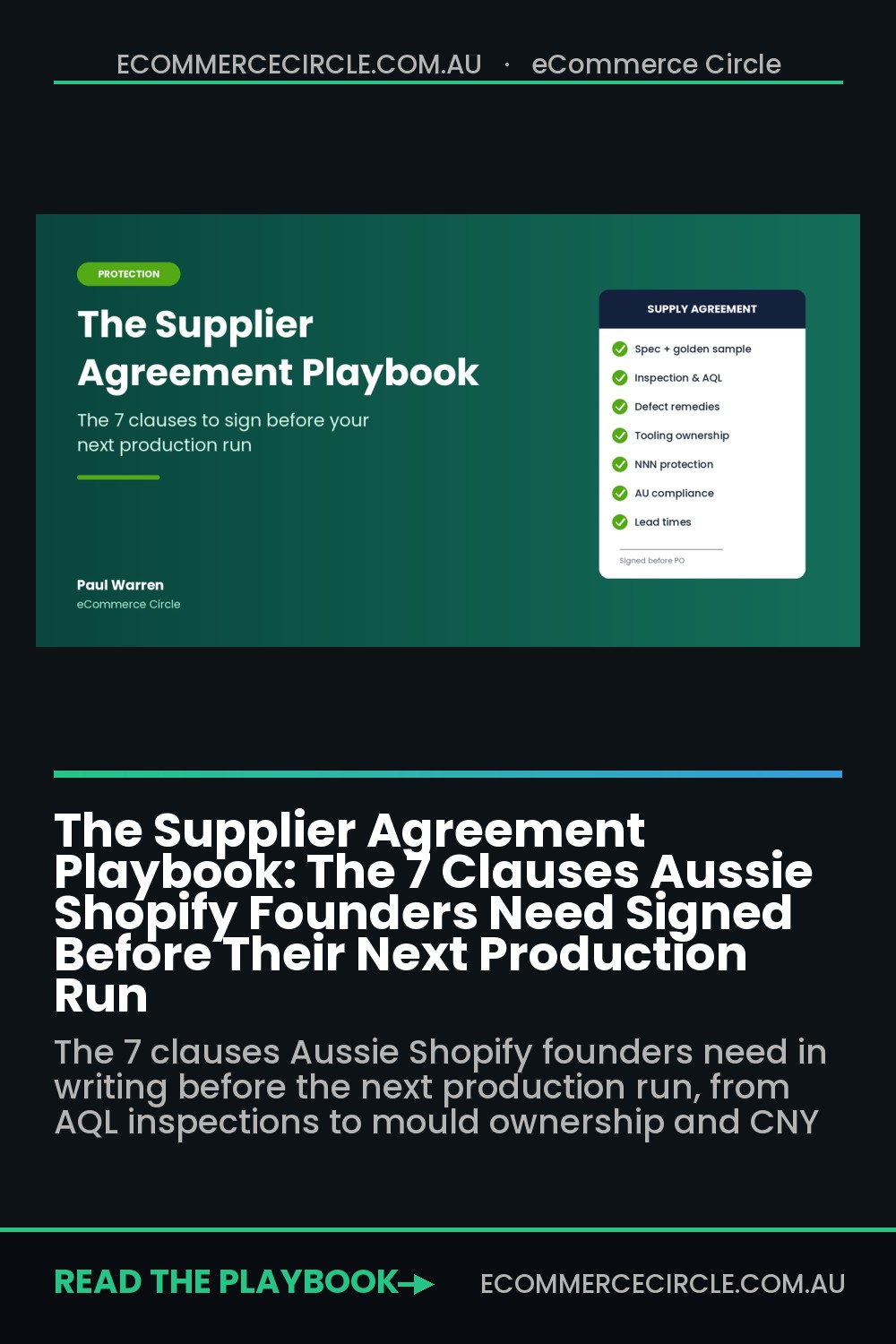
The brands that scale without supplier drama do one thing differently. Before the next PO goes out, they get seven specific clauses in writing. Not a 60-page legal monster. Seven clauses that decide who pays when something goes wrong. And the timing to do this has never been sharper: Chinese New Year falls on 6 February 2027, and the orders you place in the next eight weeks are the ones that will either arrive clean or leave you stranded in March.
This is the playbook we walk members through. By the end you’ll have a clause-by-clause checklist, a template audit you can run across every supplier this week, and a production timeline built around the CNY shutdown.
Why a Purchase Order Is Not a Supplier Agreement
A purchase order says what you’re buying, how many and for how much. That’s it. It says nothing about what “good” looks like, who inspects the goods, what happens to defective units, who owns the moulds you paid for, or what happens if the factory ships three weeks late.
US law firm Harris Sliwoski, which has spent years handling China manufacturing disputes, puts it bluntly: a purchase order rarely covers the issues that matter when a dispute arises, including quality standards, inspection rights, defective goods, late delivery, IP misuse and tooling. Their September 2026 write-up describes a client whose factory held its moulds hostage. The firm advised it would be cheaper to make new moulds than to sue, and the resulting production shutdown nearly bankrupted the company.
This matters more for Australian brands than most. China is Australia’s largest trading partner, accounting for 25% of our goods and services trade in 2024, worth $312 billion according to DFAT. If you sell physical product on Shopify, there’s a very good chance at least one of your core SKUs is made there.
And here’s the part most founders miss. Under section 7 of the Australian Consumer Law, if your overseas manufacturer has no place of business in Australia, you, the importer, are treated as the manufacturer. As LegalVision explains, that means you carry the same liability for defective goods as if you’d made them yourself. The factory’s problem becomes your problem the moment the container clears customs.
So the question isn’t whether you need an agreement. It’s whether your agreement shifts the right risks back to the party that actually controls them: the factory.
Clause 1: The Specification and Golden Sample (Define “Good” Before Anyone Argues About It)
Every quality dispute comes back to one question: good compared to what? If you can’t point to a written spec and a physical reference sample, the factory’s version of “matches the sample” wins by default.
Your specification clause should reference a separate spec sheet (attached as a schedule) that covers:
- Materials and composition. Fabric weight in GSM, fibre blend, material grade, glaze type, plastic resin. Be specific: “100% cotton” is not a spec, “240 GSM combed cotton, pre-shrunk” is.
- Dimensions and tolerances. Every measurement with an allowed variance, e.g. “chest width 52 cm ±1 cm”.
- Colour. A Pantone reference plus a physical lab dip or colour card, approved under daylight.
- Packaging and labelling. Carton markings, barcode placement, care labels, warning labels, inserts.
- The golden sample. Two identical pre-production samples, both signed and dated by you and the factory. One stays at the factory, one comes to you. Give it a reference code you’ll use on every inspection report.
Then add one line that does a lot of heavy lifting: “No change to materials, components, sub-suppliers or production facility without the Buyer’s prior written approval.” Quiet material swaps are the most common cause of batch-to-batch drift, and Harris Sliwoski notes that many quality and IP problems begin when a factory moves production to a related or cheaper facility without telling you. This single sentence gives you a clear breach to point to.
If you haven’t built a proper QC process yet, start with our Shopify quality control playbook, then come back and lock the results into this clause.
Clause 2: Inspection Rights and AQL Acceptance (Decide the Pass Mark in Advance)
A spec tells you what good looks like. The inspection clause tells you how you’ll check it, and what happens if the batch fails. Without it, you’re arguing about defects after the goods are already on the water.
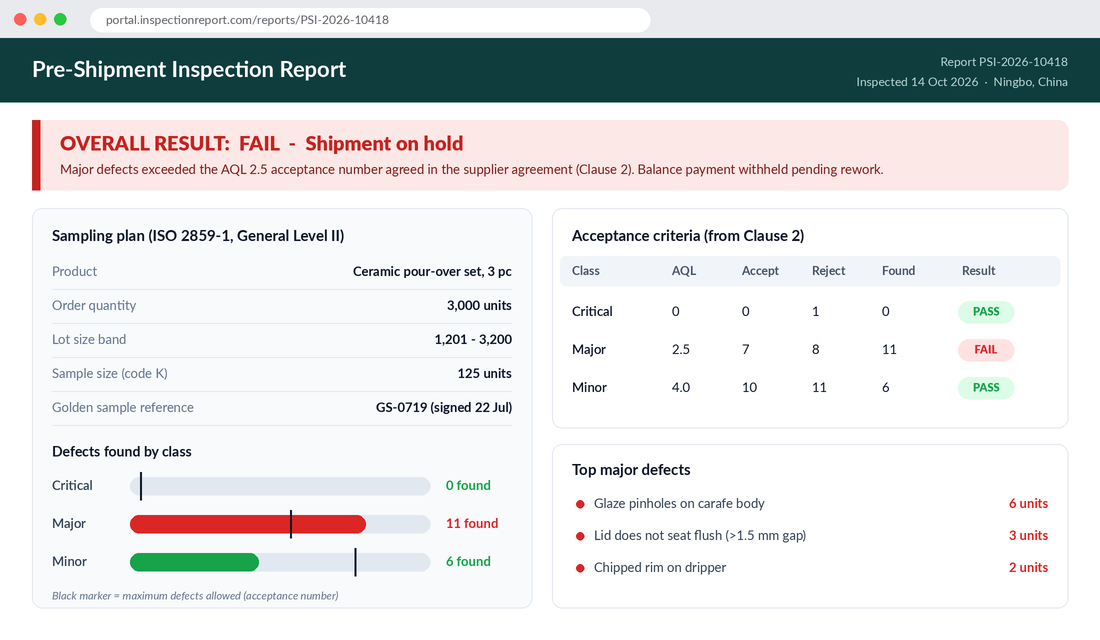
The industry standard is AQL (Acceptable Quality Limit) sampling under ISO 2859-1. Instead of checking every unit, an inspector pulls a statistically defined sample and counts defects by class. QIMA’s AQL guide sets out the common settings, and most consumer goods brands use:
- Critical defects: AQL 0. Anything unsafe or illegal. One found, batch fails.
- Major defects: AQL 2.5. Defects a customer would return the product for.
- Minor defects: AQL 4.0. Cosmetic issues that won’t trigger a return on their own.
For a 3,000-unit order at General Inspection Level II, the inspector samples 125 units. At AQL 2.5 the batch passes with up to 7 major defects and fails at 8. For electronics, tighten the major AQL to 1.0.
Your clause should state:
- You (or your nominated inspector) may inspect at any stage, with 5 business days’ notice.
- The AQL levels above apply, measured against the golden sample.
- A failed inspection means the factory pays for rework and re-inspection. Re-inspections typically cost the same as the first visit, so this adds up fast.
- Goods may not ship until a pre-shipment inspection has passed or you’ve waived it in writing.
Tool setup: booking your first pre-shipment inspection
You don’t need a sourcing agent to do this. Third-party inspection firms like QIMA, V-Trust and Bureau Veritas have inspectors in every major Chinese manufacturing hub. Here’s how to set it up with QIMA:
- Create a free account at qima.com and add your supplier’s factory address and contact.
- Choose Pre-Shipment Inspection and book it for when production is at least 80% complete and 80% packed.
- Upload your spec sheet, golden sample photos and a defect checklist (list your known critical, major and minor defects).
- Set AQL levels to 0 / 2.5 / 4.0 and General Inspection Level II.
- Pay the fixed inspector-day fee and forward the booking confirmation to your supplier so they know it’s coming.
- Review the photo report (usually within 24 hours) and only release the balance payment on a PASS.
Clause 3: Defect Remedies (Who Pays When Bad Units Slip Through)
AQL sampling reduces risk. It doesn’t eliminate it. At AQL 2.5, some defective units will always make it into your warehouse, and some defects (like a seam that splits after three washes) only show up in your customers’ hands.
This is where most verbal arrangements fall apart. The factory will happily “look into it” and then offer a 3% discount on your next order, which conveniently requires you to place another order. Your clause should instead set out:
- A hidden-defect window. Defects discovered within 12 months of delivery are the factory’s responsibility, even if the batch passed inspection.
- Your choice of remedy. Replacement units shipped at the factory’s cost, a credit note, or a cash refund. Your choice, not theirs.
- Cost of defects, not just unit price. Include your return shipping, customer refunds and the landed cost of the unit, not just the ex-works price. A $12 unit can easily cost you $40 by the time you’ve refunded the customer and paid Australia Post both ways.
- A defect-rate trigger. If the in-market defect rate on a batch exceeds an agreed threshold (say 3%), you can return the remaining stock at the factory’s cost.
- A timeline. The factory must respond to a documented claim within 7 days and settle within 30.
Pair this with a simple habit: tag every defect-related return in Shopify with the batch number. When you raise a claim, you’ll have the data rather than a hunch.
Clause 4: Tooling and Mould Ownership (Don’t Pay for Assets You Don’t Own)
If your product needs custom moulds, dies, printing plates or cutting tools, you’ve probably paid a tooling fee. Most founders assume that payment means they own the tooling. Without a written clause, you may not. China sourcing specialists regularly warn that factories treat tooling as their own property unless the contract clearly says otherwise.
That’s how the mould-hostage situation happens. You want to move to a second factory, or the factory raises prices, and suddenly your $15,000 of tooling becomes a bargaining chip against you.
Your tooling clause (or better, a standalone Mould Ownership Agreement, which Harris Sliwoski recommends so the remedy is fast and obvious) should cover:
- Ownership. All tooling paid for by the Buyer is the Buyer’s property, held by the factory in custody only.
- Identification. Each mould is physically stamped or tagged with your company name and a register number, and photographed.
- Exclusive use. The tooling may only be used to produce your products.
- Location. It may not be moved to another facility without written consent.
- Return. On request, the factory releases the tooling within 14 days to your nominated freight forwarder, with a meaningful fixed penalty for each day of delay.
Then keep a simple tooling register: mould ID, product, cost, date paid, location, photo. If you ever need to switch suppliers, this is the document that makes it a two-week job instead of a six-month rebuild.
Clause 5: NNN Protection (Stop Your Factory Becoming Your Competitor)
A Western-style NDA protects against disclosure. It doesn’t stop the factory using your design itself, or approaching your customers and suppliers directly. That’s why experienced importers use an NNN agreement: Non-Disclosure, Non-Use and Non-Circumvention.
- Non-Disclosure: your designs, specs and pricing stay confidential.
- Non-Use: the factory can’t make your product, or anything substantially similar, for anyone else, including itself.
- Non-Circumvention: the factory can’t go around you to sell to your customers or deal directly with your other suppliers.
Three details make the difference between an NNN that works and one that’s decorative. It should be written in Chinese (bilingual is fine, but the Chinese version should govern), enforceable in a Chinese court near the factory, and include a fixed liquidated damages amount for breach, so you don’t have to prove your losses from scratch.
The contract is only half of it. Register your trade mark in China as well as Australia, because China operates on a first-to-file system. And register your key product designs with IP Australia. DesignByThem, the Australian furniture and homewares brand, told SBS that sales of its best-selling $330 letterbox fell from 75 a month to 25 after an $89 copy appeared at a major retailer. They hadn’t registered that design. They’ve since spent tens of thousands registering every design that followed. For the wider trade mark picture, read our brand protection playbook.
Clause 6: Australian Compliance and Product Safety (Because the Liability Lands on You)
Remember the deemed manufacturer rule. If your product breaches an Australian mandatory standard, it’s your Shopify store the ACCC comes looking for, not the factory in Dongguan.
The penalties are real. In December 2025 the Federal Court ordered City Beach to pay $14 million in penalties after it admitted supplying products that didn’t comply with the button battery safety standard on more than 54,000 occasions. The products included novelty toys, keyrings and lights. Nobody at City Beach built those products. They imported and sold them, and that was enough.
Your compliance clause should require the factory to:
- Meet the Australian mandatory standards you list by name (for example, button batteries, toys for children up to 36 months, children’s nightwear, electrical safety under RCM).
- Provide test reports from an ISO 17025 accredited lab for each production batch or at a set frequency, at the factory’s cost.
- Apply the labelling you specify, including warning labels, country of origin and care instructions.
- Notify you within 48 hours of any safety issue, material change or regulatory recall involving the same components.
- Indemnify you for recall costs and penalties caused by their non-compliance.
Be realistic about that last point. An indemnity from a factory with no Australian assets can be hard to enforce. Its real value is that it forces the conversation about compliance before production, not after a recall. Our product compliance playbook walks through which standards apply to which categories.
Clause 7: Lead Times, Late Delivery and Subcontracting (Put the Calendar in the Contract)
Late stock is expensive in ways that don’t show on an invoice. Every week a hero product is out of stock, you lose sales, your ads lose momentum and your Google Shopping rankings slip.
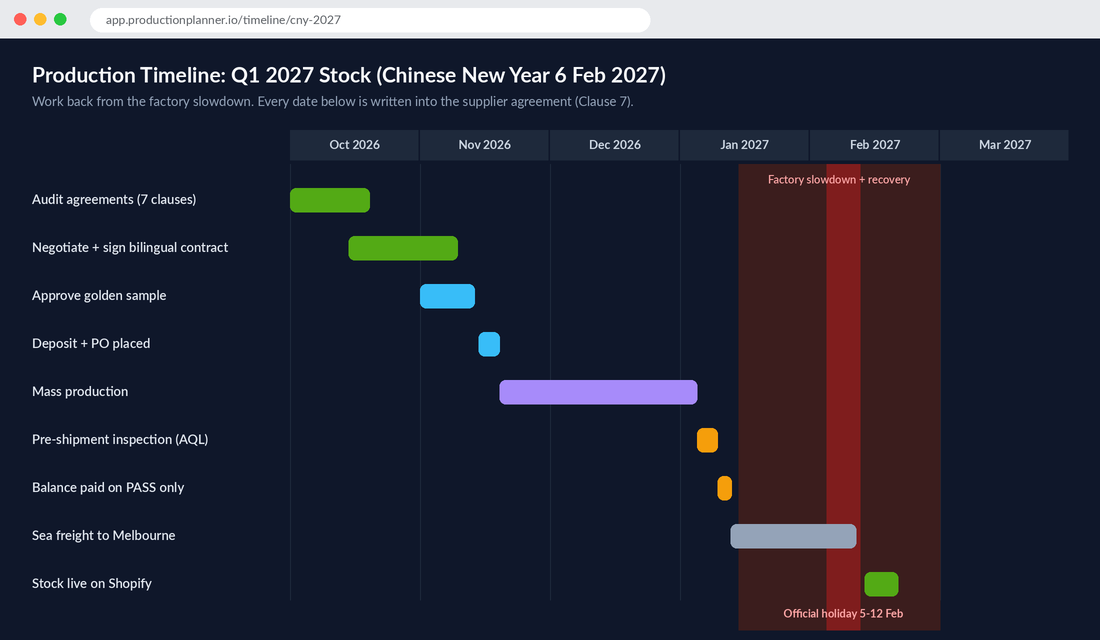
Chinese New Year makes this acute. It falls on 6 February 2027, with the official holiday running roughly 5 to 12 February. But the real disruption is much longer. Shanghai-based sourcing firm Easy Imex puts the total window at six to eight weeks: factories slow from mid-January, close for the holiday, then take two to four weeks to recover. They also note that 10 to 30% of factory workers may not return after the break, which is why the first batch after CNY carries the highest defect risk of the year. Inspection companies pause too, so pre-shipment inspections need to be done before mid-January.
Your clause should include:
- A confirmed ex-factory date on every PO, which becomes binding once the factory accepts it.
- Late delivery damages. A common structure is 0.5% of the order value per day late, capped at 10%, deducted from the balance payment.
- A right to cancel without penalty if goods are more than 30 days late.
- No subcontracting without your written consent, and any approved subcontractor bound by the same terms.
- Payment tied to milestones. The standard 30% deposit and 70% balance works, but the balance is due only after a passed inspection, not “before shipping”.
The 7-Clause Supplier Agreement Checklist (Copy This)
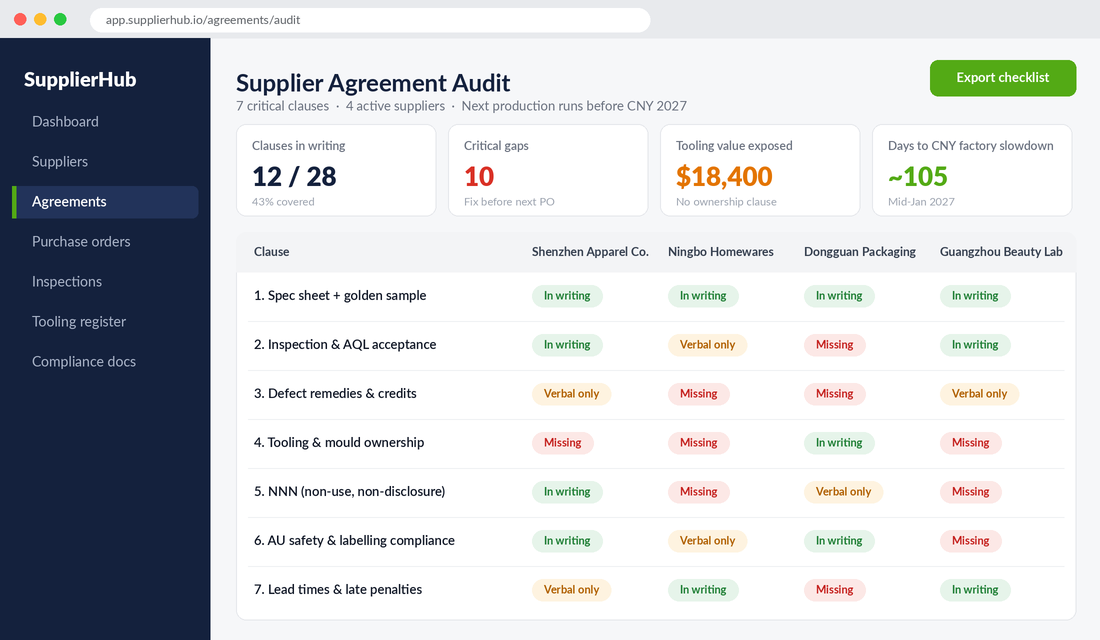
Here’s the audit template. Create a sheet with one row per clause and one column per supplier, then mark each cell In writing, Verbal only or Missing. Anything not in writing counts as missing when there’s a dispute.
| Clause | The must-have line | Red flag if missing |
|---|---|---|
| 1. Spec + golden sample | Signed sample GS-[code] and spec schedule; no material or facility changes without approval | “It matches the sample” disputes |
| 2. Inspection + AQL | AQL 0 / 2.5 / 4.0, Level II; factory pays re-inspection on fail | Defects discovered in your warehouse |
| 3. Defect remedies | 12-month hidden-defect window; your choice of replace, credit or refund | “Discount on next order” offers |
| 4. Tooling ownership | Buyer owns tooling, held in custody, released within 14 days | Moulds held hostage |
| 5. NNN | Chinese-language NNN, enforceable locally, fixed damages | Your product sold under another brand |
| 6. AU compliance | Named standards, ISO 17025 test reports, 48-hour issue notice | ACCC action against you as importer |
| 7. Lead times | Binding ex-factory date, 0.5% per day late (10% cap), no subcontracting | Stockouts through Feb and March |
Then run this five-step rollout:
- Audit (this week). Score every active supplier against the seven clauses. Start with the supplier behind your top-selling SKU.
- Prioritise. Fix gaps in order of money at risk: tooling value first, then compliance on regulated products, then quality.
- Draft once, reuse everywhere. Have an Australian lawyer with China trade experience draft a master agreement, plus a Chinese-language NNN and mould agreement. Expect a few thousand dollars. Compare that to the cost of one failed container.
- Negotiate on the relationship, not the paperwork. Frame it as “we’re scaling and want to commit bigger volumes to you”. Good factories sign these all the time. A factory that refuses a basic quality clause is telling you something.
- Operationalise it. Store signed copies in one folder, reference the agreement number on every PO, book inspections automatically, and review the audit every six months.
If you’re relying on a single factory for your hero product, pair this with our supplier risk playbook. A strong agreement protects you inside a relationship. A second supplier protects you when the relationship ends.
How the Seven Clauses Work Together
Look at the clauses individually and each one seems like a small legal detail. Look at them as a system and they change how your whole supply chain behaves.
The spec defines what good looks like. The inspection clause checks it before you’ve paid the balance, which means the factory has a financial reason to get it right the first time. The defect clause covers what inspection misses. The tooling and NNN clauses mean you can walk away if you need to, and ironically, being able to walk away is what makes factories treat you as a priority customer. The compliance clause keeps you out of the ACCC’s sights. And the lead time clause turns “it’ll be ready soon” into a date with consequences.
The compound effect shows up in your numbers. Fewer defect returns lift your contribution margin. Reliable ex-factory dates mean fewer stockouts, so your ads keep running on hero products. Payment tied to inspection keeps more cash in your account during production. And a documented tooling register makes you a more valuable, more saleable business, because a buyer can see you own your production assets.
None of this requires you to become a lawyer. It requires you to stop treating the most expensive decisions in your business, what gets made, to what standard and by when, as a handshake.
This article is general information, not legal advice. Get an Australian lawyer with international trade experience to review your agreements before you sign.
Your Next Step
Inside eCommerce Circle, supplier protection is one of the core pillars we work on with every member who holds their own stock, because one bad production run can wipe out a year of margin. If you want to see exactly where your store is being capped, take the free More Orders Scorecard. It takes two minutes and shows you which of the 10 P’s to fix first.